How Many Nights Should I Stay In Matera?
How many nights to stay in Matera, Basilicata: what one, two and three nights actually cover, what the APT arrival data shows, and how to match a stay to the Sassi, the Murgia and the day trips.
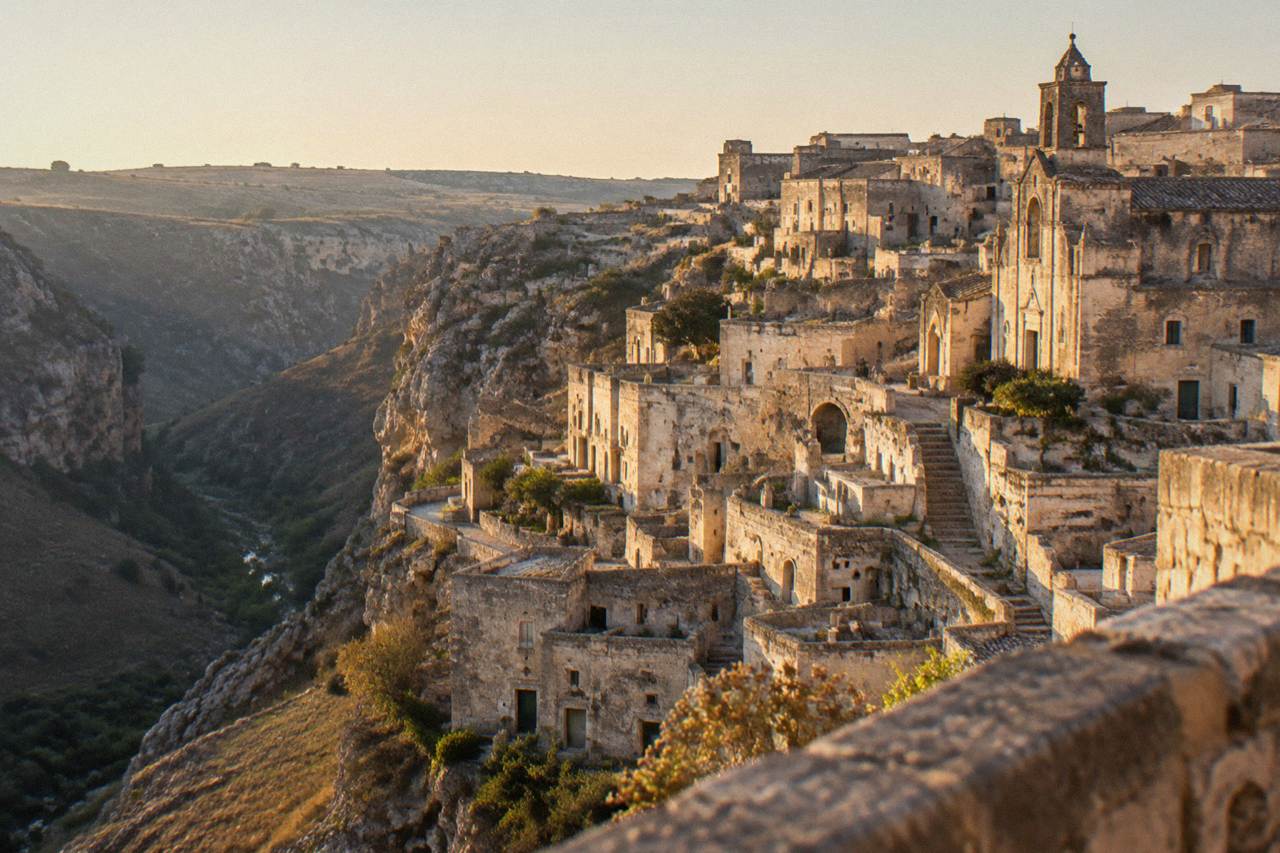
Matera, in the region of Basilicata in southern Italy, is an inland city of cave dwellings and rock-hewn churches on the edge of the Gravina canyon, and the honest answer to how long to stay is: longer than the average guest manages. The APT Basilicata accommodation data shows 479,083 arrivals in registered accommodation in 2025 and an average stay of 1.56 nights per guest, which means the typical visit is one night, one rushed morning and a drive out. That is enough to see the Sassi lit up at dusk and almost nothing else. Two nights is the working minimum this site recommends, and three is where the city stops feeling compressed.
How Many Nights Should I Stay In Matera?
Two nights is the practical minimum and three is the comfortable answer for Matera. The APT Basilicata data shows guests averaged 1.56 nights in 2025, so the typical stay barely covers the Sassi. Two nights let you walk both Sassi districts, enter a cave house and a rupestrian church, and see the canyon from the Murgia side at sunset. A third night opens the day trips that start from the city.
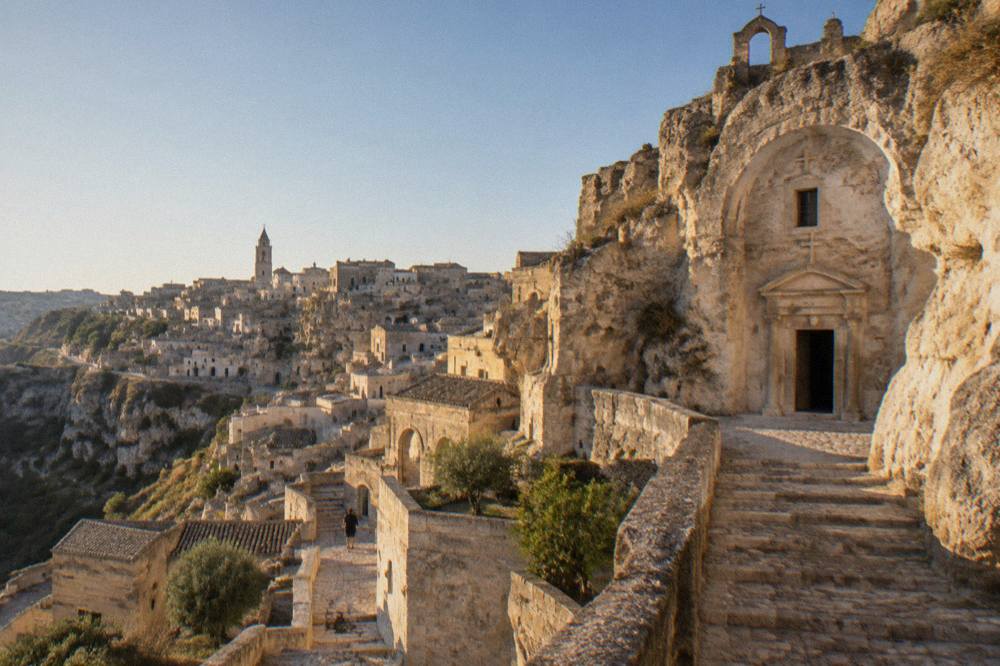
The reason is geography. The Sassi, Sasso Caveoso and Sasso Barisano, are steep, stepped and uneven, and the viewing points that made the city famous sit on the opposite side of the Gravina canyon, inside the Parco della Murgia. Seeing the city and photographing it are two separate halves of a day. Add the cave churches run by Oltre l'Arte, whose ticket page lists Santa Lucia alle Malve, Madonna de Idris and San Pietro Barisano, plus the Storica Casa Grotta di Vico Solitario, and a single day is already full before dinner.
The evening matters as much as the day. Matera's cave district changes character after dark, when the scattered lights inside the pale stone make the canyon glow. A guest who arrives in the afternoon and leaves after breakfast sees the daylight city and misses the one that ends up in photographs. That is the strongest single argument for sleeping here rather than day tripping, and the same argument shapes the one-day-in versus two-days-in question.
To catch the Sassi after dark too, book an overnight stay with Sassi tour here.
What Can You Actually See With One Night In Matera?
One night in Matera covers a sunset viewpoint, a walk through the Sassi, one cave house interior and one rupestrian church, with nothing left over. The Storica Casa Grotta di Vico Solitario charges 8.00 EUR full and the Oltre l'Arte single-church ticket is 4.50 EUR, so the core sightseeing is affordable, but the schedule has no slack.
The single-night plan is an afternoon arrival, a walk down into Sasso Caveoso or Sasso Barisano, a viewpoint at dusk, and a morning with one paid interior before leaving. Two entry fees cover the essentials: the cave house, which shows how materani families actually lived in these rooms until the evacuation that ran from 1952 into the 1970s, and one rock-cut church. The rest is free: the stairways, the canyon edge, Piazza San Pietro Caveoso, the view from the Civita ridge between the two Sassi.
What one night cannot absorb is the Murgia side. The Belvedere Murgia Timone, the classic panorama across the canyon, sits inside the park, and the Jazzo Gattini visitor centre has been the park's info point and ticket office since 6 February 2026, according to the park's own site. Reaching the belvedere and the Sentiero 406 area, which now has a staffed access point and an online access ticket announced in March 2026, takes half a day on its own. A day trip out, to Alberobello or the Crypt of the Original Sin, is out of the question.
What Do Two Nights Add Over One?
Two nights in Matera add the Murgia side of the canyon, a second Sassi district, a museum such as MUSMA at 10 EUR, and an evening at leisure instead of at a departure time. The first day covers Sasso Caveoso and the canyon viewpoints, the second covers Sasso Barisano, the Cathedral area and the park, each at a walkable pace.
The structure works because the city splits cleanly in two. Day one belongs to Sasso Caveoso, the rock churches and the canyon floor. Day two belongs to the upper town and the opposite bank: the Cathedral, whose diocesan museum route with MATA is 4.00 EUR on the Oltre l'Arte ticket page, Palazzo Lanfranchi, where the Museo Nazionale di Matera charges 10.00 EUR per site or 15.00 EUR cumulative over two days, and the belvedere across the Gravina at sunset. The cumulative museum ticket is itself an argument for two nights, since it is valid two days.
Two nights also absorb one evening activity that one night cannot. The James Bond 007 guided walk through the No Time to Die locations, for example, fits the second evening, and this site's guide to the Matera James Bond locations maps which streets and squares the production used. A cooking class or a food-and-wine evening fills the same slot for travellers less interested in the film. The point is that the second evening is the first one with slack in it.
When Is A Third Night Worth It?
A third night in Matera is worth it when day trips are part of the plan, because every major excursion needs a full day. Alberobello is about 1 h 23 by road, the Crypt of the Original Sin requires mandatory e-ticket booking at least 90 minutes before the slot, and Castelmezzano and Pietrapertosa are over an hour each way.
The day-trip ring around Matera is unusually dense. The OSRM routing figures computed for this site put Alberobello at 68 km, Polignano a Mare at 100 km, Metaponto on the Ionian coast at 47 km and Craco, the abandoned hill town, at 57 km. A traveller who wants one of these plus the city itself needs three nights: two for Matera, one for the excursion, with the excursion day bookended by evenings in the Sassi. The Crypt of the Original Sin deserves particular planning attention, because its own info page makes booking mandatory and slots run at fixed times, with capacity of 20 people per slot. More of these guides are collected on Matera Travel Guide.
Three nights also unlock the slower pleasures that a two-night stay squeezes out: the MUSMA sculpture museum in Sasso Caveoso, the Palombaro Lungo (whose price is not published on an official page, so confirm at booking), and a second pass through the Sassi at a different hour. Light changes everything here, and the canyon face that looks flat at noon glows in the early morning from the opposite bank.
| Stay | What it covers | What it misses |
|---|---|---|
| 1 night | Sunset viewpoint, one Sassi district walk, one cave house, one rock church | The Murgia side, museums, any day trip, a relaxed evening |
| 2 nights | Both Sassi districts, the Murgia belvedere at sunset, MUSMA or Palazzo Lanfranchi, one evening tour or class | All day trips except a half-day excursion |
| 3 nights | Everything above plus one full-day trip: Alberobello, the Crypt of the Original Sin, or the coast | Only the farthest Puglia stops such as Lecce, about 3 h 08 by road |
How Does The Season Change The Answer?
The season changes how many nights Matera needs more than almost any other factor, because September, not August, is the arrival peak: 61,630 accommodation arrivals in September 2025 against 43,966 in July. In the peak months a two-night stay is the sensible floor, since single nights are the ones that feel rushed when streets and viewpoints are crowded.
The APT Basilicata data gives the monthly shape. May logged 54,101 arrivals, June 50,186, August 60,257 and October 52,538, while February recorded just 15,239 and November 23,555. The ERA5 reanalysis for Matera, 1991-2020, shows the physical side: a mean high of 31.2 C in July and 31.3 C in August against 20.8 C in October, with July the driest month at 21.2 mm of rain and November the wettest at 67.1 mm. A winter stay can be shorter on crowds but the daylight is short too, about 9.6 hours a day in January against 15.0 in June.
Season also changes what the nights are for. In December the Presepe Vivente nei Sassi runs on set public days across four December weekends and the first January weekend, with tickets at 12.00 EUR full on the event's own site, and that alone justifies an extra night arranged around the calendar. In July the whole city reorganises around 2 July, the Festa della Bruna, a feast the organisers date to 1389. On 2 July the Oltre l'Arte sites close entirely, a detail worth knowing before booking a short stay around that date.
What About Staying Longer Than Three Nights?
Four nights or more in Matera suits two kinds of traveller: those using the city as a base for the wider region, and those who want the Sassi at an unhurried pace. From Matera, Bari is about 1 h 02 by road, Metaponto 52 minutes, Taranto 1 h 08 and the Castelmezzano and Pietrapertosa hike over an hour each way, so a four- or five-night stay can cover two or three excursions without repacking.
The region is the reason. Matera sits in Basilicata, bordering Puglia, and the drive times computed for this site make it a genuinely practical base: Altamura 20 minutes, Gravina in Puglia 31 minutes, Craco 58 minutes, Polignano a Mare 1 h 29. A traveller with four nights can do Alberobello and the trulli one day, the Ionian coast at Metaponto another, and still keep two full days inside Matera itself. The Puglia and Matera itinerary and the Basilicata road trip pages on this site lay out exactly those routes.
Longer stays also solve a quiet problem with shorter ones: the Sassi reward repetition. The same stairway reads differently at 08:00, at noon and after dark, and the canyon view from the Murgia side changes with every hour. UNESCO inscribed the Sassi and the Park of the Rupestrian Churches in 1993, citing continuity of settlement over more than two millennia, and that depth does not surface in a single lap of the district. Guests who stay four nights stop photographing and start noticing.
Common Questions About How Long To Stay In Matera
How many nights should I stay in Matera?
Two nights is the practical minimum and three is the comfortable answer. The APT Basilicata data shows guests averaged 1.56 nights in 2025, which covers the Sassi at sunset and little else. Two nights add the Murgia side and the museums, and a third opens the day trips.
Is one night in Matera enough?
One night is enough to walk one Sassi district, enter the Storica Casa Grotta di Vico Solitario at 8.00 EUR and see a sunset viewpoint. It is not enough for the Murgia side of the canyon, the museums, or any day trip. The trade-offs are laid out on this site's page on whether one night in Matera is worth it.
What is the best month for a short stay?
By the APT Basilicata data, September is the busiest month for arrivals, 61,630 in 2025, with a mean high of 25.7 C in the ERA5 reanalysis, 1991-2020. May and October are close behind in arrivals and cooler. February and November are the quietest, at 15,239 and 23,555 arrivals respectively.
Can I visit Alberobello from Matera in one day?
Yes. Alberobello is about 68 km and 1 h 23 by road from Matera, and several organised day tours from the city cover it. That excursion is one of the main reasons a third night is worth adding, since it consumes a full day that a two-night stay cannot spare.
Does the tourist tax affect how long I stay?
Matera charges a tourist tax collected by the accommodation, and the amount is confirmed at booking. The rate and any night cap are not published on an official page this site could verify, so factor it in at the booking stage rather than planning around a printed figure.
The short version: book two nights in Matera unless a day trip is on the list, in which case book three. The average guest's 1.56 nights is a reminder of what usually happens, not a recommendation, and the canyon views on the second evening are what the first-night schedule never quite reaches.