Is Matera In Amalfi Coast?
No: Matera is an inland city in Basilicata, southern Italy, about 400 m above sea level on the Gravina canyon, roughly 250 km from the Amalfi Coast by road. Here is what that means for planning a trip.
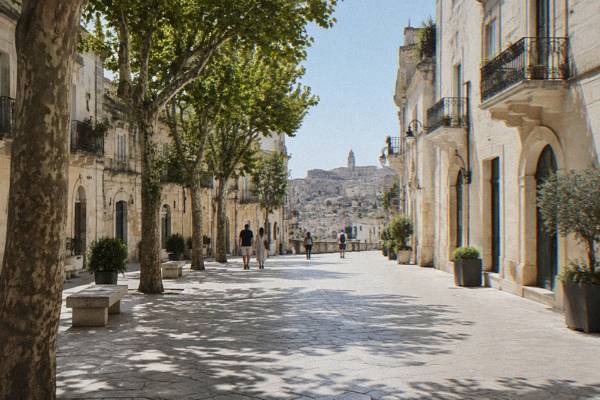
Matera is an inland city in the region of Basilicata, southern Italy, perched at about 400 m above sea level on the edge of the Gravina canyon, and no, it is not on the Amalfi Coast. The two names get bundled together because both appear on Italian bucket lists, and because Matera's cave quarters, the Sassi, photograph like nowhere else in the country. But they are different places, in different regions, with different geography: the Amalfi Coast is a cliff-lined stretch of Tyrrhenian shoreline in Campania south of Naples, while Matera sits inland on a limestone plateau with the dry ravine of the Gravina below it and the Murgia plateau opposite. There is no sea at Matera. The nearest coast, Ionian or Adriatic, is a day trip by car or train, and this page exists to clear up exactly what that means for a traveller holding a map of southern Italy and a fixed number of days.
Where Is Matera, And Why It Is Not On The Amalfi Coast?
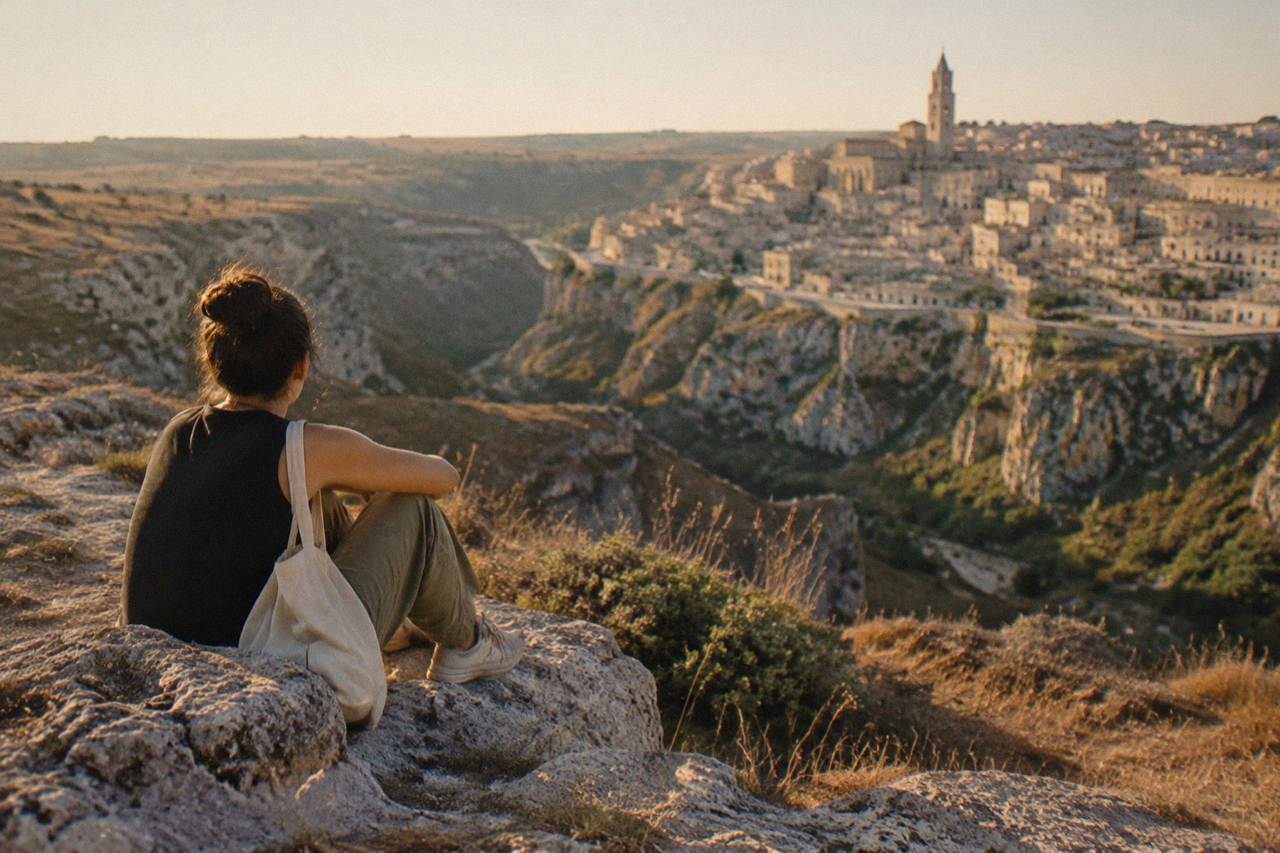
Matera is in Basilicata, the region that sits between Puglia and Calabria in southern Italy, about 400 m above sea level on the edge of the Gravina canyon, facing the Murgia plateau. The Amalfi Coast is a separate destination in Campania, on the Tyrrhenian Sea south of Naples, and the two are not neighbours. Matera has no coastline of its own; its old quarters are the Sassi, cave dwellings and rock-hewn churches cut into pale tufa limestone.
Basilicata is Italy's quiet, least coastal-famous southern region, and Matera is its best-known city. The comune counted 59,368 residents at 1 January 2026, spread over a large municipal area of 392.08 km² that runs from 49 m to 520 m in elevation. The historic centre divides into the Piano, the level town on the plateau top, and the two Sassi districts, Sasso Caveoso and Sasso Barisano, which cascade down the canyon wall below it. UNESCO inscribed "The Sassi and the Park of the Rupestrian Churches of Matera" on the World Heritage List in 1993, describing a rock-cut settlement adapted to its geomorphological setting with continuity over more than two millennia.
The Amalfi Coast belongs to a different world geographically: a strip of villages clinging to cliffs above the Tyrrhenian Sea, reached from Naples, not from Bari or Basilicata. Travellers coming from Rome or Naples by road pass through Campania's hills to reach it. To reach Matera the same travellers would have to cross the whole of the Apennine south, because Matera sits on the Adriatic-facing side of the peninsula, inland, with the Gravina canyon standing in for the sea views other southern destinations trade on.
The confusion has a practical cost. Itineraries that assume Matera is a coastal add-on to an Amalfi trip end up with impossible driving days, and travellers who expect a beach town find a canyon city instead. A related question, whether Matera belongs to Puglia at all, is covered in its own article on is Matera part of Puglia, and the short version is no: Matera is in Basilicata, even though Bari and the Puglia border sit close by.
Is Matera In Amalfi Coast?
No, Matera is not in the Amalfi Coast, and it never has been. Matera is an inland city in Basilicata, southern Italy, about 400 m above sea level on the edge of the Gravina canyon. The Amalfi Coast lies in Campania on the Tyrrhenian Sea, hundreds of kilometres away by road. The two cannot substitute for each other: one is a canyon city of cave dwellings, the other a cliffside coastal strip.
That is the whole answer, but the reasons the question exists so often are worth spelling out. Both destinations had a cinematic boom: Matera appears in films from Pasolini's The Gospel According to St. Matthew (1964) to No Time to Die (2021), and both feature in the same southern-Italy dream itineraries that circulate online. Both are UNESCO-listed. Both photograph spectacularly at golden hour. Search engines then finish the job, serving Matera images next to Amalfi text until the two blur.
For planning purposes, treat them as separate trips or as two stops on a long southern loop, never as one destination. Matera rewards a different rhythm: the Sassi are steep, stepped and uneven, and the point of a visit is walking down into the cave quarters, standing on a belvedere above the Gravina, and looking across at the rupestrian churches cut into the opposite cliff. A good guided walk anchors all of it, and the Sassi History and Culture Walk is this site's featured option for that first orientation, with Check availability at the operator's live listing.
How Far Is Matera From The Sea And The Nearest Beaches?
Matera has no sea of its own, and the nearest coast is a day trip: Metaponto on the Ionian is about 47 km and 52 minutes' drive, Bari on the Adriatic about 68 km and 1 hour, and Polignano a Mare about 100 km and 1 hour 29 minutes, all free-flow driving times computed over OpenStreetMap routing. The Amalfi Coast is far beyond any of these, on the opposite side of the peninsula.
Those distances are the useful ones to plan with, and they come from a routing engine run on the road network, meaning no traffic, no stops and no parking time. Rounded figures, real roads:
| Coastal destination | Sea | Road distance from Matera | Free-flow drive time |
|---|---|---|---|
| Metaponto | Ionian | 47 km | about 52 min |
| Bari | Adriatic | 68 km | about 1 h 02 |
| Polignano a Mare | Adriatic | 100 km | about 1 h 29 |
| Monopoli | Adriatic | 110 km | about 1 h 36 |
Metaponto is the closest beach option, an ancient Greek site turned seaside town on the Ionian gulf. The Adriatic alternatives, Polignano a Mare and Monopoli, lie north in Puglia and pair well with a Bari stop. None of these is the Amalfi Coast, and none can be reached as a quick hop from it either: the Amalfi Coast faces west, on the Tyrrhenian side, and the drive between the two regions crosses the Apennines. This site's verified data covers Matera and the road distances to these named day-trip towns; for the Amalfi Coast's own attractions and logistics, use a guide dedicated to Campania.
The geography has a climate consequence worth knowing before packing. Matera sits at elevation, and the ERA5 reanalysis for the 1991 to 2020 period gives the city a mean high of about 31 C in July and August with cold, damp winters and frost, a continental-leaning Mediterranean pattern rather than the maritime mildness a coastal town enjoys. The same reanalysis puts November as the wettest month at 67.1 mm of rain. A beach itinerary and a Matera itinerary want different wardrobes.
Can You Visit Matera And The Amalfi Coast On The Same Trip?
Yes, but only as two separate legs of a long southern-Italy trip, not as one combined destination. Matera sits inland in Basilicata and the Amalfi Coast lies in Campania on the far side of the peninsula, so linking them means a long transfer day, typically routed via Naples or via Bari. Most itineraries that do both give Matera one or two nights on its own terms.
The practical pattern that works, based on the transport facts this site has verified: fly into Bari, spend a night or two in Matera, then travel onward. There is no Trenitalia station in Matera; the local operator is FAL, whose posted weekday timetable runs from Bari Centrale with a change at Altamura, about 1 h 45 to 2 h end to end, and on Sundays and public holidays FAL runs replacement buses instead of trains. Current times live on FAL's own timetable page and change often, so check them at booking rather than trusting any printed time.
Going the other way, from Naples or the Amalfi Coast toward Matera, is a cross-peninsula drive of several hours, and this site holds no verified door-to-door figure for it, so confirm routing and transfer options when booking. The honest framing for anyone building the itinerary: the Amalfi Coast is a destination in its own right, and Matera is a detour that earns its keep. The question of how long to give the city has its own write-up in how many nights should I stay in Matera, and the APT Basilicata accommodation data gives a concrete backdrop: guests averaged 1.56 nights per stay in 2025, so the city's own visitors lean short, and the trade-off between a quick stop and a proper stay is real.
One seasonal note matters for combining the two. September, not August, is Matera's busiest month: the city's registered accommodation logged 61,630 arrivals in September 2025 against 60,257 in August, and 74.5% of those September arrivals came from abroad. Anyone planning a late-summer Amalfi-plus-Matera trip should expect Matera at its fullest exactly when the coast starts to empty.
What Is Matera Known For Instead Of Coastal Views?
Matera is known for the Sassi, two districts of cave dwellings and rock-hewn churches cut into pale tufa limestone above the Gravina canyon, inscribed by UNESCO in 1993, and for its film history and the Festa della Bruna, held every 2 July since the celebrations were fixed to that date in 1389. It is a canyon city of stone, water cisterns and rupestrian churches, not a seaside resort.
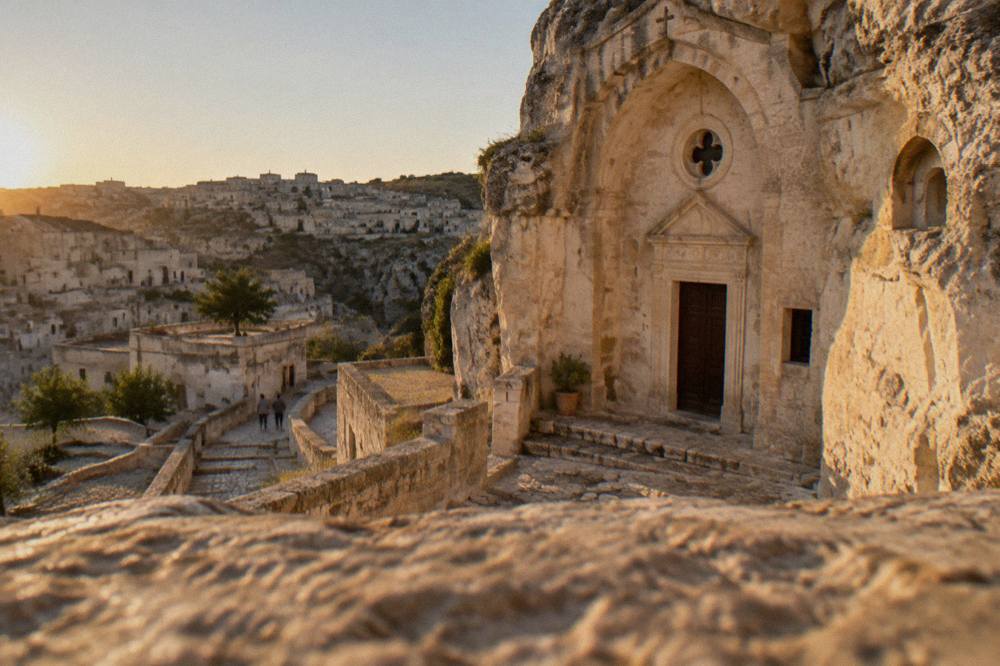
The Sassi are the reason to come. Sasso Caveoso and Sasso Barisano hold more than a thousand dwellings by UNESCO's own count, carved and built over centuries into the canyon wall, with rock churches cut into the cliffs of the opposite Murgia side. Residents were moved out of the caves between 1952 and the 1970s, and a 1986 law opened the way to the restoration that turned the quarters back into hotels, restaurants and homes, a story told in full in why was Matera abandoned. The cinema connection is verified on official film-commission pages: The Passion of the Christ (2004), Wonder Woman (2017) and No Time to Die (2021) all shot here, alongside Pasolini's 1964 Gospel.
None of that requires a coastline. The classic first day is a guided walk into the Sassi, and this site's featured walk is the Sassi History and Culture Walk, which covers the cave quarters and the viewpoints with a licensed guide; Check availability for current dates. Beyond the city, the same region offers Alberobello's trulli and the Adriatic towns listed in the table above, and the fuller menu of options is on the site's things to do in Matera page.
The pairing question also runs the other way, and it is worth being blunt about it. Travellers who want sea, boats and lemon groves will find Matera dry, steep and inland; travellers who want depth of history and a landscape carved by hand will find the Amalfi Coast expensive and crowded. The two are complements, not rivals, and the mistake is only in the geography.
Common Questions About Matera And The Amalfi Coast
Is Matera near the Amalfi Coast?
No. Matera is an inland city in Basilicata on the edge of the Gravina canyon, while the Amalfi Coast is a Tyrrhenian coastal strip in Campania south of Naples, on the opposite side of the Italian peninsula. Linking the two requires a long transfer, and this site holds no verified door-to-door figure for it, so confirm routing at booking.
Does Matera have a beach?
No, Matera has no beach. The city sits about 400 m above sea level above a canyon. The nearest sea is a day trip: Metaponto on the Ionian is about 47 km and 52 minutes' free-flow drive, and Polignano a Mare on the Adriatic about 100 km and 1 hour 29 minutes.
Is Matera in Puglia or Basilicata?
Matera is in Basilicata, not Puglia. The Puglia border and the city of Bari lie close by, about 68 km and 1 hour by road, which is one reason the two regions get confused, but Matera has been Basilicata's showcase city throughout its modern history.
Which is better, Matera or the Amalfi Coast?
They are different destinations, and this site's verified data covers only Matera, so no ranking is offered here. Matera delivers cave dwellings, rupestrian churches and canyon views inscribed by UNESCO in 1993; the Amalfi Coast delivers cliffside coastal scenery. Many travellers combine both on a long southern-Italy loop with a transfer day between them.
Can you day-trip to the Amalfi Coast from Matera?
Not realistically. The Amalfi Coast lies on the far side of the peninsula in Campania, well beyond the day-trip range of the verified distances from Matera, which top out at Adriatic and Ionian towns within about two hours' drive. Plan an overnight transfer via Naples if the coast is on the list.
What is the closest beach town to Matera?
Metaponto, on the Ionian coast, at about 47 km and 52 minutes' free-flow drive from Matera. On the Adriatic side, Monopoli is about 110 km and 1 hour 36 minutes, and Polignano a Mare about 100 km and 1 hour 29 minutes.
The short version of this whole page: the Matera Travel Guide covers a canyon city in Basilicata, and the Amalfi Coast is a different region, a different sea and a different trip. Plan for both if time allows, but never plan for them as one place.