Matera To Ostuni
Ostuni sits 102 km from Matera by road, across the regional border from Basilicata into Puglia and down toward the Adriatic coast.
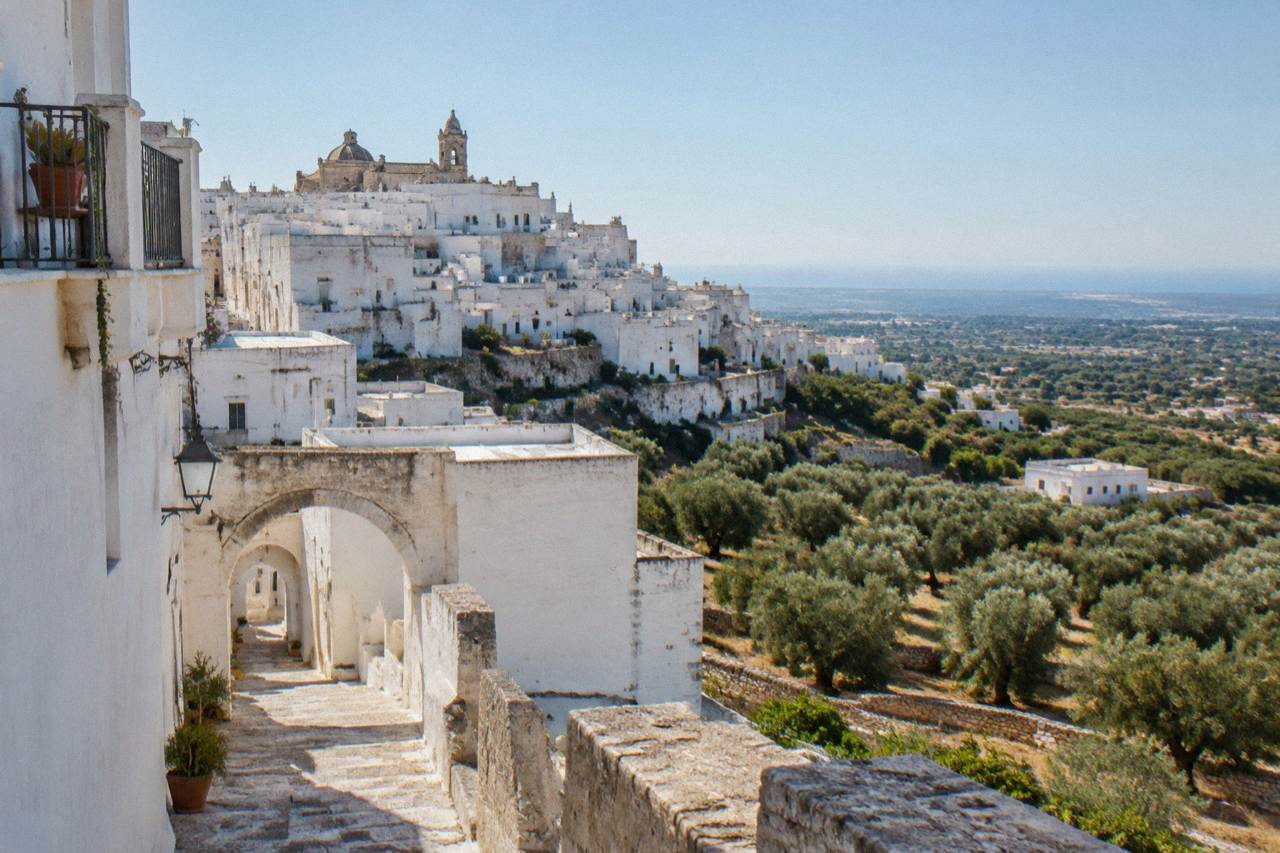
Short answer
Ostuni is about 102 km from Matera by road, roughly 2 hours of free-flow driving, and it works as a full-day trip, ideally paired with another Puglia stop on the way.
Ostuni is a hilltown in Puglia, the region east of Matera's Basilicata, and the drive between the two cities covers about 102 km of road from Matera Centrale. That makes it one of the longest day trips on this site's list, longer than Alberobello, longer than Bari, and only shorter than Lecce. This page lays out what the journey involves, how to time it, what the town itself offers a visitor, and how to fold it into a wider Puglia loop.
How Far Is Ostuni From Matera, And How Long Does The Drive Take?
Ostuni lies about 102 km from Matera by road, and the drive takes about 2 hours in free-flow conditions, measured from Matera Centrale with a routing engine over OpenStreetMap. Those figures assume no traffic, no stops and no parking hunt, so a real day trip runs longer. Ostuni is in Puglia, a different region from Matera's Basilicata, and the route crosses the whole of that regional border country before dropping toward the Adriatic side.
The distance is the point. Matera is an inland city at about 400 m above sea level on the edge of the Gravina canyon, and Ostuni is a coastal-region town, inland of the Adriatic shore but firmly on the Puglian side of the border. Nothing about the drive is scenic in a protected-park sense for most of the way: it is regional road and highway country, flat olive plain once you are past the Murge. The two-hour figure is a floor, not a plan. Add a stop, add traffic near Bari or on the SS16 approach, and the day stretches.
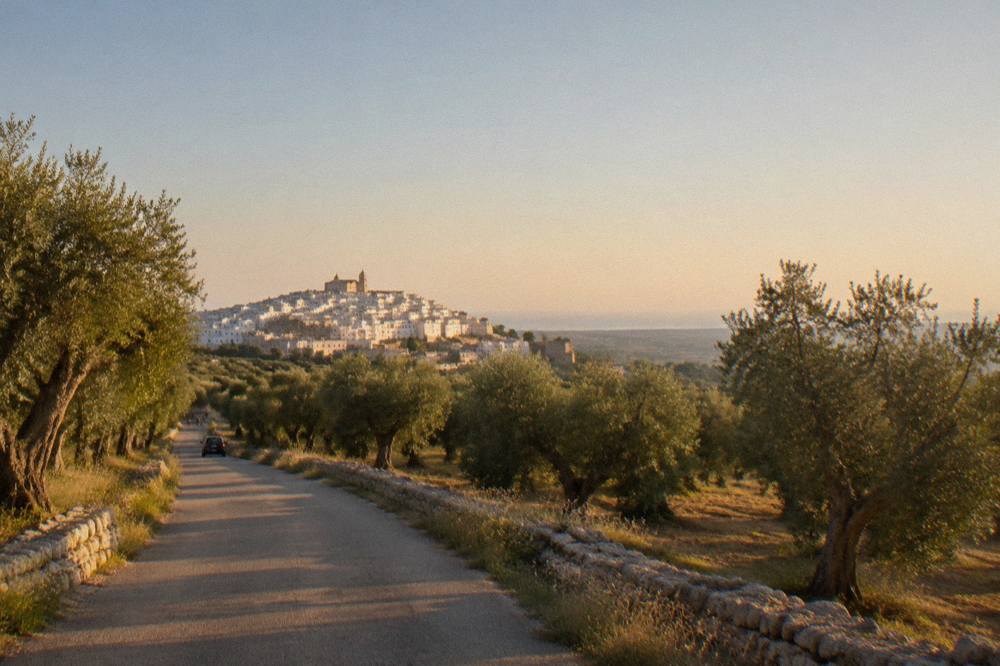
The route logic is worth understanding before you commit. Leaving Matera, the road climbs out of the Gravina basin and onto the Murge plateau, the same limestone upland that carries the Parco della Murgia on the Matera side. From there the drive trends east and then south-east, skirting the trulli country of the Valle d'Itria before dropping onto the olive plain that Ostuni watches over. Drivers who have already done the Alberobello run will recognise the middle third of the road; the last third is the part that is new, flatter and faster but longer than the kilometres alone suggest.
Here is how Ostuni compares with the other day trips measured from Matera Centrale, all computed the same way, car profile, free-flow:
| Destination | Region | Road km | Drive time |
|---|---|---|---|
| Altamura | Puglia | 20 | 20 min |
| Gravina in Puglia | Puglia | 30 | 31 min |
| Metaponto | Basilicata | 47 | 52 min |
| Taranto | Puglia | 52 | 1 h 08 |
| Alberobello | Puglia | 68 | 1 h 23 |
| Polignano a Mare | Puglia | 100 | 1 h 29 |
| Ostuni | Puglia | 102 | 2 h 00 |
| Monopoli | Puglia | 110 | 1 h 36 |
| Lecce | Puglia | 204 | 3 h 08 |
The table shows the pattern: Ostuni is past the comfortable radius. Polignano a Mare is nearly as far in kilometres but a shorter drive, because its route is faster road. If the drive itself is the deterrent, the nearer Puglian options in the Alberobello day trip or the Gravina in Puglia day trip give a similar border-crossing flavour in a third of the time.
Is Ostuni Worth The Two-Hour Drive From Matera?
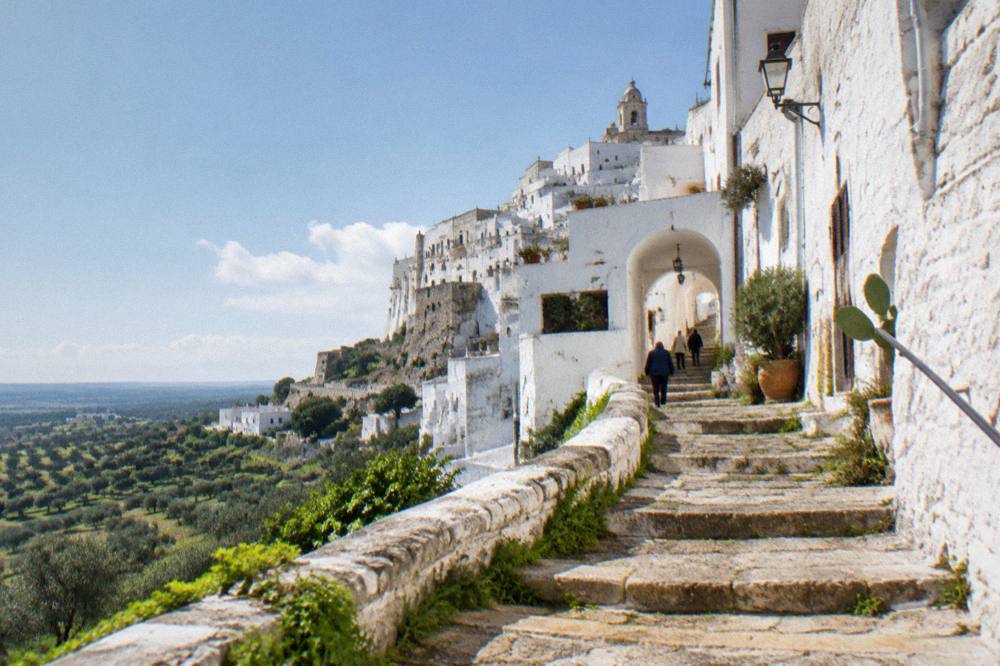
Ostuni rewards a day trip only if it is the headline of the day rather than a quick add-on, because the round drive alone is about four hours of road. The town is known for its whitewashed old town on a hill above olive country, a short way inland from the Adriatic. As a single destination from Matera it is a commitment; as one stop in a Puglia loop with Alberobello or Locorotondo it makes far more sense.
The honest framing is arithmetic. The drive takes time in each direction, and you want a good stretch of hours in and around the town to justify it. That is a full day, and it is a day that starts with driving. Compare that with Polignano a Mare, which pairs a coast walk with a shorter drive, or with Alberobello at 1 h 23, and Ostuni becomes a "yes, if" answer: yes, if you have already seen the nearer Puglian towns, or yes, if whitewashed hilltown architecture is the specific thing you came to southern Italy for.
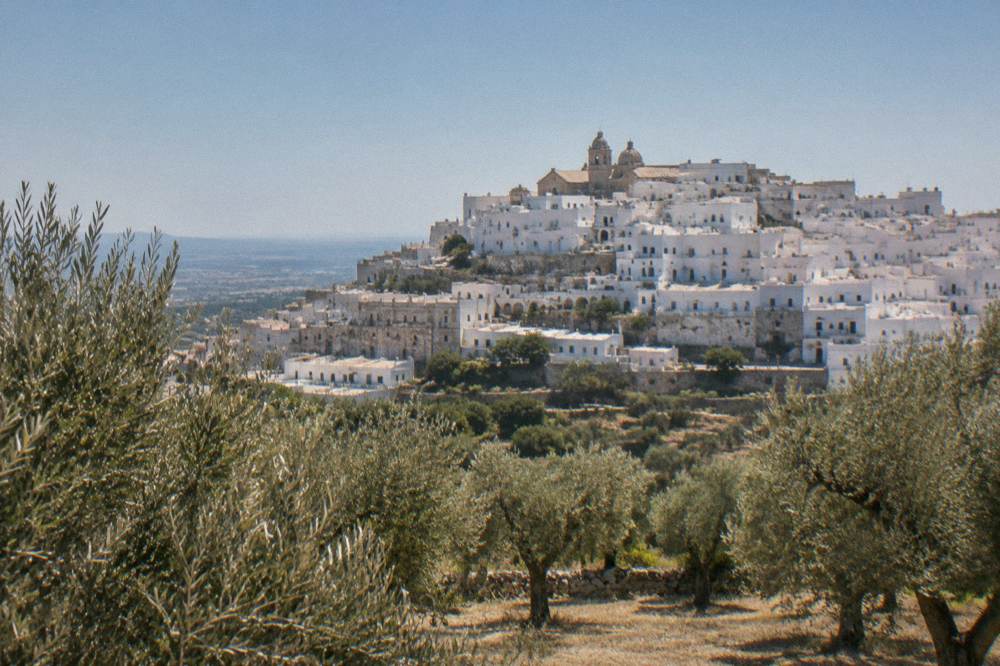
There is a second framing that favours the trip. Matera's Sassi, the cave quarters described on the Sassi di Matera page, are pale tufa and rock-hewn. Ostuni is the opposite register: lime-washed walls, arched lanes, a vertical town built for defence and display rather than dug into a canyon wall. Visitors who spend three days inside the Sassi sometimes want one day of a different southern Italy, and Ostuni delivers that contrast more sharply than any nearer town.
The contrast also works photographically. Matera's palette is stone, shadow and canyon light, and the town reads best at dawn and after dark, when the cave facades catch low sun. Ostuni reads best in full daylight, when the white walls do the work and the blue sky supplies the second colour. A photographer planning a trip around both towns gets two completely different picture problems, and that alone is a reason some travellers put Ostuni on the list despite the drive.
What Does A Day Trip From Matera To Ostuni Actually Look Like?
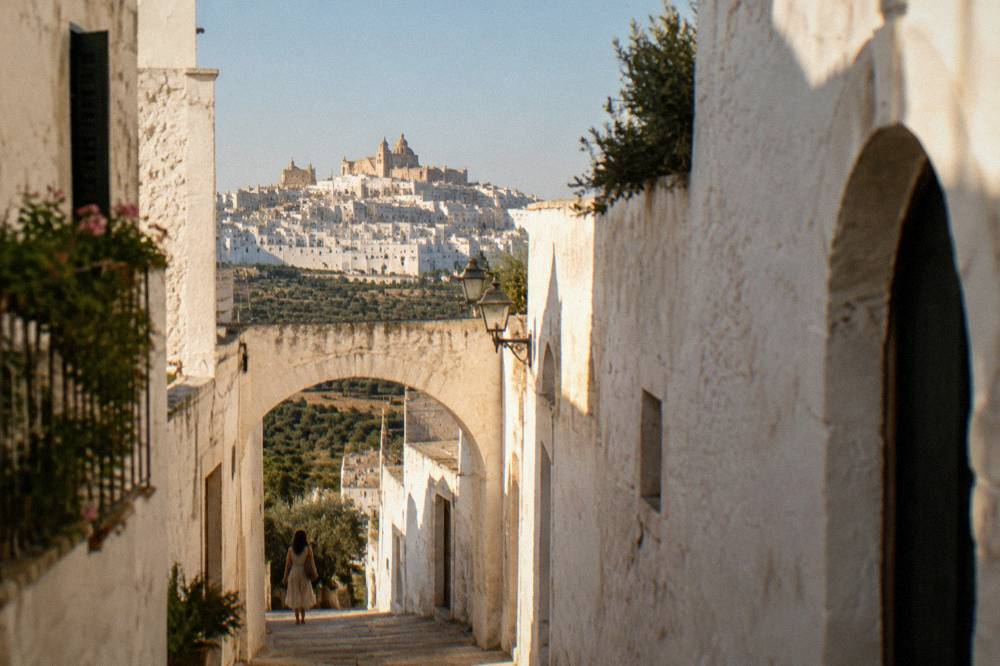
A realistic plan leaves Matera by 08:30, reaches Ostuni around 10:30 to 11:00 after a stop, gives four to five hours in the town including a long lunch, and returns to Matera by 20:00 to 21:00. The old town is compact and stepped, so the visit is mostly on foot once the car is parked, and the late-afternoon light on the white walls is the part the timing is built around.
The shape of the day matters more than the itinerary, because Ostuni's sights are not ticket-list sights. The town is walked, photographed and eaten rather than queued for. A morning arrival beats a midday one: the lanes are quieter, the light is low, and lunch can run long without costing the afternoon.
For visitors who would rather not drive the day at all, the alternative is to spend the day differently: a guided hike between the two Lucanian mountain villages of Castelmezzano and Pietrapertosa, covered in the Castelmezzano and Pietrapertosa day trip guide, keeps the whole day inside Basilicata and off the highway. It is a different genre of trip, mountain gorge against olive plain, and it is the one this site's own roster covers directly.
A sample timing skeleton, built on the verified drive figures:
| Time | Stage |
|---|---|
| 08:30 | Leave Matera Centrale area |
| 10:30 | Arrive Ostuni, park at the edge of the old town |
| 10:45 | Walk the old town lanes and viewpoints |
| 13:00 | Long lunch in or below the old town |
| 15:00 | Second loop, viewpoints, gelato stop |
| 16:30 | Start the drive back |
| 18:30 to 19:00 | Back in Matera |
Two adjustments are worth building into the skeleton from the start. First, the arrival time assumes one short break on the road; a coffee stop in the Valle d'Itria country turns the drive into two manageable halves and costs twenty minutes. Second, the return leg is deliberately scheduled to finish before dark in the shorter months: in late October the daylight budget is tight, and a 16:30 departure from Ostuni is the latest that keeps the whole drive in light. In June the same schedule feels relaxed, with hours to spare.
How Do You Get From Matera To Ostuni Without A Car?
Getting to Ostuni from Matera without a car is the weak point of the trip: there is no direct rail link, the verified public-transport option runs through Bari, and the journey can consume half a day each way. The verified road figures cover driving only. No bus or train times for Ostuni could be printed here, and anyone going car-free should confirm current connections at booking or on the operator's own timetable.
What can be said with certainty is structural. Matera's own rail operator is FAL, and its line runs north toward Bari, changing at Altamura, in about 1 h 45 to 2 h. FAL's posted weekday timetable shows 18 arrivals at Matera Centrale from the Bari side. Ostuni, however, is south-east of Bari on the Adriatic corridor, a different direction entirely, so a car-free trip means going north to Bari first and then back down the coast line. That dog-leg is why this page treats Ostuni as a driving destination. The wider set of guides lives on Matera Travel Guide.
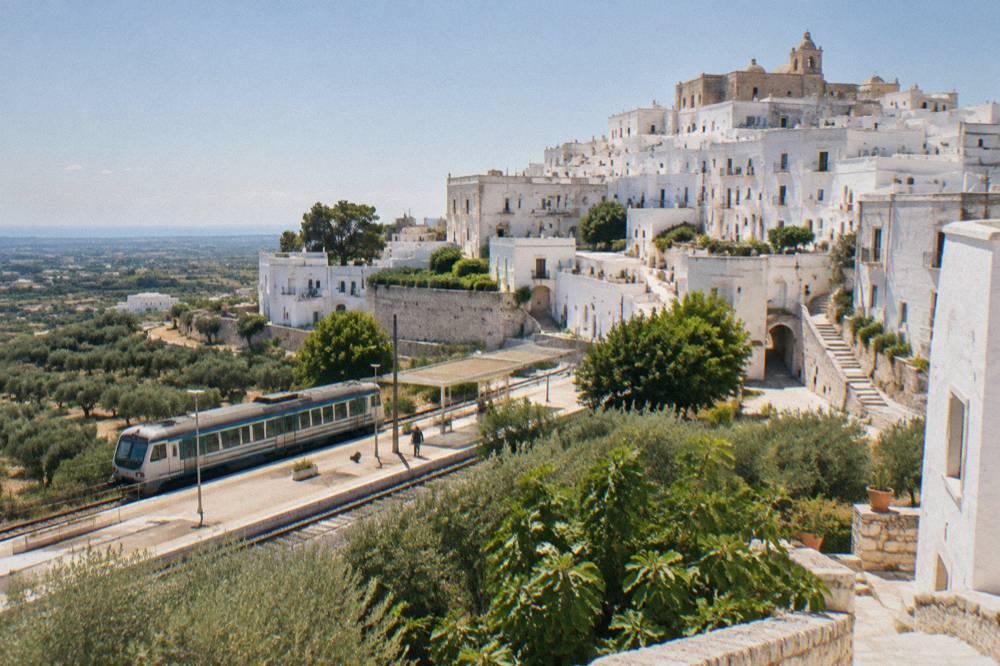
One more structural fact matters: there is no Trenitalia station in Matera at all, and FAL does not serve the Adriatic coastal line that Ostuni sits on. Anyone weighing a car-free day should read the site's Bari day trip guide for the first leg, and treat the Bari to Ostuni coastal leg as a separate booking to confirm locally. For a car-free day out of Matera with everything arranged, a guided option in the city itself beats six hours of transit, and the site's Matera walking tour page covers that alternative.
There is also a seasonal wrinkle on the first leg that car-free travellers need to know. FAL runs no trains on Sundays and public holidays; on those days the operator runs replacement buses, with 8 arrivals at and 8 departures from Matera Stazione Centrale FAL on the festive sheet. A Sunday day trip to Ostuni by rail-and-bus is therefore built on two replacement services and a coastal connection, which is a plan that should be confirmed piece by piece before anyone commits a Sunday to it.
What Is The Best Time Of Year To Drive From Matera To Ostuni?
Spring and autumn are the right seasons for this drive, because the two hours each way are punishing in the July and August heat, when the ERA5 reanalysis, 1991-2020, puts Matera's mean high at 31.2 and 31.3 C, and the olive plain around Ostuni offers no shade. May, June, September and October combine workable temperatures with the long daylight the two-hour drive home needs, and September is also Matera's busiest month for arrivals.
The climate data for Matera, from the ERA5 reanalysis for the 1991-2020 period, shows why midsummer distorts the plan. July and August both average a mean high above 31 C, with rainfall at its lowest of the year. A car journey across that plain, plus a hilltown walk with no shade, is a heat-management exercise. April, May and October sit at 17.4, 22.7 and 20.8 C mean highs, and September at 25.7 C, all far kinder to a day built around walking outdoors.
| Month | Mean high C (ERA5 1991-2020) | Rain mm | Arrivals in Matera 2025 (APT) |
|---|---|---|---|
| Apr | 17.4 | 56.5 | 45,195 |
| May | 22.7 | 41.7 | 54,101 |
| Jun | 28.2 | 35.1 | 50,186 |
| Jul | 31.2 | 21.2 | 43,966 |
| Aug | 31.3 | 21.7 | 60,257 |
| Sep | 25.7 | 44.8 | 61,630 |
| Oct | 20.8 | 51.7 | 52,538 |
The arrivals column carries a second lesson. September is Matera's peak month, 61,630 arrivals in 2025 against 60,257 in August, and 74.5% of those September guests came from abroad, so the city's hotels and lanes are at their fullest exactly when the weather is best for a long day trip. October halves the crowd, 52,538 arrivals, while keeping a 20.8 C mean high. For anyone choosing between the two, October is the sleeper pick for this specific drive.
Can You Combine Ostuni With Other Stops On The Way From Matera?
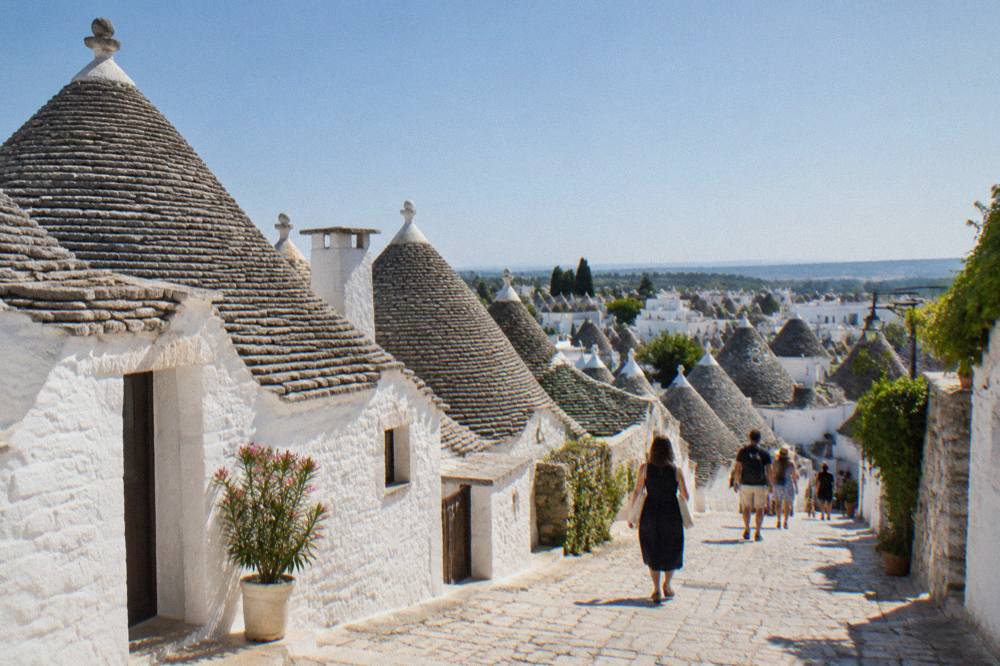
Ostuni pairs naturally with Alberobello or Locorotondo, because both sit on the route through the Valle d'Itria and add a second walkable town to the day for a modest detour, with Alberobello 68 km and 1 h 23 from Matera and Locorotondo 77 km and 1 h 30. The classic loop is Matera to Alberobello in the morning, Locorotondo for lunch, Ostuni in the afternoon light, then the long drive home.
That loop is ambitious but coherent. The verified distances stack up: 68 km to Alberobello, then a short hop to Locorotondo, then the final stretch to Ostuni, then 102 km back. The total is a long day of driving, which is a lot, but each leg is broken up and the two-hour return is the only long single stretch. Anyone planning it should read the Valle d'Itria day trip and Lecce day trip pages for how the wider region fits together.
| Loop stop | Road km from Matera | Drive time | Role in the day |
|---|---|---|---|
| Alberobello | 68 | 1 h 23 | Trulli district, morning walk |
| Locorotondo | 77 | 1 h 30 | Hilltown lunch stop |
| Ostuni | 102 | 2 h 00 | Main afternoon stop, white old town |
| Monopoli (coast variant) | 110 | 1 h 36 | Adriatic swim stop, summer only |
The coast variant swaps the inland lunch for Monopoli, 110 km and 1 h 36 from Matera, which puts an Adriatic beach into the same day. It works only in the warm months, and it makes the day longer, so it suits visitors with a full daylight budget in June rather than a short February afternoon. The Monopoli day trip page covers that stop in detail.
What Should You Know Before Driving To Ostuni From Matera?
Three practical points shape the day: Ostuni's old town is stepped and sloped, so it is a walking visit and not a gentle one; the two-hour drive each way means checking the car, the fuel and the driver's energy before committing; and Matera's own ZTL camera hours, 10:00 to 20:30 from 16 September to 30 June in the Sassi zones, matter on the return, because a late drive home lands inside the active window.
The ZTL point deserves the emphasis. Matera's restricted-zone cameras run on the seasonal schedule published by the comune: 10:00 to 20:30 from 16 September to 30 June, and 10:00 to 24:00 from 1 July to 15 September, in the Sassi zones, weekdays and holidays alike, with the central ZTL active 24 hours a day. A car parked outside the zones is unaffected, but the return leg should be planned so the car ends where it started, inside the rules. The site's Matera parking guidance covers where to leave the car for the day.
The second point is the border. Ostuni is in Puglia, and Matera is in Basilicata, and the drive crosses between them. Nothing changes at the border itself, same country, same euro, same Schengen area, same Italian language, but the regional identity does: the olive plain of Puglia is a different landscape from the Gravina canyon, and the day trip is partly a landscape tour of that contrast.
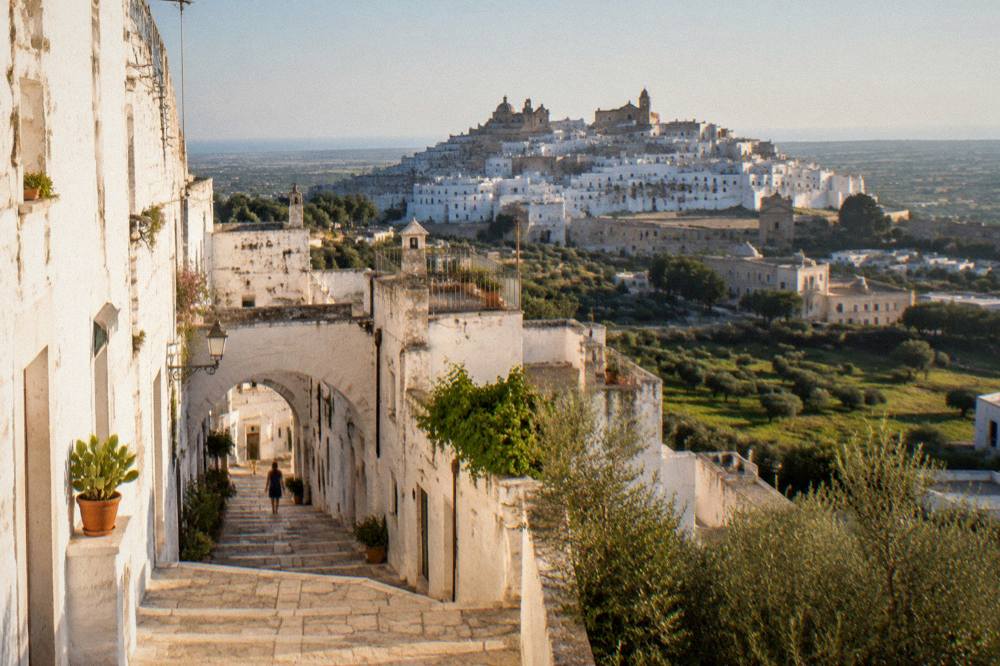
The third point is the walk itself. Like the Sassi, the old town is steep, stepped and uneven underfoot. Shoes that grip beat shoes that look good, and the middle of the day in summer is the wrong time to be climbing its lanes. Water, shade planning and a late start to the walking portion are the standard advice for any southern Italian hilltown in July and August.
Common Questions About A Matera To Ostuni Day Trip
How far is Ostuni from Matera?
About 102 km by road, roughly 2 hours of free-flow driving from Matera Centrale, computed with a routing engine over OpenStreetMap. Real conditions, traffic and stops make the day longer.
Is Ostuni in Puglia or Basilicata?
Ostuni is in Puglia. Matera is in Basilicata, a different region, and the drive crosses the regional border. Both are in southern Italy, in the eurozone and the Schengen area, so nothing changes for the traveller at the border itself.
Can you do Ostuni as a day trip without a car?
It is possible but slow, because there is no direct link and the route runs through Bari. Bus and train times for Ostuni are not listed here, so confirm current connections with the operator before planning a car-free day.
Is Ostuni worth the drive from Matera?
Yes, if it is the headline of the day or paired with Alberobello or Locorotondo on the way. As a quick add-on it is too far, with about four hours of driving in the round.
What is the best month for the trip?
May, June, September and October, by the ERA5 reanalysis, 1991-2020 climate normals for Matera, which put July and August mean highs above 31 C. October combines a 20.8 C mean high with fewer arrivals in Matera than the September peak.
Can you visit Ostuni and Alberobello in one day from Matera?
Yes. Alberobello is 68 km and 1 h 23 from Matera and sits broadly on the way, so the classic loop is Alberobello in the morning, an optional Locorotondo stop, Ostuni in the afternoon, then the drive home.
For visitors deciding between long Puglian drives and days inside the city, the things to do in Matera page is the fuller comparison, and a guided walk of the Sassi is the day that needs no car at all.
Plan it as the day's whole purpose, pair it with a Valle d'Itria stop, and it works; squeeze it in as an afterthought and the road will win.