Valle D Itria
The Valle D Itria sits across the regional border from Matera in Puglia, and its trulli towns are the most popular day trip from the city. Here is what the verified data says about distances, timing and options.
Short answer
The Valle D Itria is a karst valley in Puglia, about 68 km from Matera by road, roughly a 1 hour 23 minute drive to Alberobello at its heart. Locorotondo, Ostuni, Monopoli and Polignano a Mare all sit within day-trip range, and guided coach tours from Matera and Bari cover Alberobello and the valley in a single day.
Matera, the cave city of Basilicata in southern Italy, sits about 400 m above sea level on the edge of the Gravina canyon, and its most requested day trip crosses the regional border into Puglia: the Valle D Itria, the karst valley of trulli, whitewashed hill towns and dry-stone walls that spreads between Bari, Brindisi and Taranto. The valley is not in Basilicata at all. Alberobello, its headline town, is 68 km from Matera Centrale by road, a drive of about 1 hour 23 minutes in free-flow traffic, according to routing computed over OpenStreetMap. That is close enough that a day trip works, and far enough that planning matters.
This page sets out what the verified sources say: how far each valley town is from Matera, what the seasons do to the visit, what a guided day covers, and how the trulli landscape compares with the Sassi you have already come to see. Where a figure is not verified, the page says so rather than guessing. The Sassi di Matera are the reason you are here; the Valle D Itria is the reason to add a second day.
Where Is The Valle D Itria From Matera?
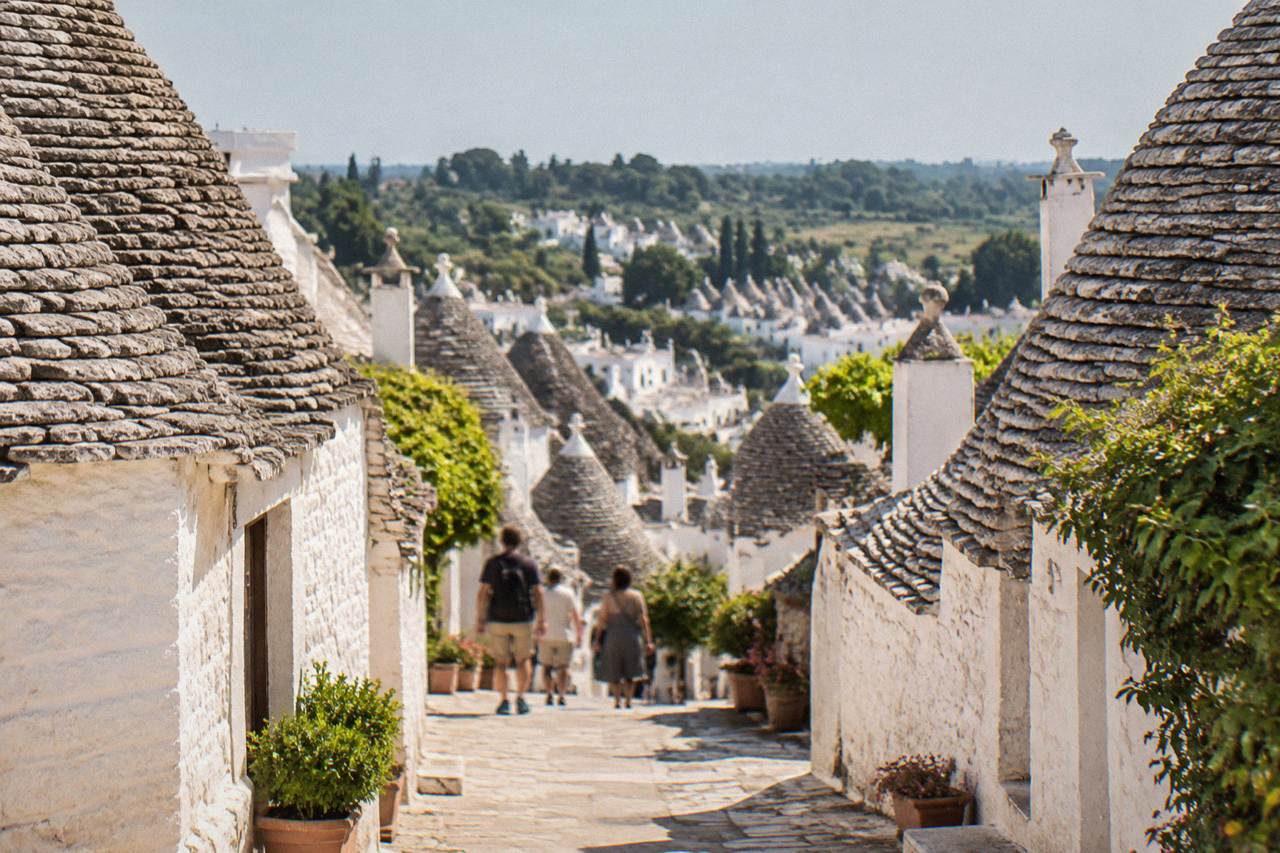
The Valle D Itria is a shallow karst valley in central Puglia, east and south of Matera across the regional border, roughly 68 to 102 km from the city by road depending on the town. Alberobello, the valley's trulli capital, is 68 km away, about a 1 hour 23 minute drive from Matera Centrale in free-flow conditions, and the whole valley lies inland, in the hills, not on the coast. The drive leaves Matera across the Murgia plateau and drops into Puglia's Itria countryside within the first half hour.
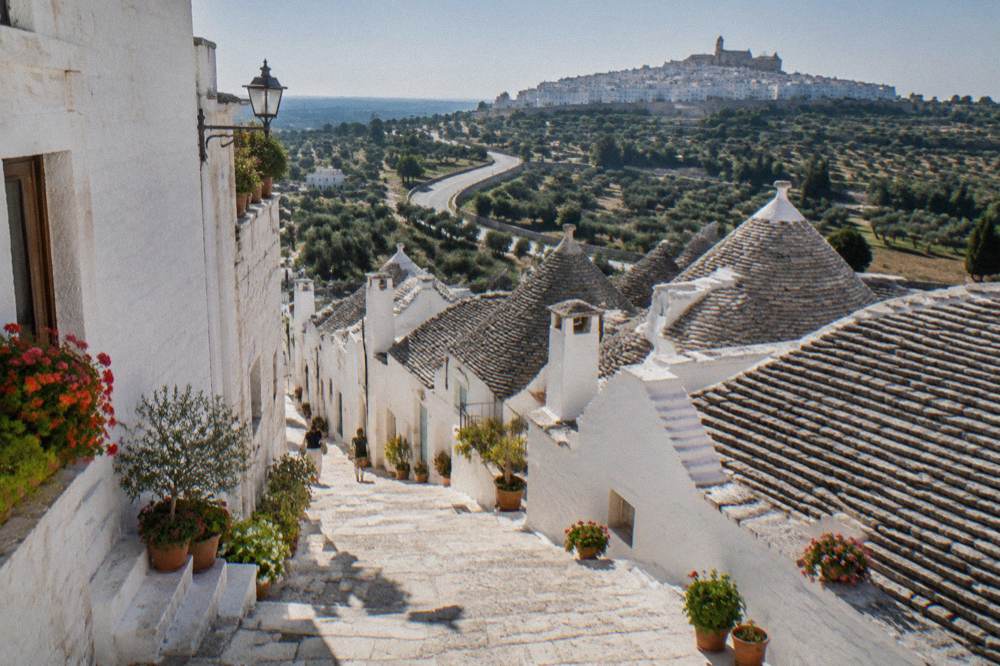
The valley's name is a little misleading. The Valle D Itria is not a single dramatic gorge but a broad rolling depression between the Murge hills, dotted with trulli, the dry-stone cone-roofed buildings that are Puglia's signature. The land rises gently and falls again; olive groves and vineyards stitch the towns together. Locorotondo, frequently photographed from its belvedere, is 77 km from Matera, about a 1 hour 30 minute drive. Ostuni, the white city on the valley's southern rim, is 102 km, about 2 hours by road. These figures come from routing computed with the OSRM engine over OpenStreetMap, car profile, free-flow, no traffic and no stops, so treat them as planning numbers and round them up.
One point of geography matters for every plan. Matera is in Basilicata; the Valle D Itria is in Puglia. There is no border control, it is the same country and the same euro, but transport, timetables and even the regional tourism bodies differ. Matera's own rail operator, FAL, does not serve the valley. The practical options from Matera are a self-drive day, a private transfer, or a guided coach tour, and the guided tours are the only option that removes the driving entirely.
The table below puts the valley's main towns in order of distance from Matera Centrale station. Every figure is a computed road distance and free-flow drive time, rounded up, not a rail time and not a tour-bus time with stops.
| Town | Region | Road km from Matera | Free-flow drive |
|---|---|---|---|
| Alberobello | Puglia | 68 | about 1 h 23 |
| Locorotondo | Puglia | 77 | about 1 h 30 |
| Ostuni | Puglia | 102 | about 2 h 00 |
| Monopoli | Puglia | 110 | about 1 h 36 |
| Polignano a Mare | Puglia | 100 | about 1 h 29 |
Two of those towns, Monopoli and Polignano a Mare, are coastal rather than valley towns, but they pair naturally with a Valle D Itria loop because they sit within the same two-hour band from Matera. If the sea is the goal, the Polignano a Mare day trip guide covers the cliff town in detail; if white hill towns are the goal, Ostuni has its own page.
Which Valle D Itria Towns Can You Visit From Matera In One Day?
A realistic one-day loop from Matera covers two valley towns comfortably and three at a push: Alberobello plus Locorotondo is the classic pairing at 68 and 77 km, Alberobello plus Ostuni stretches the day considerably, and a single-town day, Alberobello alone, leaves time for a long lunch and the trulli districts at walking pace. Guided coach tours from the region typically pair Alberobello with Matera itself rather than with a second valley town.
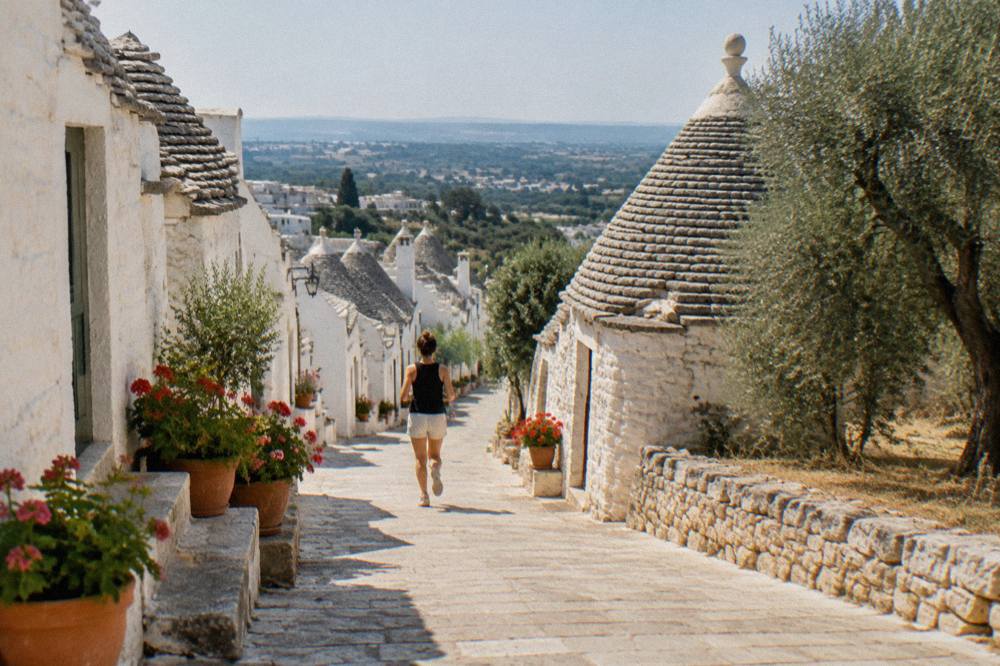
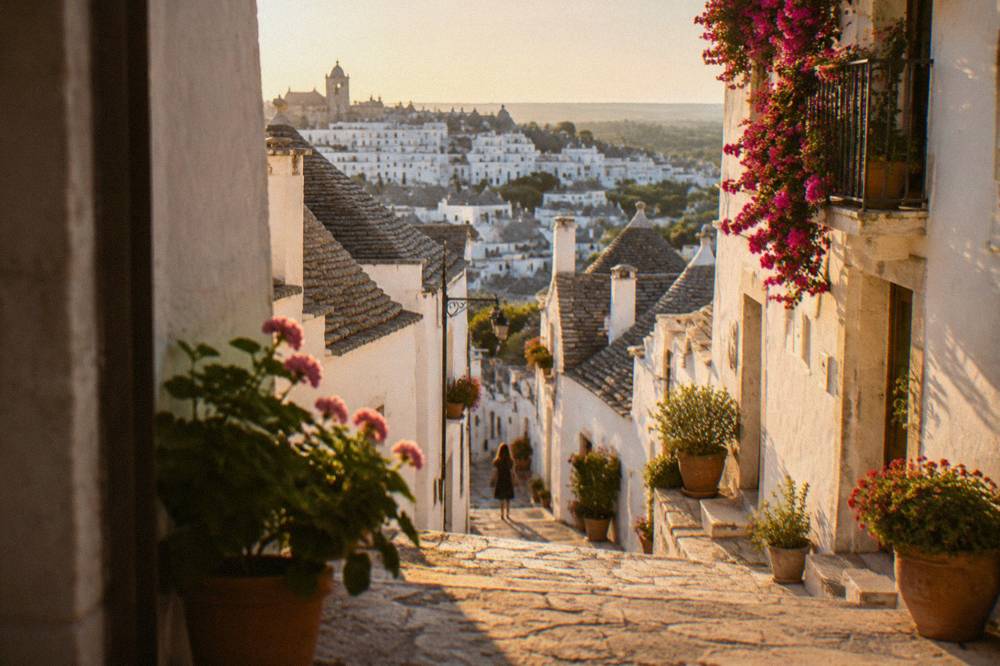
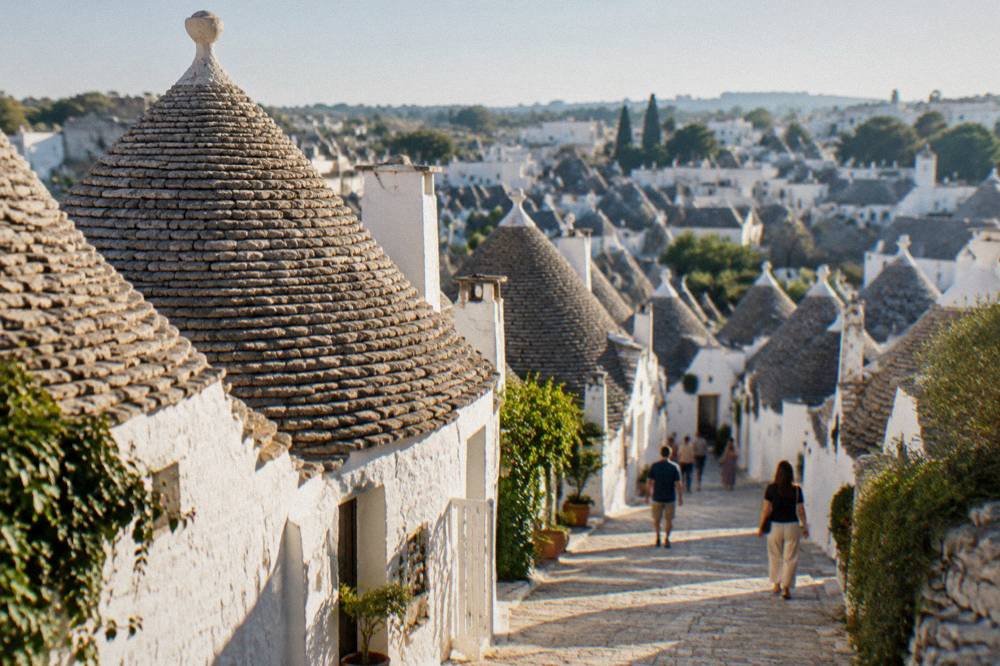
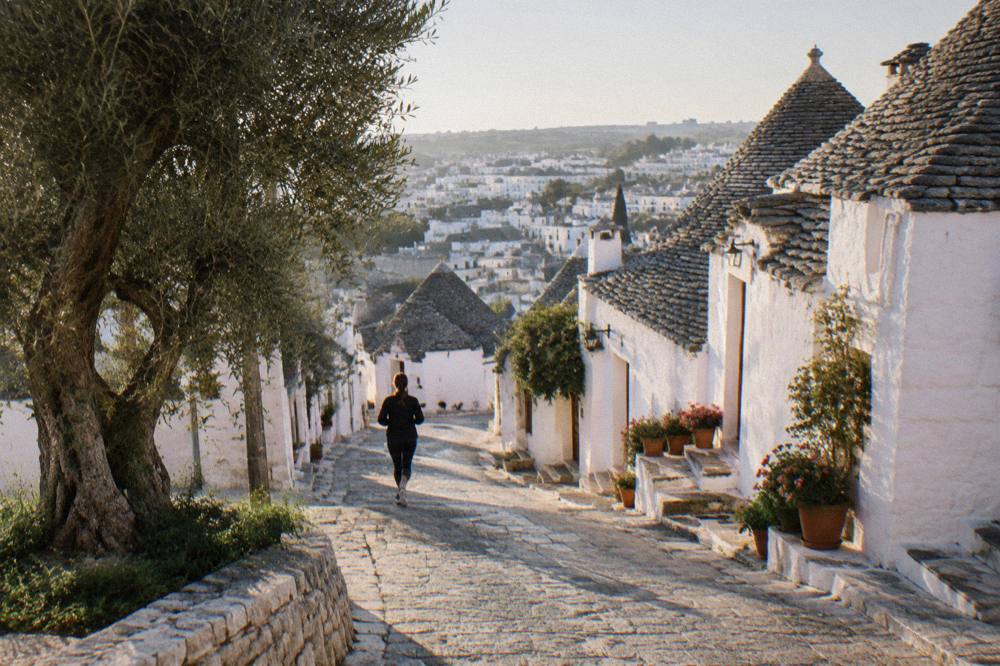
Alberobello is the anchor. Its two trulli districts, Rione Monti and Rione Aia Piccola, hold over a thousand of the cone-roofed buildings, and the town is a UNESCO World Heritage Site in its own right, separate from Matera's inscription. The Alberobello day trip guide covers the town street by street. What the pairing question comes down to is drive time: Alberobello to Locorotondo is a short hop within the valley, while Alberobello to Ostuni doubles the day.
For a self-drive day, the desk's reading of the distances is simple. Two towns at valley pace beats three towns at motorway pace. Alberobello deserves the longer stop: the trulli districts are walked, not driven, and the viewpoints along Via Indipendenza and from the Aia Piccola side need an unhurried loop. Locorotondo is compact, a single circuit from the belvedere on Via Vittorio Emanuele through the historic centre and back, and it pairs well as the afternoon stop.
The guided options take a different shape. The tours that run from this region pair Alberobello with Matera rather than with a second valley town, because the two UNESCO towns in one day is the itinerary that sells. The Matera and Alberobello tour with a tour leader on board is the site's featured pick for this page: it covers both towns with a tour leader rather than a local step-on guide, and the listing on the operator's page carries the current price, rating and duration. Check availability at the operator's live listing.
If you are staying in Matera and driving yourself, the third option is a private transfer tour of Alberobello from Matera, which removes the parking question but keeps the schedule flexible. The desk's view: take the guided coach day if you do not want to drive, self-drive if you want Locorotondo or Ostuni as well, and the transfer tour if the day is short.
How Do You Get From Matera To Alberobello And The Valle D Itria?
There is no direct train from Matera to the Valle D Itria, and the practical routes from the city are three: self-drive, about 1 hour 23 minutes to Alberobello by the computed road route; a guided coach tour with pickup in the city; or a private transfer. Matera's rail operator FAL runs north to Bari and Altamura, not east into the valley, and no verified public bus timetable from Matera to Alberobello exists on an official page, so the desk does not print one.
The rail point deserves a clear statement, because it catches people out. Matera's station is served by FAL, Ferrovie Appulo Lucane, not by Trenitalia, and the FAL network runs from Bari through Altamura to Matera. The Valle D Itria towns are not on it. A rail-based day would mean going the long way round through Bari, and the verified timetable shows a Bari to Matera journey of about 1 hour 45 to 2 hours with a change at Altamura, before any connection toward the valley. On Sundays and public holidays FAL runs replacement buses instead of trains on the Matera line. The desk's advice is to treat the Valle D Itria as a road day.
Driving yourself is straightforward. The route leaves Matera on the SS7 Appia or the SS99 depending on the valley town, crosses the Murgia, and enters Puglia's province of Bari or Brindisi. The computed distances in the table above are free-flow; add margin in July and August, when the valley's own season peaks, and around Alberobello town centre, where parking is managed and the trulli districts are closed to through traffic. The desk does not print car park tariffs for Alberobello, because no verified official tariff page for them is in the source pack; confirm locally on arrival.
The third route is the guided coach day, and for the Valle D Itria it is the one the desk recommends for a single-day visit without a car. The featured tour on this page runs with a tour leader on board and pairs Matera with Alberobello, which means the valley leg is handled end to end.
A word on the airport question, because it changes the arithmetic. Bari Airport is 64 km from Matera, about a 1 hour drive, and it is also the natural gateway to the Valle D Itria from the north. Travellers flying into Bari often do the valley on the way to or from Matera rather than as a day trip out of the city. The Bari airport to Matera page covers the transfers; the shuttle question between the airport and Matera has no verified official timetable, so the desk does not print one.
What Does A Guided Valle D Itria Day From Matera Include?
A guided day from the Matera region pairs the city with Alberobello in a single itinerary: coach transport, a tour leader on board, and time in both UNESCO towns, with the Alberobello leg centred on the trulli districts. What the booking page shows is a from-price per person, a rating from verified reviews and a duration, all rendered on the operator's live page. What the tour does not do is add Locorotondo or Ostuni, which is the trade-off against a self-drive day.
The featured tour is the Matera and Alberobello tour with a tour leader on board, and the desk highlights it for one reason: it is the only practical way to see both UNESCO towns in one day without driving. The tour leader rides the coach, handles the logistics and frames the two towns, though the deep-dive interpretation in Alberobello is a separate matter from the transport. Everything else covered here is indexed on Matera Travel Guide.
If the Alberobello visit is the priority and the interpretation matters more than the transport, a dedicated trulli walk in the town is the complement. The Alberobello guided trulli tour covers the Rione Monti and the trullo church, and the listing carries its own price, rating and duration. It pairs with a self-drive or transfer arrival rather than replacing the coach day.
If Alberobello is the priority and the interpretation matters, book an Alberobello trulli walking tour here.
The comparison table below is the desk's summary of the three ways to structure the day. Prices, ratings and durations of the bookable products render from the live listings and are deliberately not typed here.
| Day structure | Driving | Towns covered | Best for |
|---|---|---|---|
| Guided coach day with tour leader | None | Matera and Alberobello | No-car travellers, first visit |
| Self-drive loop | All | Alberobello, Locorotondo, Ostuni | Flexibility, a second valley town |
| Private transfer to Alberobello | None, car provided | Alberobello | Short days, parking-free visit |
One planning note that the first page of search results does not usually carry: Alberobello's trulli districts are at their emptiest in the early morning and again after the day coaches leave. The APT Basilicata data for Matera itself shows the same pattern in miniature, with 61,630 guest arrivals in September 2025 against 15,239 in February, and the valley's towns follow an even sharper day-trip rhythm because so much of their traffic arrives and leaves within the same afternoon. Timing the Alberobello leg before mid-morning is the single best free upgrade to any Valle D Itria day.
When Is The Best Time Of Year To Visit The Valle D Itria From Matera?
The shoulder months are the best window: April, May, June and September combine valley greenery with manageable heat, and the ERA5 reanalysis for Matera, 1991 to 2020, shows mean highs of 17.4 C in April, 22.7 C in May, 28.2 C in June and 25.7 C in September, against 31.2 C in July and 31.3 C in August. The valley sits at similar elevation to Matera's plateau country, so the same seasonal logic applies.
The climate figures deserve their label. These are ERA5 reanalysis values for the Matera grid cell, 1991 to 2020, not a weather-station record, and the Valle D Itria's own microclimate will differ in detail while following the same curve. What the numbers say is that the valley's summer is genuinely hot, with about 55 days a year reaching 30 C in the Matera cell, of which about 20 fall in August alone, and that the spring and autumn are the months when walking the trulli districts is comfortable from morning to evening. The arrival data, meanwhile, shows the crowds peak in September, not August, which is the second half of the planning story.
| Month | Mean high C (ERA5 1991-2020) | Rain mm | Matera arrivals 2025 |
|---|---|---|---|
| April | 17.4 | 56.5 | 45,195 |
| May | 22.7 | 41.7 | 54,101 |
| June | 28.2 | 35.1 | 50,186 |
| July | 31.2 | 21.2 | 43,966 |
| August | 31.3 | 21.7 | 60,257 |
| September | 25.7 | 44.8 | 61,630 |
| October | 20.8 | 51.7 | 52,538 |
The arrivals column is APT Basilicata's count of guests in registered accommodation in the city of Matera, not day-tripper totals, and it tells a story that surprises people who assume August is the peak. September 2025 logged 61,630 arrivals against 60,257 in August, and 74.5 percent of those September arrivals came from abroad. For the Valle D Itria the same logic holds: the valley's own towns fill with day traffic in high summer, while May, early June, late September and October spread the same sights over milder air.
Winter is a different proposition. The Matera cell's mean high drops to 10.3 C in January with 51.4 mm of rain, and the valley's countryside, which depends on greenery and long light for its effect, is at its barest. The compensations are real: Alberobello's trulli are architectural at any temperature, the towns are quiet, and Matera's own winter season carries the Presepe Vivente, the living nativity in the Sassi whose sixteenth edition runs on the December and early-January days listed on the organiser's site, at 12.00 EUR full and 9.00 EUR for ages 10 to 18, free under 10. A December itinerary that pairs the valley with the nativity is the desk's favourite cold-weather structure for the region.
What Should You Eat In The Valle D Itria Around Matera?
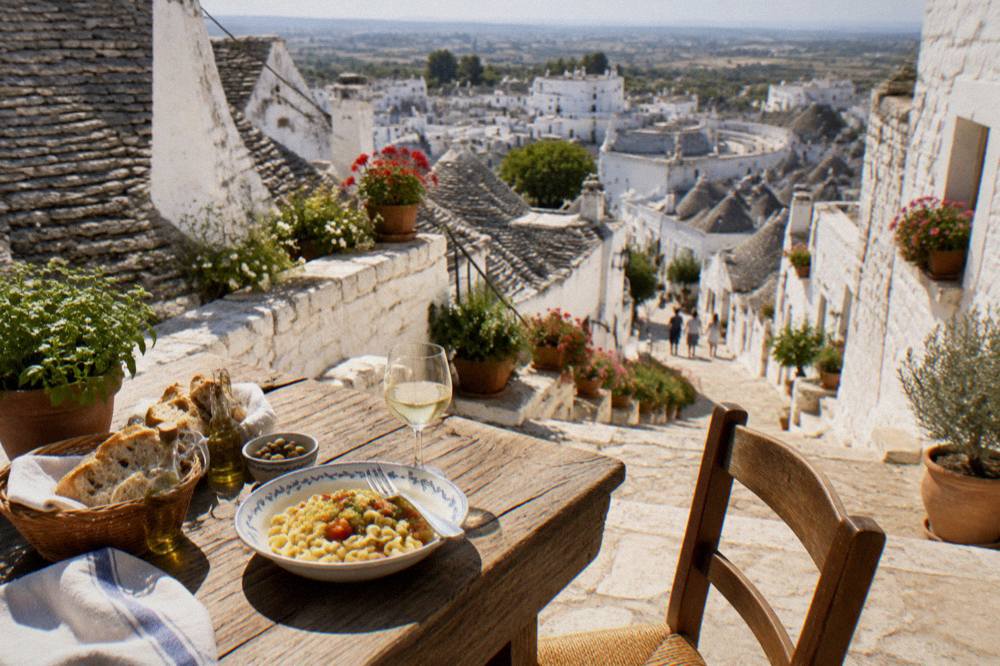
The Valle D Itria's table is Puglian and inland: orecchiette pasta with cime di rapa, grilled meats, burrata and fresh cheese from the valley's dairies, and the white wines of Locorotondo and the surrounding DOC zone, all of which sit beside Matera's own Basilicatan bread, pane di Matera, rather than replacing it. The valley is wine country first: Locorotondo's DOC whites are the region's best-known pour, and a food day in the valley is built around lunch, not dinner.
The practical advice is structural rather than culinary. The valley's restaurants concentrate in the towns and fill at the Italian lunch hour, and the trulli-countryside agriturismi, farmhouse inns scattered through the olive groves, are the setting for the long version of the meal. A self-drive day that puts Alberobello in the morning and Locorotondo at lunchtime lands in the valley's best eating window. The what to eat in Matera guide covers the Basilicatan side of the border; the valley's table is its Puglian mirror.
For a food-focused day, the guided options split by town. The Alberobello walk with a local guide covers the trulli quarters and the town's food shops; the e-bike tour with focaccia and wine, which runs from Alberobello, pairs the valley's lanes with a tasting stop and is the closest thing in the roster to a countryside food day. The desk does not print tasting-fee ranges for the valley's wineries, because no verified price list for them is in the source pack; check with each cellar before booking.
| Food stop in the valley | What it is | When it fits the day |
|---|---|---|
| Alberobello town centre | Trulli-quarter trattorias, cheese and pastry shops | Midday, after the morning walk |
| Locorotondo | DOC white wine, historic-centre osterias | Lunch or an early-evening glass |
| Valley agriturismo | Farmhouse lunch among the olive groves | Self-drive days only |
| Matera, back in the city | Basilicatan kitchen, pane di Matera | Dinner, after the drive home |
One border note. The valley's most famous export, burrata, travels badly and is best eaten within its region, which the day trip does naturally. And the desk flags the one food figure that is verified on the Matera side: pane di Matera holds PGI status, registered in 2008 under Reg. CE 160/2008, so the bread on the Matera table is a labelled product with its own rules. The valley answers with its own labels, and the two tables together are the best argument for eating your way across the border in both directions.
How Does The Valle D Itria Compare With Matera's Own Sassi?
The two are UNESCO siblings but different experiences: the Sassi are a cave city, thousands of dwellings and rock-hewn churches cut into a canyon wall, inscribed by UNESCO in 1993 for a rock-cut settlement with continuity over more than two millennia, while Alberobello's trulli are dry-stone buildings, corbelled cone roofs over field houses, inscribed for a building tradition rather than a lived-in cityscape.
The Sassi are walked on stone stairs and stepped alleys; the trulli districts are walked on cobbles and gentle slopes, and neither is a step-free zone.
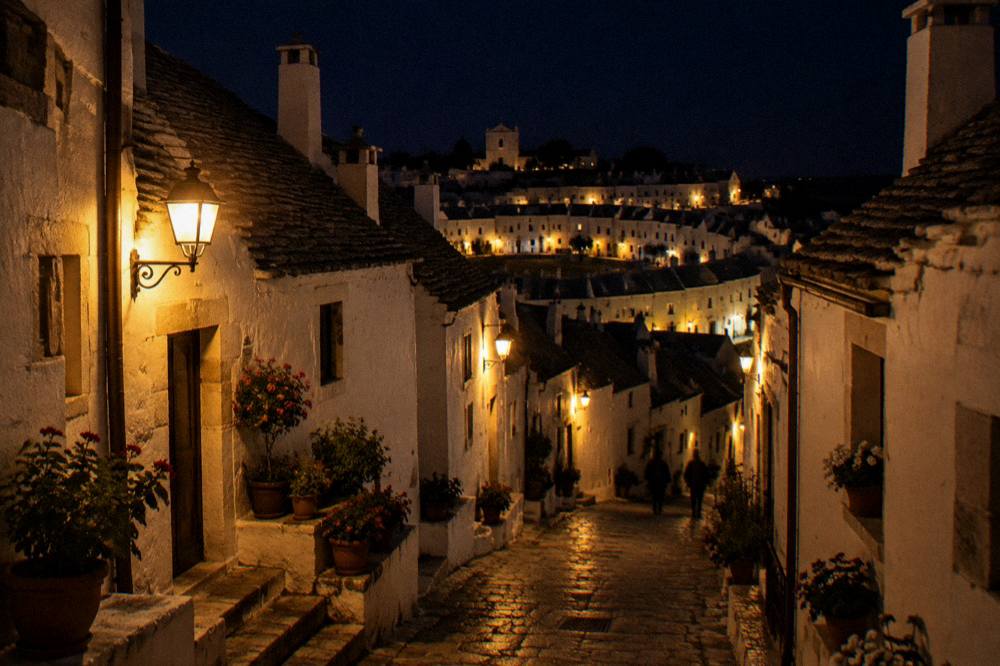
The comparison matters because many travellers treat the two as interchangeable, and they are not. The Sassi are urban and vertical: Sasso Caveoso and Sasso Barisano descend the canyon side in stepped lanes, and the Matera walking tour pages exist because the terrain rewards a guide's route-finding. Alberobello is horizontal by comparison, a small town whose trulli districts spread across flat and gently rising ground, with souvenir shops in the Rione Monti and a quieter, more residential Aia Piccola across the road.
UNESCO's own wording draws the line. Matera's inscription, "The Sassi and the Park of the Rupestrian Churches of Matera", covers 1,016 hectares and cites an outstanding example of a rock-cut settlement adapted to its geomorphological setting, with continuity over more than two millennia. Alberobello's inscription covers the trulli as a surviving prehistoric building technique. One is a city carved out of rock, the other is a building form built on top of it. The desk's rule: see the Sassi properly first, at least a full day with a cave house and a rupestrian church, and take the valley as the second act.
The practical contrast is in the crowds' shape. Matera logged 479,083 guest arrivals in registered accommodation in 2025, an APT Basilicata count, with an average stay of 1.56 nights, so its visitors sleep in the city and spread across evenings and mornings. Alberobello's traffic is overwhelmingly diurnal: the town fills with coaches through the middle of the day and empties again. That is why the desk puts Alberobello early, and why the featured guided day, which times the valley leg with the coach schedule, is a reasonable way to dodge the worst of the midday squeeze.
Common Questions About The Valle D Itria From Matera
Is the Valle D Itria worth a day trip from Matera?
Yes, if a second UNESCO landscape is the goal. Alberobello is 68 km away, about a 1 hour 23 minute drive, and the trulli districts are unlike anything in the Sassi. If time is short, the desk would keep the day in Matera, whose cave city needs at least a full day of its own.
Can you get to Alberobello from Matera by train?
No. Matera's rail operator, FAL, runs north toward Bari and Altamura, not east into the Valle D Itria, and no direct rail link exists. The options are self-drive, a private transfer, or a guided coach tour.
Which is better, Alberobello or Matera?
They answer different questions. Matera is a cave city inscribed by UNESCO in 1993 for a rock-cut settlement with continuity over more than two millennia; Alberobello is inscribed for its trulli, a dry-stone building tradition. The Matera versus Alberobello comparison covers the choice in detail.
How many days do you need for Matera and the Valle D Itria together?
Three is the comfortable number: a full day for the Sassi, a second for the valley towns, and a third for the Murgia park or the coast. The three days in Matera itinerary builds the structure.
When is the Valle D Itria too hot for walking?
July and August, when the ERA5 reanalysis for Matera, 1991 to 2020, shows mean highs of 31.2 and 31.3 C. Walk the trulli districts before midday in those months, or shift the trip to May, June, September or October.
Do guided tours from Matera cover Locorotondo and Ostuni as well?
The tours in this site's roster pair Alberobello with Matera, not with a second valley town. Locorotondo and Ostuni are self-drive additions, at 77 and 102 km from Matera respectively by the computed road routes.
The valley will still be there when the Sassi have emptied your legs. Plan the drive or the coach, take the early start, and the trulli country repays the border crossing.