What Time Is Sunset In Matera?
Sunset times in Matera across the year, month by month, with the best viewpoints over the Sassi and the Gravina canyon, and how the season changes the light.
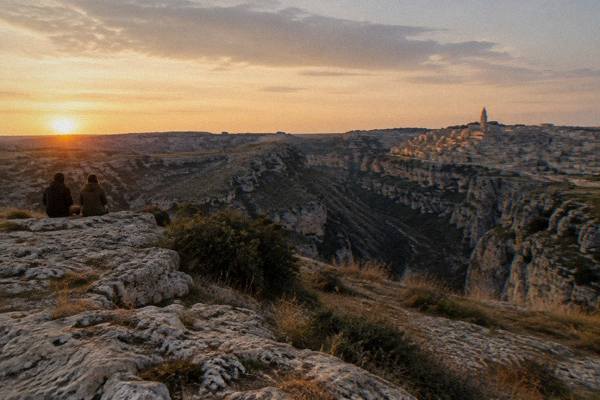
Matera sits at about 400 m above sea level on the edge of the Gravina canyon in Basilicata, southern Italy, and the moment the sun drops behind the Murgia plateau opposite the Sassi is the moment the whole city changes colour. Sunset here runs from roughly 16:30 at the winter solstice to roughly 20:30 at the summer solstice, a spread of about four hours across the year, and the pale tufa limestone of the cave districts turns from white to gold to orange as it happens. This page sets out the sunset times month by month, explains why they shift so far, and names the places to stand when the light goes.
What Time Is Sunset In Matera?
Sunset in Matera falls between roughly 16:30 and 20:45 local time depending on the season: around 16:30 in late December, around 18:30 to 19:00 at the equinoxes, and around 20:30 to 20:45 from late June into early July. Matera is an inland city at about 400 m elevation, so these times come from standard sun tables for its latitude in southern Italy, and the daylight saving shift, from late October to late March, moves every clock time by one hour.
The two anchor points are the solstices. At the winter solstice in late December the sun goes down at about 16:30, and by mid-January the days are already lengthening again. At the summer solstice in late June the sun sets at about 20:30, with usable light in the sky until past 21:00. The equinoxes in late March and late September sit in the middle, at about 18:30 to 19:00.
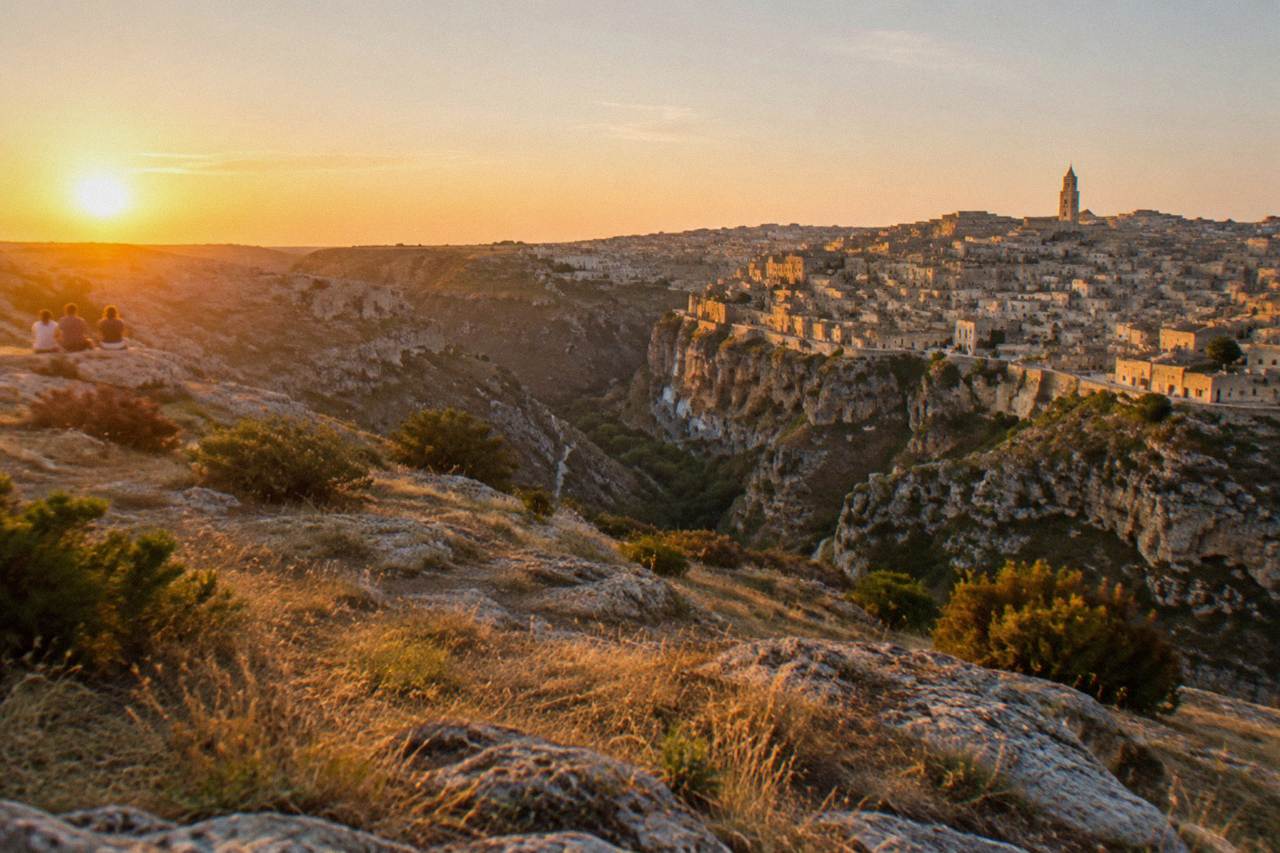
One planning detail matters more than the exact minute. Because the Sassi face south and east across the Gravina, and the Murgia plateau stands opposite, the canyon loses direct light before the published sunset time. The rock face opposite goes into shadow first, then the lower cave districts, while the upper town and the Cathedral ridge hold the light a little longer. Photographers who arrive at the published sunset time arrive late; the golden colour on the Sassi is at its best in the 30 to 45 minutes before it.
For readers planning a whole visit around light and weather, the seasonal picture is in the best time to visit Matera, and the month by month detail follows below.
When Is Sunset In Matera Month By Month?
Sunset in Matera moves through the year in a steady curve: about 16:45 in January, 18:00 by the start of March, 19:30 in mid-April, 20:15 by mid-May, 20:30 or later from late June to early July, 20:00 in late August, 18:45 by the end of September, 17:30 in mid-October, and back to about 16:45 by the end of November.
Every figure below is a mid-month approximation from published sun tables, and the day to day drift is a minute or two.
| Month (mid-month) | Approximate sunset | Notes for planning |
|---|---|---|
| January | about 16:50 | Short days; canyon in shadow by about 16:15 |
| February | about 17:30 | Gains roughly two minutes a day |
| March | about 18:10 | Clocks change to summer time late in the month |
| April | about 19:30 | After the clock change; long golden hours |
| May | about 20:05 | Warm evenings on the viewpoints |
| June | about 20:25 | Peak of the year near the solstice |
| July | about 20:25 | Sunset heat lingers; arrive early for a spot |
| August | about 19:55 | Moves earlier by about a minute and a half a day |
| September | about 18:55 | The busiest month for arrivals in the city |
| October | about 18:00 | Clocks change back late in the month |
| November | about 16:45 | Back to winter hours; lights on the Sassi early |
| December | about 16:30 | Earliest sunsets in the last week of the month |
The pattern to notice is that sunset time does not track temperature. July and August have almost identical heat in the ERA5 reanalysis for Matera, 1991-2020, with mean highs of 31.2 and 31.3 C, but August loses more than half an hour of evening light by the end of the month. September is the busiest month in the city's accommodation data, 61,630 arrivals in 2025 against 60,257 in August, and its sunsets sit at a comfortable 18:30 to 19:00 for most of the month.
The clock changes matter when you plan a sunset visit. Italy moves to summer time in late March and back in late October, so the jump between the March and April rows above, and between October and November, is the clock, not the sky. Around each change the published sunset time shifts by a full hour overnight.
If the evening plan is a ride around the viewpoints rather than a walk down into the Sassi, the open-top eco-bus circuit covers the panoramic side of the city, and it is worth checking the last departure against the sunset time for your date. The same goes for any guided walk: confirm the start time with the operator when you book, because sunset-driven departures shift week by week.
Where To Watch Sunset Over The Sassi?
The classic sunset view of Matera is from the Murgia side of the Gravina, facing the Sassi: Belvedere Murgia Timone and the park paths near it look straight across at Sasso Caveoso and the Cathedral, and the Sassi glow as the sun sets behind the viewpoint. On the city side, Piazza San Pietro Caveoso and the terrace near Santa Maria de Idris put you inside the view rather than opposite it, with the rock face catching the last light from within.
Want to be standing on the Murgia side as the light fades? Book a sunset tour here.
The Murgia side is the postcard angle. The park across the canyon, Parco della Murgia, holds the rupestrian churches and the belvedere, and from there the whole cave district is laid out with the Cathedral on its ridge. Access to the Murgia Timone side now runs through the Jazzo Gattini visitor centre, active since 6 February 2026 under a new concession, which serves as the park's info point and ticket office for the access towards Murgia Timone. The belvedere is a short walk from there, on uneven ground, so allow time and wear proper shoes. More of these guides are collected on Matera Travel Guide.
The city side works differently. From Piazza San Pietro Caveoso the sun sets to your right, over the plateau, and the light rakes across the cave facades around you. Santa Maria de Idris, cut into the rock above the square, is one of the three rupestrian churches run by Oltre l'Arte, open daily 09:30 to 19:30 from 28 March 2026, with last entry at 19:20, so in midsummer it is possible to visit the church and still catch the colour outside. The details of the church and its ticket are covered in the Santa Maria de Idris guide.
Two more spots complete the set. Piazza Vittorio Veneto, the large square on the edge of the modern town, stands over an unseen cistern and looks down into Sasso Barisano, and the terrace there catches the evening light across the northern Sassi. Across the canyon, the Tibetan bridge on Sentiero 406 has had a staffed access point and an online access ticket since March 2026, and the park's own site states the conduct rules that come with the ticket; the crossing is not a casual add-on to a sunset walk, and the access price is confirmed at booking rather than printed here.
Why Does The Sunset Time In Matera Shift So Much Through The Year?
Matera lies far enough north of the equator that day length swings sharply between winter and summer, which is what drives sunset from about 16:30 in December to about 20:30 in June. The swing is a latitude effect, not a local one, and it is the same four-hour spread you would find anywhere at this latitude in southern Italy.
The mechanics are simple. Earth's axial tilt means the northern hemisphere leans toward the sun in summer and away in winter, and the effect grows with distance from the equator. At Matera's latitude the sun rises and sets well north of east and west in June, lengthening both ends of the day, and well south of them in December, shortening both. The result is a sunset that drifts about a minute later each day through spring and about a minute and a half earlier each day through late summer.
The clock adds a second layer. Italy keeps Central European Time and observes daylight saving from late March to late October. Without the summer shift, a June sunset would land about an hour earlier on the clock and a December one about an hour earlier too, which is why the November sunset feels sudden: the sky barely changes but the clock falls back.
For photographers this swing is the whole calendar. The long June and July evenings mean the golden hour starts after 19:00 and dinner can follow the sunset rather than precede it. In December the light goes before 17:00, which compresses a Sassi visit into a short window, but the trade-off is that the city's illuminations come on early, and the Sassi by night is a different subject. The seasonal light and the evening scene are covered in the Matera at night guide and the Matera photography spots guide.
How Does Matera's Setting Change The Sunset Itself?
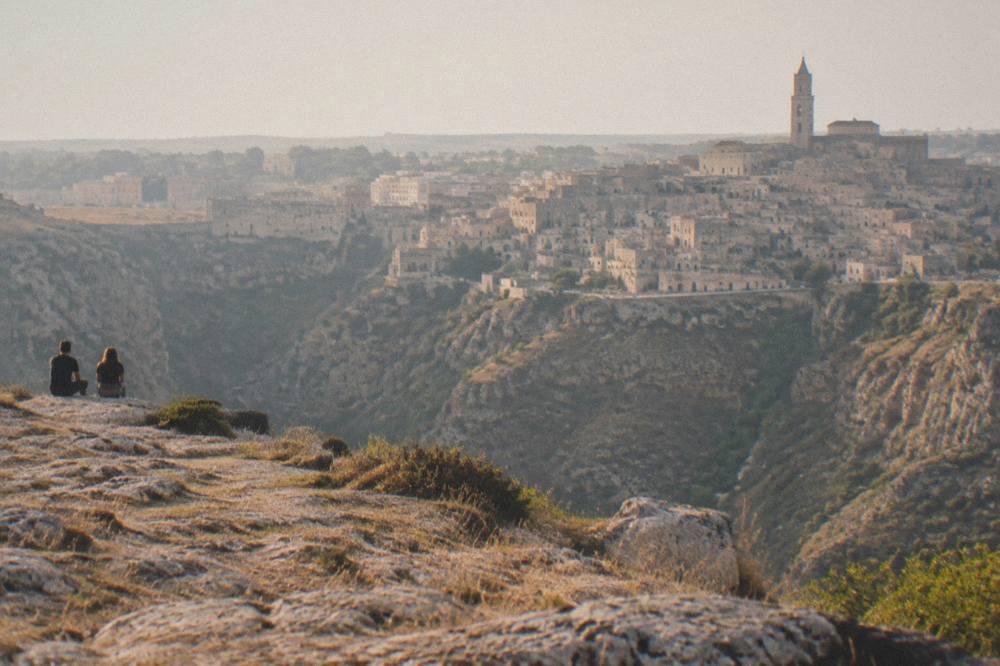
Matera is an inland city at about 400 m elevation on the edge of a canyon, so its sunset has no sea horizon and no coastal afterglow: the sun drops behind the Murgia plateau, the opposite canyon wall shades first, and the Sassi hold warm reflected light for some minutes after the direct sun is gone. The canyon geometry means the practical sunset, the moment the rock stops glowing, arrives earlier than the published one.
The Gravina is the reason. The Sassi districts are cut into the north side of the canyon, and the Murgia plateau rises on the south side, so in the evening the sun sets into the plateau and its last rays come in almost parallel to the canyon floor, raking across the cave facades. That low-angle light is what makes the tufa look molten, and it is why the same viewpoint photographs completely differently at noon and at 19:30.
Elevation plays a smaller part. At about 400 m the horizon is effectively the plateau edge rather than a flat sea line, so the published sunset time, calculated for a level horizon, overstates the light a little. The difference is small, a few minutes, but combined with the canyon shadow it means the working rule for a visit is simple: be in position 45 minutes before the published sunset time, and expect the colour to be done 15 minutes after it starts.
The season changes the direction of the light as much as the time. In summer the sun sets well to the north-west, behind the plateau but off to the right of the classic Murgia Timone view, which lights the Sassi broadly. In winter it sets almost directly behind the plateau opposite the Sassi, which gives shorter, sharper light and earlier shadow in the canyon. Either way, the half hour before the published time is the one to plan around, and the self-guided walking route can be run backwards in the evening to end at a viewpoint rather than start from one.
Common Questions About Sunset In Matera
What time is sunset in Matera?
Roughly 16:30 at the winter solstice in late December, roughly 20:30 at the summer solstice in late June, and about 18:30 to 19:00 at the equinoxes. Check a current sun table for your exact date, and be in position 45 minutes before the published time because the canyon loses direct light early.
Where is the best place to watch sunset in Matera?
The classic view is from the Murgia side of the Gravina, at Belvedere Murgia Timone and the park paths around it, looking straight across at the Sassi and the Cathedral. On the city side, Piazza San Pietro Caveoso and the area around Santa Maria de Idris put you inside the Sassi as the light hits them.
Is Matera good at sunset in winter?
Yes, but the window is short. Sunset is around 16:30 to 16:50 from late November to early January, the canyon is in shadow before that, and the evening chill arrives fast: January's mean low in the ERA5 reanalysis, 1991-2020, is 2.2 C. The trade-off is that the city's illuminations switch on early, so a winter sunset turns into a night view.
How long does golden hour last in Matera?
Plan on 30 to 45 minutes before the published sunset time. Because the sun drops behind the Murgia plateau rather than a flat horizon, and the opposite canyon wall shades first, the usable warm light on the Sassi starts earlier and ends earlier than the tables suggest.
Can you see the sea at sunset from Matera?
No. Matera is an inland city in Basilicata with no sea; the coast, Metaponto on the Ionian and Polignano a Mare or Bari on the Adriatic, is a day trip. The sunset here is a canyon and plateau sunset, over rock, not over water.
Do sunset walking tours run in Matera?
Yes, guided walks timed to the evening light run in the city, and a Murgia Park sunset walk is one of the options on the panoramic and outdoor side. Start times shift week by week with the sunset, so confirm the time with the operator's live listing before you go.
The short version: look up the published sunset for your date, subtract 45 minutes, and be standing on the Murgia side or in Piazza San Pietro Caveoso by then, because in Matera the light on the Sassi is the show, and it starts before the sun goes.