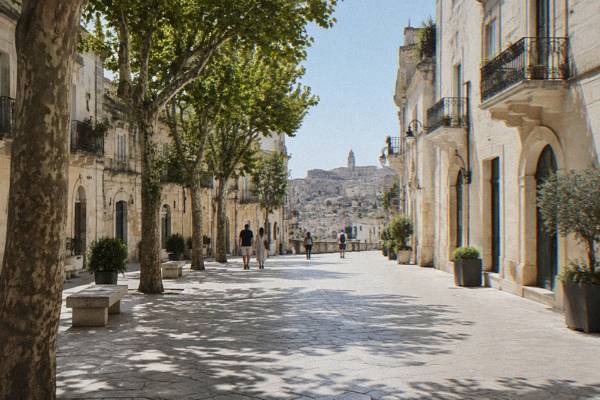
Is Matera, Italy Worth Visiting?
A clear, sourced answer to whether Matera in Basilicata is worth visiting, covering the Sassi, entry prices, crowds, climate data and how long to stay.
Matera sits inland in Basilicata, southern Italy, at about 400 m above sea level on the rim of the Gravina canyon, with the Murgia plateau facing it across the gorge. There is no sea here: the nearest coast, Metaponto on the Ionian or Polignano a Mare on the Adriatic, is a day trip away. What the city has instead is the Sassi, two districts of cave dwellings, stone houses and rock-hewn churches cut into pale tufa limestone, inscribed by UNESCO in 1993 as "The Sassi and the Park of the Rupestrian Churches of Matera". The accommodation data shows the city logged 479,083 arrivals in 2025, up 23.4% on the 2019 Capital of Culture year, so the question of whether it is worth visiting has a real answer, and it is not a quiet one.
Is Matera, Italy Worth Visiting?
Yes, Matera is worth visiting for anyone interested in rock-cut architecture, layered history and a cityscape that has no real counterpart in Europe, and the verified numbers back the reputation: UNESCO inscribed the Sassi in 1993, the park's own site counts about 8,000 hectares of protected plateau with 923 plant species, and 2025 brought 479,083 arrivals in registered accommodation, beating the 2019 Capital of Culture year by 23.4%. The conditions are real terrain, real crowds in September and a location that needs planning to reach.
UNESCO's citation describes the Sassi as "an outstanding example of a rock-cut settlement, adapted perfectly to its geomorphological setting and ecosystem and exhibiting continuity over more than two millennia". That continuity is the substance behind the postcard. The same districts that are now hotels and museums were, within living memory, the overcrowded cave quarters whose evacuation began in 1952 and ran into the 1970s, a story covered in detail in why Matera is called the shame of Italy. A 1986 law opened the way to restoration. Walking the city you move between those two realities in minutes.
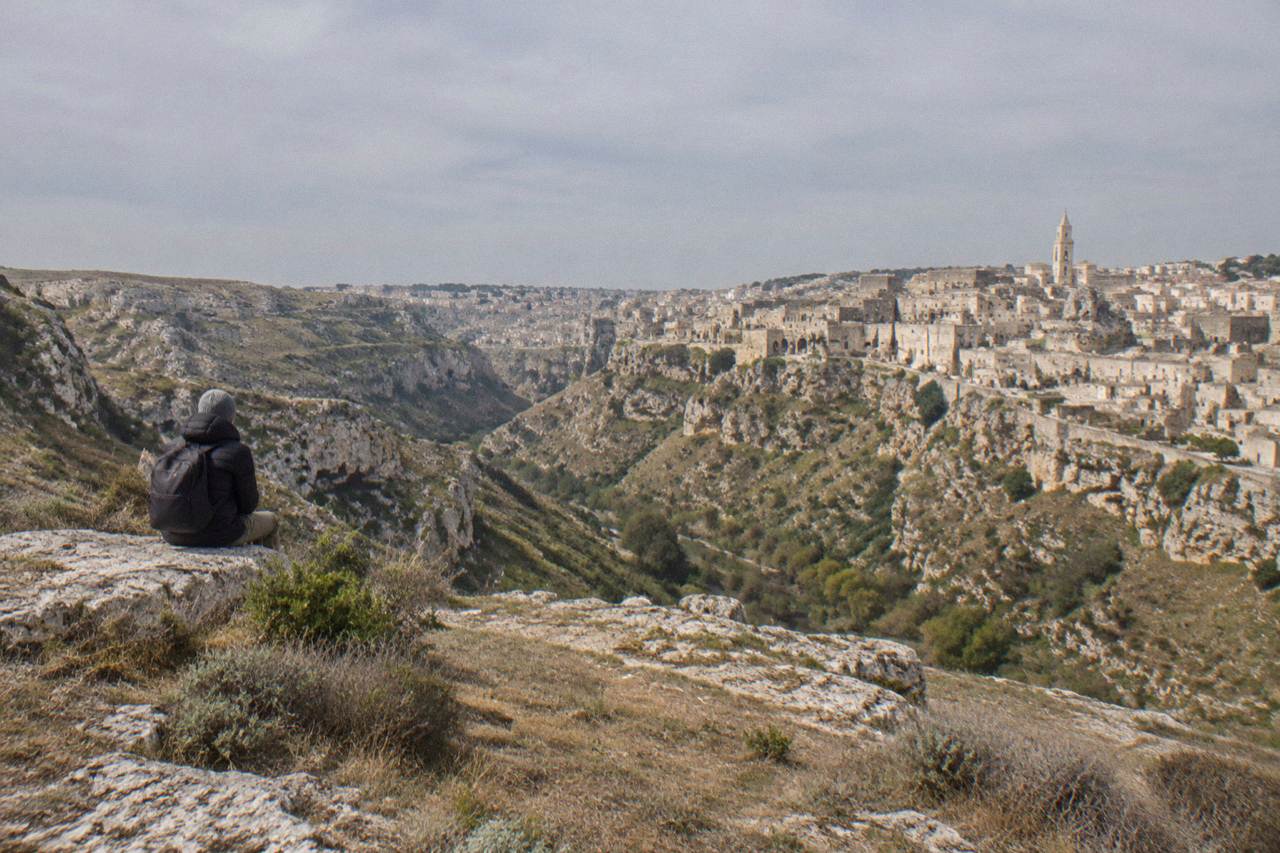
The setting does half the work. The Gravina canyon splits the city from the Murgia plateau, and the view across from Belvedere Murgia Timone, a jazzo that now serves as the park's viewpoint, is the image that drew film crews from Pasolini's 1964 Gospel According to St. Matthew to the 2021 James Bond release No Time to Die. For what that screen history adds up to, see what movie is filmed in Matera.
What the city is not is a beach town or a Puglian one. Matera is in Basilicata, a point confused often enough that this guide keeps a whole answer on whether Matera is part of Puglia.
What Exactly Do You Get For The Journey?
What you get is a two-district cave city, Sasso Barisano and Sasso Caveoso, a plateau park with rock churches cut into its cliffs, a cave-house museum with a published 2026 tariff of 8.00 EUR, and rupestrian churches entry at 4.50 EUR for one church up to 25.00 EUR for an eight-site all-inclusive ticket. No other city in Italy presents a cave habitat of this scale as a living, bookable place to sleep and eat.
The core sightseeing loop is compact but vertical. The Civita, the old town on the spur between the two Sassi, holds the Cathedral. Below it, the cave districts step down to the canyon floor, and across the gorge the Parco della Murgia holds the rock churches that give the UNESCO site its full name. The UNESCO property area itself covers 1,016 hectares, described as "more than a thousand dwellings and a large number of shops and workshops". A fuller walk-through of the districts is in what is so special about Matera.
For the canyon views without the stairways, book an open-bus panoramic tour here.
Entry prices are published and verified, which is more than can be said for many Italian cities. The current tariffs:
| Site | Ticket | Source detail |
|---|---|---|
| Rupestrian church (Santa Lucia alle Malve, Madonna de Idris or San Pietro Barisano) | 4.50 EUR | Oltre l'Arte ticket page, one church |
| Two rupestrian churches | 8.00 EUR | Oltre l'Arte combination |
| Three rupestrian churches | 10.00 EUR | Oltre l'Arte combination |
| Oltre l'Arte 8-site all-inclusive | 25.00 EUR, reduced 16.00 EUR | Churches plus MATA, Museo del Pane and more |
| Storica Casa Grotta di Vico Solitario | 8.00 EUR full, free to age 10 | Tariff in force from 4 April 2026 |
| MUSMA sculpture museum | 10 EUR full | Reduced 5 or 7 EUR |
| Casa Noha (FAI) | 6.50 EUR adults, 3 EUR children | Closed 5 to 22 October 2026 for renovation |
One warning worth repeating: the Museo Archeologico Nazionale Domenico Ridola has been closed since 7 April 2025 for energy works and a new display, with no reopening date published. Older guides still list it as open. For a city that rewards a first walk with a guide, the Sassi walking tours on this site cover what a guided route adds.
How Many Nights Does Matera Need?
Two nights is the working answer, and the data supports it: the average stay in 2025 was 1.56 nights per guest, which means a large share of arrivals treat Matera as a single night or even a day stop, then leave before the canyon light changes. One full day covers the Sassi on foot; a second evening adds the Murgia side at sunset and a cave restaurant at a human pace.
The APT Basilicata counts are guest movements in registered accommodation, not day-tripper totals, and they still show the shape of the problem: 479,083 arrivals produced 748,812 overnight stays in 2025, so the city receives a lot of pressure in short bursts. September alone logged 61,630 arrivals, and 74.5% of those came from abroad. Through the first eight months of 2026 the city counted 320,741 arrivals, up 3.1% on the same period of 2025, so the trend has not reversed. The rest of the planning pages sit on Matera Travel Guide.
For the deeper question of pacing, how many nights to stay in Matera works through the trade-offs, and whether one night is worth it answers the compressed version. The honest floor is one night, because the Sassi after the day crowds leave is a different place, and the Matera at night guide explains why.
When Should You Go, Going By The Numbers?
Going by the numbers, May and October are the sweet spots: May 2025 logged 54,101 arrivals with a mean high of 22.7 C, October 52,538 arrivals at 20.8 C, both well below September's 61,630, while July, at 31.2 C mean high, drew only 43,966 arrivals, fewer than April. February is the quiet floor at 15,239 arrivals. The crowd peak is September, not August, which most guides get wrong.
The ERA5 reanalysis for Matera, 1991-2020, gives the climate frame, and the APT Basilicata data gives the crowd frame. Put together:
| Month | Mean high C (ERA5 1991-2020) | Rain mm | Arrivals 2025 |
|---|---|---|---|
| February | 11.1 | 54.9 | 15,239 |
| April | 17.4 | 56.5 | 45,195 |
| May | 22.7 | 41.7 | 54,101 |
| July | 31.2 | 21.2 | 43,966 |
| August | 31.3 | 21.7 | 60,257 |
| September | 25.7 | 44.8 | 61,630 |
| October | 20.8 | 51.7 | 52,538 |
| November | 15.5 | 67.1 | 23,555 |
Two readings follow. July is as hot as August yet carries fewer arrivals than April, May, June, August, September or October, so heat alone steers people away. And November, the wettest month at 67.1 mm, is also the third quietest, which makes it a genuine trade: damp against near-empty lanes. Frost is not exotic here either, with about 20 frost days a year in the reanalysis, almost all from December to March. Winter has its own case, laid out in Matera in winter, and the December living nativity, the Presepe Vivente nei Sassi, runs public days across four December weekends and 2 to 3 January 2027 at 12.00 EUR full price.
What Are The Honest Downsides?
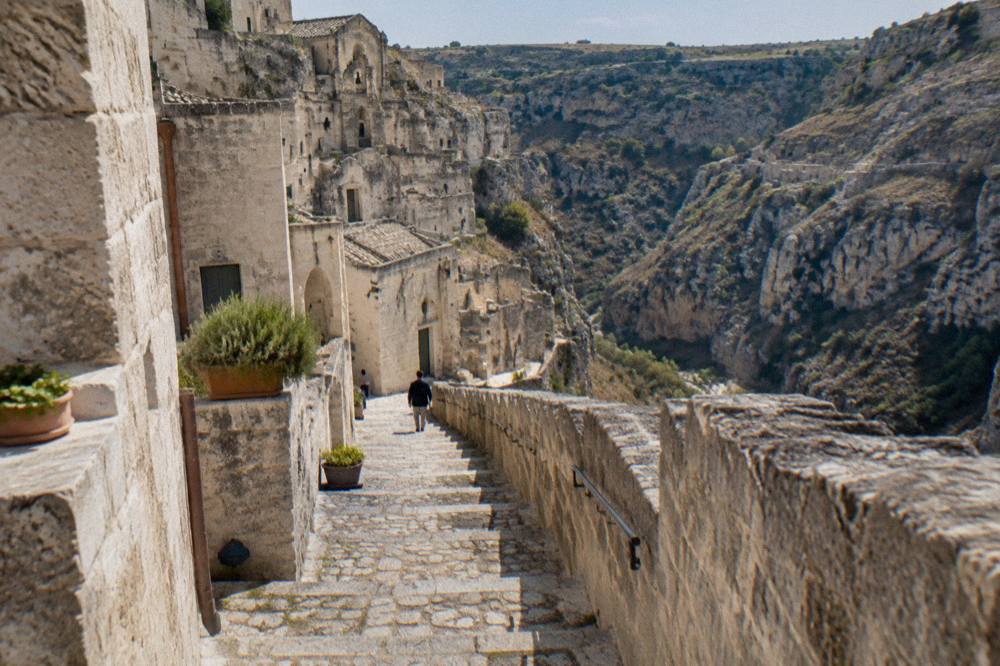
The honest downsides are steep, stepped and uneven terrain throughout the Sassi, no step-free route anywhere in the historic districts, a rail link that requires a change at Altamura from Bari with no trains on Sundays, and a September peak that packs the lanes, all of which are manageable with planning but none of which should be a surprise on arrival.
Start with the ground. The Sassi are built into a canyon wall, and every route between districts is a stairway. No named route through the districts can be described as step-free, and the Matera accessibility guide addresses what is and is not realistic.
Transport is the second constraint. There is no Trenitalia station in Matera; the operator is FAL, and the posted weekday timetable from Bari involves a change at Altamura, about 1 h 45 to 2 h in total, with replacement buses instead of trains on Sundays and public holidays. FAL's timetable page carries the current sheets. A national rail link, Ferrandina to Matera La Martella, is under construction with activation planned for 2028. Driving in, the ZTL camera hours matter: the Sassi gates run 10:00 to 20:30 from 16 September to 30 June, and 10:00 to 24:00 in summer, covered fully in the Matera parking guide.
Third, the crowds are real in the warm half of the year. The city's own viewpoints guide notes where the pressure concentrates at golden hour. And a tourist tax exists, collected by your accommodation, with the amount confirmed at booking rather than published on this site.
Common Questions About Visiting Matera
Is Matera, Italy worth visiting?
Yes. The UNESCO-inscribed Sassi, a canyon setting, published entry tariffs from 4.50 EUR and 479,083 accommodation arrivals in 2025 support the reputation, provided you accept steep terrain and plan around the September peak.
Is one day in Matera enough?
One day covers the Sassi districts on foot and one or two rupestrian churches. The average stay in 2025 was 1.56 nights, and a second evening adds the Murgia side at sunset without the clock pressure.
Is Matera too crowded to enjoy?
September 2025 logged 61,630 arrivals, the year's peak, against 15,239 in February. May and October sit in between with milder temperatures, and November is quiet but the wettest month at 67.1 mm.
Do people still live in the Sassi?
Yes, people live in the Sassi districts today, after residents were moved out between 1952 and the 1970s and a 1986 law opened restoration. The full story is on the page about whether people still live in the Sassi.
Is Matera safe to visit?
Matera is generally considered a safe small city of about 59,368 residents. The single European emergency number 112 has served the Matera district since 2 December 2025.
The verdict this site's reporting supports: go, give it two nights if you can, buy the church tickets that match your stamina, and time the visit against the arrivals table rather than the folklore.