Why Is Matera Called The Shame Of Italy?
How Matera's Sassi cave quarters earned the shame of Italy label in the postwar decades, when families were moved out from 1952, and how the city recovered to become a UNESCO site and a European Capital of Culture.
Matera, an inland city in Basilicata, southern Italy, carries a nickname that still surfaces in travel writing: the shame of Italy. The phrase belongs to the decades after the Second World War, when the Sassi, the cave quarters cut into the tufa on the edge of the Gravina canyon, housed families in conditions that became a national political scandal. The story of that label, and of the evacuation and recovery that followed it, is the clearest way to understand why the same city was inscribed on the UNESCO World Heritage List in 1993 and named European Capital of Culture for 2019. This page reports what the verified sources say, in the order the events happened.
Why Is Matera Called The Shame Of Italy?
Matera was called the shame of Italy because, in the decades after the Second World War, thousands of families were living in the Sassi cave quarters without running water, sanitation or adequate space, and the conditions became a national scandal that forced the Italian state to act. The label circulated in postwar reporting and political debate, and it stuck to the city long after the evacuation. The same districts were inscribed by UNESCO in 1993.
The nickname is not an official designation and no single document assigns it. It spread through the public debate that followed the postwar exposure of housing conditions in the Sassi, and it attached itself to the city's identity for a generation. What is documented is the sequence around it: families lived in cave dwellings in crowded conditions, the state intervened, residents were moved out between 1952 and the 1970s, and the quarters were left partly empty for years before a 1986 law opened the way to restoration.
The reversal since then is measurable. UNESCO inscribed "The Sassi and the Park of the Rupestrian Churches of Matera" in 1993, citing criteria (iii), (iv) and (v), and describing "an outstanding example of a rock-cut settlement, adapted perfectly to its geomorphological setting and ecosystem and exhibiting continuity over more than two millennia". In 2025, the APT Basilicata data records 479,083 guest arrivals in the city's registered accommodation, against 388,158 in 2019, the Capital of Culture year. The city that was once a byword for poverty now draws more guests than it did in its showcase year.
What Were The Sassi Like Before The Evacuation?
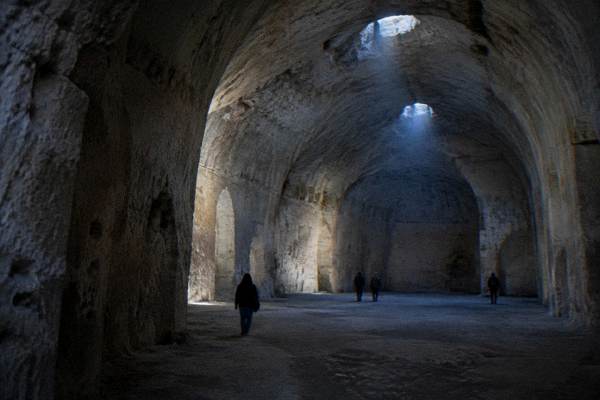
Before the evacuation, the Sassi were working-class neighbourhoods of cave dwellings and stone houses where families lived alongside animals in cramped, damp rooms cut into the tufa, with shared water points and no sewers at street level. The districts, Sasso Caveoso and Sasso Barisano, descend the slope of the Gravina canyon below the modern city on the plateau above. Housing density and sanitation, not the architecture itself, were the scandal.
The cave houses were not ruins or curiosities. They were ordinary homes, and the Sassi held a large share of the city's population in the years before the relocation began. The dwellings were cut into pale tufa limestone, which is soft to excavate and holds a steady temperature, and the quarters had grown over centuries into a dense stack of rooms, courtyards, stairways and rock-hewn churches. UNESCO's inscription text records "more than a thousand dwellings and a large number of shops and workshops" in a property area of 1,016 ha.
What made the label possible was the living standard, not the building type. Damp rooms shared with animals, shared water points and the absence of adequate drainage turned a centuries-old settlement pattern into a public-health emergency in a modernising state. The answer the Italian state chose was not to upgrade the Sassi in place but to empty them, which is the part of the story the next section covers.
Reading the geography helps more than any description. The Sassi are steep, stepped and uneven, and the canyon edge means that one side of the city looks directly at the other, so a panoramic circuit shows the full stack of cave facades in a single loop. The Matera Travel Guide desk recommends doing one overview before walking down in, and a small vehicle tour is the least tiring way to take that overview in. The related tour on this page, an Ape Calessino panoramic ride, covers exactly that circuit, and you can Check availability if that suits your plans. For the full picture of the cave dwellings themselves, the why families lived in caves in Matera page goes deeper into the geology and the housing history.
To see the cave facades and hear the story on the ground, book a guided Sassi walk here.
When Did Families Leave The Sassi?
Families were moved out of the Sassi between 1952 and the 1970s, into new public housing districts built on the plateau, under a state programme that relocated residents rather than renovating the cave quarters. A 1986 national law then opened the way to restoration of the emptied districts. The evacuation emptied whole neighbourhoods and left many cave houses abandoned for years.
The relocation was a national project, not a local one. New districts were built above the canyon to receive the families, and the Sassi emptied out over roughly two decades. The quarters did not become a museum immediately. They were partly abandoned, and the decades between the evacuation and the restoration law are the period when the "shame" framing hardened into the city's public image, even as the living conditions that justified it had already disappeared with the relocation.
The turning point was the 1986 law, which made restoration legally and financially possible. From there the trajectory runs in one direction:
| Year | Event |
|---|---|
| 1952 to the 1970s | Residents relocated out of the Sassi into new public housing |
| 1986 | National law opens the way to restoration of the Sassi |
| 1993 | UNESCO inscribes the Sassi and the Park of the Rupestrian Churches of Matera |
| 2019 | Matera is European Capital of Culture |
| 2025 | 479,083 guest arrivals recorded in the city, up 23.4% on 2019 |
Each row marks a stage in the same arc: scandal, evacuation, abandonment, restoration, recognition, and finally demand. The 2025 arrivals figure comes from APT Basilicata's guest movement data for the city of Matera, and it counts guests in registered accommodation rather than every day visitor.
How Did Matera Recover After 1986?
Matera recovered through restoration of the cave houses into homes, hotels, museums and restaurants, driven by the 1986 law and then by UNESCO recognition in 1993, which brought conservation rules, investment and eventually tourism demand. By 2019 the city was European Capital of Culture, and by 2025 its accommodation logged more arrivals than that showcase year did.
The restoration was physical first. Cave houses were re-floored, re-plumbed and re-roofed, and the rock-hewn churches inside the property were conserved. The Fondazione Matera-Basilicata 2019, the body created for the Capital of Culture year, still operates and now runs the "Matera 2026 Mediterranean Capital of Culture and Dialogue" programme, which the foundation's own site confirms. The city's cultural calendar is now dense: the Matera Film Festival runs its seventh edition from 7 to 15 November 2026, and the Festa della Bruna, the city's patronal feast fixed on 2 July every year, has been celebrated since 1389 by the organisers' own history.
The recovery is also visible in the numbers that APT Basilicata publishes. Average stay in 2025 was 1.56 nights per guest, and 57.4% of the year's arrivals came from abroad. September, not August, was the busiest month, with 61,630 arrivals, and 74.5% of those September guests were from abroad. A city that once made headlines for overcrowding now measures itself in hotel occupancy.
Is The Shame Label Still Used Today?
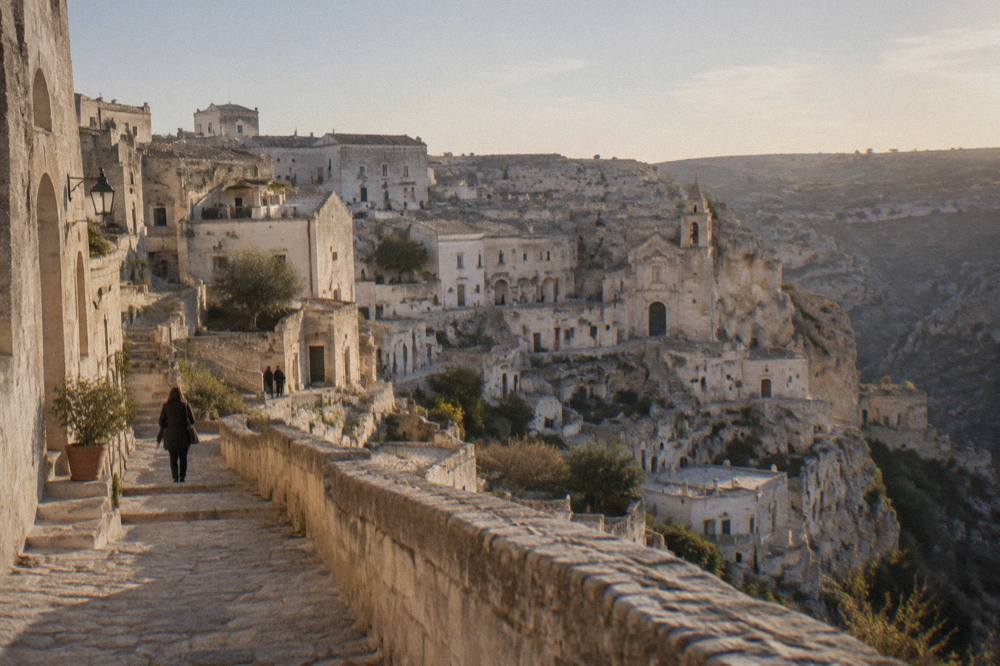
The shame label survives in travel writing and history coverage as a hook for the city's turnaround story, but it no longer describes Matera's present: the Sassi are restored, inhabited and visited, the city is a UNESCO World Heritage site, and its accommodation sector logged 479,083 arrivals in 2025. The phrase is now a historical reference to the postwar decades, not a description of the districts today.
The persistence of the label is easy to explain and worth resisting. "From shame to UNESCO" is a compelling arc, and the contrast sells articles. But the label does real work only if it is anchored to its period. The Sassi of the postwar decades, the ones that earned the nickname, were crowded and unserviced. The Sassi of today are a mix of homes, cave hotels, museums and restaurants, and the question of who lives there now has its own answer on the do people still live in the Sassi page.
Two related distinctions come up constantly. The difference between the modern city on the plateau and the two cave quarters below it is explained on the Matera versus Sassi di Matera page, and the abandonment that followed the evacuation has its own account on the why the Sassi were abandoned page. For the other side of the city's reputation, the film locations and the food, the what is special about Matera page is the place to start, and the question of whether the trip justifies the travel time is answered on the is Matera worth visiting page.
Common Questions About The Shame Of Italy Label
Why is Matera called the shame of Italy?
The label comes from the postwar decades, when families in the Sassi cave quarters lived without running water, sanitation or adequate space and the conditions became a national political scandal. It circulated in reporting and debate of that period and stuck to the city's image long afterwards.
When were people moved out of the Sassi?
Residents were relocated between 1952 and the 1970s into new public housing districts on the plateau. A 1986 national law then opened the way to restore the emptied cave quarters.
Are the Sassi still abandoned?
No. The Sassi were restored after the 1986 law and are now a mix of homes, hotels, museums and restaurants, inside a UNESCO World Heritage site inscribed in 1993. Some cave houses are still lived in, and the question of current residents has its own full answer on this site.
Did UNESCO listing come before or after the restoration?
After. The 1986 law enabled restoration, and UNESCO inscribed "The Sassi and the Park of the Rupestrian Churches of Matera" in 1993, citing criteria (iii), (iv) and (v) and continuity over more than two millennia.
Is the label accurate today?
Not as a description of the present. The APT Basilicata data records 479,083 guest arrivals in the city's registered accommodation in 2025, more than the 388,158 of the 2019 Capital of Culture year, and the restored Sassi are the city's main draw.
Where can I see what the Sassi looked like before the restoration?
The Storica Casa Grotta di Vico Solitario preserves a furnished cave house as a museum, with a ticket that also covers the Neviera, the natural cave and the rock church of Sant'Agostino al Casalnuovo, at 8.00 EUR full on the tariff in force from 4 April 2026. It is the clearest on-site record of how a cave family lived.