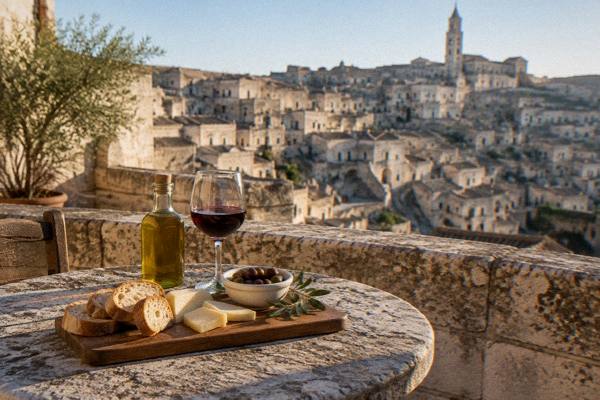
Where Do Locals Eat In Matera?
Where the materani actually eat in Matera, Basilicata: the neighbourhoods, the dishes and the habits that separate a local table from a tourist menu.
Matera, in Basilicata, southern Italy, is an inland city of cave dwellings and stone houses on the edge of the Gravina canyon, and the people who live there, the materani, eat very differently from the way the restaurant terraces along the Sassi viewpoints might suggest. The local table is built on bread, legumes, vegetables, lamb and olive oil, served in small trattorie, at standing bars and at farmhouses scattered across the Murgia plateau. This page reports where locals actually sit down to eat in Matera, what they order, and how a visitor can recognise a genuinely local room without a single printed recommendation, because no restaurant, bakery or bar in this city had its address, hours or prices checked for this article.
Where Do Locals Eat In Matera?
Locals in Matera eat in three kinds of places: small trattorie in the streets around the Sasso Barisano and the Civita, everyday bars and pizzerie in the modern town on the plateau above, and agriturismi, farmhouse restaurants, scattered across the Murgia on the city's doorstep. They largely avoid the terraces with canyon views, where prices climb and menus bend toward visitors, and they eat late: lunch rarely starts before half past twelve, and dinner tables fill from eight in the evening onward.
The geography matters. Matera splits into two levels: the Sassi, the ancient cave quarters sunk into the ravine, and the piano, the flat modern town above them. The Sassi hold the hotels, the panoramic terraces and the cave restaurants that draw visitors, and the Matera Travel Guide coverage of the city's viewpoints explains why those terraces are so photographed. Local eating happens on the edges of that map. The streets just above and beside the Sassi, around Piazza Vittorio Veneto and the lanes running inland, hold the small rooms where families celebrate and workers take lunch. The modern town, stretching away from the canyon, holds the bars, bakeries and pizzerie of daily life.
The third local table is outside the city altogether. The Parco della Murgia Materana, about 8,000 hectares by the park's own count, wraps around the canyon, and its farms raise the sheep, grow the durum wheat and press the olives that end up on Matera tables. On Sundays, materani drive out to these farmhouses for long lunches, and a visitor who wants to eat the way the city eats on its day off follows them there. For readers planning how long to stay, the answer to how many nights you should stay in Matera shapes how many of these three tables you can realistically try.
Curious how the olive oil from those plateau farms reaches the table? Book a food and wine tour here.
What Foods Do The Materani Actually Order?
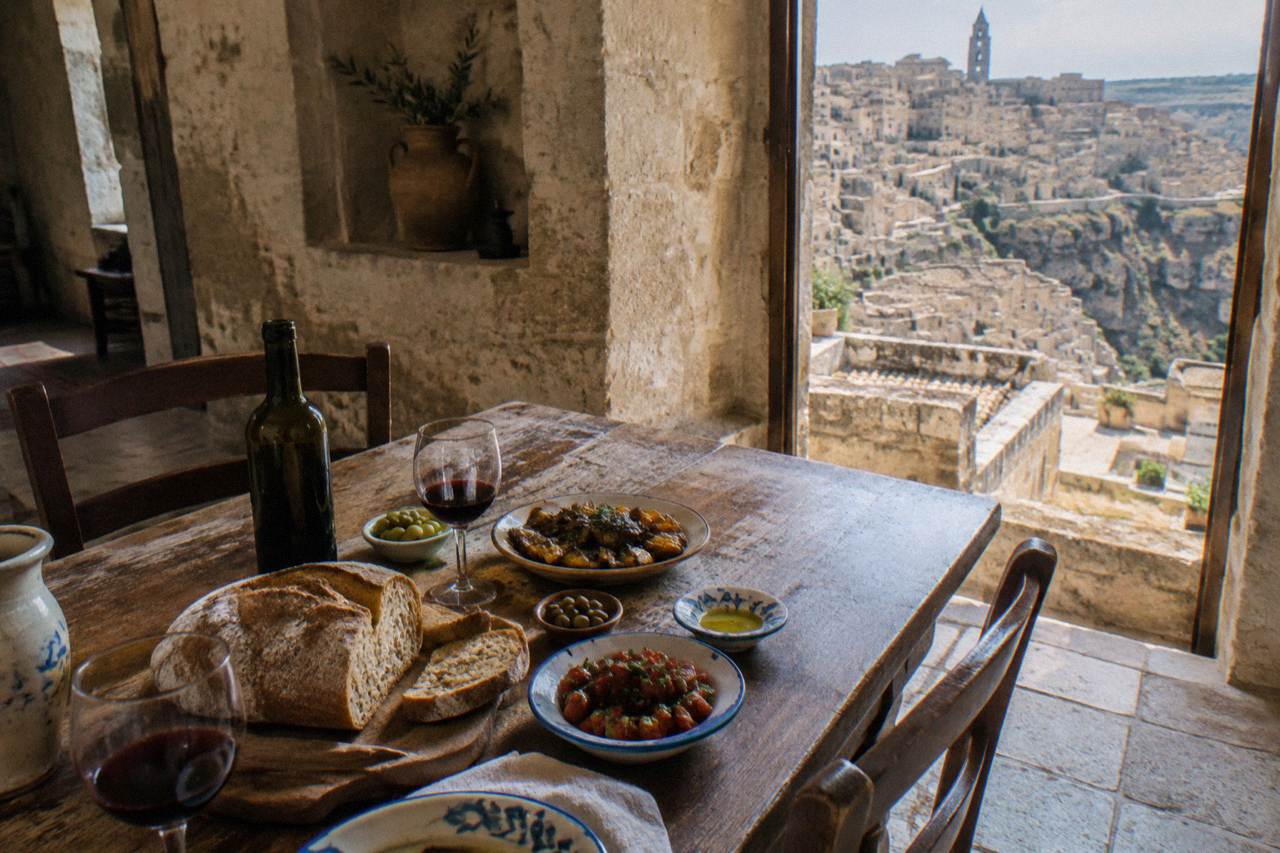
The local plate in Matera is anchored by Pane di Matera, a durum wheat sourdough registered as a PGI product in 2008 under Regulation CE 160/2008, alongside vegetable and legume dishes, lamb from the Murgia, preserved vegetables in oil and the region's cruschi peppers, sweet fried peppers that appear crushed over pasta, bread and cheese. Matera's cooking is a poor-kitchen tradition: few ingredients, long preparation, nothing wasted, and the wine poured alongside comes from Basilicata's own vineyards.
The bread deserves its own sentence. Pane di Matera is the city's registered product, a tall, crusty loaf with a soft, pale crumb, baked from local durum wheat and a natural starter. It appears at every meal, and the story of what is so special about Matera runs through it, because the loaf is a direct descendant of the wheat economy that sustained the cave quarters for centuries. The rest of the local repertoire follows the same logic of the Murgia's dry farming.
| Dish or product | What it is | How locals eat it |
|---|---|---|
| Pane di Matera PGI | Durum wheat sourdough loaf, registered 2008 | At every meal, with olive oil, or as the base for bread salads and soups |
| Peperoni cruschi | Sweet red peppers, dried and fried crisp | Crushed over pasta with breadcrumbs and cheese, or eaten as a snack |
| Legume and vegetable soups | Slow-cooked dishes with beans, greens, onions | Winter lunch food, often finished with raw olive oil |
| Lamb and mutton | Murgia pasture meat, roasted or braised | Sunday and feast-day mains, especially at agriturismi |
| Cured pork and salumi | Pig butchery from the inland tradition | Antipasti boards, with bread and peppers |
| Local wines | Reds and whites from Basilicata's vineyards | By the carafe in trattorie, by the bottle on Sundays |
Two habits distinguish a local order from a visitor's. The first is the absence of a hurry: a materano table at dinner runs through several small courses over a couple of hours, and the restaurant expects the table to stay. The second is the primacy of whatever the season offers. Menus in genuinely local rooms change with what the Murgia produces, and a dish of dried peppers and beans in November tells you more about the kitchen than a laminated multilingual menu ever could. No single eating house in the city is named on this page, because none had its address, hours or prices verified: the advice is to walk a street back from the viewpoints, read the Italian-only menu, and confirm opening details in person or at your hotel.
Do Locals Eat In The Sassi Or Outside Them?
Locals eat around the Sassi rather than inside the postcard part of them: the genuinely local rooms sit in the upper lanes of the Sasso Barisano, along the streets leading inland from Piazza Vittorio Veneto, and in the modern town above, while the panoramic cave restaurants inside the Sassi are largely a visitor economy. On weekends the real local table moves out of the city entirely, to agriturismi on the Murgia, where families drive for lamb, bread and long lunches.
The distinction is economic as much as geographic. The Sassi were emptied of residents between 1952 and the 1970s, and a 1986 law opened the way to the restoration that turned the quarters into the hotel and restaurant landscape of today. The question of whether people still live in the Sassi has a layered answer, but the dining consequence is simple: the cave restaurants are a hospitality economy built in the last four decades, and the everyday materano kitchen sits where the everyday city sits, on and around the plateau. A visitor who wants the local experience should treat the Sassi as a place for one memorable dinner and the upper town as the place for the other three.
The Murgia weekend is the third act. Farmhouse restaurants on the plateau serve the pasture lamb, the bread and the wine of the immediate countryside, and they fill on Sundays with extended families rather than tour groups. Some visitors reach this table through organised food experiences rather than by driving, and the region's producers also appear on guided tastings: one option that pairs the countryside with its food is an e-bike ride through trulli country with focaccia and wine, Check availability if that format appeals. The tour runs from Alberobello, in Puglia, about an hour and twenty minutes from Matera by road, and it is a day trip rather than a city meal, which is exactly the point: the local table of this region extends across the provincial border.
How Do You Spot A Local Restaurant In Matera?
A local restaurant in Matera shows five reliable signs: a short, seasonal, Italian-only menu; bread brought without being ordered; a room of tables talking rather than photographing; a location one street back from any viewpoint; and hours built around Italian mealtimes, with the kitchen closing between lunch and dinner. None of these guarantees anything on its own, but a room that fails four of the five is serving the visitor economy, not the city.
The menu is the fastest test. A local kitchen prints a handful of dishes and runs out of one or two of them by nine in the evening, because the shopping was done that morning for that service. A room offering every regional dish simultaneously, in several languages, with photographs of each plate, is assembling a catalogue rather than cooking a market. The bread test follows immediately: in a local room, bread arrives unasked, and it is the city's own PGI loaf or a close cousin, not a basket of packaged grissini.
| Sign | Local room | Visitor-oriented room |
|---|---|---|
| Menu | Short, seasonal, Italian only | Long, illustrated, multilingual |
| Bread | Arrives unasked, from the city's tradition | Requested, or a standard basket |
| Clientele | Tables in conversation, few cameras | Cameras and phones at most tables |
| Location | One street back from viewpoints | Directly on a viewpoint or square |
| Hours | Lunch, a close, then dinner from about 20:00 | Continuous service for arriving groups |
Hours are the sign visitors trip over most. The Italian day runs later than the northern European one, and a kitchen that serves a full dinner at six in the evening is cooking for arrivals, not for residents. Plan around it: a late-afternoon walk through the Sassi, an aperitivo at a bar, and dinner from half past eight. The question of where to eat in Matera with a view is answered elsewhere on this site, and the honest framing is that the view and the local kitchen are usually two different rooms, and both are worth an evening of a two-night stay.
What About Coffee, Aperitivo And Sweets In Matera?
Locals take coffee standing at the bar, pay first or immediately after, and drink it in minutes; the aperitivo hour, from about six in the evening, is the city's real social ritual, with a glass of local wine or a spritz and small snacks before dinner; and sweets are a morning and feast-day affair, with pastries taken at the counter rather than at a table.
Table service for a coffee exists, but the materani treat it as a concession to visitors, and the price difference between the bar and the table is real.
The morning begins at the bar. A cappuccino and a cornetto, or the local equivalent pastry, eaten at the counter in the time it takes to read a headline, is the standard breakfast of the city, and the bar is where the day's first conversations happen. The rule visitors break is ordering a milky coffee after about eleven: the materani consider cappuccino a morning drink, and an espresso, ordered simply as a caffè, is the after-meal standard. No bar in the city is named here, because none had its prices or hours checked: the pattern is the advice, not an address.
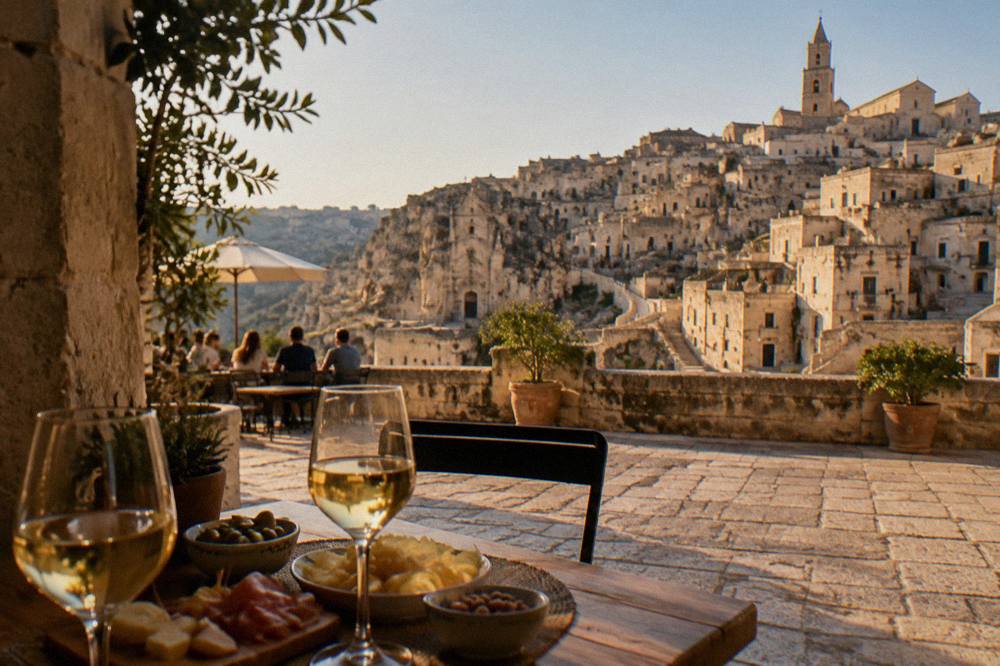
The aperitivo is the evening's overture. From early evening, the squares and the bars above the Sassi fill with people drinking local wine or a spritz over olives, taralli and chips, and this hour, not dinner, is when the city socialises most openly. It is also the cheapest way to eat the region's products, since the snacks come with the drink. The evening then moves on to dinner at the trattoria, or, for younger materani, to a pizzeria in the modern town. For readers weighing the whole trip, the question is Matera worth visiting usually resolves at exactly this hour, on exactly this kind of evening.
When Is The Best Season To Eat Like A Local In Matera?
The best eating seasons in Matera are spring and autumn: the ERA5 reanalysis for Matera, 1991 to 2020, gives mean highs of 22.7 C in May and 20.8 C in October against 31.3 C in August, and the APT Basilicata data shows September, not August, was the city's busiest month for guest arrivals in 2025 at 61,630, so the local rooms are at their fullest and most seasonal in the shoulder months, while deep winter brings the hearty legume cooking of the Murgia tradition.
The climate shapes the plate. Winter in Matera is cold and damp, with a January mean of 5.9 C and frost common, and the winter kitchen answers with soups, braised lamb and bread-heavy dishes. Summer is hot and dry, with July rainfall of just 21.2 mm, and the summer table moves toward vegetables, grilled meat and lighter plates. November is the wettest month of the year at 67.1 mm, which is soup weather, and the autumn also brings the olive harvest and the new oil that locals drizzle over everything.
The calendar adds its own feasts. The Matera Film Festival runs from 7 to 15 November 2026, and the city's rooms fill with an Italian crowd eating at local hours. In December the Presepe Vivente nei Sassi, the living nativity, opens on 4 December 2026 with public days across four December weekends and the first January weekend, and the sixteenth edition charges 12.00 EUR full price and 9.00 EUR for ages 10 to 18, with under 10s free, on the organisers' own ticket page. Matera's year as Mediterranean Capital of Culture and Dialogue runs to 28 November 2026, so the shoulder season this year carries an unusual density of evening events, which in Matera means an unusual density of aperitivo hours.
Common Questions About Eating Like A Local In Matera
Where do locals eat in Matera?
Locals eat in small trattorie around the Sasso Barisano and the streets above Piazza Vittorio Veneto, at everyday bars and pizzerie in the modern town, and at farmhouse restaurants on the Murgia plateau at weekends, rather than at the panoramic terraces inside the Sassi.
What is the most local dish in Matera?
Pane di Matera, the city's registered PGI durum wheat sourdough, is the foundation of every local meal, followed by dishes built on cruschi peppers, legumes and Murgia lamb. No restaurant is recommended by name on this site, since none had its details verified.
Do locals eat dinner late in Matera?
Yes. Dinner tables fill from about eight in the evening, lunch runs from half past twelve, and a kitchen serving a full dinner at six is cooking for visitors rather than residents.
Is it expensive to eat where locals eat in Matera?
This site prints no meal prices, because no restaurant's prices were verified. As a general rule, rooms one street back from the viewpoints, standing coffee at the bar and agriturismo lunches are the local-priced options; canyon terraces are the premium ones. Confirm prices locally.
Can visitors eat at the agriturismi on the Murgia?
Yes, farmhouse restaurants on the plateau welcome callers, but hours and booking terms vary and are not published in any verified form on this site: confirm directly before driving out, especially for Sunday lunch.
What should I order for aperitivo in Matera?
A glass of Basilicata wine or a spritz with the snacks the bar brings, taken in the early evening. The aperitivo hour is the city's most social meal, and it needs no reservation.
The honest summary is that eating like a materano is less about finding a hidden address and more about adopting a rhythm: coffee standing in the morning, a short seasonal lunch, an aperitivo at six and an unhurried dinner from eight, with the Murgia's bread and lamb in front of you. Follow the hours and the Italian-only menus, step one street back from the view, and the city's own table will find you.