Where To Eat In Matera With A View?
Where to eat in Matera with a view: the terraces, squares and canyon-edge tables in the Sassi, what to order, and when to book, reported from verified sources.
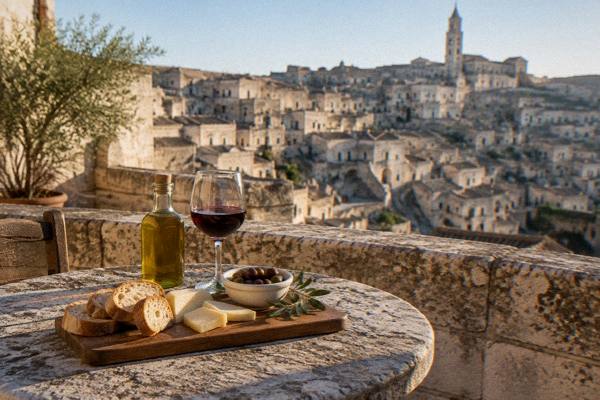
Matera, in the region of Basilicata in southern Italy, is an inland city of about 400 m above sea level, built on the edge of the Gravina canyon with the Murgia plateau rising opposite. There is no sea here, and that is the point: the view that comes with dinner in this city is a canyon view, a cave-town view, a view of pale tufa stone stacked over two millennia of settlement. The old quarters, the Sassi, hold Sasso Caveoso and Sasso Barisano, and the terraces cut into their edges look straight down into the gorge. This page, from the Matera Travel Guide editorial desk, sets out where the views actually are, what the tables around them serve, and how the seasons change both the light and the crowd.
Where To Eat In Matera With A View?
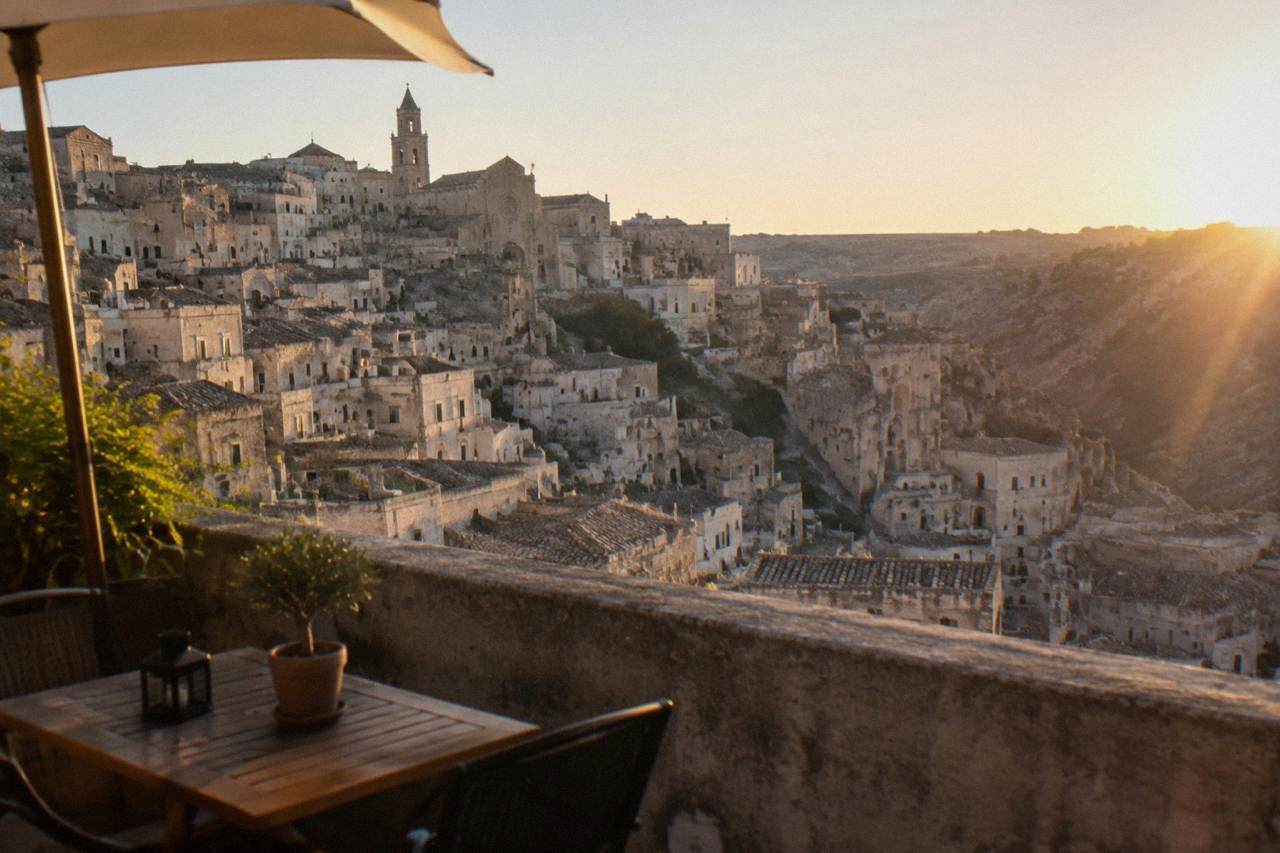
The tables with a view in Matera sit in three bands: the canyon-edge terraces of Sasso Barisano and Sasso Caveoso looking across the Gravina, the open-air tables on the edge of Piazza Vittorio Veneto above the Sassi, and the restaurants reached across the canyon from Belvedere Murgia Timone, which look back at the whole cave city. All of them are within walking distance of the centre, and none needs a car, because the city's restricted traffic zones keep the historic streets closed to most vehicles.
The first thing to understand is the geometry. The city stands on one rim of the Gravina canyon; the Murgia plateau stands on the other. A table on the Matera side looks down and across at rock-hewn churches on the far cliff. A table on the plateau side, reached through the Parco della Murgia, looks back at the stacked face of the Sassi, which is the panorama that appears in the postcards and in the James Bond and Passion of the Christ location shots the regional film commission lists for Matera.
No restaurant on this site gets a named recommendation, because no address, opening hour or price for any Matera eatery has been verified by this desk. What is verified is the geography, and the geography decides the view. Choose the quarter first, walk its edge streets at the hour you plan to eat, and pick the table that faces the direction you want.
| Viewpoint area | What the table looks at | Character of the setting |
|---|---|---|
| Sasso Barisano canyon edge | The Gravina gorge and the Murgia cliffs opposite | Restored cave rooms and terraces cut into the north-western Sasso |
| Sasso Caveoso, around Piazza San Pietro Caveoso | The lower Sassi, the rupestrian churches and the plateau | Rougher, older face of the cave town, stone stairways |
| Piazza Vittorio Veneto edge | The Sassi from the modern-city rim, at pedestrian level | Open square, closed to vehicles all day per the city's traffic PDF |
| Belvedere Murgia Timone side | The whole Sassi skyline from across the canyon | Plateau parkland, reached on foot through Parco della Murgia |
The square deserves its own note. The city's own traffic rules mark Piazza Vittorio Veneto and Via Ridola as pedestrian areas, closed to vehicles 24 hours a day, with bollards opening only 04:00 to 08:00 on weekdays for deliveries. That means the tables spilling from the bars and eateries around the square sit in car-free air, on the lip above the Sassi, without exhaust or traffic noise. The square's edge is one of the few places in the city where a view, a flat surface and a wide choice of tables come together, which matters for anyone who finds the stepped lanes of the Sassi hard going.
Which Sassi Terraces Overlook The Gravina Canyon?
The canyon-facing terraces in Matera are concentrated on the streets that run along the outer edge of Sasso Barisano and the upper lane of Sasso Caveoso, where cave houses were cut into the cliff and their roof terraces now serve as outdoor tables in the warmer months. The streets are stepped, uneven and steep in places, so the walk to the table is part of the price of the view, and no named route through the Sassi can be described as step-free.
Sasso Barisano is the restored north-western quarter, the one where the 1986 restoration law did its work most visibly. Its edge streets look north-west over the gorge, and the evening light falls across them late in the day. Sasso Caveoso, further south, is the quarter that kept more of its raw cave face: the pack lists Piazza San Pietro Caveoso as the open terrace at its heart, with the rupestrian churches of Santa Lucia alle Malve and Madonna de Idris in the cliff behind it. The view from a Caveoso table is deeper into the canyon and rougher around the edges.
A table on either edge faces the Parco della Murgia, the regional park the park's own site counts at about 8,000 hectares, protecting a landscape of rock-cut churches, many of them cut directly into the canyon walls. UNESCO inscribed the Sassi and the park together in 1993, on criteria covering the rock-cut settlement and its adaptation to this geomorphological setting, and the dinner view is precisely that inscription made visible: dwellings and churches cut into the same tufa, on both rims of the same gorge.
Want to taste the flavours of that protected landscape beyond the terrace? Book a food and wine tour here.
For readers who want the canyon explained rather than just looked at, a guided walk is the practical way to learn what is in front of the table. The site's featured tours below cover the Sassi on foot with a guide.
A guided walk and a table with a view are complementary, not competing. The walk happens in daylight, when the detail of the rock churches reads clearly; the table happens at dusk, when the Sassi's lights come up below and the canyon goes dark first. If the plan is a full day, the Alberobello and Matera day tour pairs the two UNESCO cave-and-trulli towns with a tour leader on board, and its live listing shows what the day covers, with Check availability for current dates and pricing.
What Should You Order With A View In Matera?
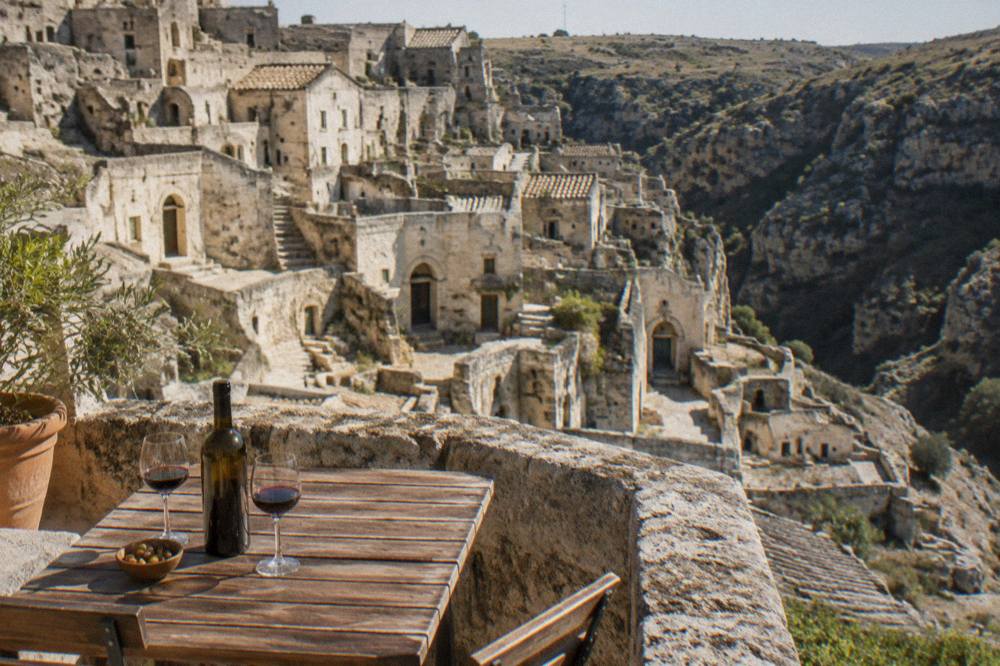
The Matera table is bread-first: Pane di Matera is a registered PGI, listed under EU regulation 160/2008, and the city's traditional cooking leans on that bread, on legume and vegetable dishes, on lamb from the Murgia, on the sweet-crunchy peperoni cruschi peppers of Basilicata, and on the local wines of the region, all of which appear on menus in general regional form rather than as a single signature dish.
The one food fact this desk can source is the bread. Pane di Matera's protected geographical indication was registered in 2008, and the loaf's shape and durum-wheat crumb come from the same wheat country that surrounds the city. Around that bread, the regional style is poor-cooking turned good: soups of legumes, wild greens, the cruschi pepper fried crisp and salted, and lamb, which has always been the Murgia's meat. Menus in the Sassi generally dress this base for visitors, but the base itself is local and old.
What to drink is regional too. Basilicata's winemaking sits inland of the better-known Puglian coast, and Matera's own wine tradition, covered in detail on the site's Matera wine guide, runs to reds suited to the lamb and to whites that suit the heat of a terrace at 31 C, which is the ERA5 reanalysis, 1991-2020, mean high for both July and August. Confirm what is on the list at the table; no producer or vintage has been verified by this desk.
| Course or item | What it is, in general terms | Why it suits a view table |
|---|---|---|
| Pane di Matera (PGI) | Durum-wheat sourdough loaf, registered 2008 under Reg. CE 160/2008 | The city's signature, served everywhere |
| Peperoni cruschi | Sweet peppers dried and fried crisp, a Basilicata staple | Light, salted, made for a long sunset |
| Legume and vegetable soups | Traditional Murgia poor-cooking with bread and greens | The old cave-town diet, still on menus |
| Murgia lamb | Hill-pasture lamb, the plateau's historic meat | The heartier end of the regional table |
| Regional wines | Reds and whites of inland Basilicata | Local pour, ask the server what is open |
One planning note belongs here. No meal price, cover charge or tasting fee for any Matera restaurant has been verified, so this page prints none. Treat menu prices as something to read in the room, not online. For readers who want the food explained rather than just served, the site keeps a dedicated Matera food tour guide and an answer page on where locals eat in Matera, which is a different question from where to eat with a view: the local tables are often deeper in the lanes, where the walls matter more than the panorama.
When Is The Best Month For A View Dinner In Matera?
September is the month the data points to: the APT Basilicata accommodation counts log 61,630 arrivals in September 2025, the year's peak, ahead of August at 60,257, while the ERA5 reanalysis, 1991-2020, shows the mean high easing from 31.3 C in August to 25.7 C in September, with evening temperatures that suit an outdoor table. May and June are the quieter warm alternatives, and October keeps usable terrace weather at a 20.8 C mean high with about half the September arrivals.
The pairing is the insight a first page of search results will not hand over. August is not the peak in Matera, September is, and the difference matters at the table: September's crowds are also the city's most international, with 74.5% of that month's 2025 arrivals from abroad, per the APT data. August, by contrast, is the one warm month when Italians dominate the guest count, at 53.2%. A terrace in August is an Italian-holiday terrace; a terrace in September is a European one, and both are full.
| Month | Mean high, ERA5 1991-2020 | Rain, mm | Arrivals 2025, APT Basilicata | Terrace verdict |
|---|---|---|---|---|
| May | 22.7 | 41.7 | 54,101 | Warm, busy, green canyon |
| June | 28.2 | 35.1 | 50,186 | Hot evenings, long light |
| July | 31.2 | 21.2 | 43,966 | Peak heat, thinner crowds |
| August | 31.3 | 21.7 | 60,257 | Peak Italian holiday |
| September | 25.7 | 44.8 | 61,630 | Year's peak, cooler air |
| October | 20.8 | 51.7 | 52,538 | Mild, half-empty tables |
November is the month to avoid for a terrace: the ERA5 reanalysis puts it as the year's wettest at 67.1 mm, and the arrival count drops to 23,555. Winter terrace dining in Matera is mostly indoors by design, in the cave rooms themselves, which is its own experience and one the site covers in Matera in winter. Whatever the month, book the view tables ahead for dinner: the canyon-edge rooms are finite, and the APT data shows the city logged 479,083 arrivals in 2025, so the best-facing terraces do not walk-in on a September evening.
How Do You Reach The View Tables Without A Car?
Every view area in Matera is walkable from the centre, and driving to dinner is the wrong plan anyway: the ZTL Sassi cameras run 10:00 to 20:30 from 16 September to 30 June and 10:00 to 24:00 from 1 July to 15 September, the ZTL Centro is active 24 hours a day, and Piazza Vittorio Veneto is pedestrian all day, so a car cannot reach the tables and the fines are automated.
The camera hours come from the comune's own ordinance PDF, and they cover weekdays and holidays alike. The practical reading is simple: from mid-morning until late, the historic centre and the Sassi belong to people on foot. A visitor arriving by car parks outside the restricted zones, which the site covers in Matera parking and the Matera ZTL guide, and walks in. The walk from the modern city down into the Sassi is short but steep and stepped, so allow time and wear proper shoes; the site's packing answer covers what footwear the lanes demand.
The plateau side is different. Belvedere Murgia Timone sits across the canyon, reached through the Parco della Murgia, and the park has controlled the access from the Jazzo Gattini side since February 2026. There is no verified urban bus route to the belvedere, so the plateau dinner plan is really a sunset plan on foot, or a guided transfer. The site lists a Murgia Timone sunset tour with transfer, which solves the return-in-the-dark problem that the canyon's unlit paths create.
For the full evening, the sequence the geography suggests is: daylight in the Sassi with a guide, dusk from the canyon edge, dinner on a terrace in Sasso Barisano or at the Piazza Vittorio Veneto rim, and the lit-Sassi panorama afterwards from the upper city. The tours below cover the guided half of that sequence, with a private option for groups.
Common Questions About Eating With A View In Matera
Where to eat in Matera with a view?
The canyon-edge terraces of Sasso Barisano and Sasso Caveoso, the pedestrian rim of Piazza Vittorio Veneto, and the plateau side at Belvedere Murgia Timone hold the city's view tables. All are walkable from the centre, and no specific restaurant is recommended on this site because no eatery's details have been verified.
Does Matera have sea-view restaurants?
No. Matera is an inland city in Basilicata at about 400 m above sea level, on the edge of the Gravina canyon. The view at dinner is a canyon and cave-town view. The nearest coasts are day trips: Metaponto on the Ionian, Polignano a Mare and Bari on the Adriatic.
Can you drive to a restaurant in the Sassi?
Not through the restricted zones. The ZTL Sassi cameras run 10:00 to 20:30 from 16 September to 30 June and 10:00 to 24:00 from 1 July to 15 September, and the ZTL Centro is active 24 hours a day. Park outside the zones and walk in; the lanes are stepped and steep.
Is September too busy for a terrace dinner in Matera?
September is the year's peak, with 61,630 accommodation arrivals in 2025 per the APT Basilicata data, ahead of August at 60,257. The ERA5 1991-2020 mean high of 25.7 C makes it the best terrace month, so book the view tables ahead rather than walking in.
What is the local dish to order at a view table?
Start with Pane di Matera, the city's PGI-registered bread (Reg. CE 160/2008), and expect the regional style around it: legume soups, wild greens, crisp-fried peperoni cruschi peppers, Murgia lamb and local Basilicata wines. Menus vary; confirm dishes and prices at the table.
Do you need a guide to reach the view areas?
No, all the view areas are reachable on foot from the centre. A guided walk adds the history of what the terrace looks at, and the plateau side at Belvedere Murgia Timone is easier with a guided transfer after dark, since the canyon paths are unlit and the park manages access from the Jazzo Gattini side.