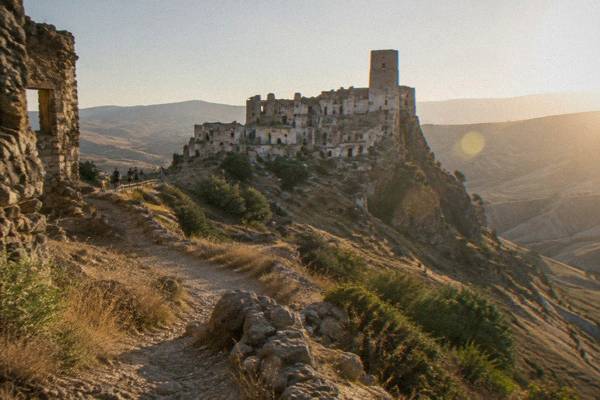
Why Is Craco, Italy Abandoned?
Why the hill town of Craco, about an hour from Matera in Basilicata, stands empty: landslides, evacuation and emigration, plus how to visit it on a day trip from Matera.
Matera, the cave city of the Sassi in Basilicata, southern Italy, makes an obvious base for exploring the region's stranger corners, and none is stranger than Craco. The hill town sits about 57 km from Matera by road, roughly 58 minutes of free-flow driving from Matera Centrale, and it is genuinely, visibly empty: no shops, no permanent residents in the old core, just rooflines, alleyways and a tall bell tower over a slowly shifting hillside. The question of why a whole town was left to the weather has a concrete answer, and it is a geological one before it is a human one.
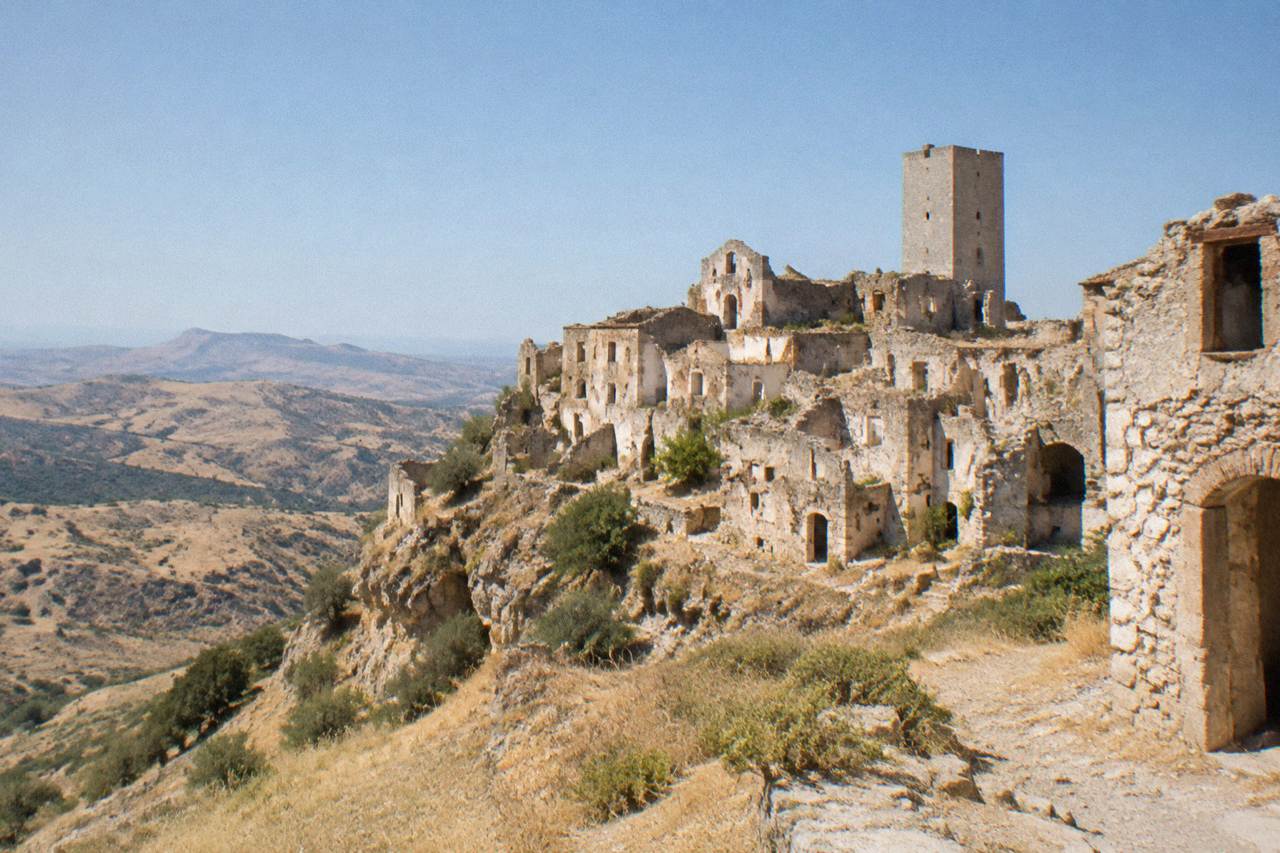
Why Is Craco, Italy Abandoned?
Craco, in Basilicata about 57 km from Matera, is abandoned because the hill it was built on became unstable. The town stands on clay and tufa ground that landslides kept undermining, and after repeated slides damaged houses and streets, the authorities ordered the population out in stages over the years that followed. A flood and then a major earthquake in southern Italy finished the evacuation, and the residents were resettled in new housing away from the old centre, which has stood empty ever since.
The sequence matters, because people sometimes assume Craco was emptied by a single catastrophe. It was not. The hill of Craco is formed of soft sediments, clays and weak sands under a harder cap of calcarenite, and that combination is prone to slow, deep ground movement when water works through it. Historical accounts of the town describe landslides and subsidence troubling the hillside over the decades that followed, damaging the upper quarters and the streets that connected them.
The institutional response was evacuation rather than defence. The comune began moving families out of the most exposed parts of the old town, and the displacement stretched over years, with residents relocated to a new settlement built on more stable ground downhill and, for others, to housing along the Ionian coast. A destructive flood in the area and then a major earthquake that struck southern Italy delivered the final verdict on the old centre's habitability. After the last organized removals, the hill town simply had nobody left in it.
What remains is a rare thing in Europe: a complete southern Italian hill town, church towers and palazzi and stepped lanes, with no everyday life inside it. The buildings were never demolished. They were left.
What Happened To The People Of Craco's Old Town?
The people of Craco's old town were resettled, not lost. Families were moved in organized stages to a new town on safer ground near the old one, and others left for the coast or emigrated abroad, joining the wider migration from rural Basilicata in the decades that followed. The comune itself continues to exist, with its administrative life and its population living outside the abandoned historic centre, which is why Craco is described as a ghost town rather than a dead one.
The distinction between an abandoned centre and a vanished community is the part casual summaries get wrong. Craco did not lose its municipality or its identity. The settlement that received the evacuees carries the town's name forward, and the community's festivals and religious processions still connect the living town to the empty one on the hill. The old centre functions today as a heritage site, opened to visitors on managed itineraries rather than left open for wandering. Other pages covering the same trip are gathered on Matera Travel Guide.
The wider context is the depopulation of inland Basilicata generally. Matera itself went through a version of this story, and it is worth reading alongside this one: the Sassi districts were emptied of their residents by state decree because the cave dwellings were judged uninhabitable, and families were moved to new housing schemes on the plateau. The difference is the ending. Matera's Sassi were later restored and repopulated, a reversal described in why was Matera abandoned, while Craco's hill was never judged safe to reinhabit.
That contrast is the real draw for travellers based in Matera. One abandoned place came back, and one did not, and standing between the two, on the same day, is one of the more thought-provoking loops you can build in this region.
Can You Visit Craco On A Day Trip From Matera?
Yes, Craco can be visited on a day trip from Matera, and a guided day trip is the practical way to do it, because the old town is a managed site where access runs through organized visits rather than free wandering. The drive is about 57 km and roughly 58 minutes each way from Matera Centrale without traffic, so the round trip plus a visit fills most of a day.
Guided options from Matera pair the ghost town with an Amaro Lucano tasting, tying the visit to the region's best-known liqueur.
The site's fragility is the reason for the managed access. Landslide ground does not become safe because decades pass, so visits run on set routes, and the operators who run them control when and where groups enter. That is also the argument for booking a structured day trip rather than driving out speculatively: the listing for the Craco ghost town day trip from Matera covers guided access to the abandoned town together with the Amaro Lucano element, and the operator's live listing carries the current price, dates and availability. Check availability
Independent travel to the area is possible by car, and the Craco day trip guide covers the practical framing, but the visit itself still depends on what access arrangements are in force when you go, which is why confirming locally or at booking is the honest advice here. Opening arrangements for the site should be confirmed locally or at booking before any are printed.
For readers building a wider plan, the ghost town pairs naturally with the classic Matera experiences. A full planning grid lives on the things to do in Matera page, and the choices below are the ones that combine well with a Craco loop.
How Far Is Craco From Matera, And What Does The Drive Involve?
Craco is 57 road kilometres from Matera Centrale, about 58 minutes of free-flow driving each way, computed over OpenStreetMap with a car profile and no traffic, stops or parking. The route leaves Matera heading west and south across the inland Basilicata hills, and it is a country drive rather than a motorway run, so real-world times run longer than the free-flow figure. Visitors should budget a half day to a full day for the round trip plus a guided visit, and check road conditions before setting out.
The free-flow figure is a floor, not a promise. These are regional roads through hill country, and the same caveat applies to every day trip measured from Matera Centrale in the table below. The figures were computed with a routing engine and describe distance and uninterrupted driving time only.
| Day trip from Matera Centrale | Road distance | Free-flow drive |
|---|---|---|
| Craco | 57 km | about 58 min |
| Montescaglioso | 19 km | about 26 min |
| Altamura | 20 km | about 20 min |
| Metaponto (Ionian coast) | 47 km | about 52 min |
| Castelmezzano | 82 km | about 1 h 23 |
| Aliano | 89 km | about 1 h 34 |
Two patterns are worth noticing in those numbers. Craco sits in a cluster of inland destinations, Montescaglioso, Altamura and Aliano, that all sit inside an hour's drive, which makes it easy to fold the ghost town into a wider inland loop. And the coast, Metaponto on the Ionian, is barely further, so a day trip that starts with the abandonment story of Craco can end at the sea, a reminder that Matera itself is an inland city at about 400 m of elevation and the water is always a deliberate excursion away.
For anyone weighing whether the detour earns its place at all, the honest comparison is with is Matera Italy worth visiting: the cave city is the region's anchor sight, and Craco is a powerful supporting act rather than a rival to it.
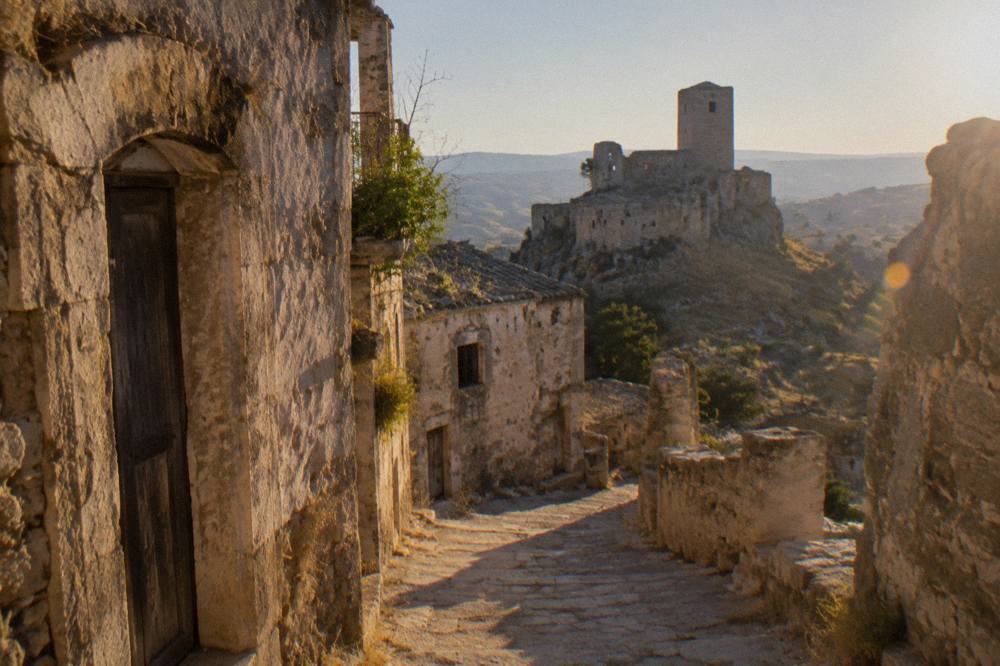
What Do You Actually See In Craco, And How Does It Compare With Matera?
In Craco you see a whole abandoned hill town: empty palazzi, stepped lanes, churches and a bell tower standing over a bare, landslide-scarred slope, with the silence of a place built for thousands and holding none. Compared with Matera, the experience is inverted: Matera's Sassi were emptied and then restored and repopulated, so they are full of hotels, restaurants and life, while Craco's old centre was never reinhabited, and its emptiness is the sight. One is a resurrection, the other a preserved ending.
That inversion is why the pairing travels well. In Matera you walk through a cave district that went from national disgrace to UNESCO listing, a story told in why is Matera called the shame of Italy, and in Craco you see what happens when the rescue never comes. The two towns bookend the modern history of rural Basilicata: evacuation, emigration, and in only one case, return.
Practically, the visits feel different too. Matera is lived-in and steep, its Sassi a working neighbourhood of stairs and cave facades, as described in what is the difference between Matera and Sassi di Matera. Craco is a controlled site, visited on an organized route with a guide, in quiet. Bring sensible shoes for both: neither town is step-free terrain, and no route in either should be described as wheelchair accessible.
| Matera (Sassi) | Craco (old town) | |
|---|---|---|
| Status | Restored, repopulated, UNESCO site since 1993 | Abandoned, managed heritage site |
| Population context | 59,368 residents in the comune at 1 January 2026 | Residents live outside the old centre |
| Drive from Matera Centrale | 0 km | 57 km, about 58 min |
| Typical visit | Walking tour of the Sassi and cave houses | Guided access on a set route |
| Atmosphere | Working city, hotels and restaurants | Silent, empty streets |
If the ghost-town angle is what draws you to Basilicata, it is also worth reading what is so special about Matera Italy, because the Sassi were themselves a near-ghost-town within living memory, and the region's story of abandonment and return is the thread that ties its sights together.
Common Questions About Craco
Why is Craco, Italy abandoned?
Because the hill beneath it became geologically unstable. Landslides repeatedly damaged the old town's houses and streets, and after a flood and a major earthquake in southern Italy compounded the danger, the population was evacuated in stages and resettled on safer ground. The old centre has stood empty since.
Can you walk around Craco freely?
No. The old town is a managed heritage site on unstable ground, and access runs through organized, guided visits on set routes rather than free wandering. Confirm current access arrangements locally or through whatever guided visit you book before traveling.
How far is Craco from Matera?
Craco is 57 road kilometres from Matera Centrale, about 58 minutes of free-flow driving each way, computed over OpenStreetMap with a car profile. Real journey times run longer once traffic, stops and parking are included, so budget a half day to a full day for the round trip plus a visit.
Do people still live in Craco?
Not in the abandoned old centre. The community was resettled in new housing on stable ground, and the comune continues to exist with its life outside the historic hill town, which is why Craco is called a ghost town rather than an extinct one.
Is a Craco day trip worth it from Matera?
For most itineraries of three days or more, yes. The ghost town is one of inland Basilicata's most distinctive sights and pairs naturally with Matera's own abandonment-and-restoration story. A guided day trip from Matera that includes the ghost town and an Amaro Lucano tasting is the simplest way to arrange access, and the operator's live listing carries current prices and dates.
What should I wear for a visit to Craco?
Sturdy shoes with grip. The old town is a hill site of stepped lanes and worn stone on ground that is managed precisely because it moves, and the same advice applies to Matera's steep Sassi streets. No route at either site should be treated as step-free or wheelchair accessible.