What Is The Difference Between Matera And Sassi Di Matera?
Matera is the whole city in Basilicata, southern Italy; the Sassi di Matera are its two historic cave districts, Sasso Caveoso and Sasso Barisano. This page separates the two clearly.
Matera is an inland city of about 59,368 residents (ISTAT, 1 January 2026) in the region of Basilicata, southern Italy, sitting at about 400 m above sea level on the edge of the Gravina canyon. The Sassi di Matera are not a separate town and not a rival destination: they are the two historic cave districts, Sasso Caveoso and Sasso Barisano, cut into the tufa limestone below the modern city centre. One name covers the whole municipality, churches, suburbs, station and all. The other covers the two canyon-side quarters that UNESCO inscribed in 1993. The confusion is understandable, because for many travellers the Sassi are the only part of Matera they ever see, and the two names have started to work as synonyms in guidebooks and booking sites. They are not synonyms, and the difference matters when you are choosing where to sleep, what to book, and how much of the city to give yourself. This page separates the two, drawing on UNESCO, the comune, and the APT Basilicata accommodation data.
What Is The Difference Between Matera And Sassi Di Matera?
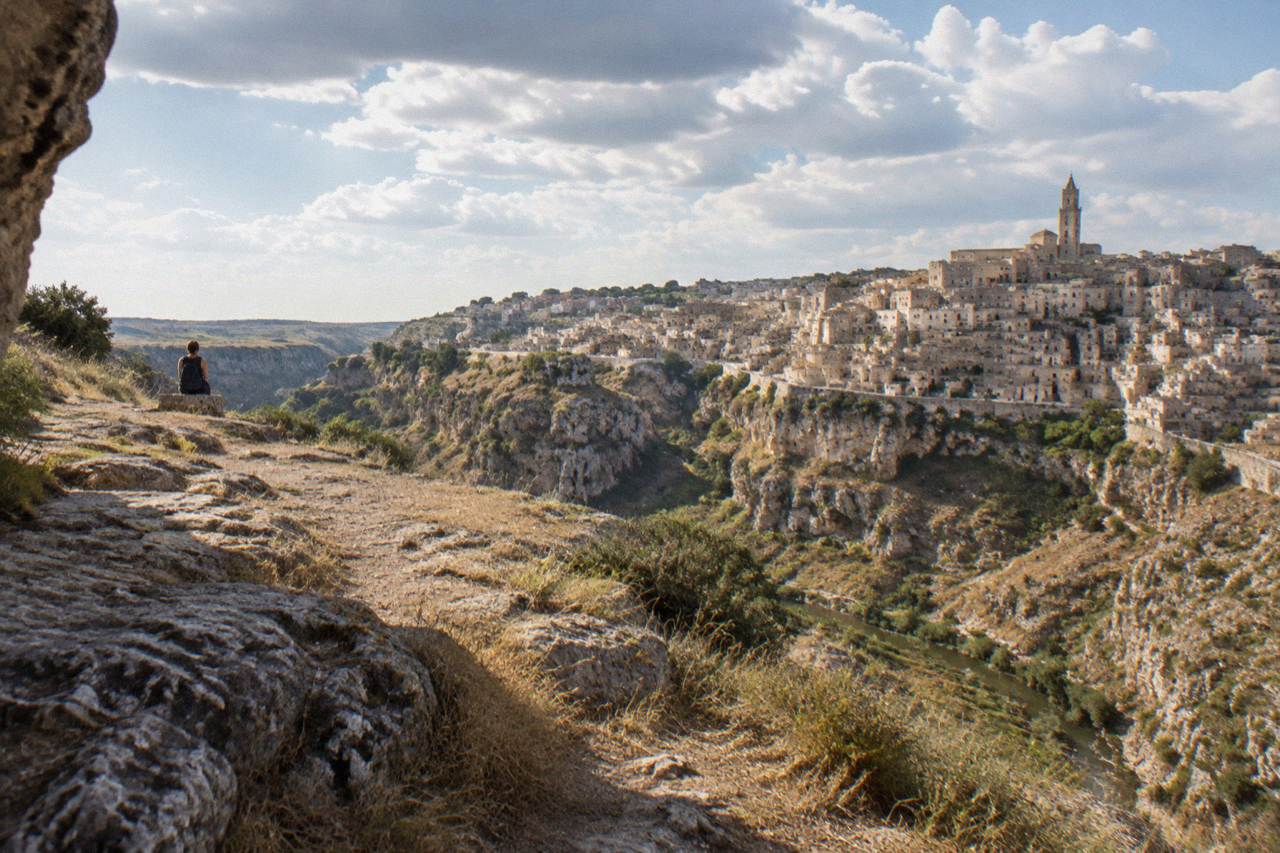
Matera is the entire city in Basilicata, southern Italy, a municipality of 59,368 residents spread over a modern centre, suburbs and outlying frazioni, while the Sassi di Matera are two specific historic districts inside it: Sasso Caveoso and Sasso Barisano, the cave quarters carved into the canyon wall below the Civita. The Sassi are part of Matera, about a thousand dwellings of it by UNESCO's count, but Matera is far more than the Sassi.
That is the short version. The longer version is where the useful detail lives. The comune di Matera covers 392.08 km², with the municipal territory running from 49 m to 520 m above sea level, and the town hall standing at about 400 m. The Sassi occupy only the canyon flank facing the Murgia plateau: pale tufa, stacked cave houses, rock-hewn churches, and the steep stepped lanes that connect them. Everything else in the city, the Piazza Vittorio Veneto, the pedestrian shopping streets, the station area, the newer neighbourhoods on the plateau, is Matera but not Sassi. When a hotel listing says "Sassi view", it means one thing. When a guidebook says "Matera", it may mean the whole city or just the old quarters, and the writer often does not know the difference either.
The naming also runs the other way. The word "Sassi" is the plural of "Sasso", and locals use the singular for each of the two districts, a point covered in more detail in what Sassi means in Italian. So "Sasso Caveoso" is one district, "Sasso Barisano" is the other, and "the Sassi" is both together. Nobody in the city says "Sassi di Matera" in everyday speech; that full form exists mainly for search engines and UNESCO paperwork. The official World Heritage name, for the record, is "The Sassi and the Park of the Rupestrian Churches of Matera", site 670, inscribed at the 17th session of the World Heritage Committee in 1993 under criteria (iii), (iv) and (v), with a property area of 1,016 ha.
| Matera (the city) | Sassi di Matera (the districts) | |
|---|---|---|
| What it is | Municipality and city in Basilicata, southern Italy | Two historic cave districts inside the city |
| Extent | 392.08 km² of municipal territory | The canyon flank facing the Murgia plateau |
| Residents | 59,368 (ISTAT, 1 January 2026) | A small resident population within the cave quarters |
| Core components | Modern centre, Civita, Sassi, plateau suburbs, station | Sasso Caveoso, Sasso Barisano, plus the Civita ridge between them |
| UNESCO status | Host of the inscribed property | Part of the inscribed property "The Sassi and the Park of the Rupestrian Churches of Matera", site 670, 1993 |
| Typical use of the name | The whole destination | The cave quarter, its hotels, its views |
Where Do The Sassi Sit Inside The City Of Matera?
The Sassi sit below and to the sides of the modern city centre, dropping down the south-facing slope of the Gravina canyon: Sasso Barisano on the north-west side, Sasso Caveoso on the south-east, and the Civita, the oldest fortified ridge, between them at the top. The modern city, with Piazza Vittorio Veneto and the pedestrian streets, stands on the plateau directly above, so the two worlds are stacked vertically rather than side by side.
The vertical stacking is the single most useful mental image for a first visit. You arrive in the modern city, which looks like any small southern Italian provincial capital: a cathedral piazza, a shopping street, cafés, offices. Then you walk to an edge, Piazza Vittorio Veneto or Via Ridola, and the ground opens. Below the pavement, terraces of cave houses fall away toward the Gravina stream, and on the far side of the canyon the Murgia plateau rises, scattered with rock churches. UNESCO's citation for criterion (iii) describes the site as "an outstanding example of a rock-cut settlement, adapted perfectly to its geomorphological setting and ecosystem and exhibiting continuity over more than two millennia", with first occupation in the Palaeolithic. That settlement is the Sassi and their immediate setting, not the whole municipality.
The districts have distinct characters, and the difference between them is real enough to shape a visit. Sasso Barisano, facing north-west, holds more restored façades, cave hotels and the concentration of cave restaurants. Sasso Caveoso, facing south-east, is rougher and more open to the canyon, with the rock churches of Santa Lucia alle Malve and Madonna de Idris cut directly into the cliff, and Piazza San Pietro Caveoso at its edge looking straight across at the Murgia. The Civita, the ridge between them crowned by the Cathedral of Santa Maria della Bruna, is the oldest core. The full breakdown of the two quarters, church by church and lane by lane, sits in the Sassi di Matera attractions guide.
Do People Still Live In The Sassi, Or Is It Only Hotels And Tours?
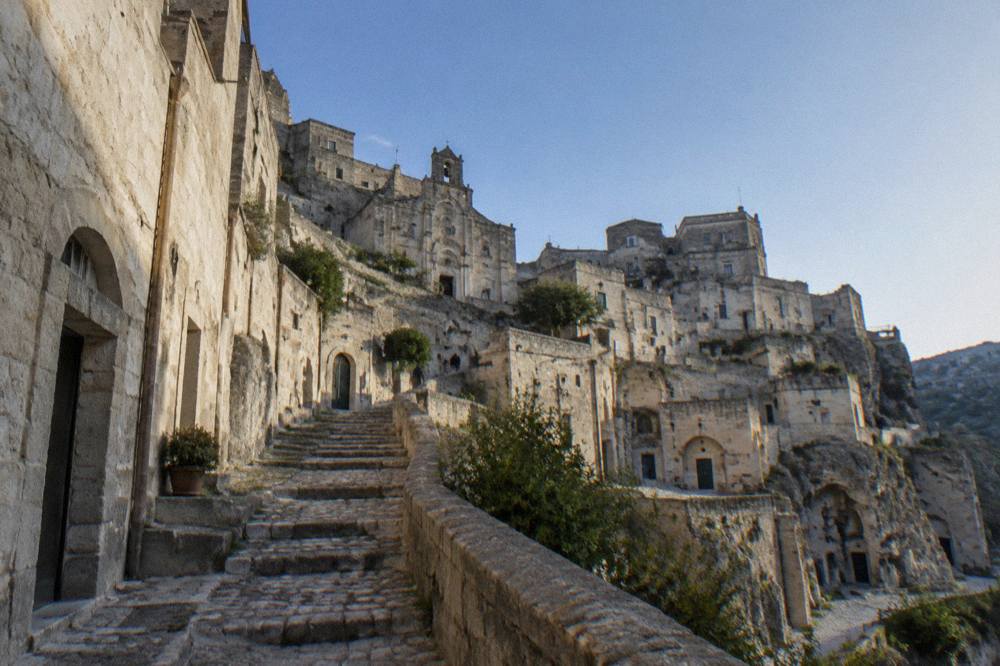
People do still live in the Sassi, though the resident population is small compared with the city's 59,368, and the quarters now mix homes with cave hotels, restaurants and museums. The Sassi were evacuated in stages between 1952 and the 1970s, when residents were moved to new housing schemes, and a 1986 law opened the way to restoration and a slow return. Today the districts are inhabited again, but tourism is the dominant economy.
The evacuation is the part of the story that tends to go untold, and it explains why the question "Matera or Sassi di Matera" is more than a naming puzzle. The cave dwellings, shared with animals and without running water for much of their history, were declared unfit and cleared in a state programme that moved thousands of families out. The quarters stood semi-empty for decades, and the city's reputation suffered with it, a history covered in why Matera was called the shame of Italy. The 1986 national law funded rehabilitation, and restoration work from the 1990s onward turned the districts back into a place people could live, work and run businesses in. UNESCO's inscription in 1993, which notes "more than a thousand dwellings and a large number of shops and workshops" in the property area, came at the start of that recovery rather than at its end.
The recovery has been dramatic by any measure the APT Basilicata data can verify. The city's registered accommodation logged 479,083 arrivals and 748,812 overnight stays in 2025, against 388,158 arrivals in 2019, the European Capital of Culture year: arrivals up 23.4 per cent, and 2025 beating the supposed record. The average stay was 1.56 nights. A large share of that demand is aimed at beds inside the Sassi themselves, which is why cave-hotel availability matters so much in high season; the practical side of that choice is laid out in the Sassi cave hotels guide. The fuller story of who lives there now, and how the community changed after the evacuation, is in do people still live in the Sassi.
The distinction between the two names also decides how you tour. A walk in the Sassi covers lanes, churches and cave houses on foot. A panoramic ride covers the viewpoints above and around both districts without the stairways, which matters because the Sassi are steep, stepped and uneven throughout, and no named route through them is step-free. For a first orientation, many travellers take a ride first and walk after.
Want to see the lanes, churches and cave houses on foot? Book a Sassi walking tour here.
Which Parts Of Matera Are Not Sassi At All?
Everything on the plateau above the canyon is Matera but not Sassi: the modern centre around Piazza Vittorio Veneto and Via Ridola, the shopping streets of the Piano, the station area, the Castello Tramontano on the northern edge, and the newer residential suburbs that house the bulk of the 59,368 residents. The Sassi cover the canyon flank only, roughly the area UNESCO mapped as 1,016 ha together with the Murgia park opposite.
The Piano deserves its own sentence, because it is the part of the city travellers walk through without realising it has a name. It is the flat plateau where the cathedral, the palazzi and the ordinary shops stand, and it was built up while the Sassi were still the inhabited cave quarters below. Piazza Vittorio Veneto and Via Ridola are pedestrian areas closed to vehicles all day, per the comune's ZTL ordinance, and they form the hinge between the two worlds: you stand on the modern pavement and look straight down into the cave districts. The Castello Tramontano, an unfinished Aragonese-style castle on the northern edge of the city, is Matera but not Sassi. So are the Matera Centrale FAL station, the museums on the plateau such as the Palazzo Lanfranchi, and the whole residential belt that grew after the Sassi evacuations.
| Area | Part of Matera? | Part of the Sassi? | What you find there |
|---|---|---|---|
| Sasso Caveoso | Yes | Yes | Rock churches, Piazza San Pietro Caveoso, canyon views toward the Murgia |
| Sasso Barisano | Yes | Yes | Restored façades, cave hotels and restaurants, the Storica Casa Grotta di Vico Solitario |
| Civita | Yes | Yes, the ridge between the two Sassi | The Cathedral of Santa Maria della Bruna, the oldest fortified core |
| The Piano (modern centre) | Yes | No | Piazza Vittorio Veneto, pedestrian shopping streets, palazzi, cafés |
| Murgia plateau (opposite bank) | No, separate park territory | No | Belvedere Murgia Timone, rupestrian churches, the classic Sassi panorama |
| Station and plateau suburbs | Yes | No | FAL station, residential neighbourhoods, Castello Tramontano |
The Murgia side is the other half of the UNESCO property, and it is neither Matera's urban fabric nor the Sassi. The Archaeological Historic Natural Park of the Rupestrian Churches, created by regional Law 11/1990, covers about 8,000 hectares by the park's own count, on the plateau across the Gravina. When you see the famous postcard panorama of the Sassi, you are almost always standing in the park, photographing the city. The park's own site counts 923 plant species across its territory, about a sixth of the national flora, which is a reminder of how much protected land sits within walking distance of the cave quarters. So the honest geography is three-part: the modern city on the plateau, the Sassi on the canyon flank, and the Murgia park opposite, with the World Heritage property drawing a line around the last two.
How Many Days Do You Need For Matera Versus The Sassi?
The Sassi can be seen in a long day of focused walking, but Matera as a whole rewards at least one night, and the APT Basilicata data shows the average guest stayed 1.56 nights in 2025. One day covers the two Sassi districts, a cave house and a rock church or two; two days add the Murgia park opposite, the museums of the Piano, and the viewpoints at sunset without rushing.
The arithmetic comes from the city's own numbers. With 479,083 arrivals producing 748,812 overnight stays in 2025, the typical visitor sleeps in the city once and leaves, which fits the Sassi-plus-panorama version of Matera but not the fuller one. September, not August, is the busiest month in the accommodation data: 61,630 arrivals in September 2025 against 60,257 in August, and 74.5 per cent of those September arrivals came from abroad. February was the quietest, at 15,239. Timing therefore matters more than the name does: the same lanes that feel empty in February are booked solid in September. The question of whether a single night is enough has its own detailed answer in is it worth staying one night in Matera, and the wider planning case, including how the Sassi compare with the rest of the city, is laid out in how many nights you should stay in Matera.
For orientation before any of that, a panoramic ride through both districts shows how Sasso Caveoso, Sasso Barisano and the Civita fit together, which is exactly the geography this page is about. The Matera Travel Guide covers each of those districts in depth elsewhere, and the practical entry prices are published by the operators themselves: Oltre l'Arte's ticket page lists its rupestrian churches at 4.50 EUR for one, 8.00 EUR for two and 10.00 EUR for three, and the Storica Casa Grotta di Vico Solitario lists an 8.00 EUR full tariff in force from 4 April 2026. Those are Sassi experiences inside the city of Matera, and the difference between the two names is exactly the difference between a destination and its most famous quarter.
Common Questions About Matera And The Sassi
What is the difference between Matera and Sassi di Matera?
Matera is the whole city in Basilicata, southern Italy, with 59,368 residents; the Sassi di Matera are its two historic cave districts, Sasso Caveoso and Sasso Barisano, carved into the canyon wall. The Sassi are part of Matera, and the UNESCO World Heritage property covers them together with the rupestrian-church park on the opposite bank.
Are the Sassi di Matera a separate town?
No. The Sassi are two districts inside the city of Matera, below the modern centre, separated from each other by the Civita ridge. There is no separate municipality, no separate administration and no border crossing; you walk between the modern city and the Sassi on stepped lanes in a few minutes.
Is the city of Matera itself worth seeing beyond the Sassi?
Yes. The Piano above the Sassi holds the cathedral, the pedestrian streets around Piazza Vittorio Veneto, the Palazzo Lanfranchi museums and the everyday life of a provincial capital. The APT data shows the average guest stayed 1.56 nights in 2025, which is enough for the Sassi but leaves the rest of the city barely touched.
Which of the two Sassi districts should you visit?
Both, if time allows, because they differ. Sasso Barisano holds the restored façades, cave hotels and the Storica Casa Grotta di Vico Solitario; Sasso Caveoso is rougher and more open to the canyon, with the rock churches of Santa Lucia alle Malve and Madonna de Idris. A route between them crosses the Civita at the top.
Why do people confuse Matera with the Sassi?
Because the Sassi are the part of Matera that photographs, films and UNESCO made famous, from Pasolini's 1964 Gospel to the 2021 Bond film No Time to Die, and because booking sites label cave hotels "Matera" while the views they sell are all Sassi. The city's fame and its quarter's fame merged into one image.