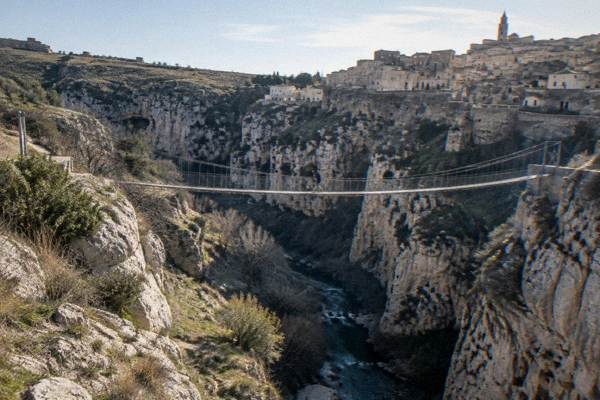
Matera Tibetan Bridge
The Tibetan bridge hangs over the Gravina canyon between the Sassi of Matera and the Murgia plateau, reached on foot along Sentiero 406, a path now run with a staffed access point and an online ticket. This guide covers the route, the rules, the difficulty and everything worth combining with the crossing.
Short answer
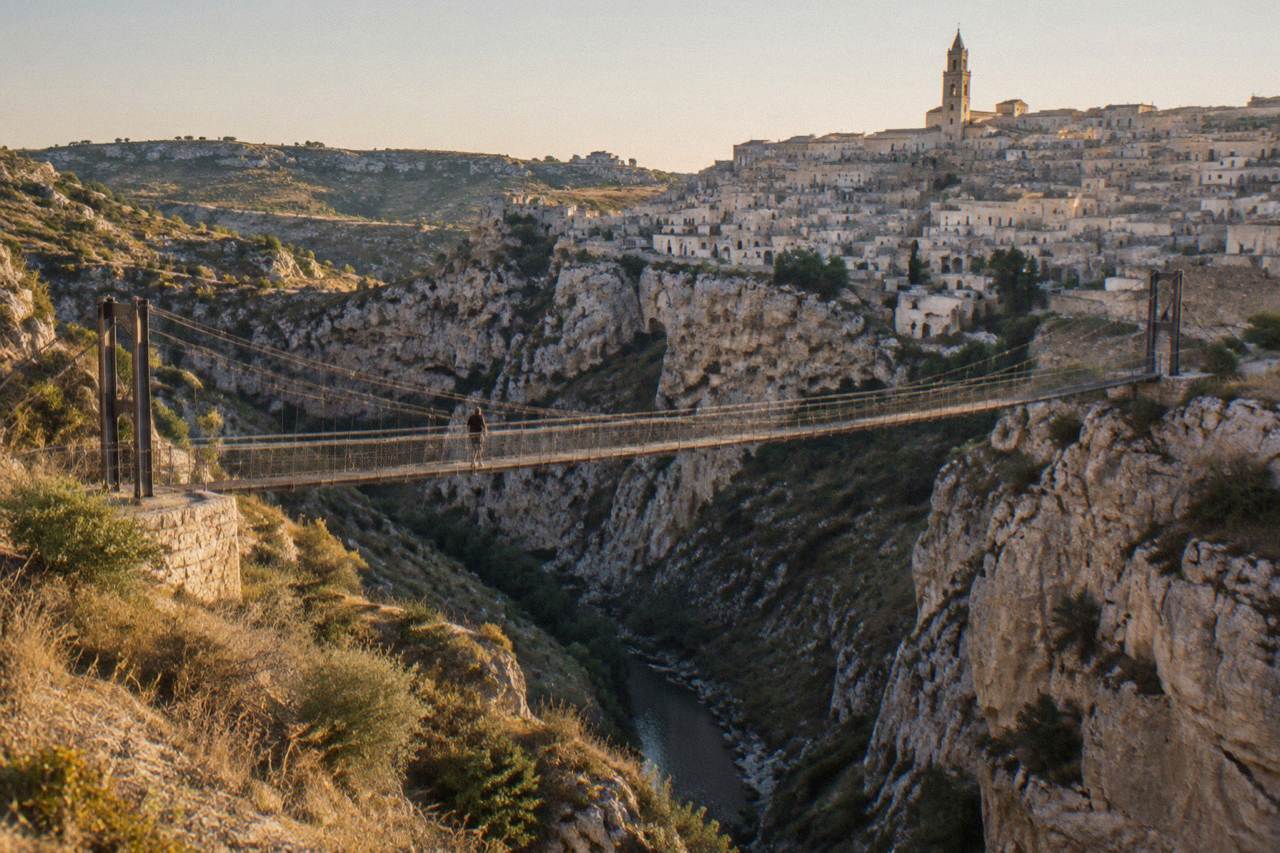
The Tibetan bridge in Matera is a suspension footbridge over the Gravina canyon, reached on the Sentiero 406 path from the Porta Pistola side of the Sasso Caveoso. Access has been managed since March 2026 with a staffed point and an online access ticket; the price and seasonal hours are confirmed on the park's ticket page, not printed here.
The Tibetan bridge in Matera, in the southern Italian region of Basilicata, is a suspension footbridge strung across the Gravina canyon, the deep limestone gorge that separates the Sassi cave quarters from the Murgia plateau. On one side stands the pale stone face of the Sasso Caveoso, honeycombed with cave dwellings and rock churches. On the other lies the protected plateau of the Parco della Murgia Materana, a scrubland of grasses, juniper and scattered rupestrian churches. The bridge is the walking link between the two, reached along Sentiero 406, a canyon path whose access has been managed by the park since March 2026 with a staffed control point and an online access ticket. This guide from the Matera Travel Guide editorial desk covers the route, the access rules, the difficulty, the seasons and what to combine with the crossing.
What Is The Tibetan Bridge In Matera?
The Tibetan bridge in Matera is a pedestrian suspension bridge spanning the Gravina canyon between the Sassi quarters and the Murgia plateau, at the bottom of a walking route called Sentiero 406 that starts near the Sasso Caveoso. It exists to let walkers cross the gorge on foot and climb to the Belvedere Murgia Timone, the terrace opposite the city from which the whole Sassi skyline is visible. The park's own site states that access is now controlled with a staffed point and an online ticket.
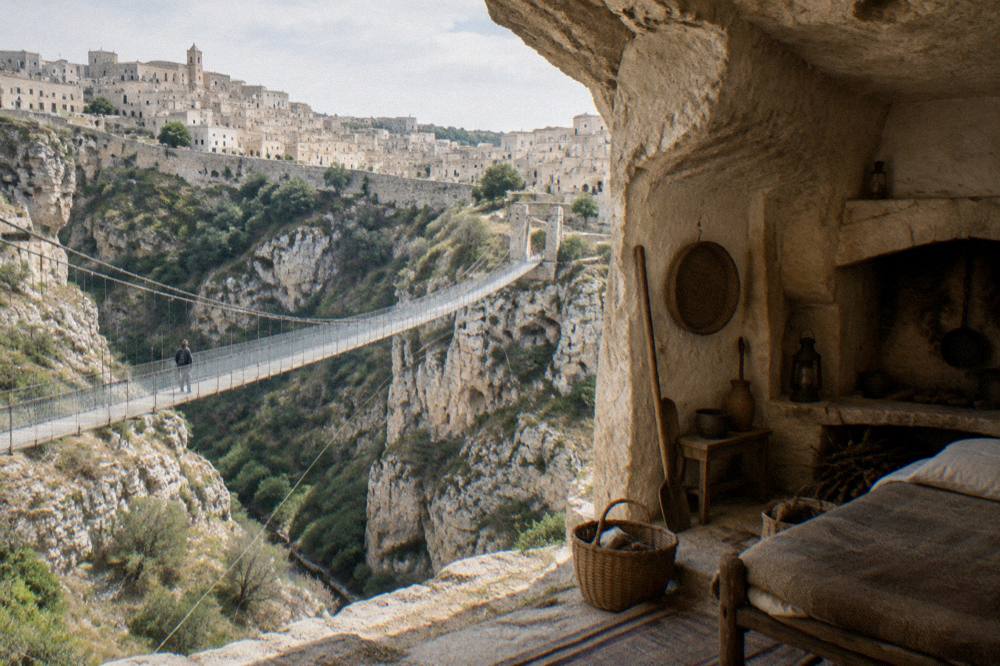
It is not a historic structure. The Sassi and the rupestrian churches around them are the ancient part of this landscape, inscribed by UNESCO in 1993 as "The Sassi and the Park of the Rupestrian Churches of Matera". The bridge is modern infrastructure laid into that landscape, a crossing of cables and planks that lets a walker descend the canyon wall, cross the floor of the Gravina and rise up the other side without a car. The name "Tibetan bridge" is the common Italian term, ponte tibetano, for any suspension footbridge of this type; it carries no Himalayan association beyond the engineering style.
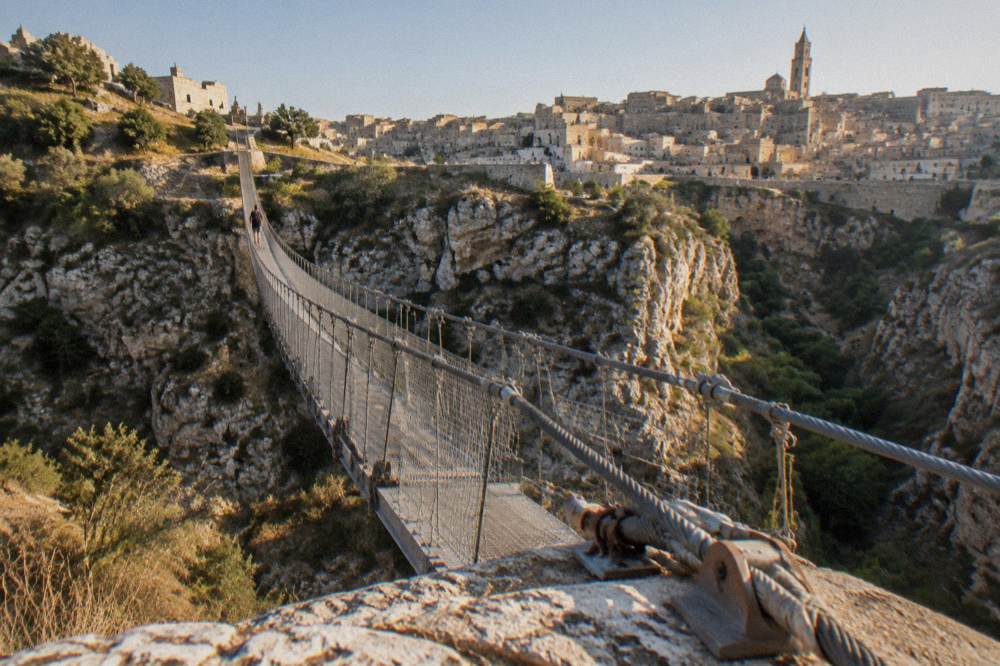
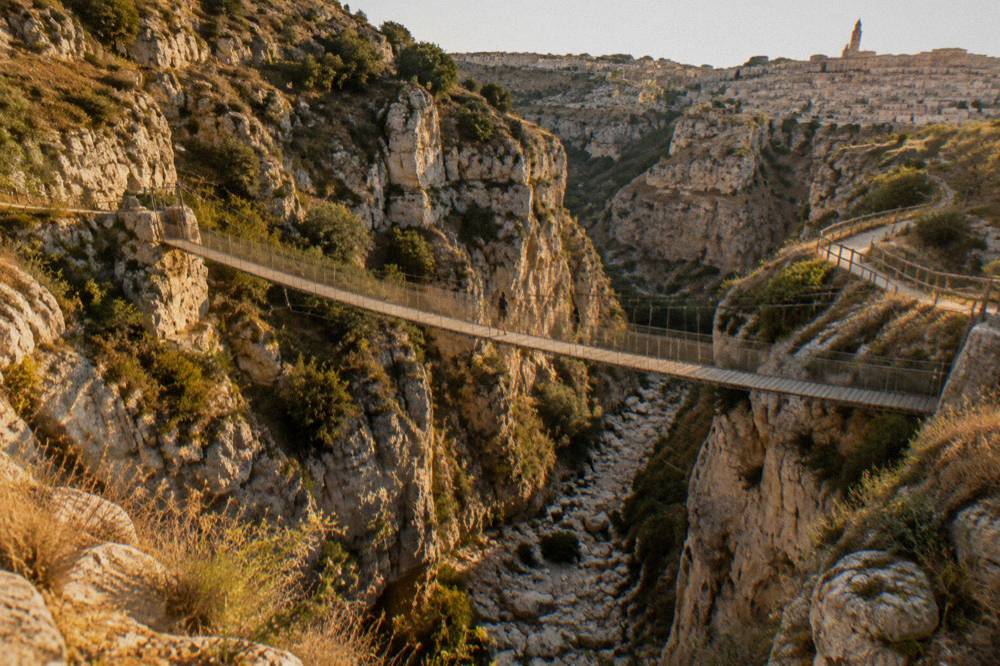
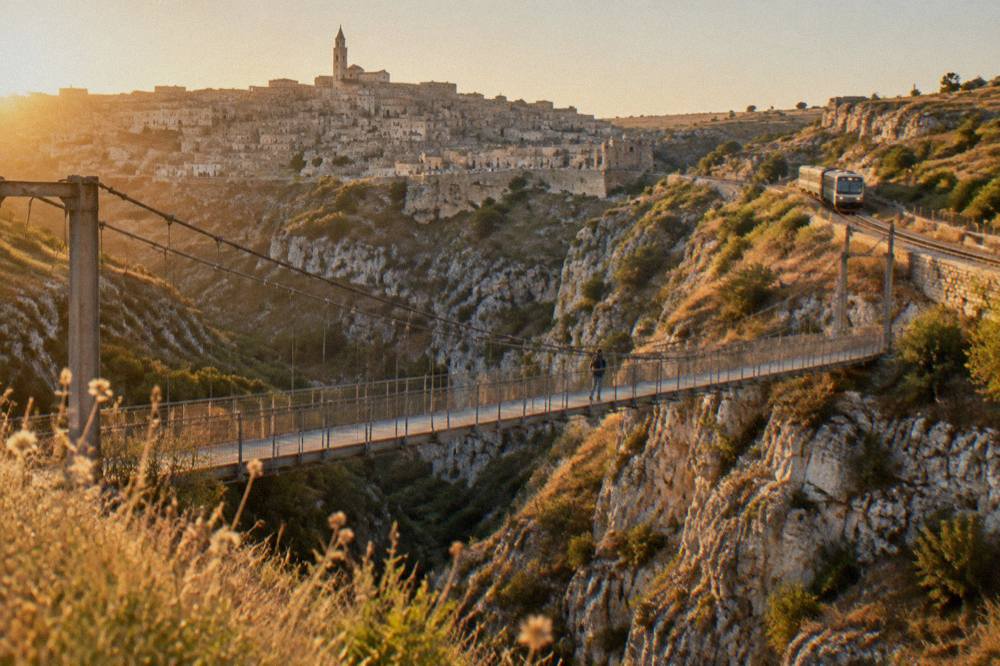
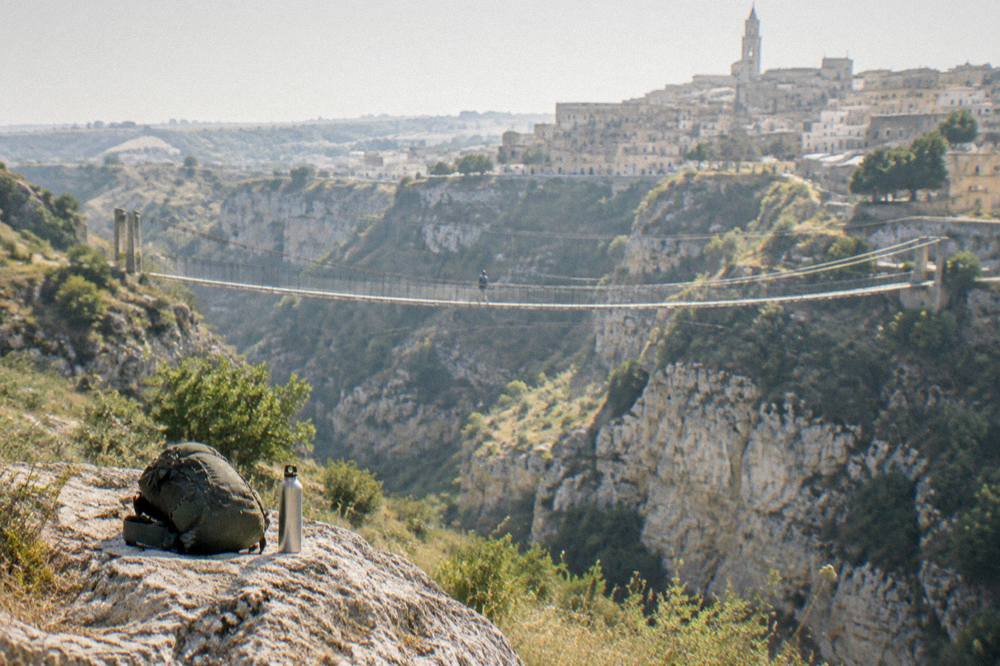
What makes the crossing remarkable is the frame. The Gravina is a canyon carved through pale tufa limestone, and the city sits at about 400 m above sea level on its western rim. From the middle of the bridge the Sasso Caveoso rises directly ahead, a vertical settlement of cave facades and terraces stacked up the cliff. Behind you lies the Murgia, a plateau the park's own site counts at about 8,000 hectares, protecting 923 plant species, which the park describes as about a sixth of the national flora. The bridge is short, the gorge is the spectacle.
For context on the two shores of that gorge, see the site's guides to the Sassi cave quarters and to the park of the rupestrian churches.
Where Is The Tibetan Bridge In Matera And How Do You Reach It?
The Tibetan bridge is reached on foot from the Matera side of the Gravina canyon, along Sentiero 406, whose access point and staffed control sit at the Porta Pistola entrance below the Sasso Caveoso. The park's ticket page names the trailhead explicitly: the access ticket for Sentiero 406 is sold as "Porta Pistola". Jazzo Gattini, the visitor centre on the Murgia side, has been the park's info point and ticket office since 6 February 2026.
The practical route for a visitor staying in the Sassi is simple to describe and moderately demanding to walk. From Piazza San Pietro Caveoso, at the southern edge of the Sasso Caveoso, streets and stairways descend toward the canyon rim, and the path drops from there into the Gravina. The terrain is stepped, uneven and exposed in places: no named route into or out of the canyon should ever be described as step-free. Footwear with grip matters more than pace.
Two facts about access changed recently and older print guides will not have them. First, the park announced on 5 March 2026 that Sentiero 406 now has a staffed access point and an online access ticket, so the crossing is no longer an unmanaged free path. Second, Jazzo Gattini, the visitor centre on the plateau, reopened under a new concession on 6 February 2026 as an info point, ticket office and access control toward Murgia Timone. The park's site is the source for both, and its ticket page is where a walker should confirm current arrangements before setting out.
For a booked outing that covers this terrain without route-finding, a guided walk such as Check availability on the Sassi, Murgia and Tibetan bridge itinerary bundles the canyon, the plateau and the crossing into a single guided route. The site's tour page for the Sassi, Murgia and Tibetan bridge walk describes what the outing covers.
What Does The Sentiero 406 Access Ticket Cover, And Who Pays Less?
The Sentiero 406 access ticket covers entry to the managed path and the suspension bridge over the Gravina, bought online through the park's ticketing site and checked at the staffed point at Porta Pistola. The park states that visitors under 25 pay half price, and that residents of Matera and Montescaglioso, children under 6 and disabled visitors with a companion enter free. Buyers must accept the park's conduct rules at purchase. The exact price and seasonal hours are confirmed on the park's ticket page.
The site's editorial desk does not print the price here, and the reason is honesty rather than caution: two different figures circulate, one on the ticket page text and another in press reports, and the park has not settled them in a single official statement. A figure repeated from memory is exactly how wrong prices spread. Confirm the amount and the season's opening hours on the park's own ticketing page when you buy.
What is verified is the structure of the scheme, and it is worth knowing before you arrive:
| Access rule | Detail | Source status |
|---|---|---|
| Managed access since 5 March 2026 | Staffed access point and online access ticket on Sentiero 406 | Verified on the park's site |
| Who pays half price | Visitors under 25 | Verified on the ticket page |
| Who enters free | Residents of Matera and Montescaglioso, under 6, disabled visitors with a companion | Verified on the ticket page |
| Conduct rules | Accepted by the buyer at ticket purchase | Verified on the park's site |
| Price and seasonal hours | Not settled in a single official figure; confirm on the park's ticket page | Deliberately not printed |
The conduct rules are not decorative. The Murgia is a protected park with fragile karst terrain, rupestrian churches off the marked paths and a fire-prone Mediterranean scrub in summer. Staying on the marked route, carrying water out and keeping to the bridge crossing as signed are the core of what the rules ask.
A guided alternative handles the logistics for you. The guided journey covering the Sassi, the Murgia and the bridge is bookable at Check availability, and the site's page on the guided canyon and bridge itinerary sets out what it includes.
How Difficult Is The Walk To The Tibetan Bridge In Matera?
The walk to the Tibetan bridge is a canyon hike, not a city stroll: it descends the wall of the Gravina on stepped and uneven ground, crosses the bridge, and climbs the Murgia side to reach the Belvedere Murgia Timone terrace. No named route into or out of the canyon is step-free or wheelchair accessible, and the site states this plainly because the terrain makes it unavoidable. Reasonable fitness, closed shoes with grip and water are the practical requirements.
The difficulty is concentrated in the vertical. Matera sits about 400 m above sea level on the canyon rim, and the Gravina floor lies well below the city streets. Every metre walked down on the way out is walked back up on the return, unless a walker arranges to finish on the plateau side and return by road. The path surface is compacted earth and rock steps in varying condition, and after rain the canyon floor can hold mud and loose stone.
Summer adds heat. The ERA5 reanalysis, 1991-2020, puts the mean daily high at 31.2 C in July and 31.3 C in August, with 19.4 and 20.9 days a month respectively reaching 30 C or more. The canyon walls give little shade through the middle of the day. A start in the earlier morning is not a stylistic preference here, it is the difference between a walk and an ordeal. A sunset departure is the other good window, and a transfer-included option such as Check availability on the Murgia Timone sunset walk exists precisely for that hour.
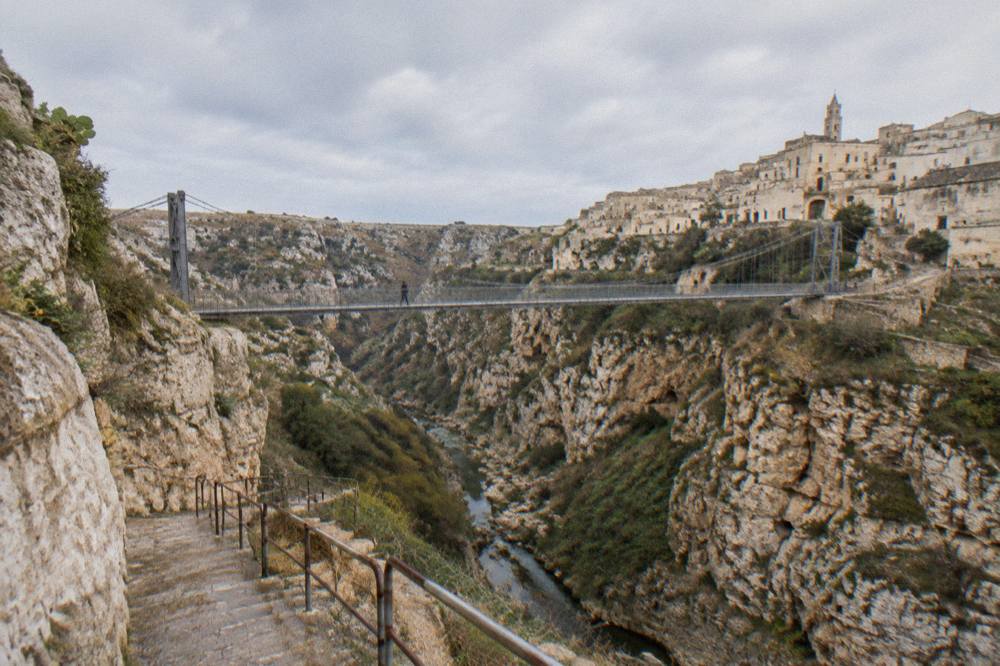
The bridge itself is the easiest part of the route. It is a suspension span walked one direction at a time under the staffed access regime, and it moves underfoot the way suspension bridges do. Anyone unhappy with a swaying plank deck over open air can still see the bridge and the canyon from the rims on either side without crossing.
When Is The Best Time Of Year For The Tibetan Bridge In Matera?
The best months for the Tibetan bridge walk are April, May, June, September and October, when the ERA5 reanalysis, 1991-2020, shows mean highs of 17.4 C to 28.2 C and the walking season is at its longest. July and August are the hardest months for a canyon hike, with mean highs above 31 C, and November is the wettest month at 67.1 mm of rain, which makes the stepped canyon paths greasy. Winter walking is possible but cold at the edges of the day.
The table below gives the modelled monthly picture. These are grid-cell reanalysis values for Matera, not a weather-station record, and they are the honest way to compare months:
| Month | Mean High C | Mean Low C | Rain Mm | Rain Days | Daylight Hours |
|---|---|---|---|---|---|
| Jan | 10.3 | 2.2 | 51.4 | 8.1 | 9.6 |
| Feb | 11.1 | 2.2 | 54.9 | 8.8 | 10.7 |
| Mar | 14.1 | 4.4 | 59.2 | 9.4 | 12.0 |
| Apr | 17.4 | 7.1 | 56.5 | 9.7 | 13.3 |
| May | 22.7 | 11.5 | 41.7 | 7.9 | 14.5 |
| Jun | 28.2 | 16.0 | 35.1 | 6.4 | 15.0 |
| Jul | 31.2 | 18.6 | 21.2 | 4.4 | 14.7 |
| Aug | 31.3 | 18.9 | 21.7 | 4.7 | 13.8 |
| Sep | 25.7 | 15.2 | 44.8 | 7.0 | 12.5 |
| Oct | 20.8 | 11.6 | 51.7 | 7.5 | 11.1 |
| Nov | 15.5 | 7.5 | 67.1 | 8.3 | 9.9 |
| Dec | 11.2 | 3.7 | 57.2 | 8.5 | 9.3 |
Crowds follow a pattern worth knowing. The APT Basilicata accommodation counts show September was Matera's busiest month in 2025, with 61,630 arrivals against 60,257 in August, and 74.5 percent of those September arrivals came from abroad. February was the quietest at 15,239. The plateau path does not feel like a city street, but the spring and autumn shoulder months pair the best walking temperatures with the fullest visitor calendar, so an early start buys both cool air and emptier viewpoints.
What Can You See From The Tibetan Bridge And The Murgia Side?
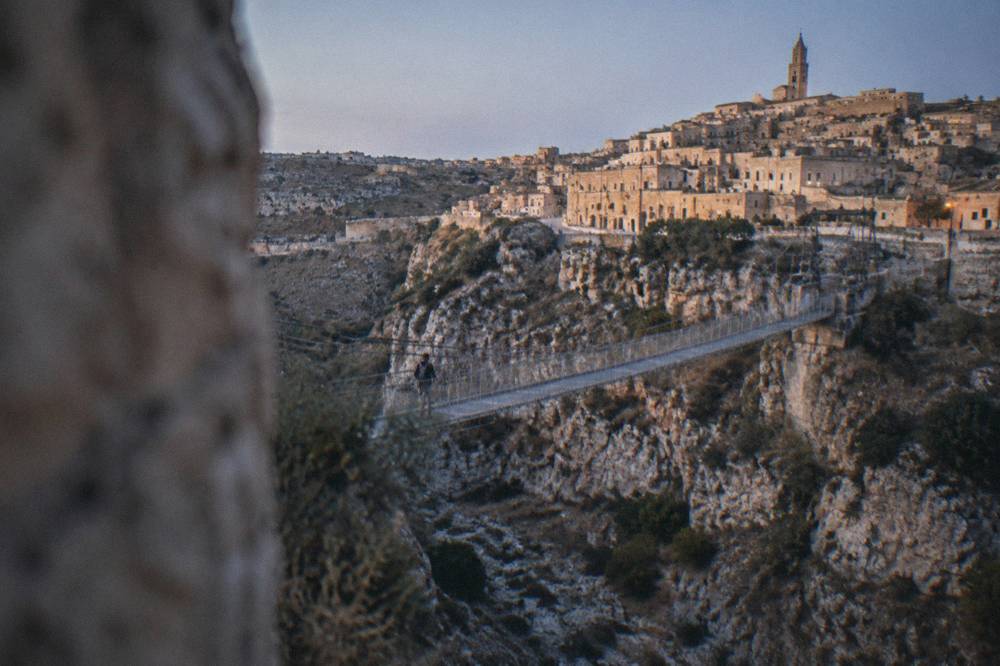
From the bridge and the Murgia side you see the full cliff face of the Sasso Caveoso across the canyon, the terraced cave facades of the old quarters, the dome and bell tower of the city above the Sassi, and, from the Belvedere Murgia Timone terrace at the top of the climb, the classic postcard panorama of the whole Sassi skyline. On the plateau itself the park protects hundreds of plant species and rock churches cut into the far canyon walls.
The Belvedere Murgia Timone is the payoff terrace, and it sits a short walk up from the bridge's plateau end. This is the view that made the Murgia shore famous: the Sassi stacked along the canyon rim, the rupestrian church fronts dotted along the cliff, and the modern city above. The site's guide to the Murgia Timone viewpoint covers the terrace itself and how the plateau side is organised since the Jazzo Gattini visitor centre took over access control in February 2026.
The Murgia plateau is not empty scrub between viewpoints. The park's own site counts 923 plant species across its territory and describes a landscape of rupestrian churches, Neolithic sites and karst landforms. Regional Law 11/1990 created the park, and UNESCO inscribed the Sassi and the park together in 1993 under criteria iii, iv and v, citing a rock-cut settlement adapted to its geomorphological setting with continuity over more than two millennia.
| Park And Heritage Figure | Value | Source |
|---|---|---|
| Park territory | About 8,000 hectares, by the park's own count | Park site |
| UNESCO's protected-area figure | Some 6,500 ha under regional Law 11/1990 | UNESCO listing |
| Plant species in the park | 923, about a sixth of the national flora by the park's count | Park site |
| UNESCO inscription year | 1993, criteria iii, iv and v | UNESCO listing |
| Inscribed property area | 1,016 ha, more than a thousand dwellings | UNESCO listing |
Two figures for the park's size exist side by side, and the honest way to report them is to give both with their sources rather than pick one. The park's own site says circa 8,000 hectares; UNESCO's listing text says regional Law 11/1990 protects some 6,500 hectares. A bare single number would flatter precision.
Photographers should note where the light falls. The Sassi face the canyon from the west, so the far shore looks at the city's lit side late in the day. The guided sunset walk from Matera across the park, bookable via Check availability, is built around exactly this geometry, and the site's overview of things to do in Matera places the crossing among the city's other half-day options.
If the golden-hour canyon light is the goal, book a sunset guided tour with transfer here.
Is The Tibetan Bridge In Matera Safe?
The Tibetan bridge in Matera is a managed crossing under a staffed access regime introduced in March 2026, with conduct rules accepted at ticket purchase and a control point on the path, and the park's own site is the authority on current conditions. The real risks are environmental rather than structural: summer heat on a canyon trail, wet stone after rain, and uneven stepped ground on both canyon walls. The single European emergency number, 112, has served the Matera district since 2 December 2025.
Managed access changed the safety picture considerably. Before March 2026 the path was open and unmanaged; now a staffed point checks tickets, the park publishes conduct rules that buyers accept, and the visitor centre on the plateau side runs an info point and access control. That is a normal pattern for a popular canyon route in a protected park, and it exists both for visitor safety and for the protection of the terrain.
The practical safety list is short and unglamorous. Water, more of it than feels necessary between June and September. Closed shoes with grip, because the steps are rock and the canyon floor is loose in places. No crossing in a storm or right after heavy rain: November averages 67.1 mm of rain over 8.3 rain days, and wet limestone is treacherous. Phone charged, and 112 memorised as the number that reaches all emergency services, with automatic location support. Children under a certain age are best carried or kept to the rim viewpoints rather than the full crossing, and the free-under-6 ticket rule does not change what the terrain asks.
Vertigo deserves respect. The bridge deck sways, the gorge is deep, and the response it provokes is physiological, not a matter of willpower. The rims on both sides give a full view of the bridge and the canyon without stepping onto it, and nothing on the plateau side is worth a panic attack halfway across.
What Else Should You Combine With The Tibetan Bridge In Matera?
The Tibetan bridge pairs naturally with the Belvedere Murgia Timone terrace on the plateau side, the rupestrian churches and cave-house museums back in the Sassi, and a viewpoint ride or a food stop to close the day, because the crossing itself is a half-day undertaking rather than a full one. Verified combination tickets exist inside the city: the Oltre l'Arte all-inclusive pass covers eight sites for 25.00 EUR, and the Casa Grotta di Vico Solitario costs 8.00 EUR.
The standard pairing is the bridge in the morning and the Sassi in the afternoon, or the reverse in hot months when the canyon is better crossed early and the shaded cave churches better visited at midday. Back in the city, the rupestrian churches run by Oltre l'Arte charge 4.50 EUR for one church, 8.00 EUR for two and 10.00 EUR for three, and the site's guides cover Santa Maria de Idris, Santa Lucia alle Malve and San Pietro Barisano individually.
| Site In Matera | Verified Full Price | What The Ticket Covers |
|---|---|---|
| Rupestrian churches (Oltre l'Arte) | 4.50 to 10.00 EUR depending on count | One, two or three rock churches |
| Oltre l'Arte all-inclusive | 25.00 EUR, reduced 16.00 EUR | Eight sites including the churches, MATA and the bread museum |
| Casa Grotta di Vico Solitario | 8.00 EUR, free to age 10 | Cave house, Neviera, natural cave, Sant'Agostino rock church |
| MUSMA sculpture museum | 10.00 EUR | Contemporary sculpture in a cave palazzo in the Sasso Caveoso |
| Casa Noha (FAI) | 6.50 EUR adults, 3.00 EUR children | The FAI orientation house on the Sassi's history |
Two closures matter if you are building a day around culture and canyon. Casa Noha is closed 5 to 22 October 2026 for renovation ahead of a relaunch with new displays, and the Museo Archeologico Nazionale Domenico Ridola has been closed since 7 April 2025 for energy works, with no reopening date published. The site's pages on Casa Noha and the Museo Ridola carry the detail.
For the afternoon after the climb, an open-top eco-bus loop over the Sassi is a way to see the city while sitting down, and it is bookable at Check availability. Visitors basing themselves in Bari can also reach both shores of the canyon on a combined UNESCO day tour, with Check availability on the Alberobello and Matera private-bus excursion covering the two World Heritage towns in one booked outing.
Can You Visit The Tibetan Bridge From Bari Or As A Day Trip?
Yes: the Tibetan bridge works as part of a Matera day trip, because the crossing and the Sassi viewpoint fit inside a half-day each, and Matera is about 68 km and a 1 h 23 drive from Alberobello, 64 km and about an hour from Bari Airport, and 68 km and about 1 h from Bari itself, by free-flow road. FAL trains connect Bari with a change at Altamura in about 1 h 45 to 2 h, though no trains run on Sundays and public holidays.
The road distances below are computed free-flow drives to Matera Centrale, without traffic or stops, and are rounded honestly:
| Place | Road Distance | Free-Flow Drive |
|---|---|---|
| Altamura | 20 km | 20 min |
| Metaponto | 47 km | 52 min |
| Bari Airport | 64 km | 1 h 01 |
| Bari | 68 km | 1 h 02 |
| Alberobello | 68 km | 1 h 23 |
| Castel del Monte | 73 km | 1 h 11 |
| Polignano a Mare | 100 km | 1 h 29 |
| Lecce | 204 km | 3 h 08 |
Rail visitors should plan around the operator's calendar. FAL, not Trenitalia, runs Matera's trains, its posted weekday timetable changes at Altamura, and on Sundays and public holidays the line runs replacement buses instead of trains, eight arrivals and eight departures at Matera Centrale on the festive sheet. FAL's notice of 9 October 2026 also changes the rail programme between Matera Sud and Altamura from 12 October 2026, replacing two early trains with buses. Confirm the live timetable on FAL's own site before committing to a fixed-day plan.
A day-tripper from Bari with one day should pick either the bridge or a second town, not both at a rush. The combined Matera and Alberobello one-day plan logic and the site's wider day-trip coverage in the Murgia park guide explain the trade-offs. A booked combined excursion keeps the schedule honest, and the trulli-town walk is bookable at Check availability.
What Should You Pack For The Tibetan Bridge Walk In Matera?
For the Tibetan bridge walk you should pack closed shoes with grip, one to two litres of water per person, sun protection for the exposed canyon sections, a light layer for the plateau wind, and a fully charged phone with 112, the single European emergency number, known to everyone in the group. Between June and September the water and sun protection are non-negotiable; between November and March add a waterproof layer and expect frost at the day's edges.
The canyon is a microclimate with attitude. It is sheltered and still hot at the floor in summer, windy and exposed on the plateau rim in winter, and the ERA5 reanalysis, 1991-2020, puts the January mean low at 2.2 C against a July mean high of 31.2 C. Frost days, about 20 a year, fall almost entirely between December and March. There is no potable water on the route and no shade to speak of between the rims, so what you carry is what you have.
Leave the city itinerary flexible around the walk. The bridge crossing occupies the legs for the rest of the day more than its distance suggests, because the climb out of the Gravina lands at the top of the effort table for most visitors. Booking the guided crossing as Check availability, or any of the options below, keeps the day structured without route-finding on tired legs.
Common Questions About The Tibetan Bridge In Matera
Is the Tibetan bridge in Matera free to cross?
Not any more. Since 5 March 2026 the path has a staffed access point and an online access ticket. The park states that visitors under 25 pay half price and that residents of Matera and Montescaglioso, children under 6 and disabled visitors with a companion enter free. The current price is confirmed on the park's ticketing page at booking.
How long does the Tibetan bridge walk take?
The site does not print a duration, because no official figure for the free-visit walk is verified. What is verified is the shape of the route: a descent into the Gravina canyon, the bridge crossing, and a climb to the Belvedere Murgia Timone terrace on the Murgia side, on stepped and uneven ground throughout. Allow a half-day window rather than a quick stop, and confirm timing with the park's info point at Jazzo Gattini.
Is the Tibetan bridge in Matera suitable for children?
Children under 6 enter free, but the terrain decides, not the ticket. The route is stepped, uneven and exposed in places, no named canyon route is step-free, and the bridge deck moves underfoot. Families with small children usually prefer the rim viewpoints on either side, which give the full view of the bridge and canyon without the descent.
Can you see the Sassi from the Tibetan bridge?
Yes. The Sasso Caveoso cliff face rises directly across the Gravina from the bridge, and from the Belvedere Murgia Timone terrace above the plateau end of the route the whole Sassi skyline is visible, the classic panorama of the city. Late-day light falls on the city's canyon-facing side, which is why sunset departures are popular.
What is the best month to walk to the Tibetan bridge?
April, May, June, September and October pair the kindest walking temperatures with the longest days. The ERA5 reanalysis, 1991-2020, shows mean highs of 17.4 C in April rising to 28.2 C in June, then 25.7 C in September and 20.8 C in October. July and August mean highs exceed 31 C, and November is the wettest month at 67.1 mm of rain.
Do you need a guide for the Tibetan bridge in Matera?
A guide is not required for the managed free visit, which needs only the online access ticket and acceptance of the park's conduct rules. A guided walk adds route-finding, transfer logistics and the geological and historical context of the canyon and plateau, and several booked itineraries bundle the Sassi, the Murgia and the bridge into one outing.