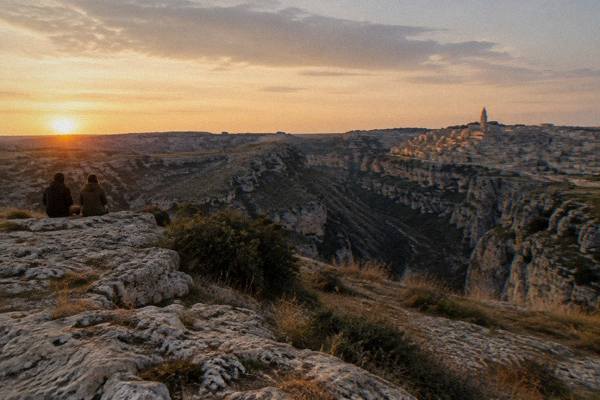
Belvedere Murgia Timone
Belvedere Murgia Timone is the lookout on the Murgia plateau directly opposite the Sassi of Matera, the spot where the whole cave city appears in one frame across the Gravina canyon. This guide covers how to reach it, what you see, and how the park's managed access works.
Short answer
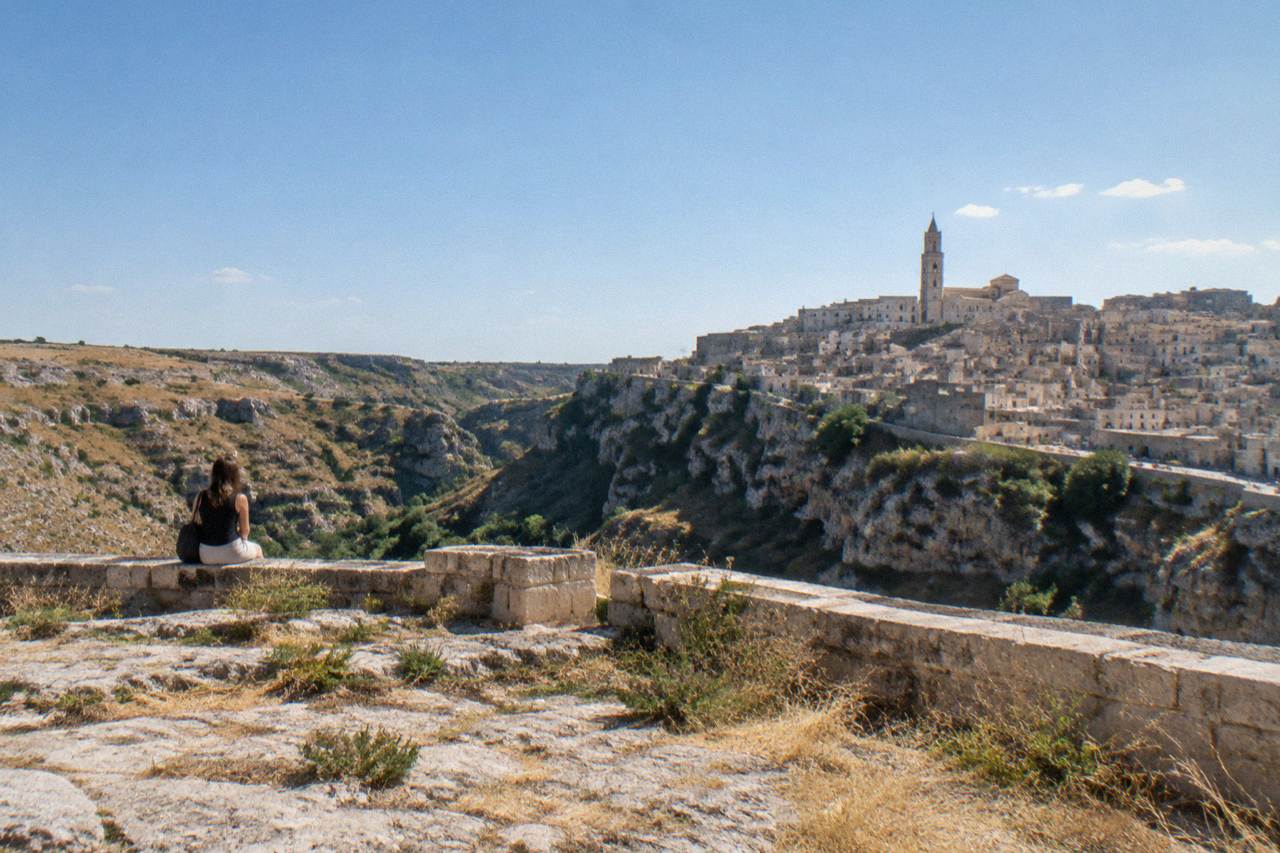
Belvedere Murgia Timone is a limestone shelf on the Murgia plateau, on the opposite side of the Gravina canyon from the Sassi of Matera, in the Parco della Murgia Materana. It is the classic place to see the whole cave city face-on. Access runs through the park, which has staffed a ticketed entry point since March 2026 and reopened its Jazzo Gattini visitor centre in February 2026.
Belvedere Murgia Timone is the terrace of soft limestone on the Murgia plateau that faces the Sassi of Matera across the Gravina canyon, in Basilicata, southern Italy. Matera is an inland city at about 400 m above sea level, and from this shelf the two old quarters, Sasso Caveoso and Sasso Barisano, appear stacked one above the other in a single view, with the Cathedral of Santa Maria della Bruna e Sant'Eustachio on the ridge between them. UNESCO inscribed "The Sassi and the Park of the Rupestrian Churches of Matera" in 1993, and the belvedere sits inside the protected park on the opposite bank, so the view is itself part of the World Heritage listing. This guide from the Matera Travel Guide editorial desk covers how to get there, what you see, the managed access the park introduced in 2026, and how to pair the lookout with the suspension bridge over the Gravina.
What Is Belvedere Murgia Timone In Matera?
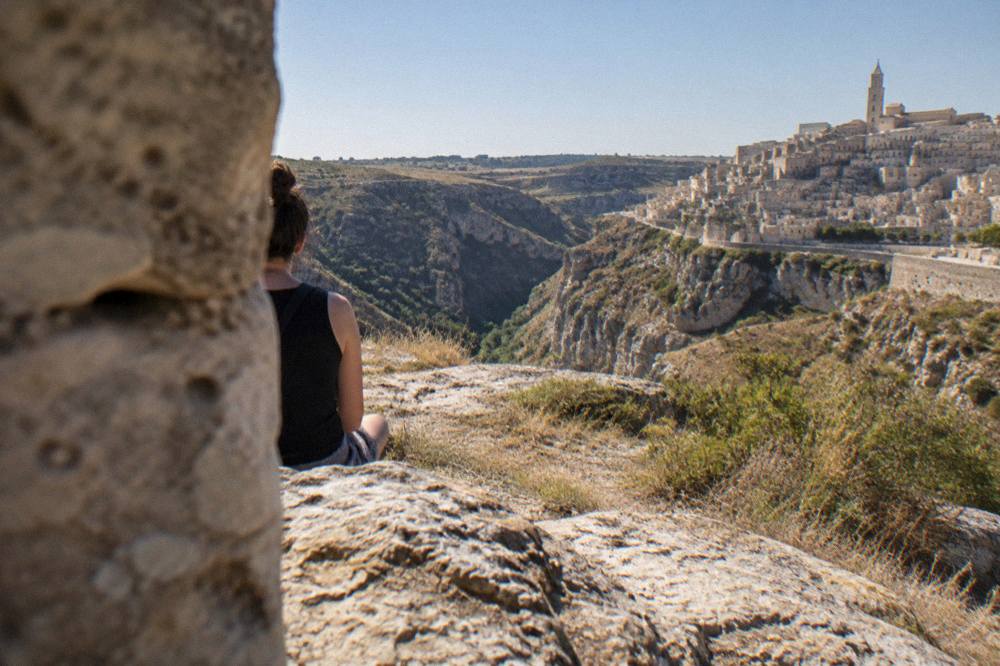
Belvedere Murgia Timone is a natural lookout on the edge of the Murgia plateau, directly opposite the Sassi of Matera across the Gravina canyon, inside the Parco della Murgia Materana. It is not a monument with walls or a ticketed museum: it is a managed terrace of bare rock and grass from which the entire cave city, Sasso Caveoso on the left and Sasso Barisano rising to the right, is visible in one panorama. The name pairs belvedere, a viewpoint, with Murgia Timone, the jure (hill) it stands on.
The platform's whole purpose is the view back. The Sassi are cave dwellings and stone houses cut into pale tufa limestone on the steep western wall of the Gravina, and from the eastern bank the architecture reads as geology: roofs, terraces and church facades share the same colour as the cliff. The park around the belvedere is the "Park of the Rupestrian Churches" half of the UNESCO listing, and the park's own site describes its territory as about 8,000 hectares by its own count, with 923 recorded plant species, roughly a sixth of the national flora by the same page. UNESCO's listing text instead says regional Law 11/1990 protects some 6,500 hectares, so treat the size as approximate.
Two practical points define a visit in 2026. First, the park authority runs a staffed access control towards Murgia Timone from the Jazzo Gattini visitor centre, which reopened under a new concession on 6 February 2026 with an info point and ticket office. Second, the neighbouring Sentiero 406 path, which descends to the suspension bridge over the Gravina, has had a staffed access point and an online access ticket since it was announced on 5 March 2026. The belvedere itself is a short walk on flat ground, while the bridge path is a longer descent, and the two are commonly confused in older guides that describe the whole park as free and unmanaged.
For context before you cross the canyon, the Sassi of Matera guide covers the quarters you will be looking at, and the Parco della Murgia Materana guide covers the park's territory, flora and rules in depth.
How Do You Get To Belvedere Murgia Timone From Matera?
From the Sassi of Matera you reach Belvedere Murgia Timone by driving out on the plateau road to the Jazzo Gattini visitor centre, from which the platform is a short walk on level ground. On foot from Sasso Caveoso the crossing is a hike of well over an hour each way on steep paths, so nearly every visitor drives, takes a transfer, or joins a guided sunset walk with transport included.
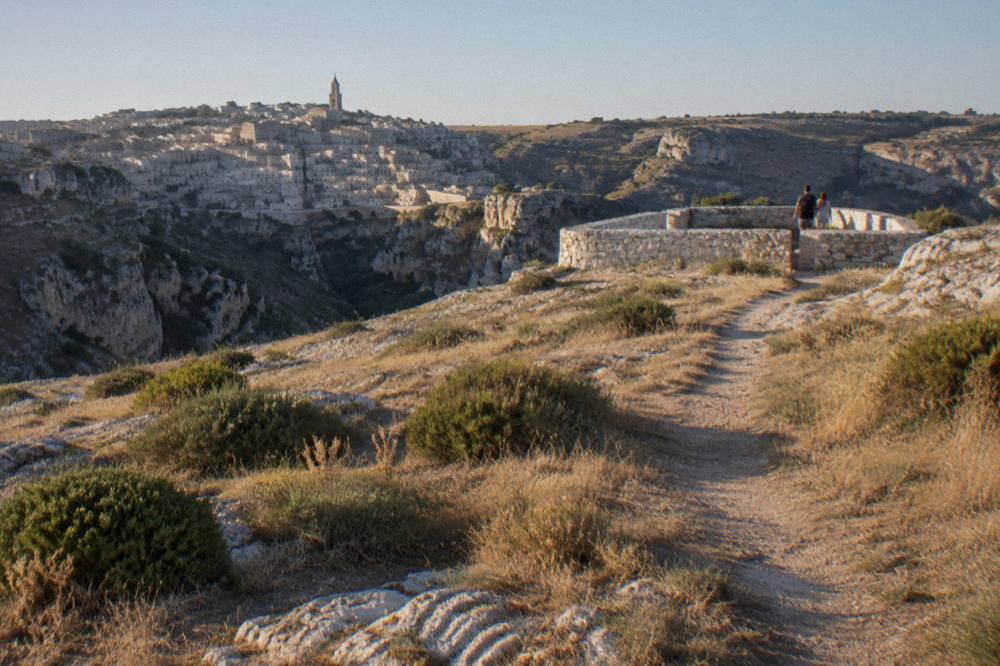
The road approach is simple: the visitor centre sits on the plateau above the east bank, and from its car area the belvedere is a few hundred metres on a track that the park describes as accessible ground, though the whole Murgia edge is bare karst, so expect uneven stone and grass rather than a paved promenade. The contrast with the city side is total. The Sassi are stepped, steep and closed to through traffic much of the day by the ZTL cameras, while the plateau is open grazing land with dry-stone walls and scattered jazzi, the old sheep enclosures that give the visitor centre its name.
Walking is possible and rewarding, but plan it honestly. The route down from San Pietro Caveoso crosses the canyon and climbs the far side on park paths; the park's conduct rules apply, and managed access at the Sentiero 406 staffed point since March 2026 means the free-roaming era is over. Confirm the access ticket situation on the park's own channels before setting out, because the price shown on the ticket page and the figures quoted in press reports conflict, and this site prints neither. If you would rather not organize the crossing, the Murgia Timone sunset tour with transfer handles the transport and the timing; you can also Check availability for your dates.
| Approach to Jazzo Gattini and the belvedere | What it involves | What to confirm before you go |
|---|---|---|
| Car or transfer from Matera | Plateau road, park at the visitor centre, short flat walk to the platform | Opening status of the Jazzo Gattini info point on the park's site |
| Guided sunset walk with transfer | Transport out and back, guided crossing timed to the light | Tour start point and what the transfer covers, on the operator's live listing |
| On foot from Sasso Caveoso | Steep canyon descent and climb on park paths, over an hour each way | Park conduct rules and the Sentiero 406 managed access arrangements |
| Bicycle | Long climbs on both canyon walls, exposed plateau roads | Water and daylight, especially from June to August |
Where Exactly Do You Stand, And What Can You See From Belvedere Murgia Timone?
You stand on the canyon rim roughly level with the upper terraces of Sasso Caveoso, looking west across the Gravina at the whole cave city: San Pietro Caveoso and its square at the southern end, the rock face of Sasso Caveoso, the Civita ridge with the Cathedral, and Sasso Barisano climbing to the north, with the terraces of Madonna delle Virtù and San Nicola dei Greci on the northern edge. The foreground is the Gravina itself, a deep dry ravine of white limestone.
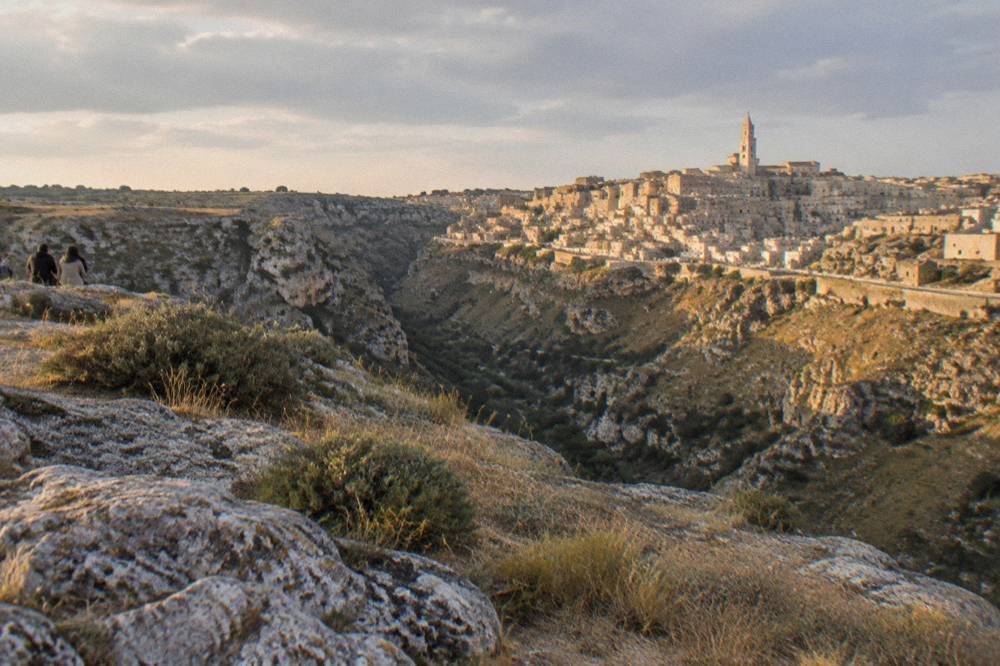
The panorama is the reason photographers cross. In late afternoon the sun drops behind the city, and the tufa face of the Sassi turns from cream to gold to grey-blue, which is why the platform fills at sunset. Reading the view left to right, the southern anchor is the church of San Pietro Caveoso at the mouth of the canyon, with the rupestrian church of Santa Lucia alle Malve and the Madonna de Idris complex cut into the cliff behind it. The centre is the Civita, the oldest part of the city, carrying the Cathedral. To the north the terraces of Sasso Barisano rise, and beyond the city edge the plain runs toward the Bradano. The canyon floor between you and the city is the Gravina di Matera, dry for most of its length and cut into the same limestone as the dwellings.
To catch this light with a guide who knows the park, book a sunset walking tour here.
| Feature in the panorama | Where it sits in the view | Depth of field |
|---|---|---|
| San Pietro Caveoso and its square | Far left (south), at the canyon mouth | Foreground-to-mid distance, closest point of the city |
| Santa Lucia alle Malve and Madonna de Idris | Left-centre, cut into the Sasso Caveoso cliff | Mid distance, rock churches visible as dark openings |
| Civita ridge and the Cathedral | Centre, highest point of the skyline | Mid distance |
| Sasso Barisano terraces | Right (north), rising in steps | Mid to far distance |
| Madonna delle Virtù and San Nicola dei Greci | Right edge, on the northern terraces | Far distance |
| Gravina di Matera | Directly below, between platform and city | Immediate foreground |
A long lens or binoculars change the picture. Individual cave facades, stairways and rooftop gardens resolve, and at dusk the windows of the cave hotels light up in rows against the dark rock. The churches in the view are real visiting sites, not decoration: the rupestrian churches of Matera opened to visitors under the Oltre l'Arte ticket system, which prices one church at 4.50 EUR, two at 8.00 EUR and three at 10.00 EUR on the tariff page, with hours from 28 March 2026. Deeper pages on Santa Lucia alle Malve, Santa Maria de Idris and San Pietro Caveoso cover each one.
When Is The Best Light At Belvedere Murgia Timone?
Late afternoon into sunset is the light the platform is known for: the sun sets behind the Sassi, the canyon goes into shadow first and the tufa face holds warm light longest, so photographers aim to be on the rim in the final hour before sunset. Sunrise reverses the effect, and it is far quieter. Midday in summer flattens the view: the ERA5 reanalysis, 1991-2020, puts July and August mean highs at 31.2 and 31.3 C with almost no rain.
The climate record matters more here than in the city, because the platform has no shade at all. The ERA5 reanalysis, 1991-2020, for the Matera grid cell shows the pattern: a mean high of 31.2 C in July and 31.3 C in August against 10.3 C in January, frost concentrated from December to March with about 20 frost days a year, and November the wettest month at 67.1 mm of rain against July the driest at 21.2 mm. Rain days climb through autumn, 8.3 in November and 8.5 in December, so an October or November sunset visit should carry a shell layer. Never rely on the canyon rim after dark without a torch: the track back to Jazzo Gattini is unlit karst.
| Month | Mean high C (ERA5 1991-2020) | Rain mm | Rain days | Light and comfort at the belvedere |
|---|---|---|---|---|
| March | 14.1 | 59.2 | 9.4 | Long golden hours, cool wind on the rim |
| May | 22.7 | 41.7 | 7.9 | Warm evenings, clear air |
| July | 31.2 | 21.2 | 4.4 | Harsh midday, no shade, go at sunset |
| September | 25.7 | 44.8 | 7.0 | Peak-month crowds at dusk, warm |
| October | 20.8 | 51.7 | 7.5 | Soft light, cooler, occasional rain |
| December | 11.2 | 57.2 | 8.5 | Early sunsets, cold wind, short days |
Crowds follow a calendar the raw weather table does not show. The APT Basilicata accommodation counts put September as Matera's busiest month, 61,630 arrivals in 2025 against 60,257 in August, and 74.5 percent of those September arrivals came from abroad. The sunset platform in September is correspondingly busy. February, with 15,239 arrivals, is the quiet month, and the winter light on pale limestone is strong and low. The full monthly picture, including the pairing of heat and crowd, is in the site's guide to the best time to visit Matera.
Is The Walk To Belvedere Murgia Timone Difficult?
The walk from Jazzo Gattini to the platform is short and nearly level, a few hundred metres on grass and stone track suitable for anyone steady on uneven ground, and it is the easiest way to see the canyon view. Reaching the visitor centre on foot from the Sassi is the hard part: the canyon crossing involves steep descents and climbs on rocky paths, and this site never describes a Sassi or park route as step-free or wheelchair accessible, because the terrain is stepped and uneven throughout.
Split the journey honestly. From the visitor centre, the belvedere itself demands no more than walking shoes and attention to the unfenced rim in places. From the city, the full hike down the Gravina side and up the Murgia side is a genuine half-day undertaking with exposure, loose stone and, from late spring, serious heat. The park's conduct rules apply to anyone entering the managed paths, and the park asks visitors to accept those rules when buying the Sentiero 406 access ticket. Water, closed shoes and a hat are the baseline from May to September, when mean highs run from 22.7 C to 31.3 C.
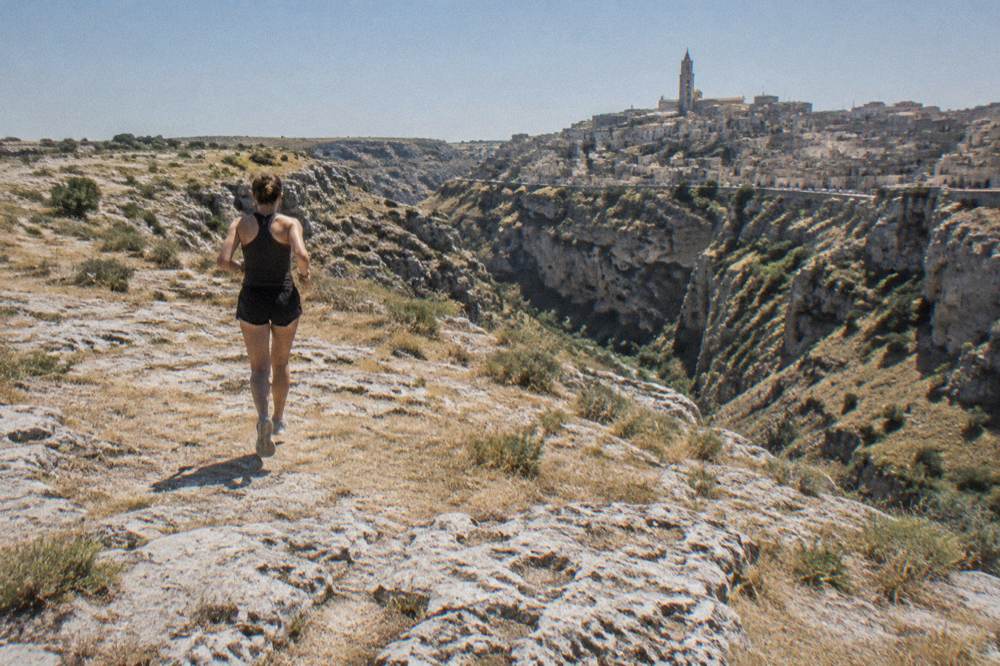
Accessibility deserves a straight answer rather than optimism. The plateau approach by vehicle avoids all stairs, and the final track is level but natural, not paved. The canyon paths are steep, rocky and stepped. Anyone who wants the panorama without the crossing can also see the city from within it: the terraces around Piazza Vittorio Veneto look down into the Sasso Barisano canyon, and the Piazza Vittorio Veneto page explains what is visible from there, including the hypogeal structures beneath the square. The reverse view, city to plateau, is the one the Matera viewpoints overview tracks across the whole site.
What Lives And Grows In The Parco Della Murgia Around Matera?
The park around the belvedere is semi-natural Mediterranean steppe: the park's own site records 923 plant species, which it describes as about a sixth of the national flora, across grassland, Mediterranean scrub, pseudosteppe and the sheer limestone of the Gravina. Birdlife is the other headline: the cliffs and the canyon walls hold breeding raptors, and the plateau's sheep-grazing regime, unchanged for centuries in its outline, is what keeps the grassland open.
The jazzo system explains the landscape. Jazzo Gattini, the visitor centre, takes its name from the enclosures where shepherds penned flocks and made cheese, and the dry-stone walls crossing the plateau mark that grazing economy. Grazing suppresses scrub, scrub suppression keeps the pseudosteppe open, and open steppe holds the plant and bird communities the park protects. The rupestrian churches scattered across the territory, cut into the same canyon walls the belvedere overlooks, are the cultural layer of the same landscape; UNESCO's criterion for the site calls it an outstanding example of a rock-cut settlement adapted to its geomorphological setting, with continuity over more than two millennia.
Visitors see more of this with a guide than alone, and the roster reflects it. Beyond the sunset belvedere tour, the city-side walks such as the English group city walk and the Sassi walk with cave house and rock church entry cover the geology from the other bank; a solo option is rendered below.
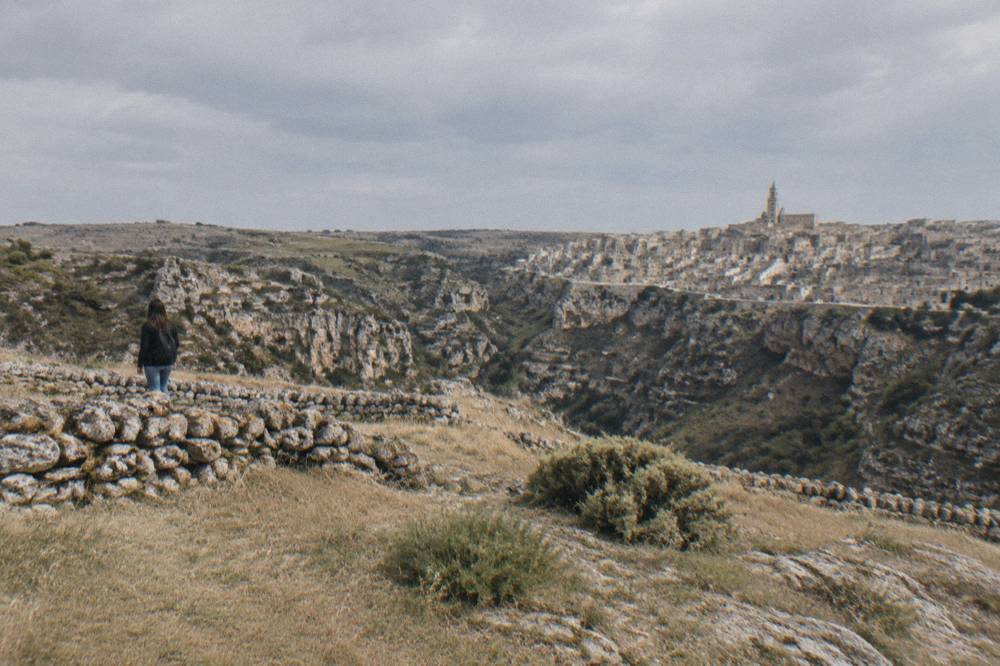
| Layer of the Murgia landscape | What it is | Where you notice it from the belvedere |
|---|---|---|
| Pseudosteppe grassland | Open grazed grassland, part of the 923 plant species the park records | The flat approach from Jazzo Gattini |
| Mediterranean scrub | Mastic, thorn and holm oak thickets on untended ground | The canyon slopes below the rim |
| Karst limestone | Bare dissolved rock, dolines and pavements | The white walls of the Gravina directly below |
| Jazzo enclosures | Dry-stone sheep pens and walls, the historic grazing system | Jazzo Gattini itself and walls across the plateau |
| Rupestrian churches | Churches cut into the canyon walls, the park's name-giving feature | Dark openings in the city cliff across the canyon |
Can You Combine Belvedere Murgia Timone With The Tibetan Bridge At Matera?
Yes, and the pairing is the plateau's signature outing: Belvedere Murgia Timone for the panorama, then Sentiero 406 down to the suspension bridge over the Gravina for the canyon from within. Access to the bridge path has been managed by the park since March 2026, with a staffed access point and an online access ticket, half price for under 25s and free for residents of Matera and Montescaglioso, under 6s and disabled visitors with a companion.
The access price is not settled in verified sources, so confirm it on the park's ticketing page.
The two experiences sit on the same rim but differ completely. The belvedere is about the wide frame; the bridge is about depth, a narrow span over the ravine with the canyon walls closing in. Sentiero 406 descends from the plateau toward the Gravina, and its management change in 2026 was significant: what older guides describe as a free, unmarked trail is now a staffed entry with conduct rules attached to the ticket. Seasonal hours for the path were not verified in official sources, so check the park's channels for the day you go rather than trusting a printed schedule, and treat any reported shuttle or car-limit rule at Murgia Timone as unconfirmed unless the park states it.
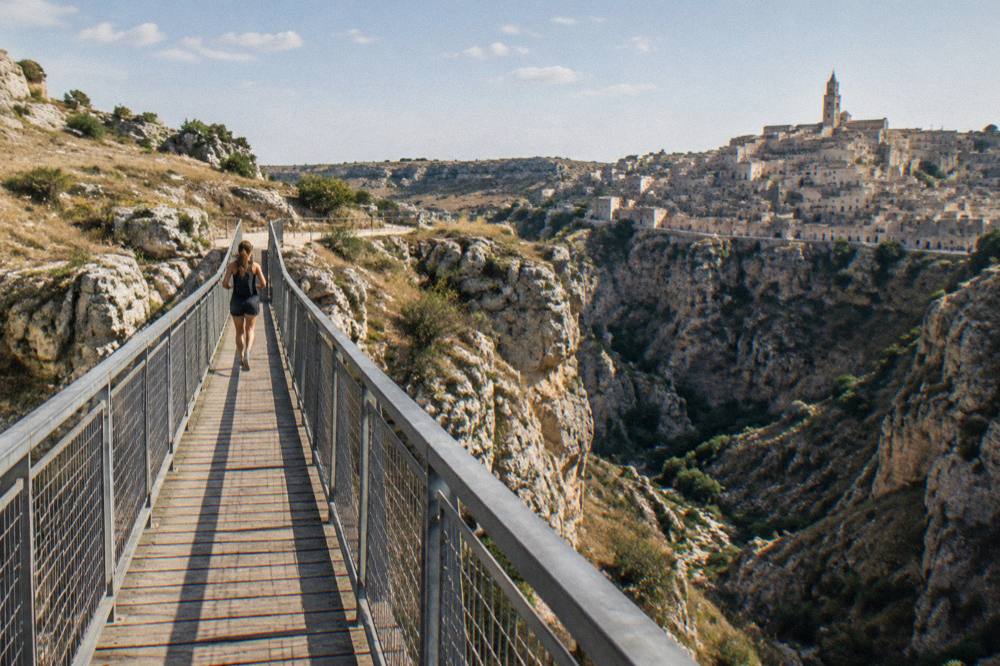
The full crossing story, including the path's rules and what the bridge feels like within the canyon, is on the Tibetan bridge at Matera page. A combined outing works best as a late-afternoon plan: bridge first while light still fills the canyon, then back up to the platform for sunset. Allow more time than the map suggests, because the descent and return climb are on rocky ground, and November's 67.1 mm of monthly rain can leave the path slick. Anyone wanting a single organized version can Check availability on the sunset tour, which covers the Murgia side with a guide and transfer.
What Should You Know Before You Go To Belvedere Murgia Timone?
Take closed shoes, water and a layer for the wind, arrive at Jazzo Gattini rather than trying to park at the rim, check the park's own pages for the managed access status on your date, and plan to be on the platform about an hour before sunset in the busy months. There is no shade, no water point on the plateau track and no lighting after dark, and the emergency number throughout Italy, including Matera's district since December 2025, is 112.
The park's structures are the practical backbone. Jazzo Gattini reopened on 6 February 2026 under a new concession with an info point, a ticket office and access control towards Murgia Timone, so it is both the starting point and the place where current rules are posted. A second visitor centre, in the former convent of Santa Lucia in the Sassi, is listed by the park as opening soon, with no date published. On the city side, note two closures if you are building a same-day itinerary: the Museo Ridola has been closed since 7 April 2025 for energy works with no reopening date, and Casa Noha, the FAI orientation site in the Sassi, closed 5 to 22 October 2026 for renovation ahead of a relaunch, so neither belongs in a same-day plan in that window.
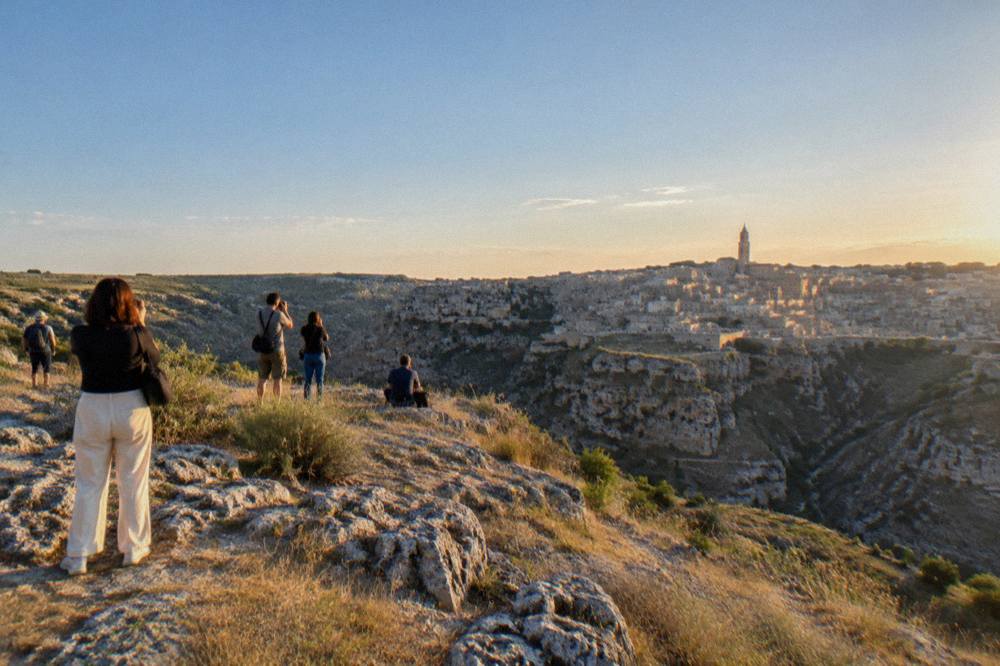
A final note on how the visit fits a wider Matera plan. The belvedere gives the city's defining image but costs half a day once travel and light are counted, and the average stay in Matera in 2025 was 1.56 nights per guest in the APT Basilicata accommodation data. On a short stay, an evening crossing plus a morning walking the Sassi themselves, through Sasso Caveoso and into a cave dwelling such as the Casa Grotta di Vico Solitario, covers both banks of the canyon. The sunset platform is the one place where Matera's architecture and its landscape read as a single thing, and that is the frame worth crossing for.
Common Questions About Belvedere Murgia Timone
Is Belvedere Murgia Timone free to visit?
The platform sits inside the Parco della Murgia Materana, which has operated managed access towards Murgia Timone through the Jazzo Gattini visitor centre since February 2026, and a staffed, ticketed access point on Sentiero 406 since March 2026. Verified sources conflict on the access price for the bridge path and none was confirmed for the belvedere approach, so confirm the current arrangement on the park's own pages before you go.
How do I get to Belvedere Murgia Timone without a car?
Options are a guided sunset tour with transfer included, a private transfer to Jazzo Gattini, or the full hike across the Gravina from Sasso Caveoso on park paths. The urban bus network's coverage of the belvedere was never confirmed on an official page, so this site does not describe a bus route; check locally on the day.
What is the best time of day for Belvedere Murgia Timone?
The final hour before sunset. The sun drops behind the Sassi, the canyon shadows rise and the tufa face of the city holds warm light longest. Sunrise is quieter and lights the canyon floor early, while midday from June to August, when ERA5 reanalysis, 1991-2020, shows mean highs above 31 C, is harsh and shadeless.
Can you see the Sassi of Matera from Belvedere Murgia Timone?
Yes, the whole face of both quarters, Sasso Caveoso and Sasso Barisano, plus the Civita ridge with the Cathedral and the terraces of Madonna delle Virtù and San Nicola dei Greci on the northern edge, all in one frame across the Gravina canyon.
Is the walk to Belvedere Murgia Timone suitable for children or anyone with limited mobility?
The track from Jazzo Gattini to the platform is short and nearly level but natural grass and stone, not paved. The canyon crossing on foot from the Sassi is steep, rocky and stepped, and this site never describes a Sassi or park route as step-free or wheelchair accessible. Arriving by vehicle to the visitor centre removes the climbs.
What is the emergency number in Matera?
112. Matera's phone district joined the single European emergency number on 2 December 2025, and it works with automatic location and multilingual support. There is no lighting or water on the plateau track, so carry a phone, water and a torch for after sunset.