Sasso Caveoso
Sasso Caveoso is the rawer, quieter half of Matera's Sassi: rock-cut churches, a furnished cave house, a sculpture museum in a palazzo and the canyon edge below San Pietro Caveoso.
Short answer
Sasso Caveoso is the southern of Matera's two Sassi districts, facing the Gravina canyon. Its headline sights are the Santa Lucia alle Malve and Madonna de Idris rock churches, the Storica Casa Grotta di Vico Solitario, MUSMA and the terrace at San Pietro Caveoso, with tickets from 4.50 EUR per church and 8.00 EUR for the cave house.
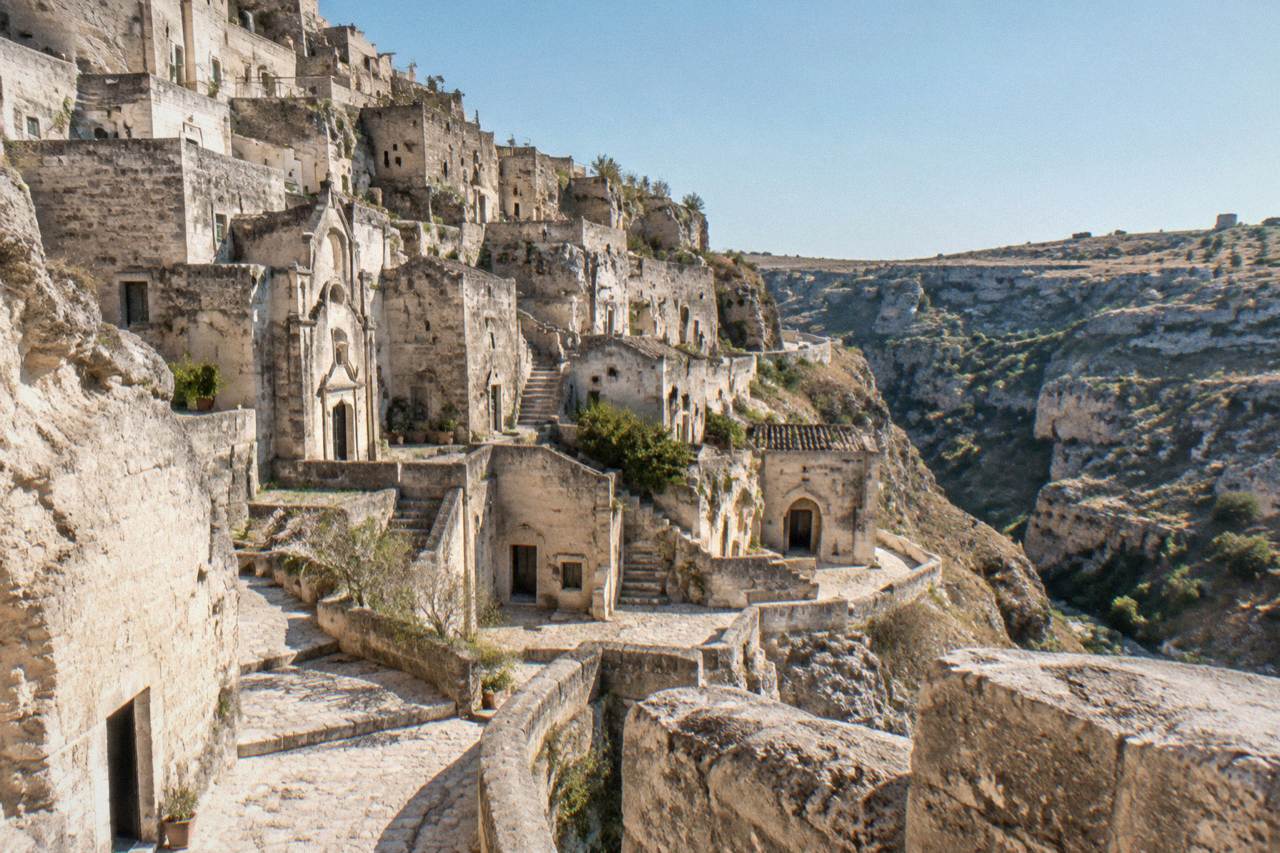
Sasso Caveoso is the southern of the two Sassi districts of Matera, in Basilicata, southern Italy: a heap of pale cave dwellings and stone houses dropping from the Civita ridge toward the Gravina canyon, with the Murgia plateau on the opposite wall. Where its twin Sasso Barisano was largely rebuilt and polished into hotels and bars, Caveoso stayed closer to what the district was after residents were moved out between 1952 and the 1970s: lower rooflines, more bare rock, more churches cut straight into the cliff. The listing for "The Sassi and the Park of the Rupestrian Churches of Matera" entered the UNESCO World Heritage list in 1993, on criteria (iii), (iv) and (v), and UNESCO's own wording praises "an outstanding example of a rock-cut settlement" with "continuity over more than two millennia".
This page covers what the district is, what to see in it, how the tickets work, how it differs from Sasso Barisano, where the viewpoints are, and how long to give it. Every price below was read on the operator's own page and belongs to that sight only.
What Is Sasso Caveoso In Matera?
Sasso Caveoso is the southern half of the Sassi of Matera, the cave-dwelling districts inscribed by UNESCO in 1993, lying below the Civita ridge and facing south across the Gravina canyon toward the Murgia plateau. It takes its name from Caveoso, the medieval hamlet around today's Piazza San Pietro Caveoso, and it keeps the lower, rockier silhouette of the pre-restoration Sassi: dwelling caves, neviere and churches hewn into tufa limestone. Its three headline rock churches are run by one operator, Oltre l'Arte, on a single ticket ladder.
The Sassi are two, not one. Sasso Barisano faces northwest and holds most of the Caveoso district's polished opposite: cave hotels, restaurants and workshop storefronts. Caveoso faces the canyon and the Parco della Murgia Materana, and its edge is where the city stops and the gorge begins. The rock churches, the canyon rim path and the Belvedere Murgia Timone views across to the Sassi are all part of why this district reads as the archaeological half.
Unusually for a district this famous, Caveoso is not a museum. People live in it, workshops run in it, and the churches still hold services on occasion. The materani who stayed, and the families who came back after the 1986 law opened restoration, share lanes with a sculpture museum, a furnished cave house and one of the most photographed terraces in southern Italy. For a first overview of how the two districts fit the rest of the city, the one day in Matera itinerary walks both Sassi in order.
What Are The Essential Sights In Sasso Caveoso?
The essential sights in Sasso Caveoso are the rock churches of Santa Lucia alle Malve and Madonna de Idris with San Giovanni in Monterrone, the Storica Casa Grotta di Vico Solitario, the sculpture museum MUSMA on Via San Giacomo, and the terrace at San Pietro Caveoso above the canyon. All of them sit within a few minutes' walk of Piazza San Pietro Caveoso, the district's natural gateway. Casa Noha, the small FAI interpretation house on the edge of the district, is closed 5 to 22 October 2026 for renovation.
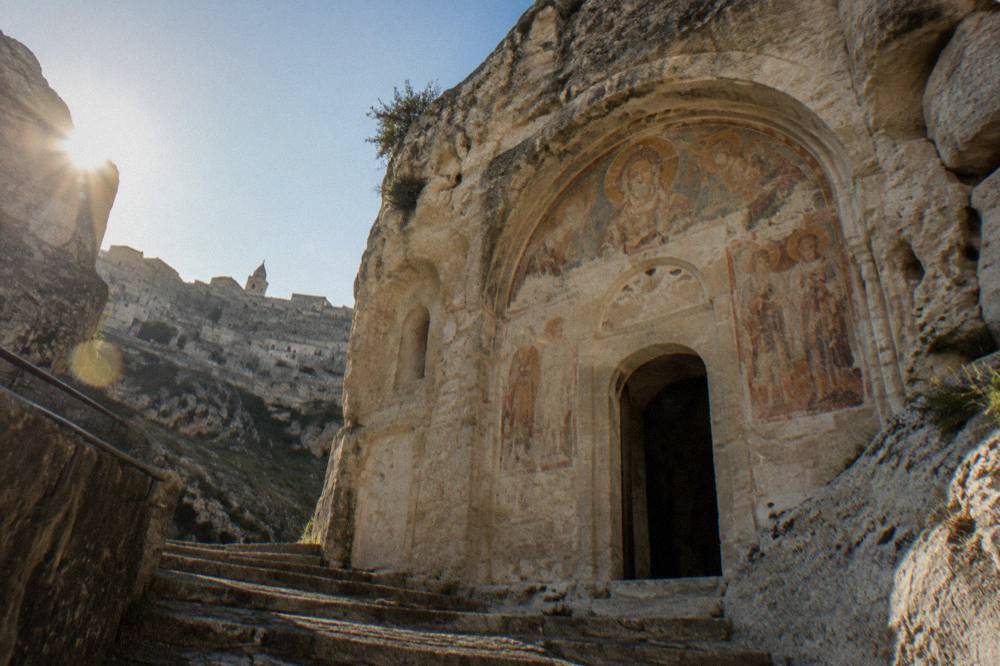
Start with the churches, because they are what the UNESCO inscription is about. Oltre l'Arte's ticket page lists the three rupestrian churches it runs, two of them in Caveoso and one, San Pietro Barisano, just over the line. Santa Lucia alle Malve is the standout: the first female monastic settlement in the area, its frescoes cut into the rock face. Madonna de Idris sits on a spur above it, joined internally to San Giovanni in Monterrone, whose dark circular interior is lit from a single opening. Opening hours from 28 March 2026 run 09:30 to 19:30 for the two Caveoso churches, last entry 19:20.
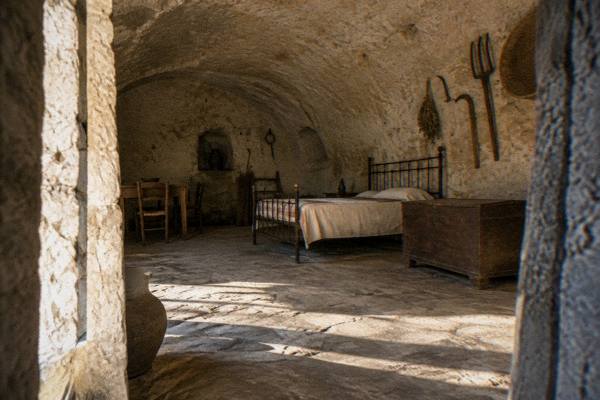
The Casa Grotta di Vico Solitario is the furnished cave house: a dwelling reconstructed as it was lived in, with the bed behind a curtain, the mule stall inside the room and the rainwater cistern below. Its tariff, in force from 4 April 2026, is 8.00 EUR full, 5.00 EUR reduced, 3.00 EUR for ages 11 to 18 and free to age 10, and the ticket also covers the Neviera, a natural cave and the rock church of Sant'Agostino al Casalnuovo. MUSMA, the sculpture museum in Palazzo Gattini's Sasso Caveoso seat at Via San Giacomo, charges 10 EUR full with reductions at 5 and 7 EUR, open 10:00 to 20:00 from April to September and 10:00 to 18:00 the rest of the year.
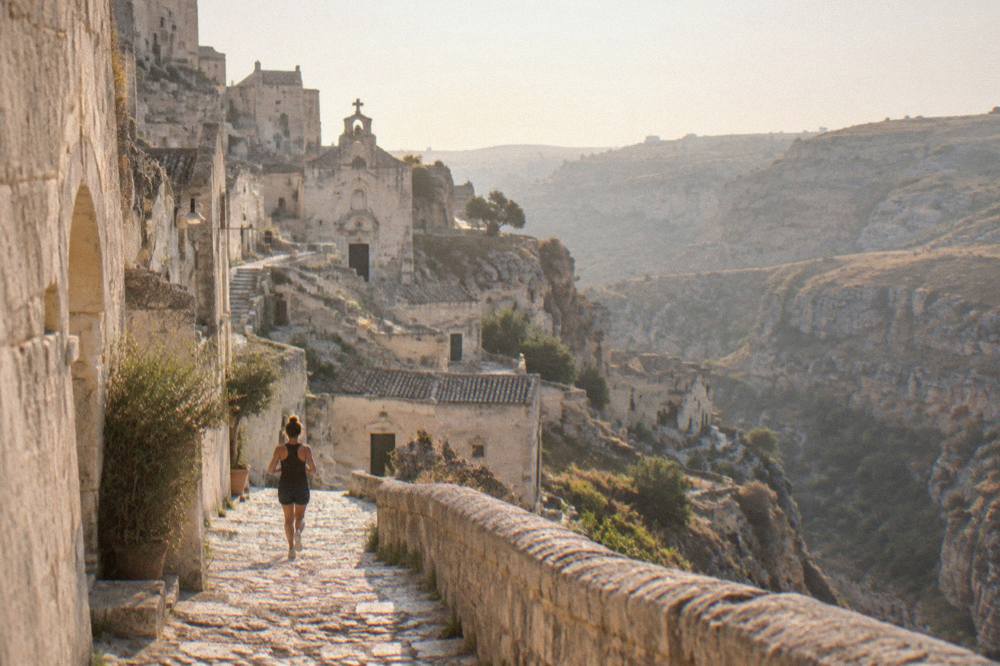
End, not start, at San Pietro Caveoso: the church terrace is the district's balcony, and late afternoon is when the low sun picks out the facades across the whole bowl. From the terrace the path drops toward the canyon floor and the belvedere trail toward Murgia Timone.
Here is what the main Caveoso sights cost, from each operator's own page:
| Sight | Full ticket | Reductions | Source basis |
|---|---|---|---|
| Santa Lucia alle Malve (1 church) | 4.50 EUR | 3.50 EUR; 2.50 EUR with licensed guide | Oltre l'Arte tariff from 28 March 2026 |
| Madonna de Idris + San Giovanni in Monterrone (2 churches) | 8.00 EUR | 5.50 EUR; 4.00 EUR with licensed guide | Oltre l'Arte tariff |
| All 3 Oltre l'Arte churches | 10.00 EUR | 7.50 EUR; 5.00 EUR with licensed guide | Oltre l'Arte tariff |
| Storica Casa Grotta di Vico Solitario | 8.00 EUR | 5.00 EUR; 3.00 EUR ages 11 to 18; free to 10 | Tariff from 4 April 2026 |
| MUSMA | 10 EUR | 5 EUR ages 7 to 18 and groups; 7 EUR FAI members; free to 6 | MUSMA contacts page |
| Oltre l'Arte 8-site all-inclusive | 25.00 EUR | 16.00 EUR | Oltre l'Arte tariff |
A note on planning around those numbers. The 25.00 EUR all-inclusive Oltre l'Arte ticket spans eight sites across both Sassi, including the three churches, the Vicinato a Pozzo, the Antica Casa Grotta in Via Fiorentini, MATA, the Purgatorio exhibition and the bread museum, so it only pays off if several of those are on your list. Oltre l'Arte closes all of its sites on 25 December and on 2 July, the feast of the Festa della Bruna, when the whole city belongs to the procession.
How Do You Get To Sasso Caveoso And Where Do You Enter?
The usual entry to Sasso Caveoso is from Piazza San Pietro Caveoso, reached on foot from Matera's modern centre in about ten minutes down Via Fiorentini or through the Civita from Piazza Duomo, since the whole Sassi is car-free at its core. From Matera Centrale station the walk is around twenty minutes uphill on the return.
The ZTL Sassi camera gates on Via Buozzi, Via Madonna delle Virtù and Via D'Addozio are active 10:00 to 20:30 from 16 September to 30 June, and until 24:00 in summer, so driving into the district is not an option in those windows.
Matera's rail operator is FAL, not Trenitalia, and there is no national rail station in the city. From Bari the posted weekday timetable involves a change at Altamura and about 1 h 45 to 2 h of travel; on Sundays and public holidays no trains run at all and FAL substitutes buses. Current times sit on FAL's own timetable page, which changes by notice, so read it before committing to a day trip. If you are arriving from Bari for the day only, the Matera day trip from Bari itinerary sequences both Sassi around a short stop.
By car, park in the new town and walk down. No public car park tariffs for Matera appear on any official page, so the numbers circulating on third-party sites should be treated as unconfirmed; check signage at the garage. The pedestrian areas of Piazza Vittorio Veneto and Via Ridola are closed to vehicles all day, with bollards opening only 04:00 to 08:00 on weekdays for deliveries. For the wider picture of districts, parking and the ZTL gates, the Matera Travel Guide homepage collects the practical pages in one place.
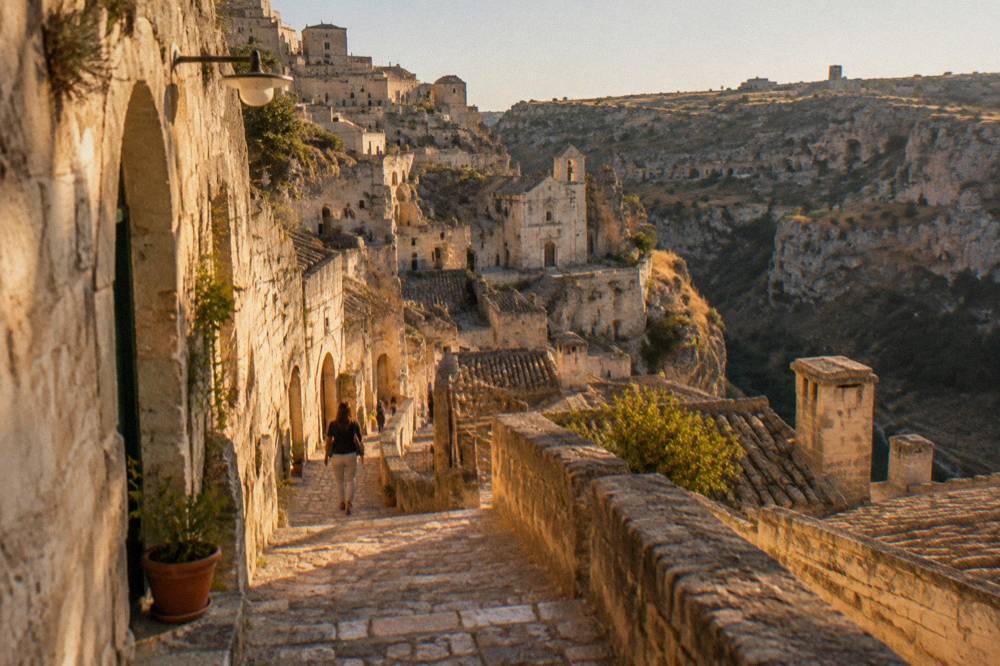
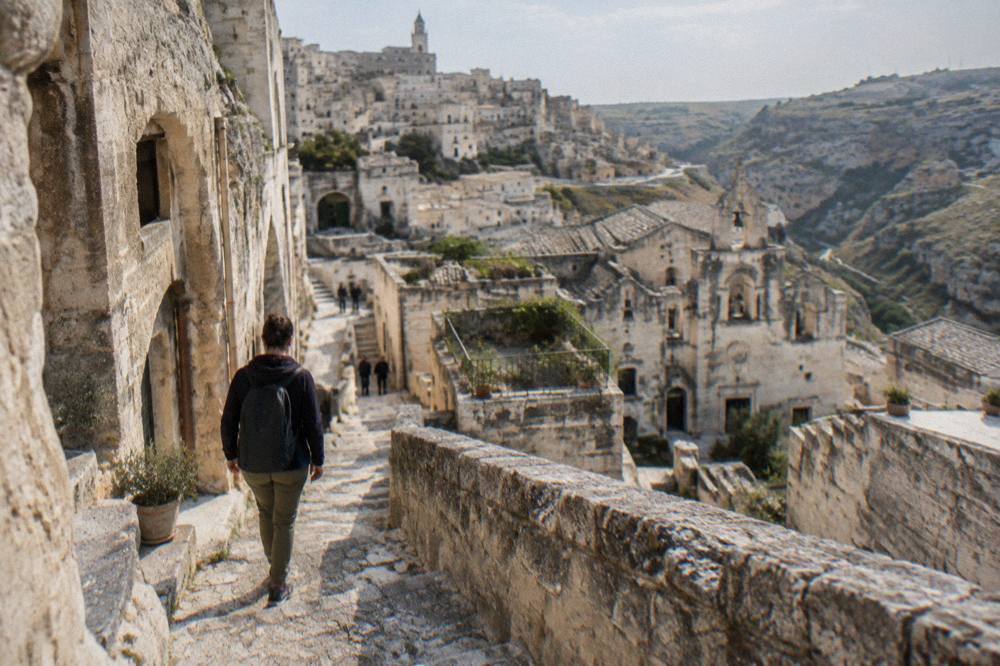
Inside the district the lanes are stepped, cobbled and uneven, cut into and out of rock. No named route here can be described as step-free, and the drop from the Civita to the canyon-edge churches involves stairs in both directions. Wear closed shoes with grip, and treat the Gravina-side paths, which belong to the park rather than the city, as hiking terrain rather than pavement.
What Is The Difference Between Sasso Caveoso And Sasso Barisano?
Sasso Barisano is the restored, commercial half of Matera's Sassi, dense with cave hotels, restaurants and renovated facades facing northwest, while Sasso Caveoso is the rockier, quieter southern half that drops toward the Gravina canyon and holds the rupestrian churches, the furnished Casa Grotta and MUSMA. Barisano gives the polished evening; Caveoso gives the archaeology and the canyon views. UNESCO listed both together in 1993, and neither is a substitute for the other.
The split has a practical shape. Barisano's lanes climb from Via delle Beccherie toward the Matera Cathedral side of the Civita, and its cave openings are mostly shopfronts and suites. Caveoso's openings are mostly churches, museums and still-lived-in houses, and its rim faces open country: the canyon, the rupestrian churches of Matera scattered through the park opposite, and the belvedere trail network. The districts meet at the Civita, the fortified old core between them, which the Civita area guide covers separately.
| Sasso Caveoso | Sasso Barisano | |
|---|---|---|
| Orientation | Faces the Gravina canyon, south side | Faces northwest, inland side |
| Character | Rock churches, museums, quieter lanes | Cave hotels, restaurants, shops |
| Headline sights | Santa Lucia alle Malve, Madonna de Idris, Casa Grotta, MUSMA | Facades, workshops, the Sasso Barisano terraces |
| Best time of day | Afternoon to sunset at San Pietro Caveoso | Evening for lit facades and dinner |
| Terrain | Steeper, more steps toward the canyon | Steep but more restored stairways |
Caveoso also carries the district's harder history more visibly. The Sassi evacuation, which ran from 1952 into the 1970s, emptied these caves after national law reclassified them as unhealthy housing, and the story of that displacement, and of the malaria-era reputation that preceded it, is told on the site's page about why Matera was called the shame of Italy. Restoration under the 1986 law came later to Caveoso than to Barisano, which is precisely why more of its rock face shows.
Where Are The Best Viewpoints Over Sasso Caveoso?
The best viewpoints over Sasso Caveoso are the terrace of San Pietro Caveoso church, the belvedere on the Murgia side reached from Jazzo Gattini, and the canyon-rim path below the district, with the classic postcard angle being the Murgia Timone belvedere across the Gravina, which looks back at the whole bowl. Within the district itself, the drop along Via Madonna delle Virtù gives layered roofline views, and the terrace at Santa Lucia alle Malve frames the canyon.
Want the canyon angles without the steep lanes? Book a panoramic bus tour here.
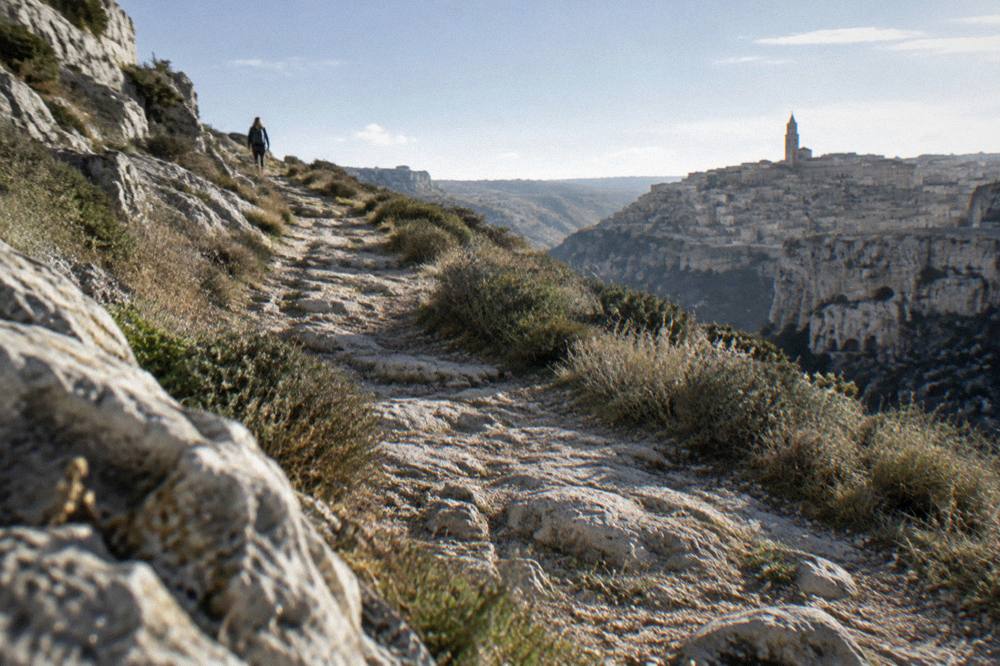
The Murgia side matters because Caveoso is the district you photograph from outside. Jazzo Gattini, the park's visitor centre, reopened under a new concession on 6 February 2026 with an info point and ticket office controlling access toward Murgia Timone, so the crossing is now a managed one rather than a free scramble. The Sentiero 406 path down the Gravina, with its suspension bridge, has had a staffed access point and an online access ticket since March 2026; the ticket page shows 10.00 EUR in spring and summer and 5.00 EUR in autumn and winter, but press reports quote different figures, so the price should be confirmed at the park's ticket page rather than assumed. Half price applies under 25, and entry is free for residents of Matera and Montescaglioso.
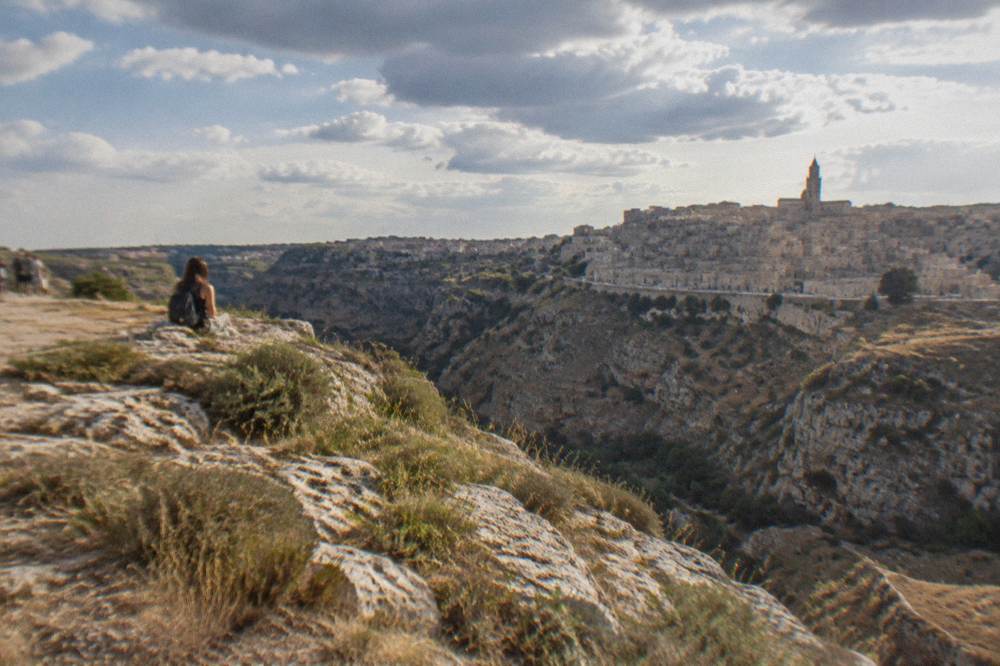
Sunset is the anchor time, and the Matera viewpoints guide maps each angle. Two cautions: the emergency number in Matera since 2 December 2025 is 112, the single European number, and the park trails are wild ground, closed shoes and water in summer. The climate normals, from the ERA5 reanalysis 1991-2020 for the Matera grid cell, put the July mean high at 31.2 C and August at 31.3 C, so the crossing is a morning or late-afternoon walk in those months, not a midday one.
How Much Time Do You Need In Sasso Caveoso?
Plan on half a day for Sasso Caveoso itself: two rock churches, the Casa Grotta and the San Pietro terrace fit comfortably into three to four hours at walking pace, with MUSMA adding about an hour if sculpture is on the list. The APT Basilicata data shows the average stay in Matera is short, 1.56 nights per guest in 2025, so a half-day in one district is a realistic allocation rather than a rushed one. Add the Murgia-side belvedere crossing and the day is full.
September, not August, is the busiest month in that data: 61,630 arrivals in September 2025 against 60,257 in August, and 74.5% of September's arrivals came from abroad. What that means on the ground is that the church entrances and the Casa Grotta queue least in the earlier morning, and that February, the quietest month at 15,239 arrivals, is a different city entirely, cold at night but nearly empty on the lanes.
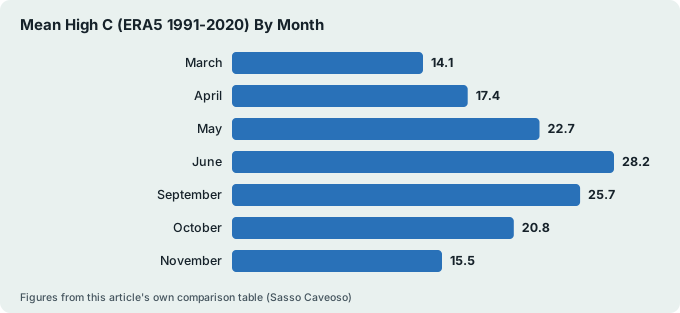
| Month | Mean high C (ERA5 1991-2020) | Rain mm | Arrivals 2025 (APT Basilicata) |
|---|---|---|---|
| March | 14.1 | 59.2 | 23,629 |
| April | 17.4 | 56.5 | 45,195 |
| May | 22.7 | 41.7 | 54,101 |
| June | 28.2 | 35.1 | 50,186 |
| September | 25.7 | 44.8 | 61,630 |
| October | 20.8 | 51.7 | 52,538 |
| November | 15.5 | 67.1 | 23,555 |
If the whole Sassi, both districts plus the Civita, are on one day, the two days in Matera itinerary splits them more sensibly than any single-day squeeze. Guided walks are the efficient way to cover the district's story, and the Matera walking tour options include group and private formats; where a tip-based walk comes up, tip-based walks do run locally, and terms should be confirmed with the guide directly.
What And Where Do You Eat Around Sasso Caveoso?
Eating around Sasso Caveoso means cave restaurants and bread-based Materan cooking: the district's cellars serve pane di Matera, legume soups, lamb and peperoni cruschi, and the wine list leans on Basilicata's Aglianico del Vino. There is no sea at Matera, an inland city at about 400 m elevation, so seafood is not the local story here; the classic pairing is a cave cellar in Sasso Caveoso or Barisano followed by an aperitivo on a terrace. The bread carries PGI status, registered in 2008.
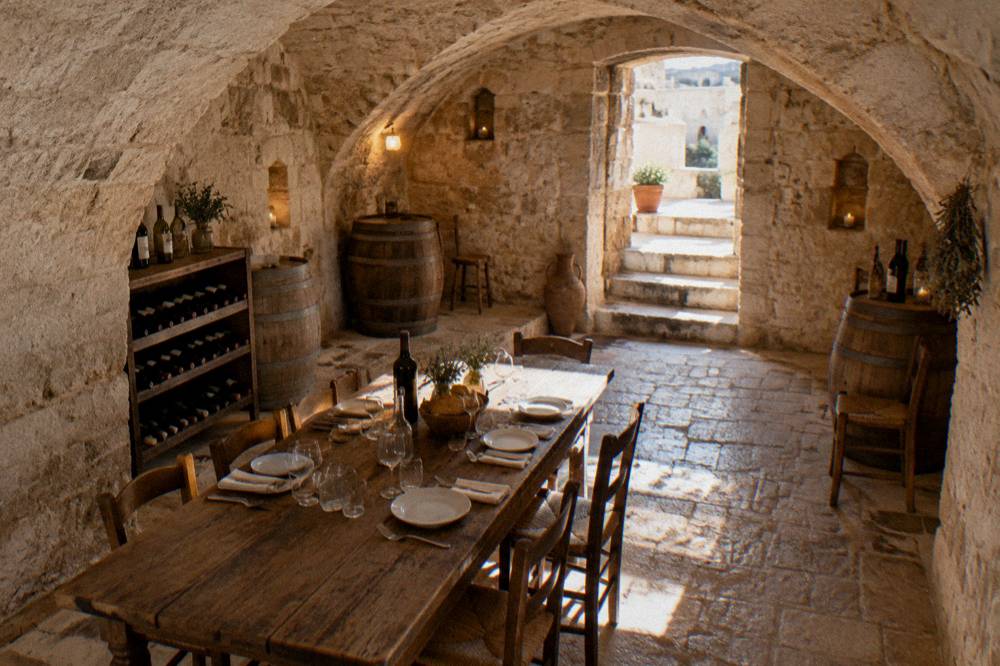
The district's own tables sit in converted wine cellars and stables along the lanes below Piazza San Pietro Caveoso, and the site's restaurant and cave-restaurant guides list the verified ones with what to order. A cooking class is the other route into the food: a pasta class run in an ancient Caveoso wine cellar covers the dough, the shapes and the meal that follows, and it slots naturally into a second afternoon once the churches are done.
For a shorter stop, the Matera bars and aperitivo guide sits alongside the pages on local wine and on cruschi peppers. Two practical notes from the record: a tourist tax applies in Matera and is collected by your accommodation, with the amount confirmed at booking, and table service in the Sassi runs late by northern European habit, which suits the sunset-first rhythm of the district.
What Day Trips Work From Sasso Caveoso?
The verified day trips from Matera by road are Altamura at 20 km, Gravina in Puglia at 30 km, Craco at 57 km and the Adriatic coast at Polignano a Mare at 100 km, all computed as free-flow drive times of roughly 20 minutes to 1 h 30. Alberobello, the trulli town in Puglia, is 68 km and about 1 h 23. Matera is inland Basilicata, so the sea, Ionian or Adriatic, is always a deliberate drive rather than a quick hop.
These are free-flow figures from a routing engine over OpenStreetMap, so add time for parking and summer traffic. The pairs that work best from a Sasso Caveoso base:
| Destination | Road km from Matera | Free-flow drive |
|---|---|---|
| Altamura | 20 | 20 min |
| Gravina in Puglia | 30 | 31 min |
| Metaponto (Ionian coast) | 47 | 52 min |
| Craco | 57 | 58 min |
| Bari | 68 | 1 h 02 |
| Alberobello | 68 | 1 h 23 |
| Polignano a Mare | 100 | 1 h 29 |
The ghost town of Craco and the Gravina gorge town are the two inland classics, while Altamura and Alberobello push into Puglia, the neighbouring region, which is a distinction worth keeping straight: Matera is in Basilicata, and the Puglia towns are day trips out of it. The guided options for the farther ones, including the Craco and Amaro Lucano trip and the Castelmezzano hike, appear in the picks bands on this page.
What Should You Know Before Walking Sasso Caveoso?
Before walking Sasso Caveoso, know that the lanes are stepped and uneven and no route can be called step-free, that the rock churches close on 25 December and 2 July, that Casa Noha is closed 5 to 22 October 2026 for renovation, and that the Museo Ridola, the archaeological museum, has been closed since 7 April 2025 with no reopening date published. The district's churches run on hourly rhythms with last entries 10 to 20 minutes before closing, and the emergency number is 112.
Clothing and timing matter more here than in most Italian towns. The ERA5 reanalysis, 1991-2020, gives January a mean low of 2.2 C and July a mean high of 31.2 C, so layers in winter, a hat and water in summer, and closed shoes year-round. Frost days cluster from December to March, about 20 a year, and rain is spread across the year at 562.5 mm annually, heaviest in November at 67.1 mm, lightest in July at 21.2 mm.
The closures and openings worth checking against your dates:
| Site | Status on the operator's page |
|---|---|
| Oltre l'Arte churches (Caveoso and Barisano) | Open daily 09:30 to 19:30 from 28 March 2026; closed 25 December and 2 July |
| Casa Grotta di Vico Solitario | Open daily; Jul and Aug 09:00 to 20:30, Apr to Jun and Sep to 20:00 at weekends |
| Casa Noha | Closed 5 to 22 October 2026; adults 6.50 EUR, open every day except Wednesday |
| Museo Ridola | Closed since 7 April 2025, no reopening date published |
| Museo Nazionale, Palazzo Lanfranchi | Open 09:00 to 20:00, 10.00 EUR, cumulative ticket 15.00 EUR for all sites over 2 days |
| Sentiero 406 (suspension bridge) | Staffed access point and online ticket since March 2026; price confirmed at the park ticket page |
Is Sasso Caveoso Worth It Compared With The Rest Of Matera?
Sasso Caveoso is worth the better part of a day on its own terms: it holds the majority of what the UNESCO inscription actually describes, the rock-cut churches and the canyon-edge settlement, plus the furnished Casa Grotta and MUSMA, none of which have equivalents in Sasso Barisano. Barisano is where you sleep and eat well; Caveoso is where the site earns its World Heritage status. A visit that skips it has seen the packaging and missed the substance.
The pairing that works is Caveoso by day, Barisano and the Piano, the modern centre, by evening. The Sassi di Matera overview explains how the two districts and the Civita divide the old city, and the broader question of whether Matera justifies the journey is answered with the arrival data on the site's homepage: 479,083 arrivals in registered accommodation in 2025, up 23.4% on the 2019 Capital of Culture year, which is a verdict written in bookings rather than adjectives.
Common Questions About Sasso Caveoso
What is Sasso Caveoso?
Sasso Caveoso is the southern of Matera's two Sassi districts, in Basilicata, southern Italy, dropping from the Civita ridge to the Gravina canyon. It holds two of the three Oltre l'Arte rupestrian churches, the Casa Grotta di Vico Solitario and MUSMA, and it was inscribed with the rest of the Sassi on the UNESCO World Heritage list in 1993.
How much does Sasso Caveoso cost to visit?
Walking the district is free. The ticketed sights inside it cost 4.50 EUR for one rock church, 8.00 EUR for two, 10.00 EUR for all three, 8.00 EUR for the Casa Grotta di Vico Solitario and 10 EUR for MUSMA, on the tariffs published on each operator's own page.
Which is better, Sasso Caveoso or Sasso Barisano?
Neither is a substitute for the other. Sasso Barisano is the restored half with cave hotels and restaurants; Sasso Caveoso is the rockier half with the churches, the furnished cave house, MUSMA and the canyon views. Both are part of the same UNESCO inscription from 1993.
Can you drive into Sasso Caveoso?
No. The ZTL Sassi camera gates on Via Buozzi, Via Madonna delle Virtù and Via D'Addozio are active 10:00 to 20:30 from 16 September to 30 June and 10:00 to 24:00 from 1 July to 15 September, and the district's core is pedestrian. Park in the modern town and walk down.
What is open and closed in Sasso Caveoso right now?
Casa Noha is closed 5 to 22 October 2026 for renovation, and the Museo Ridola has been closed since 7 April 2025 with no published reopening date. The Oltre l'Arte churches, the Casa Grotta and MUSMA are open daily on their published hours, except that Oltre l'Arte closes all its sites on 25 December and 2 July.
How long does it take to walk around Sasso Caveoso?
Allow three to four hours for the core circuit of two rock churches, the Casa Grotta and the San Pietro Caveoso terrace, and about an hour more for MUSMA. The Murgia-side belvedere crossing, a managed access since March 2026, is a separate half-day addition.
The lanes are steep, the churches close early on feast days, and the light does the district its greatest favour in the last two hours before sunset, so time the walk to end at the San Pietro terrace with the canyon going gold.