Is Matera A Safe City To Visit?
A sourced safety briefing for Matera in Basilicata: the emergency number, the terrain of the Sassi, driving and ZTL rules, night walking and practical precautions.
Matera, the cave city of Basilicata in southern Italy, is a small inland municipality of 59,368 residents at ISTAT's 1 January 2026 count, perched about 400 m above sea level on the edge of the Gravina canyon. That physical setting, not crime, is the main safety story: the Sassi quarters are steep, stepped and cut into soft tufa limestone, the streets are narrow, and the rules that protect the historic centre are enforced by cameras. This page reports what official sources say about each practical safety question, from the single European emergency number to the ZTL barriers and the terrain underfoot.
Is Matera A Safe City To Visit?
Yes, Matera is considered a safe city to visit, and the safety questions that matter there are practical rather than criminal: the terrain of the Sassi is steep, stepped and uneven, the emergency number is 112, and the historic centre is protected by camera-enforced traffic zones. No source this site consulted publishes crime statistics for Matera, so this briefing sticks to the verified operational facts: terrain, emergency services, traffic rules and standard precautions.
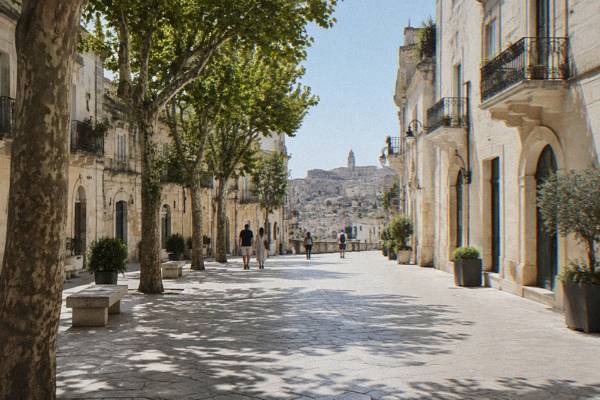
The city is small enough that orientation is quick. The old quarters, Sasso Caveoso and Sasso Barisano, sit below the modern town on the canyon rim, and the contrast between the flat Piano and the stepped Sassi is the single most important thing a first-time visitor can understand. The Piano, around Piazza Vittorio Veneto, is a pedestrian area closed to vehicles all day, with retractable bollards that open only from 04:00 to 08:00 on weekdays for deliveries, according to the comune's own hours document.
What official pages do not contain is any crime dataset. This site will not invent one. What the sources do confirm is that Matera's infrastructure is actively managed: the park authority staffs access points, the comune publishes its ZTL camera hours as a public PDF, and the fire brigade announced the arrival of the single European emergency number with a dated notice. A city that publishes its rules this clearly is a city a visitor can plan around.
What Are The Main Safety Risks In The Sassi?
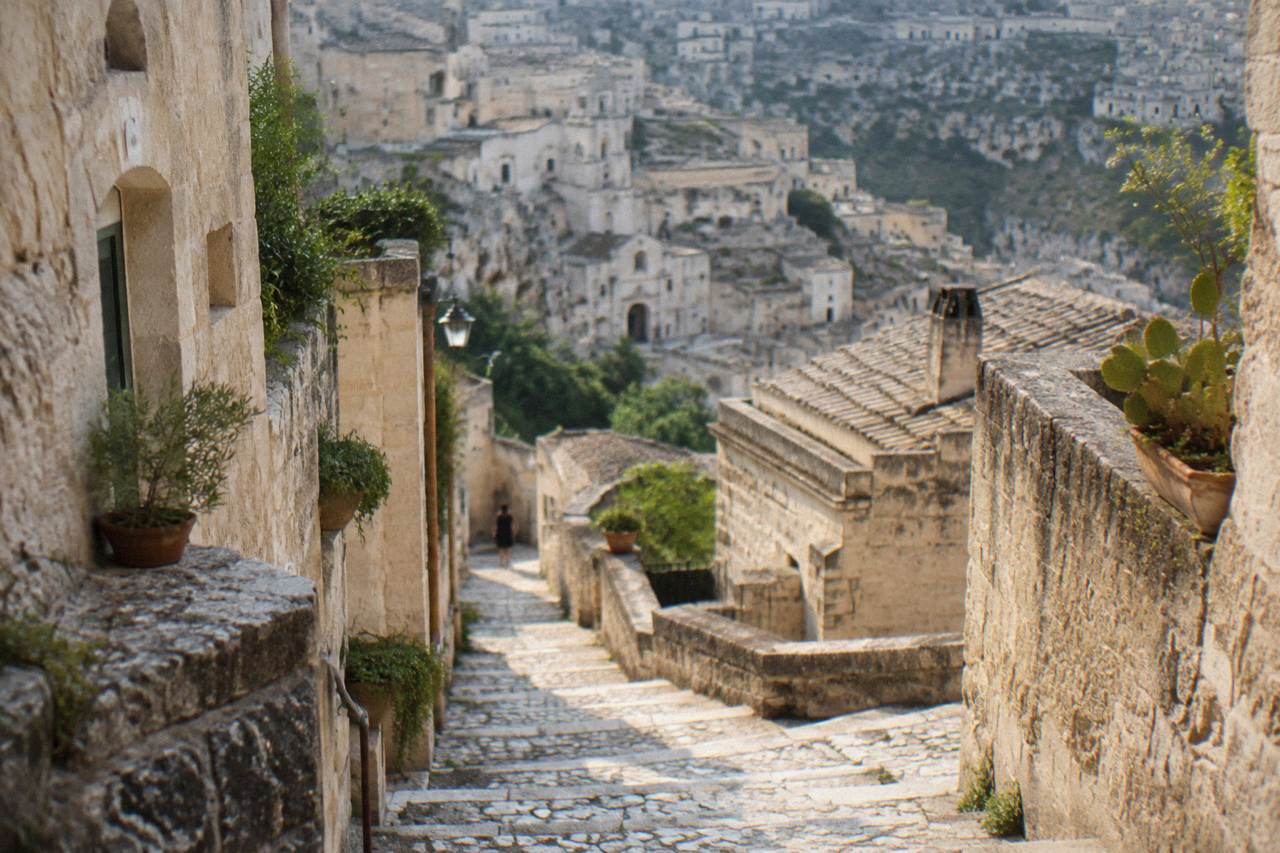
The main risks in the Sassi are terrain and traffic, and both are manageable with planning: the cave quarters are steep, stepped and uneven, with no step-free route this site can name, the tufa stone can be slippery when wet, and the ZTL Sassi cameras run from 10:00 to 20:30 for most of the year. Visitors with mobility limits or small children should plan routes on the upper streets and use the viewpoints rather than the full descents.
Start with the ground. The Sassi are cave dwellings and stone houses stacked down the canyon wall, and the connections between them are stairways, ramps and cobbled lanes cut into the rock. No named route in the Sassi can be described as step-free or wheelchair accessible, and this site will not label one as such. Footwear matters more than in a flat city: the stone is worn smooth in places, and rain makes it slick. The ERA5 reanalysis for Matera, 1991-2020, shows rain on roughly 8 to 9 days a month between November and March, with November the wettest month at 67.1 mm.
Then the canyon edge itself. The Gravina drops away below the Sassi, and several viewpoints along the rim, like the terrace near Santa Maria de Idris and the belvederes above Sasso Caveoso, have low parapets or none at all. The parco della Murgia on the opposite side is a protected park, about 8,000 hectares by the park's own count, and its trails are unsupervised scrubland paths: the park authority has run a staffed access point and ticket office at Jazzo Gattini since 6 February 2026, its notice says, which is the place to ask about trail conditions before crossing to the Murgia side.
For visitors who want the canyon views without the descents, the open-top eco-bus ride around the Sassi covers the viewpoints from the road above the quarter, and a guided walk with a local guide keeps the group on the established paths. The eco-bus has its own page on this site at Sassi of Matera eco-bus tour details, with live pricing on the operator's listing.
Practical preparation helps more than any gadget. Tap water in Matera is drinking water, so a refillable bottle is a normal precaution against the summer heat rather than a safety measure, and packing questions are covered in full on What Clothes Should I Pack For Matera?. In July and August the ERA5 reanalysis puts the mean high at about 31 C, and the Sassi stairways offer little shade between viewpoints.
Is It Safe To Walk In Matera At Night?
Yes, walking in Matera at night is broadly safe on the lit upper streets and the main Sassi routes, with the same terrain caution as by day: the stairways are unlit in places, the drops at the canyon edge do not disappear after dark, and the ZTL Sassi cameras switch off at 20:30 for most of the year, which is when delivery traffic re-enters some streets. The emergency number to memorise is 112.
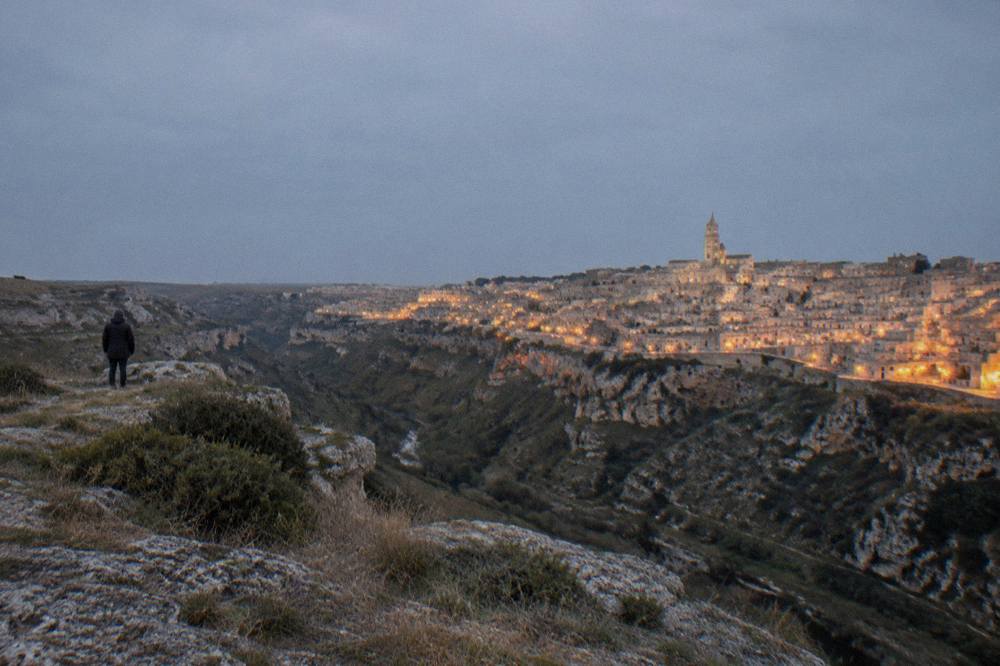
Matera at night is one of the city's draws: the illuminated Sassi seen from the Piano, and the reverse view of the canyon from the Murgia side at sunset. The main streets, Via del Corso and the areas around Piazza Vittorio Veneto, are pedestrian or near-pedestrian and stay busy through the evening in the tourist season. The APT Basilicata data gives 479,083 arrivals in registered accommodation in 2025, with 60,257 in August and 61,630 in September, so the high-season evenings are well populated.
The caution is the same one as by day, just harder to see. The stairways between the Piano and the Sassi are steep and irregular, and lighting is uneven once off the main lanes. The canyon rim is unfenced in stretches. A torch or a phone light is genuinely useful for the walk back up from Sasso Caveoso. The question of how long the city takes to walk end to end is answered with route detail on How Long Does It Take To Walk Around Matera?.
One dated operational fact belongs here. Matera's 0835 phone district joined the single European emergency number 112 on 2 December 2025, the fire brigade's notice states. The number is free, works from any phone, and passes automatic location and multilingual support. Visitors should not memorise 113 or 118 as the primary number for Matera: 112 is the one that covers police, medical and fire response.
How Do The ZTL And Driving Rules Affect Safety In Matera?
Driving into Matera is safe but rule-bound: the ZTL Sassi cameras on Via Buozzi, Via Madonna delle Virtù and Via D'Addozio are active 10:00 to 20:30 from 16 September to 30 June and 10:00 to 24:00 from 1 July to 15 September, the ZTL Centro runs 24 hours a day, and Piazza Vittorio Veneto is pedestrianised all day. The practical answer is to park outside the restricted zones and walk down.
The comune publishes the camera hours as a public PDF under ordinances 147 and 148/2025, and the hours matter for two reasons. First, a ZTL fine is the most common way an otherwise uneventful visit acquires an unexpected cost, and the gates are camera-enforced with no barrier to stop a car. Second, the loading windows, 07:00 to 10:30 and 15:00 to 17:00, are when delivery vehicles move through streets that are otherwise pedestrian, so a visitor walking at those hours shares the lane with vans.
| Restricted zone | Streets covered | Active hours |
|---|---|---|
| ZTL Sassi | Via Buozzi, Via Madonna delle Virtù, Via D'Addozio | 10:00 to 20:30 from 16 Sep to 30 Jun; 10:00 to 24:00 from 1 Jul to 15 Sep |
| ZTL Centro | Via Scotellaro, Via del Corso, Via delle Beccherie, Via Duomo, Piazza Sedile, San Francesco | 24 hours a day, every day |
| ZTL San Giovanni / San Biagio, ZTL Santa Cesarea | The named historic quarters | 24 hours a day, every day |
| ZTL Piave | Electronic gates, definitive operation under Ordinance 257/2025 | Same seasonal hours as ZTL Sassi |
| ZTL Prefettura, Ridola, Casalnuovo, Stigliani | Evening zone around the modern centre | 20:30 to 24:00, weekdays and holidays |
| Pedestrian area (APU) | Piazza Vittorio Veneto, Via Ridola | Closed to vehicles all day; bollards open 04:00 to 08:00 weekdays for deliveries |
Public car park tariffs are not published on any official page this site could verify, so the advice stays general: park outside the zones, confirm the tariff at the meter, and walk. The ZTL office takes questions at ztl@comune.mt.it and transit declarations through the comune's own portal, both listed on the comune's ZTL page. Visitors arriving without a car avoid the whole question, which is one argument for the train: FAL runs the line from Bari with a change at Altamura, about 1 h 45 to 2 h, and there are no trains on Sundays and public holidays, only replacement buses, so current times should be checked on FAL's timetable page.
The same caution applies to the roads out of town. The SS7 Appia and SS99 are ordinary regional roads, and this site holds no verified information on current roadworks beyond the Anas maintenance programme, so drivers should check the Anas notices before a day trip. Distances from Matera are verified: Altamura is about 20 km, Alberobello about 68 km, and Bari Airport about 64 km with roughly an hour of free-flow driving.
What Should Visitors Know About Health, Money And Everyday Precautions?
Everyday precautions in Matera are the standard Italian ones plus the terrain: carry the 112 number, keep the European Health Insurance Card if eligible, expect a tourist tax collected by the accommodation at an amount confirmed at booking, and treat the Sassi stairways as a hiking route rather than a city street. Italy is a Schengen member and uses the euro, and the language is Italian.
None of this is exotic. The tourist tax, imposta di soggiorno, is collected by hotels and rentals, and no official Matera tariff page could be verified, so the amount is confirmed at booking rather than printed here. Pharmacies are marked with green crosses as anywhere in Italy. Tap water is potable, covered in detail on Can I Drink Tap Water In Matera?.
| Situation | What the sources say to do |
|---|---|
| Any emergency, police, medical or fire | Call 112, live in the 0835 district since 2 December 2025, free, with automatic location |
| Slippery Sassi stone after rain | ERA5 1991-2020 normals show 8 to 9 rain days a month from November to March; footwear with grip |
| Canyon-edge viewpoints | Unfenced stretches along the Gravina rim; keep children and dogs on the upper paths |
| Murgia park trails | Staffed info point and ticket office at Jazzo Gattini since 6 February 2026; ask about trail conditions there |
| Driving into the historic centre | ZTL cameras per the comune's hours PDF; park outside the zones and walk down |
| Tourist tax amount | Collected by the accommodation; confirmed at booking, no official tariff published |
The city's own scale is part of the answer. With 59,368 residents and a compact historic core, Matera is a city where the distances are short and the footfall is concentrated: 61,630 arrivals in September 2025 against 15,239 in February means the summer and early-autumn streets are busy and the winter ones are quiet, and both situations reward the same preparation. A quieter city is not an unsafe one, but an empty lane in the Sassi at 22:00 is darker and steeper than the same lane at midday.
For readers weighing the whole question of whether the trip is worth it, the case for the city is set out on Is Matera Italy Worth Visiting?, and the background to the restored cave quarters is on Why Was Matera Abandoned?. This Matera Travel Guide page reports only what the official sources state, and where a number is not published, it says so rather than guessing.
Common Questions About Safety In Matera
Is Matera a safe city to visit?
Yes. The verified safety facts are practical ones: the Sassi terrain is steep and uneven, the emergency number is 112, and the historic centre is protected by camera-enforced traffic zones. No official crime statistics for Matera are published in the sources this site verified, so the briefing sticks to terrain, emergency services and traffic rules.
Is Matera a safe city to visit at night?
The lit upper streets and main Sassi lanes are busy through the evening in season. The caution is terrain: stairways are unlit in places and the canyon rim is unfenced in stretches, so a torch is useful for the walk back up from Sasso Caveoso.
What is the emergency number in Matera?
112. Matera's 0835 phone district joined the single European emergency number on 2 December 2025, according to the fire brigade's notice. It is free, works from any phone, and connects police, medical and fire response with automatic location.
Are the Sassi dangerous to walk?
Not dangerous, but demanding. The routes are steep, stepped and cut into tufa stone that is slick when wet. No named route in the Sassi can be called step-free or wheelchair accessible, and sturdy footwear matters more than in a flat city.
Is it safe to drive in Matera?
Yes, provided the restricted zones are respected. The ZTL Sassi cameras run 10:00 to 20:30 for most of the year, the ZTL Centro runs 24 hours a day, and Piazza Vittorio Veneto is pedestrianised. The practical answer is to park outside the zones and walk down into the Sassi.
Is Matera safe for solo travellers and families?
The verified facts point to a manageable small city: 59,368 residents, a compact core, staffed park access points and published municipal rules. Families should keep children on the upper paths near the canyon rim, and the standard Italian precautions, 112 in the phone and the EHIC where eligible, cover the rest.