What Clothes Should I Pack For Matera?
A season-by-season packing list for Matera in Basilicata, built on ERA5 climate normals, with advice on shoes for the Sassi, layers for winter frost and clothes for summer heat.
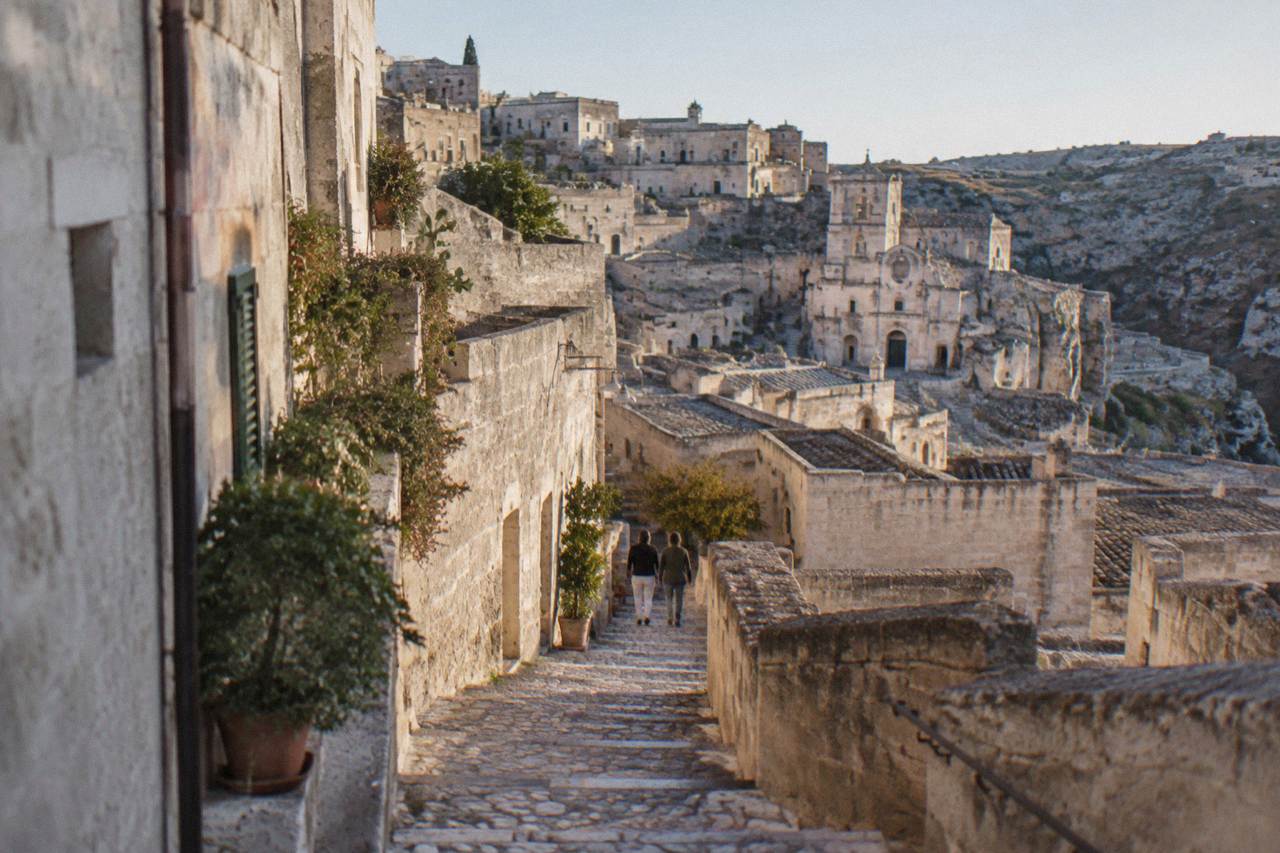
Matera is an inland city in Basilicata, southern Italy, at about 400 m above sea level on the edge of the Gravina canyon, and that elevation does more to shape a packing list than any guidebook summary suggests. The ERA5 reanalysis for Matera, 1991-2020, puts the July and August mean highs at 31.2 and 31.3 C, while January lows average 2.2 C with about 20 frost days a year, almost all between December and March. Add the Sassi themselves: steep stone stairways and uneven alleys cut into pale tufa limestone, and the packing question becomes one of shoes as much as shirts.
What Clothes Should I Pack For Matera?
Pack for a continental-leaning Mediterranean climate with a wide seasonal swing: breathable cotton or linen for July and August, warm layers, a proper coat, hat and gloves for December to March when frost is normal, and above all closed walking shoes with real grip, because the Sassi are stepped, uneven and worn smooth underfoot. Add a rain layer for November, the wettest month at 67.1 mm in the ERA5 reanalysis, 1991-2020, and modest shoulder coverings for visiting churches.
That is the short version. The longer version starts with the fact that Matera is not a seaside town, even though day trippers often arrive expecting Puglia's coastal weather. The coast is a drive away: Metaponto on the Ionian, Polignano a Mare and Bari on the Adriatic. Matera itself sits on the Murgia plateau's edge, and the Matera Travel Guide climate data, drawn from the ERA5 reanalysis, 1991-2020, shows mean lows of 2.2 C in both January and February. Frost is a normal winter feature here, not a rarity, and the damp cold of the canyon reads colder than the thermometer.
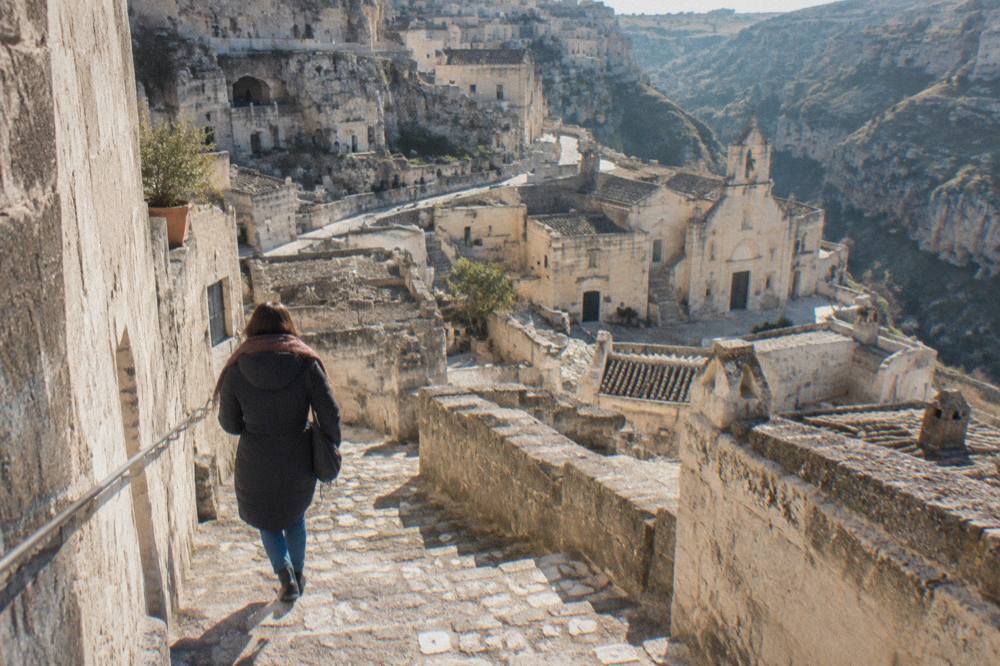
The second driver is the city fabric. The Sassi, Sasso Caveoso and Sasso Barisano, are cave dwellings and stone houses linked by staircases carved and worn into rock. Sandals, smooth-soled sneakers and anything with a heel turn every descent into a calculation. Grip, ankle support and socks you can walk in all day matter more than any fashion choice, and that holds in every season.
| Season | Typical daytime feel (ERA5 means) | Core packing items |
|---|---|---|
| Winter (Dec to Feb) | Highs 10.3 to 11.2 C, lows 2.2 to 3.7 C, frost likely | Warm coat, sweater or fleece, hat, gloves, scarf, waterproof shoes |
| Spring (Mar to May) | Highs 14.1 to 22.7 C, lows 4.4 to 11.5 C | Layers, light jacket, long sleeves for evenings, rain shell |
| Summer (Jun to Aug) | Highs 28.2 to 31.3 C, lows 16.0 to 18.9 C | Linen or cotton shirts, sun hat, sunglasses, breathable trousers |
| Autumn (Sep to Nov) | Highs 15.5 to 25.7 C, lows 7.5 to 15.2 C | Layers again, light jacket, umbrella for November |
How Should You Dress For Matera's Summer Heat?
Dress for sustained heat rather than a brief midday peak: the ERA5 reanalysis, 1991-2020, gives July a mean high of 31.2 C and August 31.3 C, with mean lows still at 18.6 and 18.9 C, so nights barely cool. Loose cotton or linen shirts, breathable trousers or skirts, a wide-brimmed hat, sunglasses and high-factor sunscreen are the core kit, and about 55 days a year reach 30 C, of which roughly 40 fall in July and August.
The structure of a summer day in Matera argues for a specific rhythm. Mornings are the comfortable window for the Sassi's stairways, both for temperature and for light on photography. Midday belongs to shade, long lunches and the cave-cool interiors that give Matera its character: cave churches such as Santa Lucia alle Malve hold a naturally stable temperature while the surface bakes. Oltre l'Arte's ticket page lists those churches open daily from 09:30 to 19:30 from 28 March 2026, so an early or late entry avoids the worst of the heat.
Footwear in summer is where visitors get caught out. The temptation is sandals, and the stone is the argument against: stair treads polished by generations of feet, loose gravel on the Murgia paths, and hot surfaces that radiate well into the evening. A closed walking shoe with a grippy sole, worn with thin socks, handles all of it. If you plan to cross to the Parco della Murgia side for the classic view back over the Sassi, note that the park's access to Sentiero 406 has been managed by a staffed point with an online access ticket since March 2026, and the path itself is rough going, another vote for proper shoes.
A final summer point concerns modesty inside churches. The rupestrian churches, the Cathedral and the working parish churches are active places of worship, and shoulders covered is the working rule. A light scarf or a shirt with sleeves, carried rather than worn in the heat, solves the cathedral entry without turning the whole outfit formal. The Cathedral and MATA diocesan museum route is listed at 4.00 EUR on Oltre l'Arte's ticket page, with tourist visits pausing on Sundays and solemnities between 10:00 and 12:30.
How Should You Dress For Winter In Matera?
Pack real winter clothes, not a light jacket over a sweater: the ERA5 reanalysis, 1991-2020, puts January mean lows at 2.2 C with about 20 frost days a year across the city, almost all from December to March, and the damp canyon air makes 5 C feel sharper than the number suggests. A warm coat, layered knitwear, hat, gloves and waterproof, insulated shoes are the honest winter kit for Matera.
Winter here surprises the arrivals who equate southern Italy with mild. Matera is inland and elevated, and the same geography that bakes in August chills in January. The APT Basilicata data shows the season is genuinely quiet: February 2025 logged 15,239 arrivals in the city's accommodation against 61,630 in September, so a winter visitor gets empty staircases and low hotel demand in exchange for cold mornings. For what the cold actually feels like, the companion page How Cold Does It Get In Matera? breaks down the lows month by month, and Does It Snow In Matera? covers the white-stuff question separately.
Layers are the practical answer because Matera's winter day swings. A morning at 2 C can reach a mean high of 10.3 C by early afternoon, and cave interiors hold a different temperature again. A base layer, a mid-weight knit and a wind-and-water-resistant coat let you shed and add without carrying a second wardrobe. Rain matters too: December averages 57.2 mm and November 67.1 mm in the ERA5 reanalysis, 1991-2020, so a compact umbrella earns its space.
Winter also has a specific payoff that shapes the packing list. The Presepe Vivente nei Sassi, a living nativity with 20 scenes staged through Sasso Caveoso, runs its public days across the December weekends and 2-3 January, with tickets listed at 12.00 EUR full on the organiser's site. It is an outdoor evening event on stone streets in December: hat, gloves, a proper coat and the warmest shoes in the suitcase are not optional extras for it, they are the ticket to enjoying it.
What Shoes Work Best On The Sassi's Stone Streets?
Choose closed, grippy walking shoes with decent tread and some ankle support, worn in before the trip: the Sassi's stairways are steep, stepped and uneven, worn smooth in places, and damp stone after rain is slippery, so sandals, smooth-soled sneakers and heels all fail here in every season. A second pair, light and dry, for evenings is a reasonable luxury; flip-flops belong only in the hotel.
This is the single most consequential clothing decision for Matera, and the reason deserves spelling out. The Sassi are a cave district, not a paved one. Routes between Piazza San Pietro Caveoso, the Rione Malve and the ridges above drop and climb continuously, tufa steps are irregular, and the descent to the Gravina side and the path network of the Parco della Murgia add loose gravel and dust to the mix. No named route in the Sassi can be described as step-free or wheelchair accessible, and the same terrain that makes that true makes footwear the difference between a full day and a shortened one.
Season adjusts the shoe question rather than changing it. In summer, breathable mesh or leather walking shoes with thin socks avoid overheated feet; in winter, a waterproof shoe or a light boot handles the frost mornings and the 51.4 mm of rain an average January brings, per the ERA5 reanalysis, 1991-2020. One practical note on rain: the stone dries patchily, and a shaded staircase can stay slick hours after a shower. Tread, not weather prediction, is the fix.
For visitors who plan guided walking, the footwear logic doubles. A guided Sassi walk covers the same stairways at a guide's pace, and the Sassi Walk with Cave House route includes cave interiors with low thresholds and worn floors. The same preparation applies to tip-based walks, which run locally in Matera: confirm meeting point and route with the guide directly, and wear the shoes you would trust on wet stone.
What Should You Pack For Spring And Autumn In Matera?
Pack in layers and expect the biggest day-to-day swing of the year: spring runs from a March mean high of 14.1 C to May's 22.7 C, while autumn drops from September's 25.7 C to November's 15.5 C, with lows anywhere from 4.4 to 15.2 C across those months in the ERA5 reanalysis, 1991-2020, so a light jacket, a sweater and a rain shell cover almost every shoulder-season day in Matera.
Shoulder season is also the season the arrival data favours. The APT Basilicata counts show April 2025 at 45,195 arrivals, May at 54,101 and October at 52,538, all strong months, while September's 61,630 was the year's peak and 74.5% of those September guests came from abroad. What that means for clothes is simple: the crowds of September still walk in summer-weight kit by day, but the evenings, with a mean low of 15.2 C, want a layer. October's mean low of 11.6 C makes that layer non-negotiable.
| Month | Mean high C | Mean low C | Rain mm | What the numbers say to pack |
|---|---|---|---|---|
| March | 14.1 | 4.4 | 59.2 | Warm layers, jacket, rain shell |
| April | 17.4 | 7.1 | 56.5 | Light layers, sweater for evenings |
| May | 22.7 | 11.5 | 41.7 | Day summer kit, one warm layer |
| September | 25.7 | 15.2 | 44.8 | Summer kit plus evening layer |
| October | 20.8 | 11.6 | 51.7 | Layers, light jacket, umbrella |
| November | 15.5 | 7.5 | 67.1 | Warm layers, waterproof, umbrella |
The rain numbers deserve their own sentence: November is the wettest month at 67.1 mm, and March follows at 59.2 mm, per the ERA5 reanalysis, 1991-2020. Neither is a washout figure by northern European standards, but both land on stone that holds surface water. A packable rain shell and a compact umbrella, plus the grippy shoes already discussed, convert a wet shoulder-season day from a retreat into the hotel into a workable walking day, and Matera's cave interiors, from MUSMA to the rock churches, are natural wet-weather plans.
Autumn packing has one cultural add-on. The Matera Film Festival's seventh edition runs 7 to 15 November 2026, and the Orchestra ICO della Magna Grecia season at Auditorium Gervasio runs from 26 October 2026 to 16 April 2027, so an autumn or winter visitor may want one smart-casual outfit for evening events. Matera is not a formal city, but a jacket over the walking kit covers cinema seats and concert halls alike.
What Extras Belong In A Matera Suitcase?
Beyond clothes, pack sun protection for the exposed Murgia ridges, a refillable water bottle, a small daypack for the steep walks, a power bank for photo-heavy days, and modest cover-ups for church visits, because the practical demands of Matera are sun, stone, stairs and worship spaces, in roughly that order, with tap water safe to drink straight from the supply.
The sun point is easy to underestimate outside July and August. The Belvedere Murgia Timone viewpoint and the park paths are exposed plateau with little shade, and a hat and sunscreen matter from April onward even when the air feels mild. The water point matters on the same walks: the companion answer Can I Drink Tap Water In Matera? confirms the supply is drinkable, so a bottle saves both money and plastic on long stairway circuits.
The daypack earns its place on the layering logic alone. A coat shed at 11:00 and needed again at 17:00 has to live somewhere, and the Sassi's staircases punish shoulder bags that swing. A small, stable backpack also carries the church cover-up, the umbrella in the November-to-March window, and the guidebook or e-ticket for the Oltre l'Arte sites, whose all-inclusive 8-site ticket is listed at 25.00 EUR on the operator's own page.
One planning extra: the length of stay shapes how much of this list you actually need. The average guest in 2025 stayed 1.56 nights, per the APT Basilicata data, so many arrivals pack for two days and walk most of the time. The page How Many Nights Should I Stay In Matera? is the companion read, and for anyone deciding whether the city justifies the packing effort at all, Is Matera Worth Visiting? makes the case from the same verified sources.
Common Questions About Packing For Matera
Do I need walking boots for Matera?
Boots are useful but not mandatory. What the Sassi demand is a closed shoe with real tread and some ankle support, because the stairways are steep, uneven and worn smooth. A well-soled walking shoe handles the city streets; a light boot is the better call if your plans include the Parco della Murgia paths or the descent toward the Gravina.
Is Matera too hot for jeans in summer?
The ERA5 reanalysis, 1991-2020, gives July and August mean highs of 31.2 and 31.3 C with nights near 19 C, so heavy denim is uncomfortable on stairway days. Loose cotton or linen trousers, or breathable alternatives, are the practical summer choice, with jeans fine for evenings and cave-cool interiors.
Will I need a coat in the evenings in summer?
Rarely. Summer mean lows sit at 16.0 C in June, 18.6 C in July and 18.9 C in August, per the ERA5 reanalysis, 1991-2020, so a light layer for late dinners on exposed terraces is enough. A scarf doubles as the shoulder covering for church visits.
What should I wear to the churches in the Sassi?
Shoulders covered and something close to long trousers or a longer skirt is the working rule for the rupestrian churches, the Cathedral and active parish churches. A light scarf or shirt carried in a day bag is the simplest solution, and it costs nothing in summer comfort on the walk between sites.
Does it rain enough in Matera to need an umbrella?
Yes, in the wetter half of the year. The ERA5 reanalysis, 1991-2020, averages 562.5 mm of rain over about 90.7 rain days annually, with November the wettest month at 67.1 mm and July the driest at 21.2 mm. A compact umbrella is worth carrying from October to April, and a rain shell with a hood is even better on the stairways.
What should I pack for the Parco della Murgia side?
Treat it as a light hike: grippy shoes, a hat, sunscreen, water and a layer for the wind on the exposed plateau. Access to Sentiero 406 has been ticketed through a staffed point since March 2026, so check the park's access page before setting out, and expect rough ground rather than city pavements.
Packing for Matera comes down to respecting two facts the data makes plain: this is an elevated, inland city with a real winter and a real summer, and its historic core is walked on stone that rewards good shoes in every month of the year. Get the footwear and the layers right, and the rest of the suitcase takes care of itself.