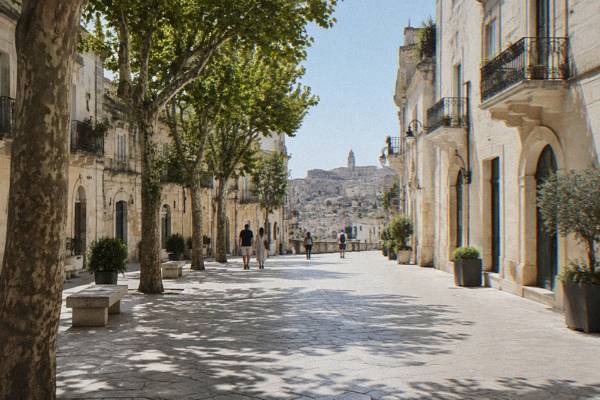
How Long Does It Take To Walk Around Matera?
How long it takes to walk around Matera, what slows a visit to the Sassi down, and which parts of the city in Basilicata are covered on foot.
Matera, in the region of Basilicata in southern Italy, is an inland city of 59,368 residents sitting at roughly 400 m above sea level on the edge of the Gravina canyon, with the Murgia plateau rising opposite. Its historic core, the Sassi, is a dense web of cave dwellings, stone houses and rock-hewn churches cut into pale tufa limestone, split into the Sasso Caveoso and the Sasso Barisano and threaded by stairways rather than streets. That geography answers the timing question before any stopwatch does: the walkable part of Matera is compact, but it is steep, stepped and uneven, and the municipal area spreads across 392 km², most of it far outside any walking circuit.
How Long Does It Take To Walk Around Matera?
There is no single verified walking-time figure for Matera, because the answer depends on where the walk stops. The historic core, the two Sassi districts plus the Civita ridge between them, is compact enough that a continuous circuit of its main lanes and stairways is a matter of a few hours at a steady pace. A visit that also enters cave houses and rock churches, or crosses to the Murgia viewpoints, becomes a full day.
The APT Basilicata figure is worth pausing on. It counts arrivals and stays in the city's hotels and rentals, 479,083 arrivals and 748,812 overnight stays in 2025, and the computed average of 1.56 nights per guest says something practical about the ground: people do not base themselves in Matera for a week of daily circuits the way they might in a coastal resort. The coast, after all, is not here. Matera is inland, and the nearest sea, at Metaponto on the Ionian or Polignano a Mare on the Adriatic, is a day trip measured in driving time, not a stroll.
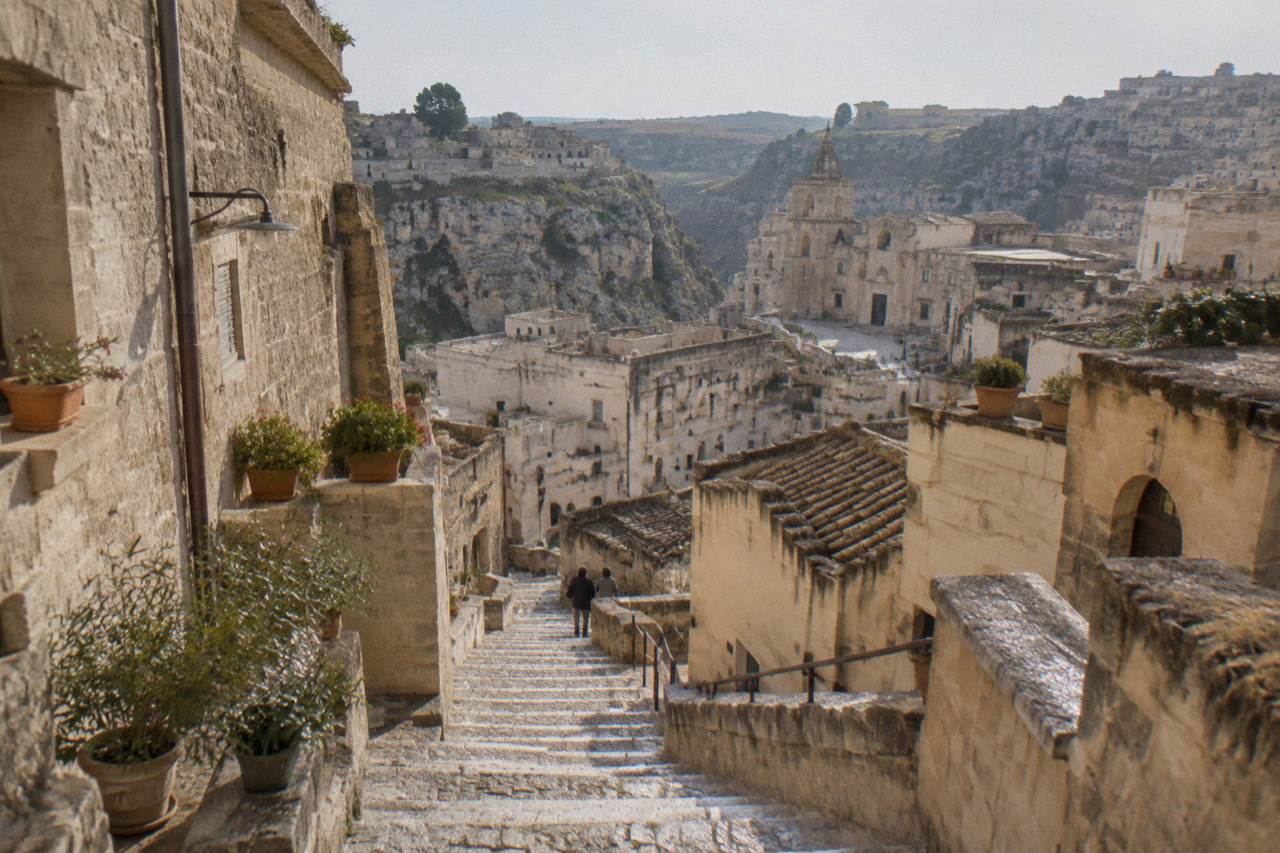
What the numbers cannot capture is the vertical. A map of the Sassi looks like a tight knot of lanes, but almost every connection between the modern upper town, the two Sassi districts and the canyon floor is a stairway or a stepped lane. The pace that matters is not the flat-street pace of a city like Bari's murattiano grid. Anyone comparing a walking circuit here with a same-distance circuit elsewhere should budget extra time for the stairs, the uneven stone and the dead ends that the canyon imposes.
Why Does Walking In Matera Take Longer Than The Map Suggests?
The Sassi of Matera are carved into the wall of a canyon, so the routes climb, descend and double back rather than running on the level, and several paths that look like shortcuts end at the Gravina. Stone stairways, uneven tufa paving and viewpoints set at different heights slow every walker. No named route in the Sassi can be described as step-free, and the park authority treats the canyon terrain as something to be managed, not flattened.
The Parco della Murgia, on the opposite side of the Gravina, made that management explicit in 2026. The park's own site states that the Sentiero 406, the path with the suspension bridge over the Gravina, has had a staffed access point and an online access ticket since March 2026, and that the Jazzo Gattini visitor centre has served as the park's info point and ticket office since 6 February 2026. The access price is not settled in any source this site can verify, so it stays off the page; the point for a walker is that crossing the canyon is now a ticketed, managed activity with its own time budget, not a casual add-on to a Sassi stroll.
The ZTL rules add a second, less obvious time factor. The comune's camera schedule shows the Sassi limited-traffic zone active from 10:00 to 20:30 between 16 September and 30 June, and from 10:00 to 24:00 from 1 July to 15 September, on weekdays and holidays alike. Cars are therefore not an option for hopping between viewpoints in the middle of the day, which pushes every visitor back onto foot, and onto the stairs. The practical consequence: the time it takes to walk around Matera is close to the time it takes to see Matera, because there is no faster way to move inside the historic core. The getting around Matera guide covers the transport options that do exist for the longer hops.
Shoes and season matter too, and the packing advice for Matera is built on the same terrain. The ERA5 reanalysis for Matera, 1991-2020, gives a July and August mean high of about 31 C, and a January mean low of 2.2 C with frost. A steep stone stairway in either condition changes a walker's pace, and the same circuit can take meaningfully longer in the mid-afternoon heat of summer than in the cool of the evening.
Which Parts Of Matera Can You Cover On Foot?
On foot, a visitor can realistically cover the Civita, the Sasso Caveoso, the Sasso Barisano and the upper town around Piazza Vittorio Veneto, which together hold the bulk of what the UNESCO inscription of 1993 protects. The walkable sightseeing core sits inside the 1,016 ha inscribed property as a much smaller band. What is not walkable is the Murgia plateau opposite, reached through the park's managed access points, and the surrounding towns, which are drives of half an hour and more.
The split matters for planning. Inside the core, the main entries are close together: the rupestrian churches run by Oltre l'Arte sit within the Sasso Caveoso and Sasso Barisano, the Casa Grotta di Vico Solitario is a cave house on the Caveoso side, and the Cathedral and the MATA museum sit on the Civita. Oltre l'Arte's ticket page lists its current options, and the prices are worth knowing before a walk, because entering sites, not walking between them, is what consumes the hours.
| Oltre l'Arte ticket | Price | What it covers |
|---|---|---|
| 1 rupestrian church | 4.50 EUR | One of Santa Lucia alle Malve, Madonna de Idris, San Pietro Barisano |
| 2 rupestrian churches | 8.00 EUR | Any two of the three |
| 3 rupestrian churches | 10.00 EUR | All three |
| Cathedral and MATA | 4.00 EUR | The "Percorso Culturale" route |
| 8-site all-inclusive | 25.00 EUR | Three churches, Vicinato a Pozzo, Casa Grotta Via Fiorentini, MATA, Purgatorio exhibition, Museo del Pane |
Oltre l'Arte's own page states that all its sites close on 25 December and 2 July, the day of the Festa della Bruna, and that children up to 10 enter free with a parent. The hours run long in season: from 28 March 2026, Santa Lucia alle Malve and Madonna de Idris are open daily 09:30 to 19:30, with last entry at 19:20. A walker planning to enter sites rather than just pass them should treat each church as a stop of some substance, not a photo pause.
The other anchor stops carry their own verified tariffs. The Storica Casa Grotta di Vico Solitario charges 8.00 EUR full, on the tariff in force from 4 April 2026, and the ticket covers the cave house, the Neviera, the natural cave and the rock church of Sant'Agostino al Casalnuovo. Casa Noha, the FAI property that introduces the Sassi's story, charges adults 6.50 EUR, though its own page states it is closed 5 to 22 October 2026 for renovation ahead of a relaunch with new displays. MUSMA, the sculpture museum in the Sasso Caveoso, is 10 EUR full. The Museo Nazionale di Matera charges 10.00 EUR per site or 15.00 EUR for a cumulative two-day ticket, with under-18s free, though the Museo Ridola, one of its sites, has been closed since 7 April 2025 for energy works and a new display, with no reopening date published.
How Long Do Guided Walks Of The Matera Sassi Take?
The durations of Matera's guided walks are printed on each operator's live listing rather than in any municipal source, and this site does not type product figures into prose. The roster shows a consistent pattern: standard guided walks of the Sassi cluster around a short outing, private tours run longer, and themed walks such as the James Bond locations tour sit in the same band as the standard ones. A guided walk therefore fits inside a half-day with room to spare.
The point of a guide in Matera is not distance but access and orientation. A licensed guide unlocks the reduced Oltre l'Arte church tariffs listed on the operator's ticket page, and a guided route through the Sasso Caveoso or Sasso Barisano tends to move at the pace of explanation, pausing at cave houses, rock churches and viewpoints that a solo walker might pass without recognising. The James Bond walking tour of Matera is a good example of the pattern: No Time to Die was shot here in 2021, one of a long list of films verified on official film-commission pages that also includes The Passion of the Christ, Wonder Woman and Pasolini's The Gospel According to St. Matthew, and the tour's route threads those locations through the same lanes any walker would cover.
To have the Sassi explained while you cover them on foot, book a guided walking tour here.
For travellers who would rather compress the orientation into a single outing, the private tour of the old town and Sassi covers the core with a guide dedicated to one group. The trade-off is simple: a private tour costs more per group, and its duration and rating render on the booking page, while the group walks cost less per person and follow a fixed route. Neither changes the underlying arithmetic of the terrain, which is that the Sassi reward slow walking regardless of who leads it.
Not everything near Matera is walkable, and one related product exists precisely for the ground beyond the Sassi. The quad ride around Matera crosses the Murgia terrain that a walking circuit cannot reach, and its price and duration render on its own listing: Check availability.
The quad option answers a real gap. The Parco della Murgia covers about 8,000 hectares by the park's own count, with 923 plant species, and its trails run across open plateau and canyon edge, terrain where a walker covers ground slowly and a vehicle covers it quickly. For a visitor asking how long it takes to walk around Matera, the honest split is: the Sassi on foot, the plateau by tour or by the park's managed access paths.
Should You Book A Guided Walk Before You Arrive In Matera?
Booking ahead is the safer choice in the months when Matera is busy, and the APT Basilicata data shows exactly when those months are. September was the busiest month of 2025 with 61,630 arrivals in registered accommodation, ahead of August at 60,257, May at 54,101 and October at 52,538, while February logged just 15,239. In September 2025, 74.5% of arrivals came from abroad. A walker arriving in that peak without a booked walk or ticket risks finding the popular slots gone.
That September peak is one of the least-known facts about Matera's calendar, and it inverts the assumption that an Italian city fills up in August. The same data shows 57.4% of all 2025 arrivals came from abroad, so the busy season here is not driven by the Italian holiday calendar alone. Walks and tickets booked for September or early October should be treated the way a coastal resort treats August.
When Is The Best Time Of Day To Walk Around Matera?
The sources point to early morning and evening for the walking itself, and to the shoulders of the day for the viewpoints. The ERA5 reanalysis for Matera, 1991-2020, gives July and August mean highs of about 31 C with roughly 55 days a year reaching 30 C, so a steep Sassi stairway is a different walk at 13:00 than at 19:00. Oltre l'Arte's churches stay open to 19:30 in season, making a late-afternoon circuit with evening entries realistic.
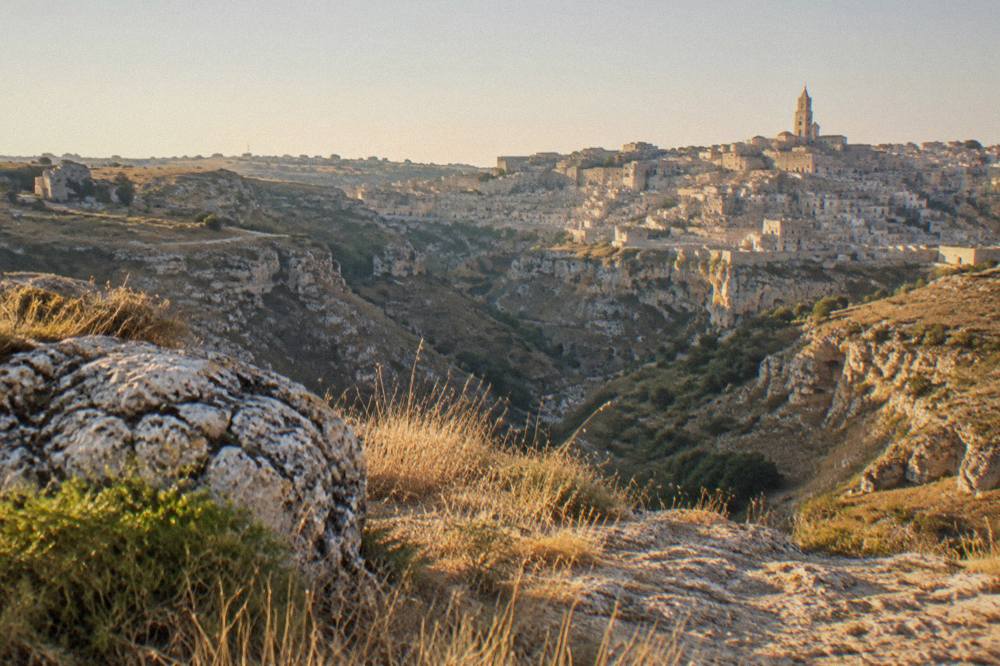
Sunset timing is its own question, covered in detail in the site's answer on sunset times in Matera, and the photography logic follows from the geography: the Sassi face the canyon, so the evening light from the Murgia side, reached through the park's access points at Jazzo Gattini or along the Sentiero 406, is the classic angle. The park's visitor-centre arrangements since February 2026 mean the evening crossing is now an organised activity with staffed access, not an informal scramble.
Winter walking has its own shape. The same reanalysis gives a January mean high of 10.3 C and a mean low of 2.2 C, with about 20 frost days a year, almost all between December and March, and November the wettest month at 67.1 mm of rain. The Sassi in winter are quiet in a way the September data makes easy to picture: 23,555 arrivals in November 2025 against 61,630 in September. Wet stone stairways deserve respect at any time of year, and the safety answer for Matera covers the practical side of the same streets.
What Lies Beyond Walking Distance From Matera?
Everything outside the Sassi-Civita-upper-town core is beyond a walking circuit, and the verified road distances make the boundary plain. Altamura is 20 km and about 20 minutes' drive, the Crypt of the Original Sin's ticket office is 13 km and about 19 minutes, and the coast is a serious trip: Metaponto 47 km, Polignano a Mare 100 km, Bari 68 km. These are free-flow driving times computed over OpenStreetMap routing, and they define the day trips that no amount of walking replaces.
| Destination from Matera | Road distance | Free-flow drive time |
|---|---|---|
| Crypt of the Original Sin ticket office | 13 km | about 19 minutes |
| Altamura | 20 km | about 20 minutes |
| Gravina in Puglia | 30 km | about 31 minutes |
| Metaponto, Ionian coast | 47 km | about 52 minutes |
| Bari Airport | 64 km | about 1 hour |
| Alberobello | 68 km | about 1 h 23 |
| Polignano a Mare, Adriatic coast | 100 km | about 1 h 29 |
The Crypt of the Original Sin deserves its own note on timing, because its own site states the rules: booking is mandatory, by e-ticket at least 90 minutes before the slot, visitors must be at the ticket office 30 minutes early, and each guided slot holds 20 people. Its price is not verifiable on an official page, so it does not appear here. The lesson for the wider question is that "how long does it take" is rarely just travel time around Matera; it is access rules, early arrivals and managed slots layered on top of the distance.
For travellers weighing whether the city justifies the travel at all, the site's answer on whether Matera is worth visiting and the one-night question work through the same APT data from the stay-length side. The short version consistent with every figure above: the walking core is small, the terrain is slow, and the time goes not into distance but into depth.
Common Questions About Walking Around Matera
How long does it take to walk around Matera?
A continuous circuit of the walkable core, the two Sassi districts, the Civita and the upper town, is a matter of a few hours at a steady pace. Add site entries, a canyon crossing or a Murgia viewpoint and it becomes a full day. The APT Basilicata data shows guests averaged 1.56 nights in Matera in 2025, which matches a compact core seen slowly rather than a wide city raced through.
Is the Sassi walk difficult?
The Sassi are steep, stepped and uneven, and no named route in them can be called step-free or wheelchair accessible. The lanes connect different levels of a canyon wall, so the walk involves repeated stairs. The terrain is the reason the circuit takes longer than the map suggests, and sturdy shoes are the standard advice.
Can you walk across the Gravina to the Murgia viewpoints?
Yes, through the Parco della Murgia's managed access. The Sentiero 406, with its suspension bridge, has had a staffed access point and an online access ticket since March 2026, and the Jazzo Gattini visitor centre has been the park's info point and ticket office since 6 February 2026. The access price is not settled in any source this site can verify, so confirm it on the park's ticket page.
Do you need a guide to walk the Sassi of Matera?
No, the lanes are open and the core can be walked independently. A licensed guide does two things a map cannot: unlocks the reduced church tariffs listed on Oltre l'Arte's ticket page and explains what the cave houses and rock churches actually are. Tip-based walks also run locally; confirm arrangements directly with the guide.
How long should you stay in Matera if you want to walk everywhere?
The APT Basilicata data gives an average stay of 1.56 nights in 2025, which covers the walking core and a viewpoint. A visitor who also wants the rupestrian churches, a Murgia crossing and one day trip, say the Crypt of the Original Sin or Altamura, needs more than that. The site's answer on how many nights to stay in Matera works through the options.
When is the quietest time of year to walk Matera?
February, by the APT Basilicata counts: 15,239 arrivals in registered accommodation in February 2025 against 61,630 in September. November is close behind at 23,555, though the ERA5 reanalysis, 1991-2020, marks it as the wettest month at 67.1 mm of rain, so the trade-off is quiet streets against wet stone.
The honest summary, consistent with every figure in the verified sources: walking around Matera means walking the Sassi, the Civita and the upper town, a compact core that takes hours rather than days precisely because the terrain refuses to be hurried. The rest of the region, coast, plateau and neighbouring towns, is measured in driving time, and the Matera Travel Guide covers each of those trips on its own page.