What Are Some Interesting Facts About Matera?
Verified facts about Matera in Basilicata, Italy: UNESCO status, population, arrivals data, films, climate and transport, all from official sources.
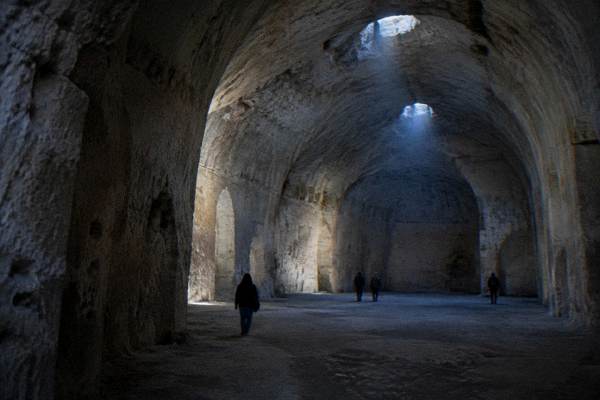
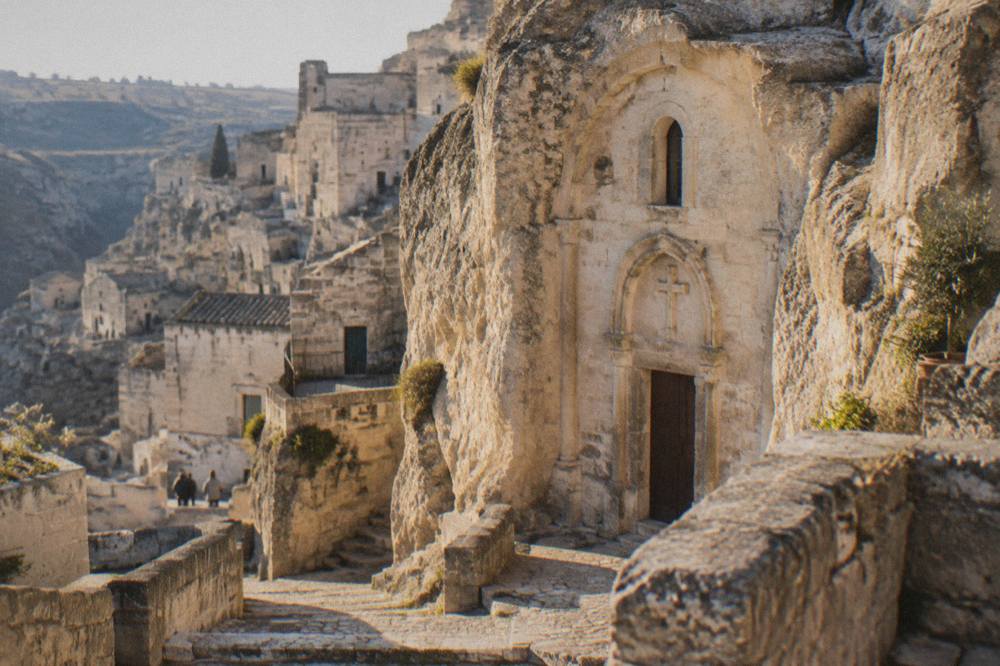
Matera, in the region of Basilicata in southern Italy, is an inland city of about 400 m above sea level, sitting on the edge of the Gravina canyon with the Murgia plateau opposite. Its old quarters, the Sassi, are cave dwellings and rock-hewn churches cut into pale tufa limestone, and UNESCO inscribed them as a World Heritage Site in 1993. This page gathers the facts that hold up on an official page: population, arrivals data, UNESCO wording, films, climate and transport. It is part of the fact-checked coverage on Matera Travel Guide, and every figure below comes from a source that was checked.
What Are Some Interesting Facts About Matera?
Matera is a city of 59,368 residents in Basilicata, southern Italy, whose Sassi cave districts were inscribed by UNESCO in 1993 as "The Sassi and the Park of the Rupestrian Churches of Matera". Its accommodation logged 479,083 arrivals in 2025, more than the 2019 Capital of Culture year, and 57.4% of those arrivals came from abroad.
The city sits inland at about 400 m above sea level, with no sea and no Trenitalia station, and its patron feast, the Festa della Bruna, has been fixed to 2 July since 1389.
Those are the headline numbers. Behind them sits a longer story: a city whose residents were moved out of the cave districts between 1952 and the 1970s, then brought back by a 1986 restoration law, and which then became a European Capital of Culture in 2019. The Fondazione Matera-Basilicata 2019 still operates and runs the "Matera 2026 Mediterranean Capital of Culture and Dialogue" programme. If the deeper backstory is what you are after, the pages on what is so special about Matera and why Matera was called the shame of Italy cover it in detail.
| Fact | Figure | Source basis |
|---|---|---|
| Residents, 1 January 2026 | 59,368 | ISTAT via tuttitalia.it |
| UNESCO inscription | 1993, criteria (iii), (iv), (v) | UNESCO list, site 670 |
| UNESCO property area | 1,016 ha | UNESCO list |
| Arrivals 2025 | 479,083 | APT Basilicata |
| Average stay 2025 | 1.56 nights | APT Basilicata, computed |
| Patron feast | Madonna della Bruna, 2 July | Festa della Bruna site |
| Emergency number | 112 | Vigilfuoco, live since 2 December 2025 |
Where Is Matera And What Kind Of City Is It?
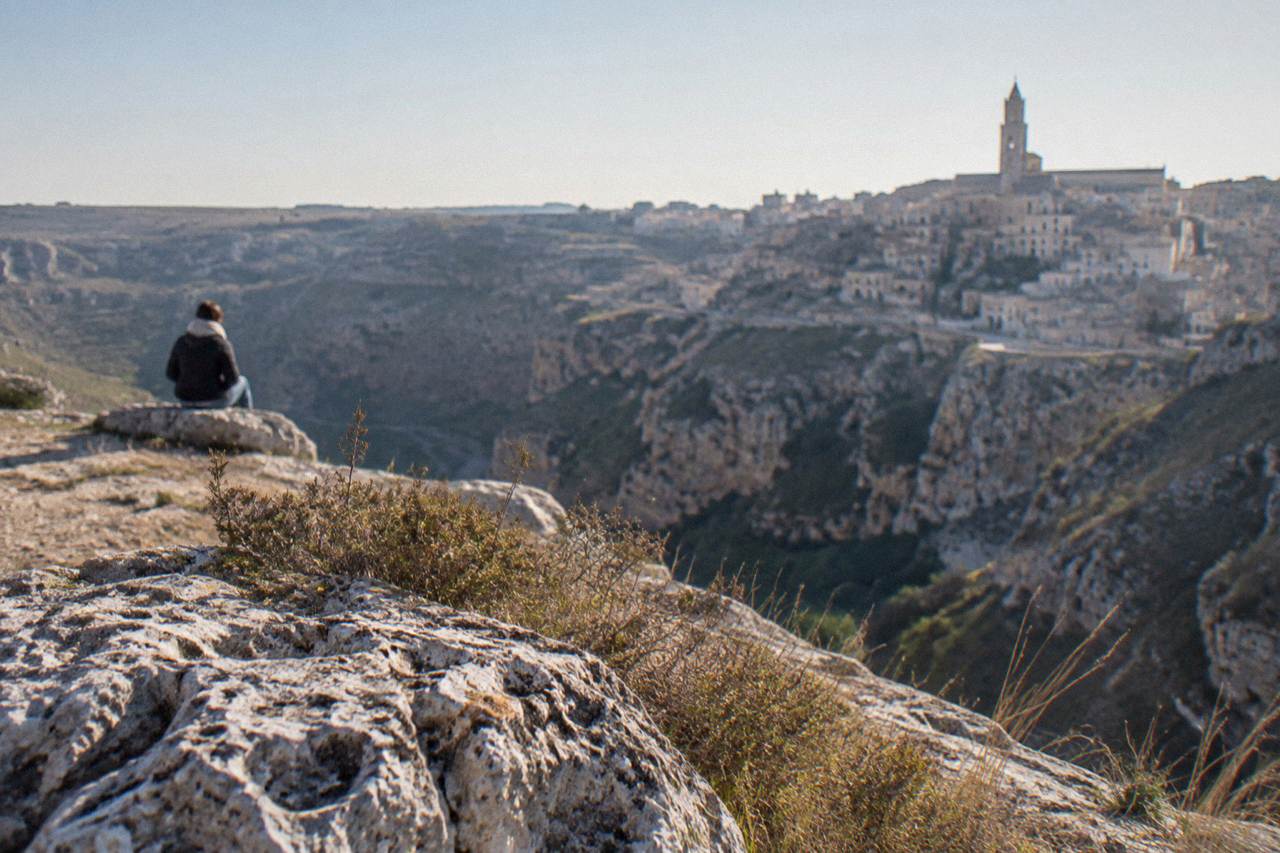
Matera is an inland city in Basilicata, southern Italy, the capital of the province of Matera, with a municipal area of 392.08 km2 and 151 residents per km2. There is no sea at Matera: the coast is a day trip, to Metaponto on the Ionian or Polignano a Mare and Bari on the Adriatic. The city stands about 400 m above sea level on the edge of the Gravina canyon, and its residents are called materani.
The elevation matters more than a map suggests. The climate is continental-leaning Mediterranean: the ERA5 reanalysis for Matera, 1991-2020, gives a mean high of about 31 C in July and August and a mean low of 2.2 C in January and February, with about 20 frost days a year. November is the wettest month at 67.1 mm of rain. The Sassi themselves are steep, stepped and uneven ground, cut into tufa on the canyon side, with the Murgia plateau and its rupestrian churches facing them across the Gravina. For the boundary questions, see is Matera part of Puglia and the difference between Matera and Sassi di Matera.
The city's identity is bound up with its bread as much as its stone. Pane di Matera holds PGI status, registered in 2008, and the bread's irregular shape and durum-wheat crust are a fixture of the local table. The patron feast, the Festa della Bruna, is the one date the whole city organises itself around: the organisers' own history ties the celebrations to 1389, when Pope Urban VI, a former archbishop of Matera, fixed the feast to 2 July, and the 2025 edition was the 636th by their count.
Why Is Matera A UNESCO World Heritage Site?
UNESCO inscribed "The Sassi and the Park of the Rupestrian Churches of Matera" in 1993, at its 17th session, under criteria (iii), (iv) and (v). Criterion (iii) calls it "an outstanding example of a rock-cut settlement, adapted perfectly to its geomorphological setting and ecosystem and exhibiting continuity over more than two millennia". The inscribed property covers 1,016 ha and includes more than a thousand dwellings plus shops and workshops.
The park side of the inscription is the Parco della Murgia, created by regional Law 11/1990. The park's own site gives its size as about 8,000 hectares and counts 923 plant species, which it describes as about a sixth of the national flora. UNESCO's own text, by contrast, says the law protects some 6,500 ha, so the two official figures differ and this site prints neither as a bare exact number. The rock-hewn churches inside the park are the other half of the story, and the page on whether people still live in the Sassi explains how the districts went from evacuation to repopulation. A guided walk is the practical way to read the site, and the Sassi walk with cave house covers both a cave dwelling and a rupestrian church, or Check availability for current dates.
What Films Were Shot In Matera?
Matera's Sassi have stood in for the ancient and biblical world on film since Pasolini's The Gospel According to St. Matthew in 1964, and the verified list includes King David (1985), The Night Sun (1990), The Passion of the Christ (2004), The Nativity Story (2006), The Omen (2006), Wonder Woman (2017) and No Time to Die (2021). The regional tourism board and the Italian film commission both name these titles on their own pages.
The Bond connection is the one that still draws people to specific spots, and the page on what movie is filmed in Matera and where Daniel Craig stayed in Matera follow it street by street. The TV series Imma Tataranni, Sostituto procuratore has also filmed in the city across five seasons. One caution: film lists circulating online add titles that do not check out, so this site sticks to the titles named on the official Basilicata tourism and film-commission pages.
What Do The Numbers Say About Matera Today?
Matera's registered accommodation logged 479,083 arrivals and 748,812 overnight stays in 2025, against 388,158 and 730,434 in the 2019 Capital of Culture year, a rise of 23.4% in arrivals. September, not August, was the busiest month with 61,630 arrivals, and 74.5% of them came from abroad. Across the whole of 2025, 57.4% of arrivals were foreign, and the average stay was 1.56 nights.
The APT Basilicata data counts guests in registered accommodation, not day trippers, so it is a floor rather than a total. The pattern inside the year is consistent: the peak is early autumn, not midsummer, and foreign guests are the majority in April, May, June, July, September and October, while August is the one warm month when Italian guests dominate. January to August 2026 ran 3.1% ahead of the same months of 2025, so the trend has continued. The rest of the planning pages sit on Matera Travel Guide.
| Month | Mean high C (ERA5 1991-2020) | Rain mm | Arrivals 2025 (APT) |
|---|---|---|---|
| February | 11.1 | 54.9 | 15,239 |
| May | 22.7 | 41.7 | 54,101 |
| July | 31.2 | 21.2 | 43,966 |
| August | 31.3 | 21.7 | 60,257 |
| September | 25.7 | 44.8 | 61,630 |
| November | 15.5 | 67.1 | 23,555 |
The pairing in that table is the detail a first page of search results misses: July and August have nearly identical mean highs, yet July drew fewer arrivals than April, May, June, August, September or October. The crowd peaks in September, once the mean high has dropped to 25.7 C. For the practical side of that, see how many nights you should stay in Matera.
What Should You Know About Getting To And Around Matera?
Matera has no Trenitalia station: the rail operator is FAL, whose posted weekday timetable has you change at Altamura, with a journey of about 1 h 45 to 2 h from Bari. On Sundays and public holidays no trains run at all and FAL runs replacement buses. The city's historic centre is wrapped in limited-traffic zones, the ZTL Sassi cameras run from 10:00 to 20:30 for most of the year, and the single European emergency number 112 has served the Matera district since 2 December 2025.
The ZTL detail is the one that costs visitors money. The Sassi gates on Via Buozzi, Via Madonna delle Virtù and Via D'Addozio are camera-enforced on weekdays and holidays alike, and the central ZTL around Via del Corso and Piazza Sedile is active 24 hours a day. Piazza Vittorio Veneto and Via Ridola are pedestrian areas closed to vehicles all day. The practical pages on how long it takes to walk around Matera and where to stay in Matera with a car handle the consequences.
One more transport fact worth knowing: Matera is not yet on the national rail network. RFI is building a new line from Ferrandina to Matera La Martella, 20 km of single electrified track at a cost of 525 million EUR, with works under way since 2023 and activation planned for 2028. Until then FAL, a regional operator, is the only rail link, and its timetable page is the place to check current times before any journey.
Matera also works as a base for the stranger corners of Basilicata. The abandoned hill town of Craco, emptied after landslides and now a film set in its own right, sits about 57 km away by road, and the Craco ghost town and Amaro Lucano day trip pairs it with a tasting of the region's historic liqueur, or Check availability for dates.
Common Questions About Matera Facts
What Are Some Interesting Facts About Matera?
Matera has 59,368 residents, was inscribed by UNESCO in 1993 for its rock-cut settlement, logged 479,083 accommodation arrivals in 2025 with 57.4% from abroad, has no Trenitalia station, and celebrates its patron feast, the Festa della Bruna, every 2 July, a date fixed since 1389.
Is Matera The Oldest City In The World?
No official source this site could open says so. UNESCO's own wording is "continuity over more than two millennia" and "first occupied during the Palaeolithic", and that is the wording this site uses. See the dedicated page on is Matera the oldest city in the world.
Is Matera Near The Sea?
No. Matera is an inland city at about 400 m above sea level on the edge of the Gravina canyon. The nearest coasts are day trips: Metaponto on the Ionian, and Polignano a Mare, Monopoli and Bari on the Adriatic.
What Is Matera Famous For?
For the Sassi, cave dwellings and rock-hewn churches cut into tufa limestone, for a long list of films shot among them, and for the Festa della Bruna on 2 July, whose celebrations the organisers date to 1389.
What Region Is Matera In?
Basilicata, in southern Italy, and it is the capital of the province of Matera. It is not in Puglia, though Alberobello, Bari and Polignano a Mare, all popular pairings with Matera, are.
How Busy Is Matera?
By the APT Basilicata accommodation counts, 479,083 arrivals in 2025, with September the busiest month at 61,630 and February the quietest at 15,239, roughly a fourfold difference between the peak and the winter low.