Matera In Winter
Matera in winter is cold and damp at about 400 m above sea level, but the crowds thin, the cave churches stay open and the Presepe Vivente fills the Sassi in December. Here is what the sources say.
Short answer
Winter in Matera (December to February) brings mean lows of 2.2 to 3.7 C and mean highs of 10.3 to 11.2 C, with 51.4 to 57.2 mm of rain a month. September, not August, is the busy month, so winter is quiet: February 2025 logged 15,239 arrivals against 61,630 in September. Museums and rock churches stay open with shorter hours; the Museo Ridola remains closed.
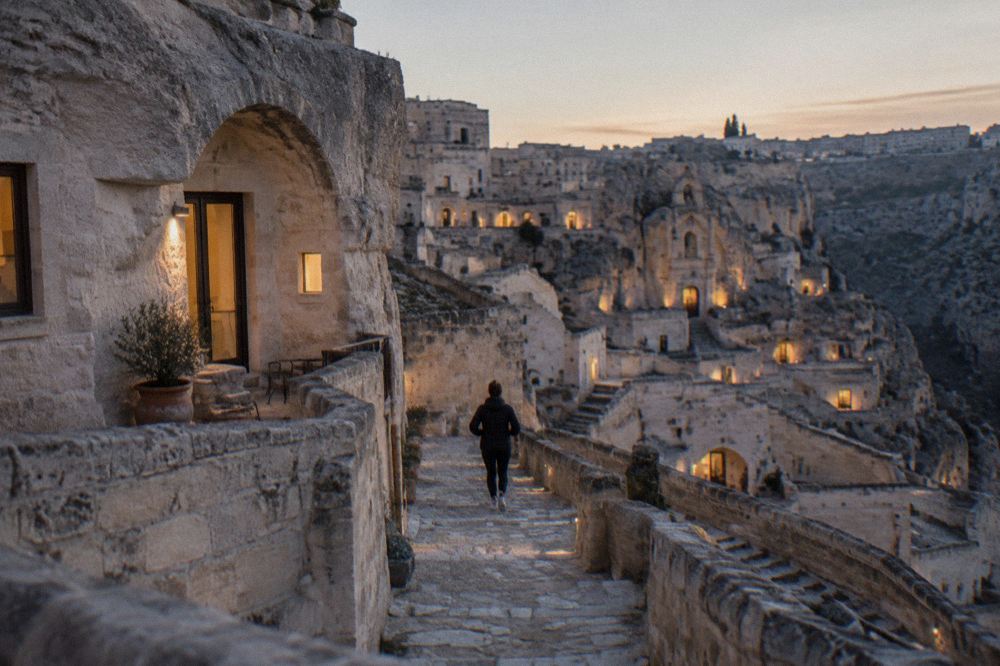
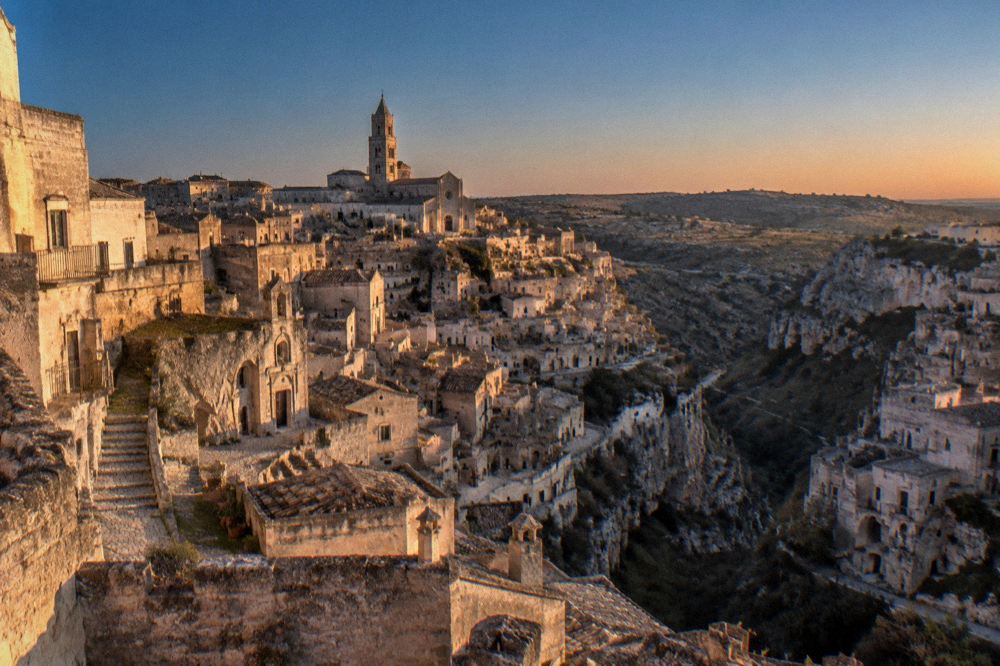
Matera sits inland in Basilicata, southern Italy, at about 400 m above sea level on the edge of the Gravina canyon, and winter here is a real winter: cold nights, damp mornings and frost on the Sassi stairways. What winter is not, is crowded. The APT Basilicata accommodation data shows February 2025 drew 15,239 arrivals against 61,630 in September, so the low season leaves the cave city to itself. This guide sets out what the verified sources say about weather, opening hours, closures, events and day trips between November and March.
How Cold Does Matera Get In Winter?
Matera's winter, by the ERA5 reanalysis 1991-2020 normals for its grid cell at about 398 m, runs from mean lows of 2.2 C in January and February to mean highs of 10.3 C in January and 11.2 C in December, with 51.4 mm of rain in January, 54.9 mm in February and 57.2 mm in December. About 20 frost days fall across the year, almost all between December and March. This is a modelled climate normal, not a weather-station record.
Those numbers matter for planning because the Sassi are steep, stepped and uneven, and damp stone in January is a different surface from dry stone in July. The reanalysis gives November as the wettest month of the whole year at 67.1 mm over 8.3 rain days of 1 mm or more, so late autumn, not midwinter, is when the umbrella earns its place. Daylight is short too: the normals give 9.6 hours a day in January and 9.9 in November, against 15.0 in June, which pushes sightseeing into a compact window and makes the early-evening lantern light of the Sassi part of the winter visit rather than an afterthought.
| Month | Mean high C | Mean low C | Rain mm | Rain days | Daylight h/day |
|---|---|---|---|---|---|
| November | 15.5 | 7.5 | 67.1 | 8.3 | 9.9 |
| December | 11.2 | 3.7 | 57.2 | 8.5 | 9.3 |
| January | 10.3 | 2.2 | 51.4 | 8.1 | 9.6 |
| February | 11.1 | 2.2 | 54.9 | 8.8 | 10.7 |
| March | 14.1 | 4.4 | 59.2 | 9.4 | 12.0 |
More on what these figures mean for a visit, including what to pack, appears further down; the deeper climate picture, month by month, is in the Matera weather guide.
Why Is Winter The Quietest Time In Matera?
The APT Basilicata accommodation data shows Matera logged 15,239 arrivals in February 2025, 18,402 in January and 23,555 in November, against 61,630 in September and 60,257 in August: roughly four times the winter low at the peak. The average stay in 2025 was 1.56 nights, and 57.4 per cent of the year's 479,083 arrivals came from abroad, with foreign guests peaking at 74.5 per cent of September's count.
Read that table as a crowds calendar in reverse. The months with the smallest arrival counts are the months when hotel availability is widest and the Sassi lanes least congested, and February, the quietest month of all, has mean highs already back at 11.1 C with daylight stretching to 10.7 hours a day. Winter is not the season the APT data rewards with records, but it is the season when a morning at the rock churches does not queue. The trade-off is shorter opening hours and two standing closures, covered next, plus a city that fills again for a few days around the Presepe Vivente in late December, when the living nativity's public days run through the Sasso Caveoso.
| Month (2025) | Arrivals | Month (2025) | Arrivals |
|---|---|---|---|
| January | 18,402 | July | 43,966 |
| February | 15,239 | August | 60,257 |
| March | 23,629 | September | 61,630 |
| April | 45,195 | October | 52,538 |
| May | 54,101 | November | 23,555 |
| June | 50,186 | December | 30,385 |
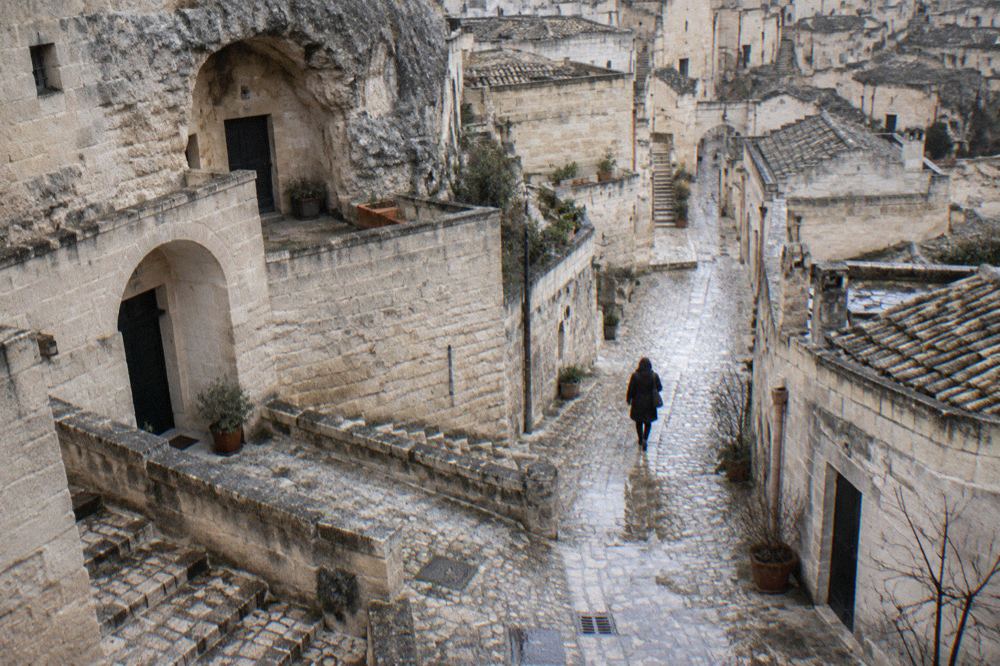
For the full peak-versus-shoulder comparison, including why September outranks August, see the best time to visit Matera guide.
Winter is also a season when indoor and vehicle-based sightseeing earns its keep, because the panorama viewpoints can be raw in a north wind while the cave interiors hold a steady cool temperature. Three options that suit the season:
What Is Open In Matera In Winter, And What Is Closed?
The Oltre l'Arte rupestrian churches open daily year-round (Santa Lucia alle Malve and Madonna de Idris 09:30 to 19:30, San Pietro Barisano 10:00 to 19:00, from 28 March 2026), and the Casa Grotta di Vico Solitario runs October-to-December hours of 09:30 to 18:00 weekdays, entry 8.00 EUR. Two sites are closed: the Museo Ridola since 7 April 2025, and Casa Noha 5 to 22 October 2026, reopening after renovation.
The closures first, because older guides still list both as open. The Museo Archeologico Nazionale Domenico Ridola has been shut since 7 April 2025 for energy works and a new display under the PNRR programme, and its own visit page still reads "Temporaneamente chiuso" with no reopening date published. Casa Noha, the FAI interpretation centre in Recinto Cavone, is a shorter story: closed 5 to 22 October 2026 for renovation ahead of a relaunch with new spaces and displays. From November it operates its winter hours, 10:00 to 17:00, closed Wednesdays, at 6.50 EUR for adults and 3 EUR for children.
Everything else on the main sight list keeps winter doors open, generally with earlier last entries than summer. MUSMA, the sculpture museum in the Sasso Caveoso, runs October-to-March hours of 10:00 to 18:00 with last entry an hour before closing, at 10 EUR full. The Museo Nazionale at Palazzo Lanfranchi is 09:00 to 20:00 Monday to Sunday at 10 EUR per site, or 15 EUR cumulative over two days, with under-18s free; note the palace carries a works page while staying open. The Crypt of the Original Sin, outside town, runs November-to-February guided slots at 09:30, 11:00, 12:30 and 15:30 only, booking mandatory by e-ticket at least 90 minutes ahead, capacity 20 per slot.
| Site | Winter entry | Winter hours | Notes |
|---|---|---|---|
| Oltre l'Arte rupestrian churches | 4.50 EUR one, 8.00 two, 10.00 three | 09:30 to 19:30 (10:00 to 19:00 San Pietro Barisano) | All sites closed 25 December and 2 July |
| Casa Grotta di Vico Solitario | 8.00 EUR full | Oct to Dec Mon-Fri 09:30 to 18:00 | Last entry 20 minutes before closing |
| MUSMA | 10 EUR full | Oct to Mar 10:00 to 18:00 | Last entry one hour before |
| Palazzo Lanfranchi (Museo Nazionale) | 10 EUR, 15 EUR cumulative | Mon-Sun 09:00 to 20:00 | Under 18 free |
| Casa Noha (FAI) | 6.50 EUR adults | Nov to 6 Jan 10:00 to 17:00 | Closed Wednesdays; shut 5-22 Oct 2026 |
| Crypt of the Original Sin | Price on booking | Nov to Feb slots 09:30, 11:00, 12:30, 15:30 | E-ticket at least 90 min ahead |
| Museo Ridola | Closed | Closed since 7 April 2025 | No reopening date published |
For the church-by-church detail, including the ticket combinations and what each site holds, the dedicated pages on the rupestrian churches of Matera, the Casa Grotta di Vico Solitario and Casa Noha carry the full tariffs.
What To Do In Matera In Winter When It Rains?
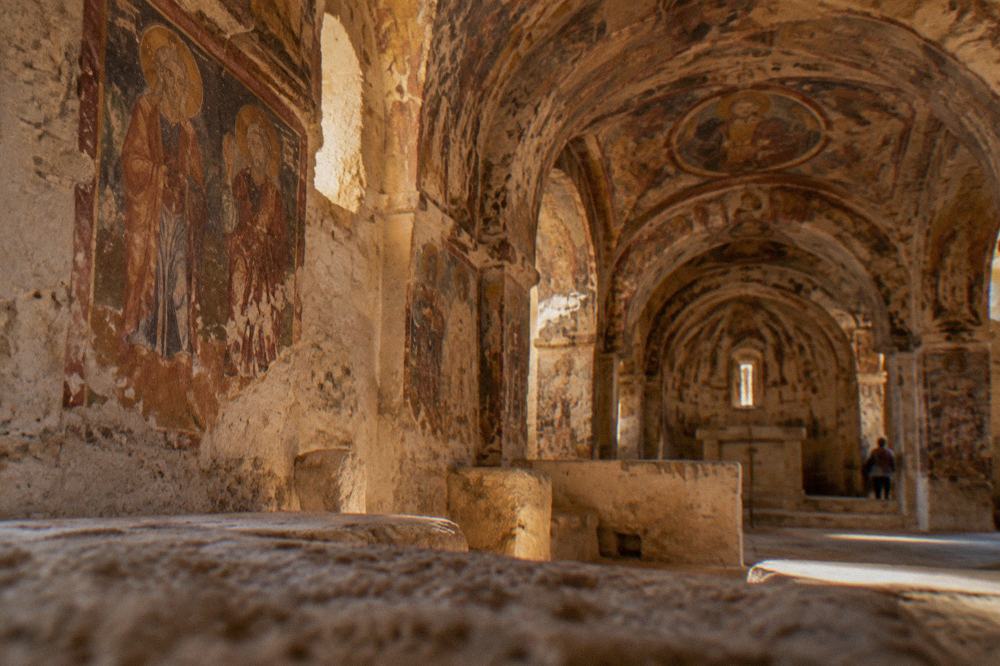
The rainy-day core is the cave-and-museum layer: the three Oltre l'Arte rock churches, the Casa Grotta di Vico Solitario, MUSMA, Palazzo Lanfranchi and the Palombaro Lungo, all within walking distance of one another, plus the bread museum and MATA on the 25.00 EUR all-inclusive Oltre l'Arte ticket. November averages 67.1 mm of rain, so a wet day is a planning assumption, not a surprise.
The genius of Matera in bad weather is that its headline sights are underground or inside rock, which is exactly where rain cannot reach. A church carved into tufa does not close for drizzle, and the Oltre l'Arte all-inclusive ticket, 25.00 EUR reduced to 16.00 EUR, bundles the three rupestrian churches, Vicinato a Pozzo, the Antica Casa Grotta in Via Fiorentini, MATA, the Purgatorio exhibition and the Museo del Pane into one chain of covered visits. The Palombaro Lungo, the vast water cistern under Piazza Vittorio Veneto, keeps its own site; its price and hours are not published on an official page, so confirm locally before going. The full index of guides sits on Matera Travel Guide.
Rain in Matera rarely lasts all day at that intensity, and a covered morning often gives way to a clear late afternoon, which is the moment for the viewpoints. When the sky clears, the Ape Calessino tour above covers the Sassi panorama from a covered three-wheeler, and the viewpoint guide lists where the canyon views open up; for the full wet-weather itinerary, see Matera on a rainy day. Food is the other indoor pillar: the restaurants guide and the what to eat in Matera pages cover the cave dining rooms and the winter dishes, and Pane di Matera has the PGI bread's own story.
Does It Snow In Matera?
Snow in Matera is occasional, not routine. The ERA5 reanalysis 1991-2020 gives about 20 frost days a year, almost all between December and March, against mean highs of 10.3 to 11.2 C in the three winter months, so precipitation falls mostly as rain and settled snow is uncommon. When snow does lie on the Sassi rooftops it is a short-lived event, and the stepped lanes need the same care as after rain.
The frost-day figure is the one to plan around rather than any snowfall promise. Sub-zero nights mean ice on stone in the early morning, particularly on the stepped descents into the Sasso Caveoso and the paths towards the Gravina, and the site never describes a named route as step-free or wheelchair accessible for exactly this kind of reason. Sensible winter footwear matters more here than in the flatter Puglia towns down the road. Daylight and temperature also shape the hiking options: the park paths around the Parco della Murgia and the Tibetan bridge are best mid-morning to mid-afternoon in winter, and the bridge's Sentiero 406 now has a staffed, ticketed access point whose price is not settled in the sources, so confirm at the park's ticket site before setting out.
What Events Fill The Matera Winter Calendar?
The Presepe Vivente nei Sassi is the anchor: its sixteenth edition, titled Vera Fratellanza, opens 4 December 2026 with public days on 5-6, 12-13, 19-20 and 26-27 December 2026 and 2-3 January 2027, tickets 12.00 EUR full, 9.00 EUR ages 10 to 18, free under 10. Around it sit the Matera Film Festival, 7 to 15 November 2026, and the closing of the Matera 2026 Mediterranean Capital of Culture programme on 28 November 2026.
The living nativity is the one winter event that visibly changes the city. Twenty scenes run from Piazza San Pietro Caveoso through Vico Solitario, Rione Malve and Casalnuovo to Via Bruno Buozzi, turning the Sasso Caveoso into a walk-through Bethlehem, and the December dates are the busiest nights of the winter calendar in an otherwise quiet season. The film festival, in its seventh edition and twinned with Tétouan, screens across town in mid-November, and the Gezziamoci jazz festival's thirty-ninth edition runs to 29 December across Matera venues. For everything fixed further out, including the Festa della Bruna on 2 July 2027, the Matera events page is the standing calendar, and the Matera at Christmas page expands the December picture.
| Event | Dates | Winter status |
|---|---|---|
| Matera Film Festival, 7th edition | 7 to 15 November 2026 | Twinned with Tétouan |
| Matera 2026 Mediterranean Capital of Culture | Programme closes 28 November 2026 | Foundation programme year |
| Presepe Vivente nei Sassi, 16th edition | 4 Dec 2026 opens; public 5-6, 12-13, 19-20, 26-27 Dec and 2-3 Jan | 12.00 EUR, 9.00 EUR ages 10-18, free under 10 |
| Gezziamoci jazz festival, 39th edition | To 29 December 2026 | Across Matera venues |
| Oltre l'Arte sites | Closed 25 December | All its sites shut Christmas Day |
Is Winter A Good Time For Day Trips From Matera?
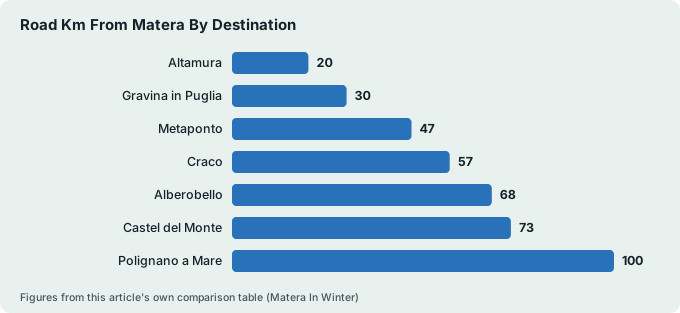
Winter works well for the near day trips: Alberobello is about 68 km and 1 h 23 of free-flow driving from Matera, Altamura 20 km and 20 minutes, Gravina in Puglia 30 km and 31 minutes, and Craco 57 km and 58 minutes. The coastal options are longer, Polignano a Mare at 100 km and 1 h 29, Metaponto at 47 km and 52 minutes, and short daylight plus a 10 C mean high argues for one target per day rather than a loop.
The distances above are OSRM free-flow figures over OpenStreetMap, computed to Matera Centrale station, so they exclude traffic, stops and parking, and winter rain can stretch them. The classic winter pairing is Alberobello, whose trulli quarter is compact enough that a cold day does not defeat it, and this site's featured day trip covers it with private transfer from Matera and a guided walk among the trulli, which removes the winter parking question in the ZTL-bound towns; check the dates on the operator's live listing, since hours narrow off-season. The Alberobello and matera and alberobello in one day pages carry the full itinerary.
| Destination | Road km from Matera | Free-flow drive |
|---|---|---|
| Altamura | 20 | 20 min |
| Gravina in Puglia | 30 | 31 min |
| Metaponto | 47 | 52 min |
| Craco | 57 | 58 min |
| Alberobello | 68 | 1 h 23 |
| Castel del Monte | 73 | 1 h 11 |
| Polignano a Mare | 100 | 1 h 29 |
Getting to Matera itself in winter has one standing trap: FAL runs no trains on Sundays and public holidays, replacement buses only, and from 12 October 2026 its notice changes the rail programme between Matera Sud and Altamura, so the live timetable on FAL's page is the authority; the Bari to Matera and how to get to Matera guides carry the detail, and driving in from Bari Airport is about 64 km and an hour free-flow.
What Should You Pack For Matera In Winter?
Pack for mean lows of 2.2 to 3.7 C and mean highs of 10.3 to 11.2 C between December and February, with 51.4 to 57.2 mm of rain a month and about 20 frost days a year concentrated in those months: layered warm clothing, a waterproof rather than an umbrella for the stepped lanes, and grippy footwear for damp or icy stone. Around the Presepe Vivente dates, add serious warmth for standing outdoors at night.
The layering advice follows directly from the diurnal swing: a January day can run from 2.2 C at dawn to 10.3 C at mid-afternoon, so an outer shell over a midlayer beats one heavy coat. Footwear is the second decision, because the Sassi's stepped streets, the descent to the Gravina viewpoints and the cave-house floors are stone, and winter damp makes them slick. The packing advice question is answered in full on its own page, including the winter-specific answer to does it snow and how cold it gets.
Where Should You Stay In Matera In Winter?
Cave hotels in the two Sassi districts run year-round and are the winter answer, because a room cut into the rock holds a stable temperature while the mean low outside sits between 2.2 and 7.5 C from November to February. February's 15,239 arrivals against September's 61,630 mean winter availability is at its widest, though exact nightly rates are never quoted on this site: confirm current prices and the tourist tax at booking.
The tax point is worth a line of its own. Matera charges a tourist tax collected by the accommodation, and its amount is confirmed at booking rather than printed here, because no official tariff page could be verified. On the rooms themselves, the choice is between the Sasso Caveoso, quieter and rougher-edged, and the Sasso Barisano, closer to the evening life; the where to stay in Matera, Matera cave hotels and Sassi di Matera hotels pages break the districts down. One winter-specific note from the events calendar: the Presepe Vivente public days in late December pull arrivals up from November's 23,555 to December's 30,385, so book the Christmas window earlier than the rest of winter.
Is A Winter Trip To Matera Worth It?
On the evidence in the sources, yes: winter trades the September peak of 61,630 arrivals for February's 15,239, keeps the rock churches, cave houses and museums open on shorter hours, and adds the Presepe Vivente and a film festival to the calendar, at the cost of mean highs around 10 to 11 C, 8 to 9 rain days a month and two standing closures. It is the season for the city itself rather than the panoramas alone.
What winter asks in exchange is honest planning around daylight and damp. Nine and a half hours of light in January, frost on early stone, and the Museo Ridola still shut since April 2025 are the constraints; a quiet Sassi at 10 C, indoor cave sights that ignore the weather, and a living nativity walking the lanes in December are the return. The desk's summary, from Matera Travel Guide's own verified files, is that February is the city at its emptiest and December its warmest-lit, and both are months the APT data shows the materani largely have to themselves.
Common Questions About Matera In Winter
How cold does it get in Matera in winter?
By the ERA5 reanalysis 1991-2020, mean lows fall to 2.2 C in January and February, with mean highs of 10.3 C in January, and about 20 frost days a year, almost all December to March. It is a cold, damp winter at about 400 m elevation, not a mild coastal one.
Is December a good time to visit Matera?
Yes, if the Presepe Vivente dates fit. December 2025 logged 30,385 arrivals against 61,630 in September, the living nativity runs on four December weekends plus early January, and the museums and rock churches stay open, though the Oltre l'Arte sites close on 25 December.
What is the wettest month in Matera?
November, at 67.1 mm of rain over 8.3 rain days, per the ERA5 reanalysis 1991-2020. December follows at 57.2 mm and February at 54.9 mm.
Is the Sassi area open in winter?
The Sassi are permanent residential quarters and always open. The ticketed sites inside them keep winter hours: the Casa Grotta di Vico Solitario runs 09:30 to 18:00 on October-to-December weekdays, and MUSMA runs 10:00 to 18:00 from October to March.
Does it snow in Matera?
Occasionally. Frost is routine, about 20 days a year, but with winter mean highs above 10 C, precipitation falls mostly as rain and settled snow on the Sassi is a short-lived event rather than a seasonal feature.
Is Matera crowded in winter?
No. The APT Basilicata accommodation data gives 15,239 arrivals in February 2025, the year's low, against 61,630 in September, the peak. The December Presepe Vivente dates are the one winter window that fills up.