Matera Wine
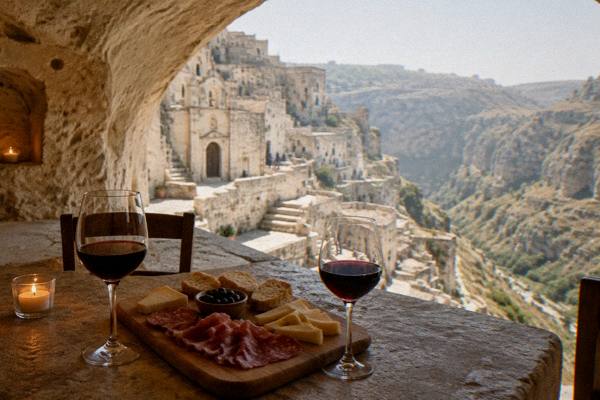
Matera, in Basilicata, southern Italy, is an inland city of cave quarters where wine is poured in cellars cut into tufa limestone. This guide covers where to taste, which bookable experiences exist and when to go.
Short answer
Matera itself is a tasting city rather than a vineyard you walk through: wine is served in cave cellars and historic buildings in the Sassi, and vineyard experiences are day trips into the surrounding Basilicata and Puglia countryside. Bookable options include city tastings with food pairings, walking tours that end with a tasting, and an e-bike wine and focaccia tour from Alberobello.
Matera, in the region of Basilicata in southern Italy, is an inland city of about 59,368 residents standing at roughly 400 m above sea level on the edge of the Gravina canyon, and its wine culture is shaped by that geology. The pale tufa limestone that holds the Sassi cave quarters also holds cellars, and the city's bars, restaurants and bookable experiences pour southern Italian wine in spaces dug centuries ago. This guide, from the Matera Travel Guide editorial desk, covers where tasting happens, which bookable wine experiences exist, what the climate data says about when to visit, and what belongs on the plate beside the glass.
Where Does Wine Fit Into A Visit To Matera?
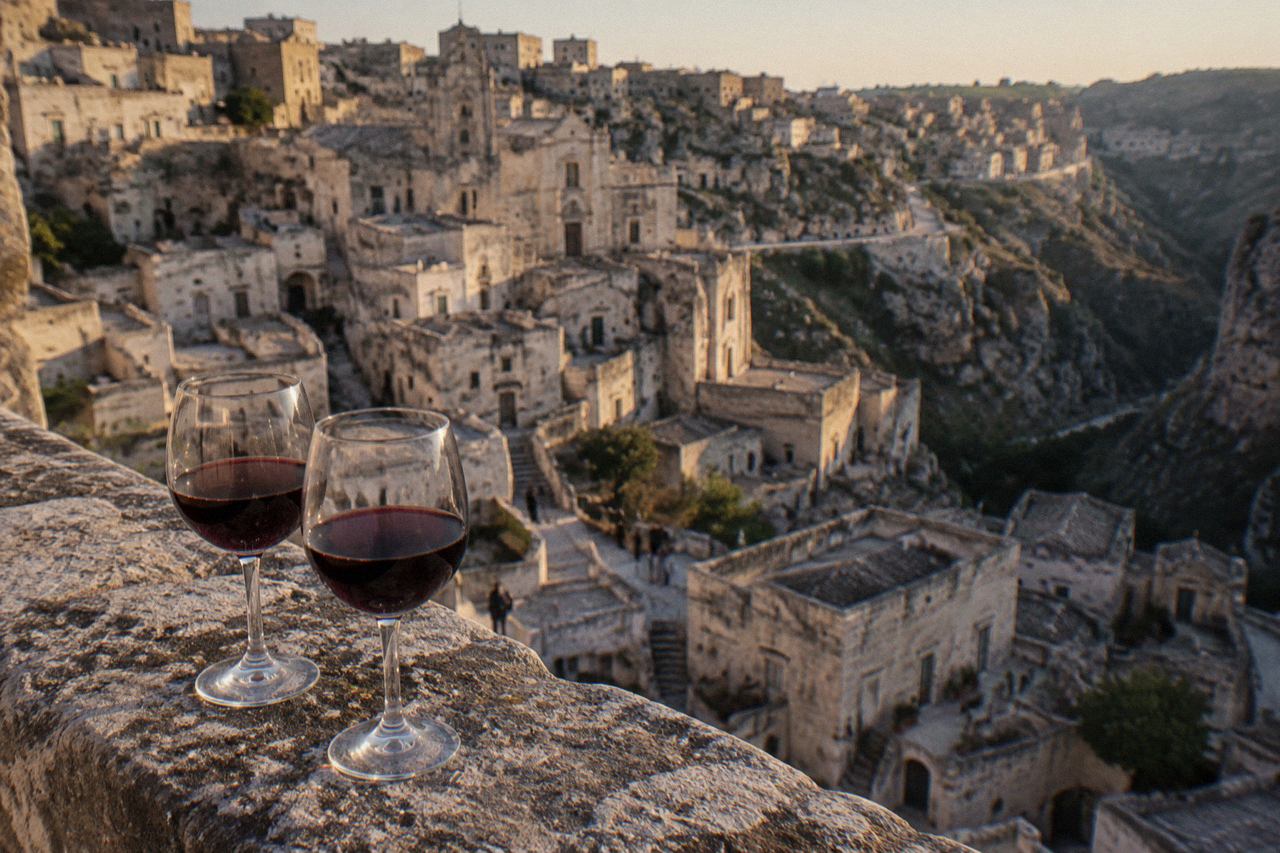
Wine in Matera is an urban experience first and a rural one second: the tastings, the cave-cellars and the wine bars sit inside the Sassi and the historic centre, while actual vineyards sit in the surrounding countryside of Basilicata and neighbouring Puglia, reached as day trips. The city is the tasting room; the region is the cellar door. That split decides how a visit is planned, with city tastings on foot and vineyard experiences booked as excursions.
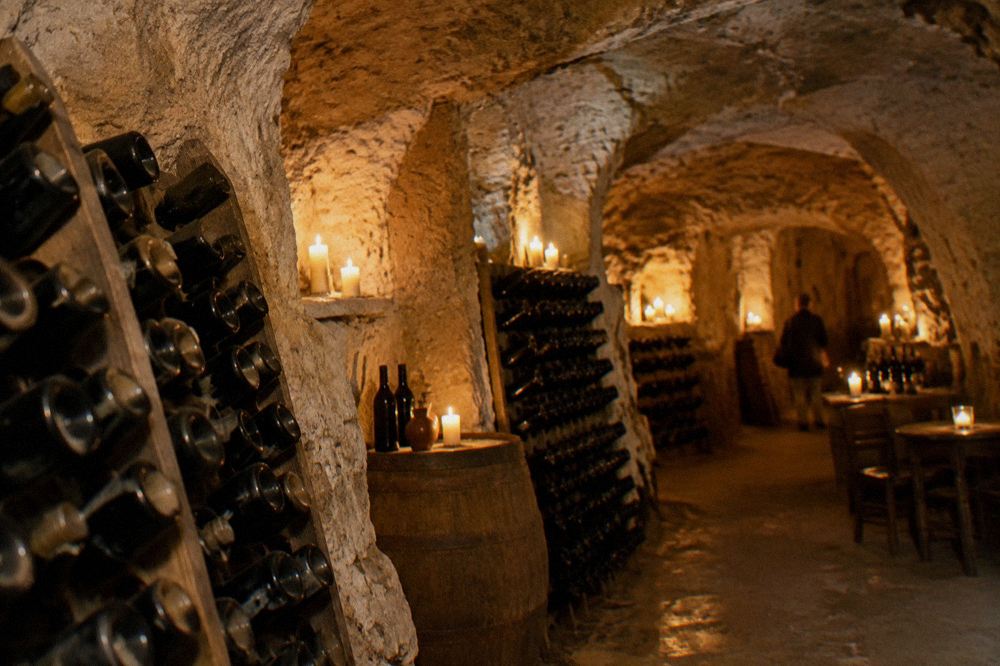
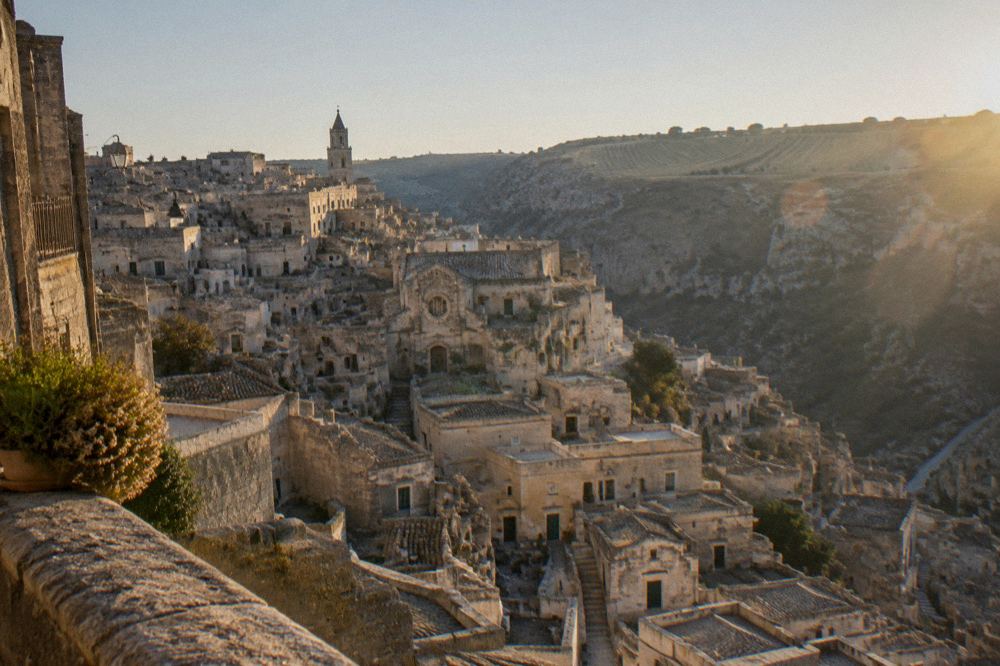
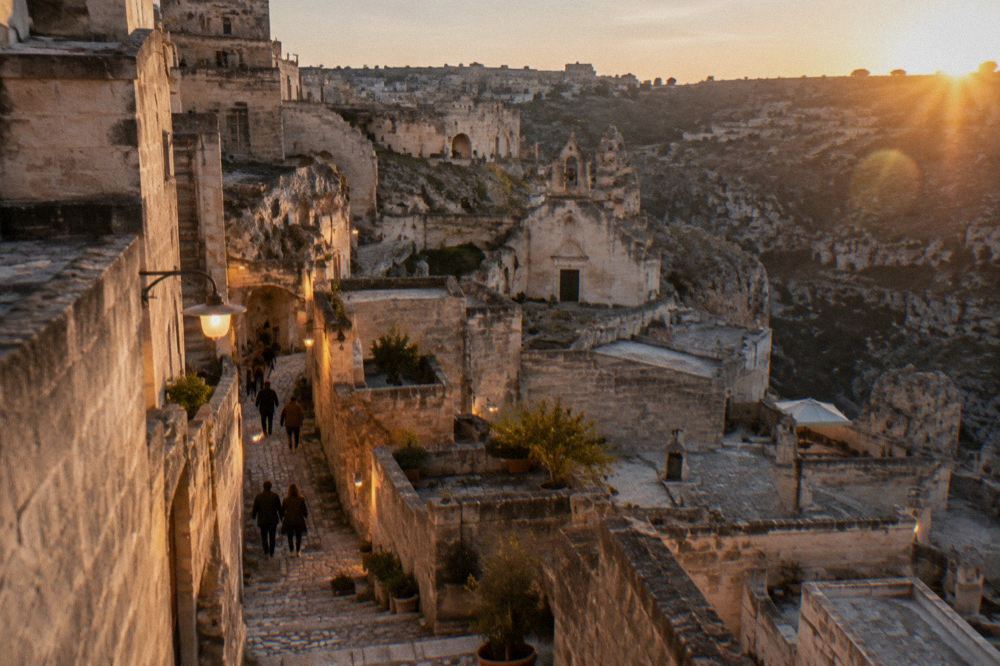
The structure of the city explains it. The Sassi, Sasso Caveoso and Sasso Barisano, are cave dwellings and rock-hewn churches cut into the canyon wall, and the same tufa that made dwellings made storage: cool, humid, constant-temperature spaces where wine and food kept well before refrigeration. Several of Matera's dining and tasting spaces are those former cellars, adapted rather than replaced. The UNESCO inscription of 1993, which covers "The Sassi and the Park of the Rupestrian Churches of Matera" over 1,016 ha, protects exactly this built fabric that the wine spaces sit inside.
A practical consequence: a wine-focused visit does not need a car. The tasting venues, the restaurants and the viewpoints are within walking distance of each other, on steep, stepped, uneven streets that reward strong shoes. A vineyard day trip is the exception, and that is where bookable tours with transport earn their place.
The essentials a first-time visitor needs are covered elsewhere on this site: start with one day in Matera if the visit is short, and with where to stay in Matera for the cave-hotel question that follows every first booking.
Where Can You Actually Taste Wine In Matera?
The honest answer is that tasting in Matera happens in three settings: dedicated tasting experiences bookable in advance, restaurant and bar pours inside the Sassi, and walking tours that fold a tasting stop into a route through the cave quarters. No single official municipal wine venue exists, and the site's editorial desk has verified no individual bar or enoteca's address, hours or price list, so specific venues are deliberately not recommended here. What can be booked with verified details appears in the product blocks below.
What the desk can state from verified sources is the setting, not the stock list. Matera's dining rooms and cellars occupy excavated spaces in the tufa, and wine is routinely served steps from a rock-cut wall. The general regional style at the table is southern Italian: reds carrying the weight the climate gives them, and simple local white wine by the carafe, which is normal practice across the south rather than a Matera peculiarity. Beyond that general framing, which glasses to order is a question for the person pouring them.
For food context, what to eat in Matera covers the regional plates, and the single verified protected food fact is that Pane di Matera holds PGI status, registered in 2008 under Reg. CE 160/2008. Bread, oil and wine are the base triangle of the Matera table, and the best-restaurants guide covers where travellers report eating well: restaurants in Matera.
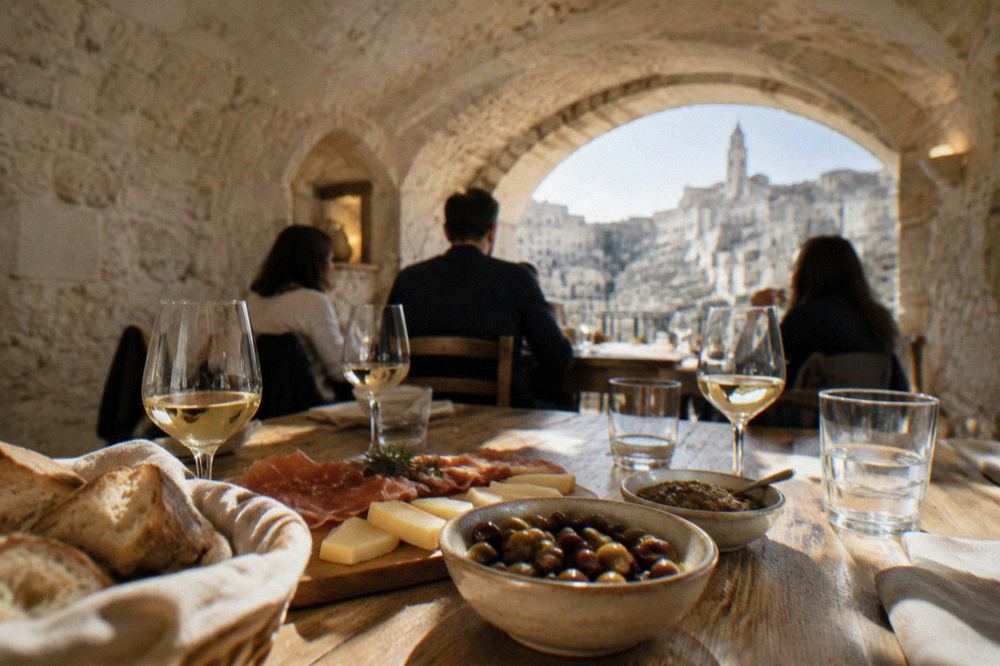
For visitors who want structure rather than improvisation, bookable experiences fill the gap the desk will not fill with named venues. A small-group tasting with food pairing runs in the city:
To try the local table with your glass, book a small-group wine tasting here.
And a food-and-wine walk through olive country outside the city covers the oil side of the triangle:
Which Wine Experiences Can You Book In And Around Matera?
Bookable wine experiences fall into four shapes: a seated small-group tasting with food pairing in Matera, a walking tour of the Sassi that ends with a tasting, a farmhouse cooking class where the meal comes with wine, and vineyard-adjacent day trips into the countryside, including an e-bike tour from Alberobello that pairs focaccia and wine. Prices, ratings and durations for each render from the verified product data in the blocks below and are never quoted by hand on this page.
The choice between them is a choice about how central wine is to the day. A dedicated tasting makes the glass the point of the booking. A walking tour with a tasting makes the glass the ending of a history walk through the Sassi, which suits a first visit where the cave quarters themselves are the main draw. A cooking class makes wine part of a meal the group has cooked. And a day trip makes wine one stop on a route that takes in another town entirely.
The three formats below are the site's featured picks for this page:
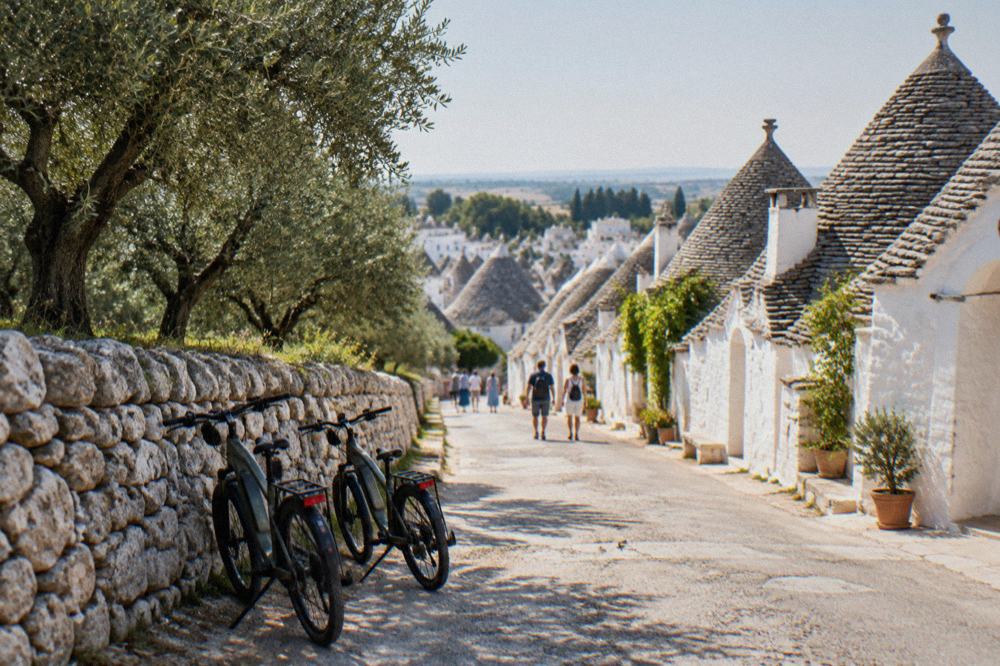
The e-bike option deserves its own note, because it is the one that gets closest to vines. It runs from Alberobello, the trulli town in Puglia, about 68 road km from Matera Centrale by the OSRM-computed route, roughly an hour and a quarter of free-flow driving. Alberobello is a UNESCO site in its own right, so the day combines two inscribed places with a ride through the Itria valley countryside between them, focaccia and wine included at the stop.
What Does The Alberobello E-Bike Wine And Focaccia Tour Cover?
The e-bike tour from Alberobello is a guided ride through countryside between the trulli town's surroundings, with stops for focaccia and wine, run as a day trip from the Puglia side rather than inside Matera itself. Its price, rating and duration render from the verified product block, not from prose. It suits travellers who want vines and lanes rather than cellars and stairways, and it pairs naturally with a night in Matera before or after.
Two points of practical honesty. First, Alberobello is in Puglia, not Basilicata: the tour crosses the regional line, which is a fifteen-minute fact worth having straight before the day. The desk's drive-time table below gives the road distance from Matera. Second, the Sassi themselves are steep, stepped and uneven, and no route through them is step-free, so anyone for whom that matters may find the flat-lane e-bike format the easier day out; the e-bike assist does the climbing.
Booking carries the usual flexibility: the operator's live listing shows current availability, and the button below reads the terms as free cancellation applies.
For travellers comparing the two-town idea in other formats, Matera and Alberobello in one day covers the bus and tour options for the pairing.
How Does Matera's Climate Shape The Wine Year?
The ERA5 reanalysis for Matera, 1991-2020, shows the pattern that matters for both vines and visitors: a hot, dry summer and a cold, damp winter at elevation, with July and August mean highs of 31.2 and 31.3 C and only about 21 mm of rain each, against November's 67.1 mm as the wettest month and January's 5.9 C mean as the coldest. Roughly 90.7 rain days a year spread across the calendar.
These are modelled grid-cell normals, not a weather-station record, and the desk labels them as such. For a wine trip the numbers translate simply: midsummer tasting days are hot and dry but crowded in the streets; late September drops the mean high to 25.7 C while keeping rain modest at 44.8 mm; and winter tasting is perfectly viable indoors in caves that hold a steady cool temperature year-round, with a real chance of frost, about 20 frost days a year, nearly all between December and March.
| Month | Mean High C | Mean Low C | Rain mm | Rain Days |
|---|---|---|---|---|
| Jan | 10.3 | 2.2 | 51.4 | 8.1 |
| Feb | 11.1 | 2.2 | 54.9 | 8.8 |
| Mar | 14.1 | 4.4 | 59.2 | 9.4 |
| Apr | 17.4 | 7.1 | 56.5 | 9.7 |
| May | 22.7 | 11.5 | 41.7 | 7.9 |
| Jun | 28.2 | 16.0 | 35.1 | 6.4 |
| Jul | 31.2 | 18.6 | 21.2 | 4.4 |
| Aug | 31.3 | 18.9 | 21.7 | 4.7 |
| Sep | 25.7 | 15.2 | 44.8 | 7.0 |
| Oct | 20.8 | 11.6 | 51.7 | 7.5 |
| Nov | 15.5 | 7.5 | 67.1 | 8.3 |
| Dec | 11.2 | 3.7 | 57.2 | 8.5 |
When Is The Best Season For A Wine Trip To Matera?
By the APT Basilicata accommodation data, September is both the busiest and arguably the best month: 61,630 arrivals in 2025, the annual peak, with the mean high down to 25.7 C and three quarters of the month's arrivals, 74.5%, from abroad. May runs close behind at 54,101 arrivals with 22.7 C mean highs. Winter is the quiet value window, with February 2025 at just 15,239 arrivals.
The crowd logic is worth stating plainly because the internet gets it backwards: guide after guide calls August Matera's peak, and the verified data says September. August is the one warm month when Italians dominate the guest mix, at 53.2% of arrivals, which fits the ferragosto holiday pattern. Foreign guests are the majority in April, May, June, July, September and October.
| Month | Arrivals 2025 | Foreign Share Notes |
|---|---|---|
| Jan | 18,402 | Quietest winter month after February |
| Feb | 15,239 | Annual low, cool and quiet |
| Mar | 23,629 | Shoulder, mild days |
| Apr | 45,195 | Foreign guests the majority from this month |
| May | 54,101 | Strong shoulder, 22.7 C mean high |
| Jun | 50,186 | Hot, drier streets |
| Jul | 43,966 | As hot as August, fewer guests |
| Aug | 60,257 | Italian majority, 53.2% |
| Sep | 61,630 | Annual peak, 74.5% from abroad |
| Oct | 52,538 | Foreign guests the majority |
| Nov | 23,555 | Wettest month, 67.1 mm |
| Dec | 30,385 | Presepe Vivente season |
For a wine traveller the shoulder months win twice over: the climate table above shows April, May and October trading a few degrees of heat for emptier tasting rooms, and September's grape-harvest timing coincides with the annual arrival peak, so early booking matters most then. The fuller month-by-month picture is in the best time to visit Matera, and December visitors should read Matera at Christmas, when the living nativity runs on fixed public days.
What Should You Eat Beside The Glass In Matera?
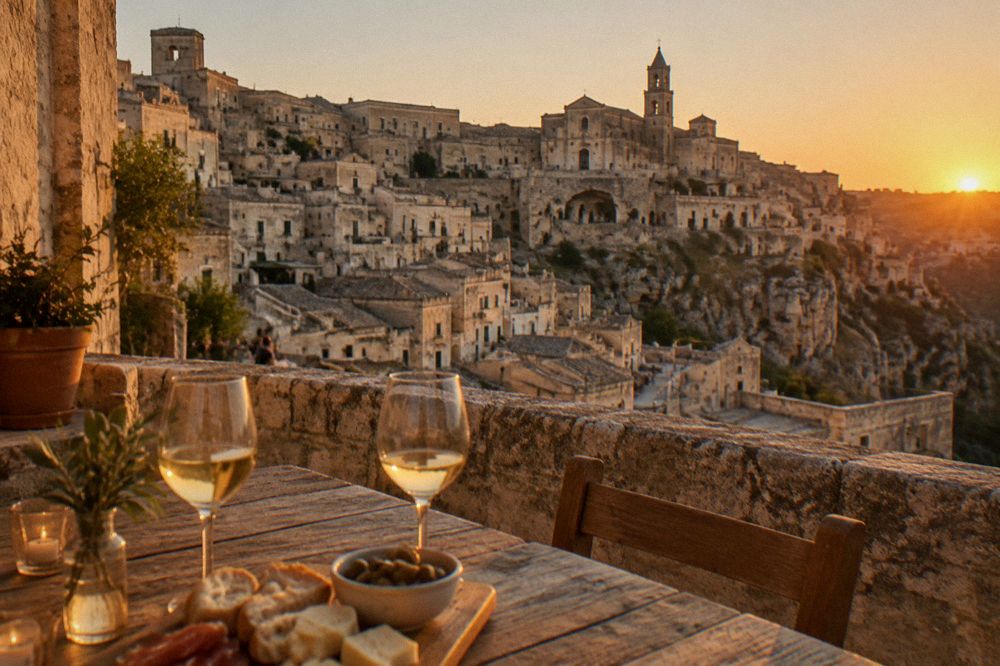
The Matera table runs on bread, oil, vegetables and pasta: Pane di Matera is a registered PGI, held since 2008 under Reg. CE 160/2008, and the regional style leans on legumes, greens, aged pork and the region's sweet-and-crunchy dried peppers. Wine in Matera is normally drunk with food rather than instead of it, and the tastings that can be booked build the pairing into the format, with local cheeses, bread and preserves served alongside the glasses.
The desk reports rather than rhapsodises, because no venue's menu was verified. What is safe to say: ordering wine by the glass or carafe with a plate of local cheese, bread and preserved vegetables is the standard tasting-format meal in the region, and several bookable experiences replicate exactly that structure inside a cave cellar. Cooking classes push the same logic further, pairing the pasta the group makes with wine at the shared table; the farmhouse cooking class in the roster is the food-first version of that idea.
For the dedicated food background, the site carries pane di Matera on the bread itself and Matera's cave restaurants on the cellar-dining setting, where the wine list and the tufa wall share the room.
Can You Visit Vineyards As A Day Trip From Matera?
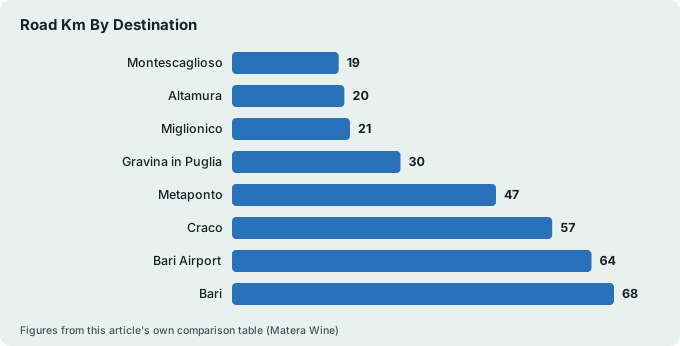
Yes, but the desk names no winery: no producer's address, hours, price or phone in the region was verified, so specific cellar doors stay off this page. What the verified OSRM routing data does give is the scale of the region, with Alberobello 68 km and about 1 h 23 by car, Altamura 20 km and 20 minutes, and Montescaglioso 19 km and 26 minutes from Matera Centrale, all free-flow figures without traffic or stops.
The pattern to take from the table is that Matera sits in a tight knot of wine-and-food countryside: nothing on the list is more than two hours away, and the closest agricultural towns are under half an hour. Booked day trips solve the two problems a self-driven day creates, parking and the ZTL camera zones, which the site covers in detail on parking in Matera and the Matera ZTL.
| Destination | Road Km | Drive Time |
|---|---|---|
| Montescaglioso | 19 | 26 min |
| Altamura | 20 | 20 min |
| Miglionico | 21 | 26 min |
| Gravina in Puglia | 30 | 31 min |
| Metaponto | 47 | 52 min |
| Craco | 57 | 58 min |
| Bari Airport | 64 | 1 h 01 |
| Bari | 68 | 1 h 02 |
| Alberobello | 68 | 1 h 23 |
| Locorotondo | 77 | 1 h 30 |
| Polignano a Mare | 100 | 1 h 29 |
One reminder that catches wine travellers out: there is no sea at Matera. The coast, Metaponto on the Ionian or Polignano a Mare on the Adriatic, is a day trip in its own right, as beaches near Matera explains, so a swim is not a lunch stop on a wine day.
What Events Fill A Wine Trip's Evenings In Matera?
Matera's verified cultural calendar gives a wine traveller real evening anchors around the tastings: a film festival in November, a jazz festival running into late December, a concert season from the orchestra of Magna Grecia, and the Presepe Vivente living nativity in the Sassi on fixed public days, with tickets at 12.00 EUR full and 9.00 EUR for ages 10 to 18, under 10 free. The Festa della Bruna follows in July, a date fixed since 1389.
Tasting in the afternoon, concert or film in the evening is a shape that works well here, because the venues sit minutes apart on foot. The desk's verified event list for the window ahead:
| Event | Dates | Status |
|---|---|---|
| "The Sea Is Closer Than You See" exhibition | 3 Oct to 8 Dec 2026, Palazzo Lanfranchi, TAM, MUSMA | Local news source |
| Matera Film Festival, 7th edition | 7 to 15 Nov 2026 | Verified on festival site |
| Orchestra ICO della Magna Grecia season | 26 Oct 2026 to 16 Apr 2027, Auditorium Gervasio | ANSA report |
| Gezziamoci jazz festival, 39th edition | To 29 Dec 2026 | Jazzitalia report |
| Presepe Vivente nei Sassi | 5-6, 12-13, 19-20, 26-27 Dec 2026 and 2-3 Jan 2027 | Local news; prices verified |
| Festa della Bruna | 2 Jul 2027 | Verified, date fixed since 1389 |
How Do You Plan The Practical Side Of A Matera Wine Trip?
Matera charges a tourist tax collected by the accommodation, with the amount confirmed at booking; the city is in Italy, so the currency is the euro and the country is a Schengen member; and the single emergency number is 112, live in the Matera district since 2 December 2025. Arrival is by FAL rail from Bari with a change at Altamura, about 1 h 45 to 2 h, with no trains on Sundays and public holidays, when replacement buses run.
Those are the four practical facts the desk can state from verified sources, and they cover the questions that actually break itineraries. The transport picture has a second layer: the site's guides to getting to Matera, Bari to Matera and Bari Airport to Matera carry the detail, including the airport road distance of 64 km and about an hour's free-flow driving.
| Item | Detail |
|---|---|
| Region | Basilicata, southern Italy, inland, about 400 m elevation |
| Currency | Euro (EUR) |
| Tourist tax | Exists, collected by the accommodation, amount confirmed at booking |
| Emergency number | 112, live in the 0835 district since 2 Dec 2025 |
| Rail from Bari | FAL, change at Altamura, about 1 h 45 to 2 h |
| Sundays and holidays | No FAL trains, replacement buses |
| Arrivals 2025 | 479,083 in registered accommodation, average stay 1.56 nights |
| UNESCO status | Inscribed 1993, criteria (iii), (iv), (v) |
For evening planning after the tasting, Matera at night covers the viewpoints and the passeggiata hours, and the sunset tour in the trio below is the bookable version of the same hour.
Common Questions About Matera Wine
Is Matera A Wine Region Itself?
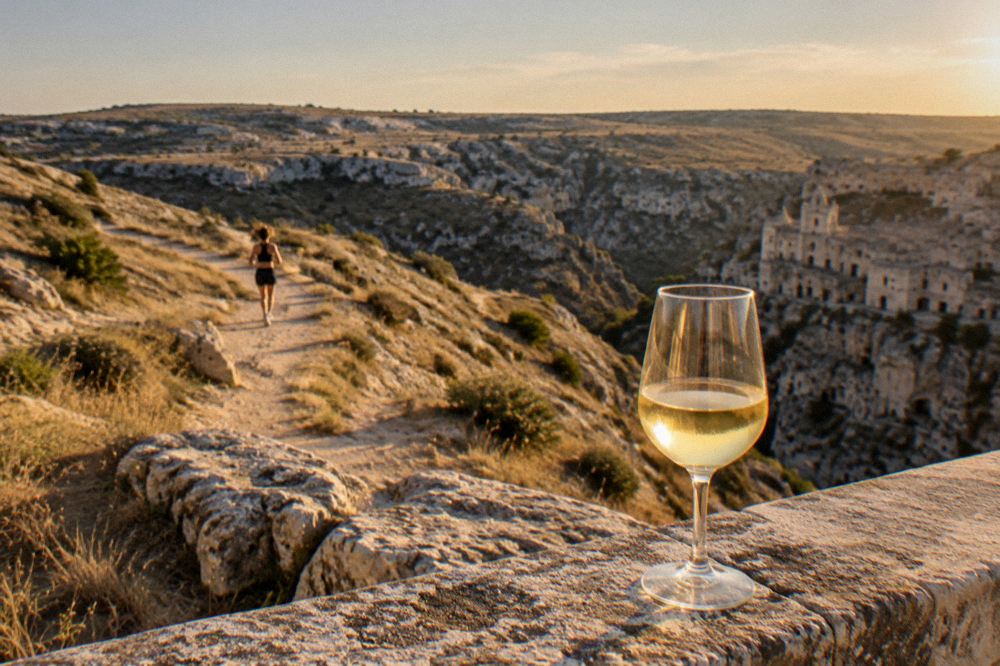
Matera is a city inside a wider southern Italian wine landscape. The tasting venues sit in the city's historic cellars, while vineyard experiences are day trips into the Basilicata and Puglia countryside around it, including an e-bike tour from Alberobello with focaccia and wine.
Can You Do A Wine Tasting In The Sassi?
Yes. Bookable tastings run in historic spaces in the city, including a small-group tasting with food pairing, and walking tours that end with a tasting stop inside the cave quarters. The desk names no individual bar, since no venue's hours or price list was verified.
How Much Does A Wine Tour From Matera Cost?
Prices for every bookable experience on this page render from the verified product blocks, never from typed prose, so the figure shown beside each tour is the current one. Check the operator's live listing for what the from-price covers before booking.
When Is Wine Harvest Season Around Matera?
The grape harvest in southern Italy falls broadly across September, which the APT data shows is also Matera's busiest month, with 61,630 arrivals in 2025. Late September pairs harvest timing with a mean high of 25.7 C, down from summer's 31 C.
Do You Need A Car For A Wine Trip To Matera?
No for the city: tastings, cellar restaurants and the Sassi are walkable, on steep and stepped streets. A car or a booked day trip helps for vineyard countryside, but parking and the ZTL camera zones make guided transport the simpler option; the drive-time table above gives the distances.
What Food Goes With Matera Wine?
The regional table is bread, olive oil, legumes, vegetables, aged pork and dried peppers, with Pane di Matera a registered PGI since 2008. Tastings typically serve local cheese, bread and preserves beside the glasses, and cooking classes pair the meal the group cooks with wine.
The short version: book the tasting or the tour before arrival, pack shoes that grip stone, and let the cave cellars do the rest.