Why Did People Live In Caves In Matera?
Why cave dwelling became the normal way of life in Matera, Basilicata: the tufa geology, the climate logic, how the Sassi houses worked, and why families left them between 1952 and the 1970s.
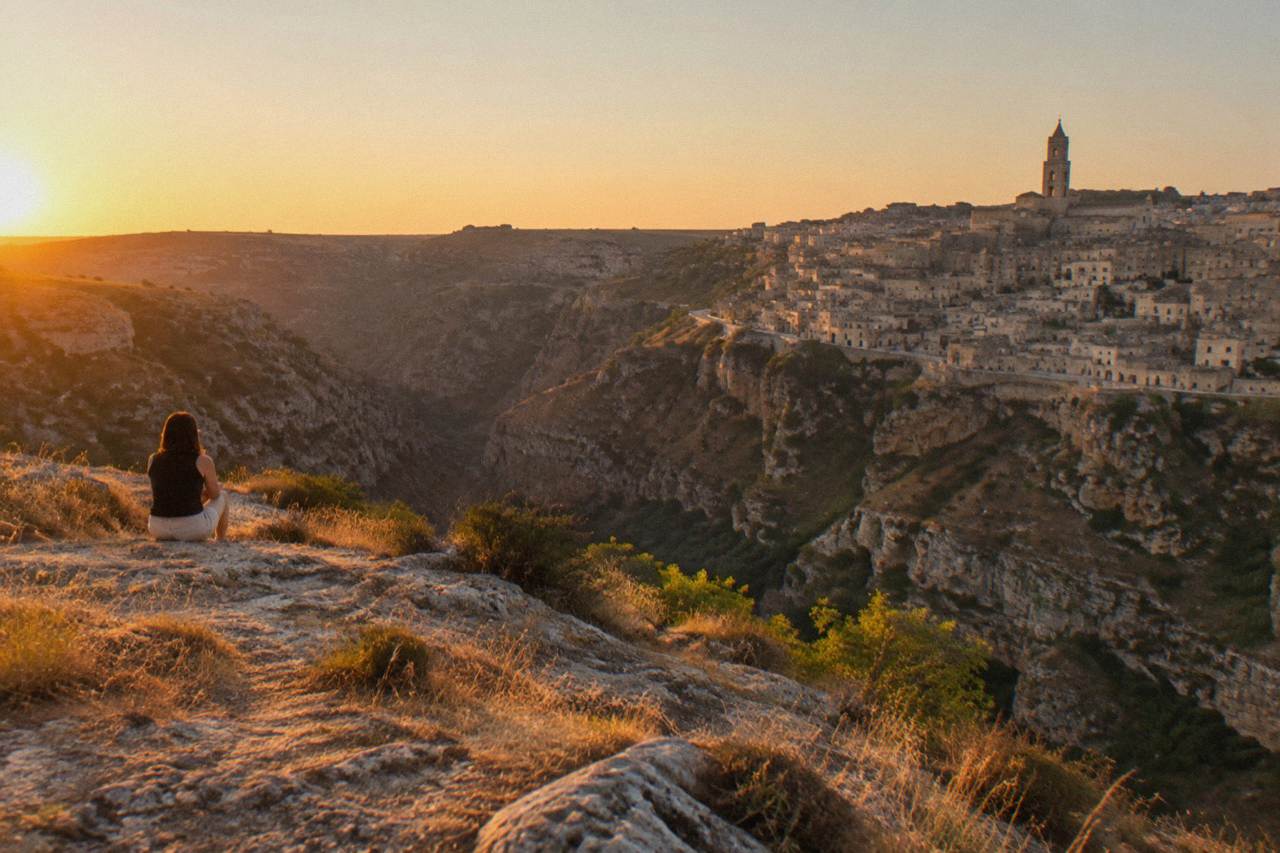
Matera, in the region of Basilicata in southern Italy, is the city where cave dwelling was not a curiosity but the ordinary way of building for centuries. The old quarters, the Sasso Caveoso and the Sasso Barisano, sit on the edge of the Gravina canyon at about 400 m above sea level, facing the Murgia plateau. UNESCO inscribed "The Sassi and the Park of the Rupestrian Churches of Matera" on the World Heritage List in 1993, describing a rock-cut settlement adapted to its geomorphological setting and exhibiting continuity over more than two millennia, with the area first occupied during the Palaeolithic. The short answer to why people lived in caves there is geological: the tufa limestone under the city is soft enough to cut with hand tools, hard enough once exposed to hold a room, and free to anyone willing to dig. This page sets out what the sources say about that choice, how the houses actually worked, and why the cave quarters were emptied between 1952 and the 1970s.
Why Did People Live In Caves In Matera?
People lived in caves in Matera because the local tufa limestone could be dug out with simple hand tools, so a family could create a weatherproof home without buying stone, timber or a builder's labour. The canyon walls of the Gravina gave ready-made vertical faces to cut into, water collected in the rock below, and the same carved rooms stayed cool through hot summers and held warmth through frosty winters. Cave dwelling in Matera was engineering by subtraction: the house was the hole left behind.
That last phrase is worth pausing on. Ordinary masonry construction is additive: you stack materials up until you have walls and a roof. Rock-cut construction works the other way round. A materano family with a pick, a hatchet and patience removed rock rather than assembling it, and every cubic metre dug out was a cubic metre of usable interior. The UNESCO listing records more than a thousand dwellings plus a large number of shops and workshops inside a property area of 1,016 hectares, and it credits the settlement with continuity over more than two millennia. Nothing in that record suggests rarity: the caves were the default, the norm, the way housing was done.
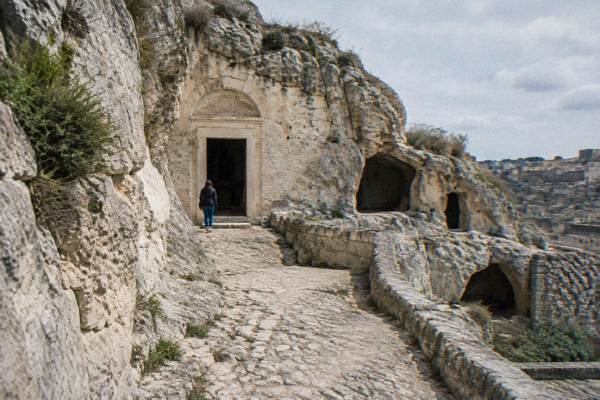
The setting did the rest. The Gravina, a deep erosive canyon, cuts through the plateau and exposes long cliff faces of pale tufa. A cliff face is a free facade: dig horizontally into it and you have a room with one open side, sheltered from rain and wind on the other five. Dig deeper and you have two rooms, then a stable, then a cistern. Water was part of the same system, because rain falling on the plateau and the roofs filtered through the limestone and could be caught in cisterns cut into the rock beneath the houses. The Sassi were not just shelter but a worked landscape, with dwellings, yards, stairways, cisterns, wine cellars, stables and churches all carved from the same material.
The rock-hewn churches deserve their own mention, because they show that the technique served grand purposes too. The park on the opposite side of the canyon, created by regional Law 11/1990, protects a landscape of rupestrian churches cut into the same tufa, and the site's own pages describe about 8,000 hectares by the park's count. If you want the full picture of how those churches work, the rupestrian churches of Matera guide covers the caves, the churches and the sites you can enter today.
What Made The Tufa Of Matera So Easy To Carve?
The tufa of Matera is a soft, pale limestone that can be cut with hand tools while it is damp and sheltered from the weather, yet it hardens on exposure to air and holds a stable carved face for centuries. The canyon of the Gravina exposes long vertical walls of it, so diggers could work horizontally into a ready-made cliff instead of sinking a shaft.
The same rock also stores water in cisterns and insulates interiors, which made it a building material, a water system and a climate control in one.
Geology set the terms. Tufa in this part of Basilicata is a calcareous rock, porous and relatively young, and it behaves differently from the hard limestones of the Apennines. Freshly exposed, it cuts easily; weathered, it forms a firmer crust. That combination is exactly what a cave dweller needs, and it explains why the technique spread across the whole Murgia plateau rather than staying a local oddity. The same rock faces across the canyon hold dozens of rupestrian churches, and the same logic produced the cisterns and cellars under the modern city, including the great water cistern known as the Palombaro Lungo.
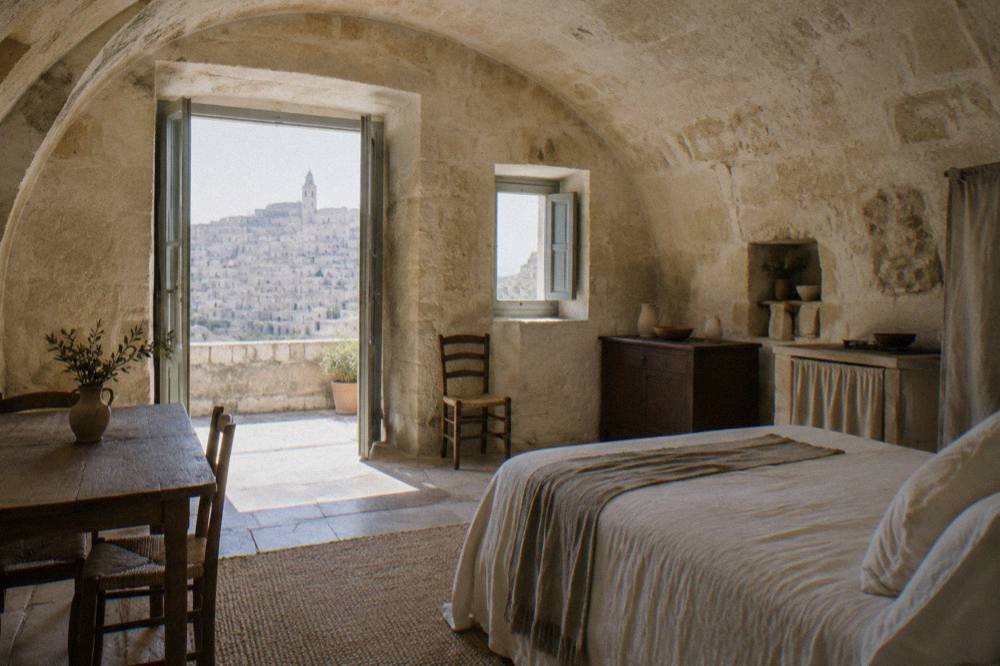
The climate argument is quantifiable. The ERA5 reanalysis for Matera, 1991-2020, gives a mean high of 31.3 C in August against a mean low of 2.2 C in January, with frost on roughly 20 days a year, almost all from December to March. A cave cut into rock damps those swings: the stone warms and cools slowly, so interiors stay far closer to the annual average than a thin-walled surface building. In a city with hot, dry summers and cold, damp winters, at about 400 m of elevation and with no sea to moderate anything, that thermal mass was not a luxury. It was the difference between a livable room and an unbearable one.
| Month | Mean High C | Mean Low C | Rain, mm |
|---|---|---|---|
| January | 10.3 | 2.2 | 51.4 |
| April | 17.4 | 7.1 | 56.5 |
| July | 31.2 | 18.6 | 21.2 |
| August | 31.3 | 18.9 | 21.7 |
| September | 25.7 | 15.2 | 44.8 |
| November | 15.5 | 7.5 | 67.1 |
Values are ERA5 reanalysis, 1991-2020, for the Matera grid cell. The seasonal swing, over 29 degrees between the January mean low and the August mean high, is what a few metres of rock ironed out. The cave houses of the Sassi were, in effect, passive climate machines, and the materani who dug them understood that long before anyone wrote the word insulation.
Cost sealed the argument. A surface house needs quarried stone, mortar, timber for roofs and floors, and skilled labour for all of it. A cave needs a strong back and time, and the time could be found in seasons when the fields did not demand it. For the rural poor of the Murgia, the caves were the only housing economy within reach, which is why the Sassi grew into dense neighbourhoods rather than scattered hermit huts. If you are weighing a visit against other southern Italian destinations, the is Matera worth visiting answer sets out what the city offers now.
How Did A Cave House In The Sassi Actually Work?
A typical Sassi dwelling combined a carved room, a walled forecourt and a shallow excavated cistern in one unit: the family lived in the cave room, kept animals in a second chamber or a stall beside it, and gathered rainwater from the courtyard and the rock face into a cistern below. The excavated material was reused to build the facade walls and the yard, so nothing was wasted. Stables, wine cellars, storage and even churches were cut on the same principle, sometimes stacked on several levels down the canyon slope.
The unit the sources describe is the casa grotta, the cave house, and the best surviving example open to visitors is the Storica Casa Grotta di Vico Solitario in the Sasso Caveoso. Its operator's ticket covers four elements: the cave house itself, the Neviera, a natural cave, and the rock church of Sant'Agostino al Casalnuovo. That combination tells the whole story in one address. A family's dwelling sat beside a cold store, a water store and a church, all carved from the same rock, all within a few steps, and the same pattern repeated across the quarter. Other pages covering the same trip are gathered on Matera Travel Guide.
The forecourt, the vicinato, was the shared outdoor room. Neighbouring cave houses opened onto a common yard, which collected rainwater toward the cisterns and served as the space where cooking, washing, craft work and social life happened. Oltre l'Arte, the body that runs several of the rupestrian churches, also opens a site called Vicinato a Pozzo, literally the neighbourhood at the well, and its all-inclusive ticket covers eight sites including the Antica Casa Grotta in Via Fiorentini, the MATA diocesan museum and the Museo del Pane. The bread museum belongs to the same story: the caves included communal ovens, and bread, not just shelter, was produced inside the system.
| Site open today | What it shows | Ticket, from the operator's page |
|---|---|---|
| Storica Casa Grotta di Vico Solitario | A furnished cave house with cold store, natural cave and rock church | 8.00 EUR full, 5.00 EUR reduced, tariff from 4 April 2026 |
| Oltre l'Arte rupestrian churches | Santa Lucia alle Malve, Madonna de Idris, San Pietro Barisano | 4.50 EUR one church, 10.00 EUR for all three |
| Oltre l'Arte all-inclusive | Eight sites including a cave house, the vicinato, museums and the bread museum | 25.00 EUR, reduced 16.00 EUR |
| Casa Noha (FAI) | An orientation house on the Sassi's history, closed 5 to 22 October 2026 | 6.50 EUR adults, 3 EUR children |
The table above is the practical answer for a visitor: the cave houses are not sealed ruins, several are open, ticketed and explained. The Casa Noha exception matters, because the FAI property is temporarily closed for renovation between 5 and 22 October 2026 ahead of a relaunch with new displays, so its schedule needs checking before you build a day around it.
Why Did Families Leave The Caves Between 1952 And The 1970s?
Families left the Sassi because by the middle of the last century the cave quarters had become severely overcrowded, with people and animals sharing cramped chambers and sanitation that dated from the cistern system rather than from plumbing, and the state responded by moving residents out between 1952 and the 1970s into new public housing on the plateau.
A 1986 national law then opened the way to restoring the emptied caves, which is what turned the Sassi from a displaced population's former home into the inhabited and visited quarter it is now.
The evacuation is the hinge of Matera's modern story, and it deserves precision rather than legend. The moves ran from 1952 through the 1970s, driven by conditions in the quarter that had deteriorated as rural poverty pushed more families into the same finite stock of caves. Overcrowding meant shared chambers, shared caves with livestock, and water still carried from cisterns, and the malaria that had historically affected this part of Basilicata had shaped the city's reputation long before. The word "shame" attached itself to the Sassi in national debate, and the why Matera was called the shame of Italy answer covers that episode in full.
What followed is less widely known. The emptied caves did not stay empty, and they were not demolished. The 1986 law made restoration legally and financially possible, and over the following decades the Sassi were progressively reclaimed: houses re-fitted, cave churches stabilised, hotels and museums carved back into the rock. UNESCO's 1993 inscription, on criteria (iii), (iv) and (v), was in effect the world's certificate that the rescue had worked. The city that had been evacuated for its living conditions became a World Heritage site for exactly those living conditions, preserved and interpreted.
The population numbers frame the scale. The comune of Matera counted 59,368 residents at 1 January 2026, ISTAT based figures, and in 2025 the city's registered accommodation logged 479,083 arrivals and 748,812 overnight stays, with 57.4 per cent of arrivals from abroad. The quarter that was emptied as a slum now hosts a tourism economy measured in hundreds of thousands of guest arrivals a year, and the question of who actually lives in the Sassi today has its own answer, covered in do people still live in the Sassi.
Can You Still See The Cave Dwellings In Matera Today?
Yes, and not only as facades: several cave houses are open as museums, the rupestrian churches can be entered on Oltre l'Arte's tickets, and hotels and restaurants now occupy restored caves across both Sassi. The Storica Casa Grotta di Vico Solitario shows a furnished dwelling on its 2026 tariff, the three main rock churches open daily from 28 March 2026 hours, and guided walks of the Sassi run year round, including an English-language group walk and tours that pair the cave quarter with Alberobello.
The practical choices group into three kinds of visit. First, the house museums, where the casa grotta and its cisterns are explained room by room. Second, the churches, where the same carving technique was used at devotional scale, with frescoed interiors cut straight into the canyon walls. Third, the panoramic and guided routes, which put the quarter into context from above and from within. The Matera caves guide maps all of them, and the self-guided walking route covers the streets between them for anyone visiting without a guide.
For travellers arriving from Bari, the pairing of Matera with Alberobello in one day is a well-trodden route, since both are UNESCO towns and the drive between them is about 1 h 23. The Alberobello and Matera by private bus tour covers both towns with transport included, and it suits visitors who want the cave quarter and the trulli town without hiring a car. Check availability on the operator's live listing if that combination fits your dates.
Walking tours inside the Sassi are the other natural fit for this subject, because a guide can point at a wall and explain which parts are carved and which are built, a distinction that is genuinely hard to read on your own. The English-language group city walk and the Sassi tour with rock-cut churches both cover the cave quarter on foot, and the trio above shows the current options side by side. For a fuller comparison of how long to give the city, the how many nights to stay in Matera answer works through the timing question.
Curious which parts of a wall are carved and which are built? Book a Sassi walking tour here.
Common Questions About Matera's Cave Dwellings
Why did people live in caves in Matera?
Because the local tufa limestone could be dug with hand tools, the Gravina canyon offered ready cliff faces to cut into, and the resulting rooms cost nothing to build while staying warm in winter and cool in summer. Cave dwelling was the cheapest and most practical housing technology available to the rural poor of the Murgia for centuries.
Were the caves natural or man-made?
Both, in the sense that natural fissures and hollows in the tufa were widened, deepened and shaped into rooms. The finished casa grotta was overwhelmingly man-made excavation: the facades, courtyards, cisterns and interior partitions were all cut or built by hand. UNESCO describes the Sassi as a rock-cut settlement adapted to its geomorphological setting.
How many people lived in the Sassi?
The site is not given a historical population figure in the verified sources, so no number is printed here. What is documented is the evacuation: residents were moved out of the Sassi between 1952 and the 1970s into new housing, and the comune of Matera counted 59,368 residents overall at 1 January 2026.
When did people stop living in caves in Matera?
The state-organised evacuation ran between 1952 and the 1970s, and a 1986 law opened the way to restoring the emptied caves. Restoration and return followed over subsequent decades, and today the Sassi are both inhabited and open to visitors. The details are in the why was Matera abandoned answer.
Can you go inside a cave house in Matera?
Yes. The Storica Casa Grotta di Vico Solitario is open as a museum on its 2026 tariff, Oltre l'Arte opens cave houses and rupestrian churches on its tickets, and restored caves across both quarters now serve as hotels and restaurants. Check opening days before visiting, since some sites close on 25 December and 2 July, the Festa della Bruna.
The cave dwellings of Matera answer a question that most cities never have to ask: what happens when the ground itself is the cheapest building material available? The materani answered it with pickaxes, cisterns and patience, and the quarter they carved out of the Gravina's walls is now the reason several hundred thousand guests a year come to an inland city in Basilicata that has no sea, no beach and no need of one.