Piazza Vittorio Veneto Matera
Piazza Vittorio Veneto is the modern square that sits on the lip of the Sassi in Matera, Basilicata: part viewpoint, part meeting point, and the roof of an enormous underground water cistern.
Short answer
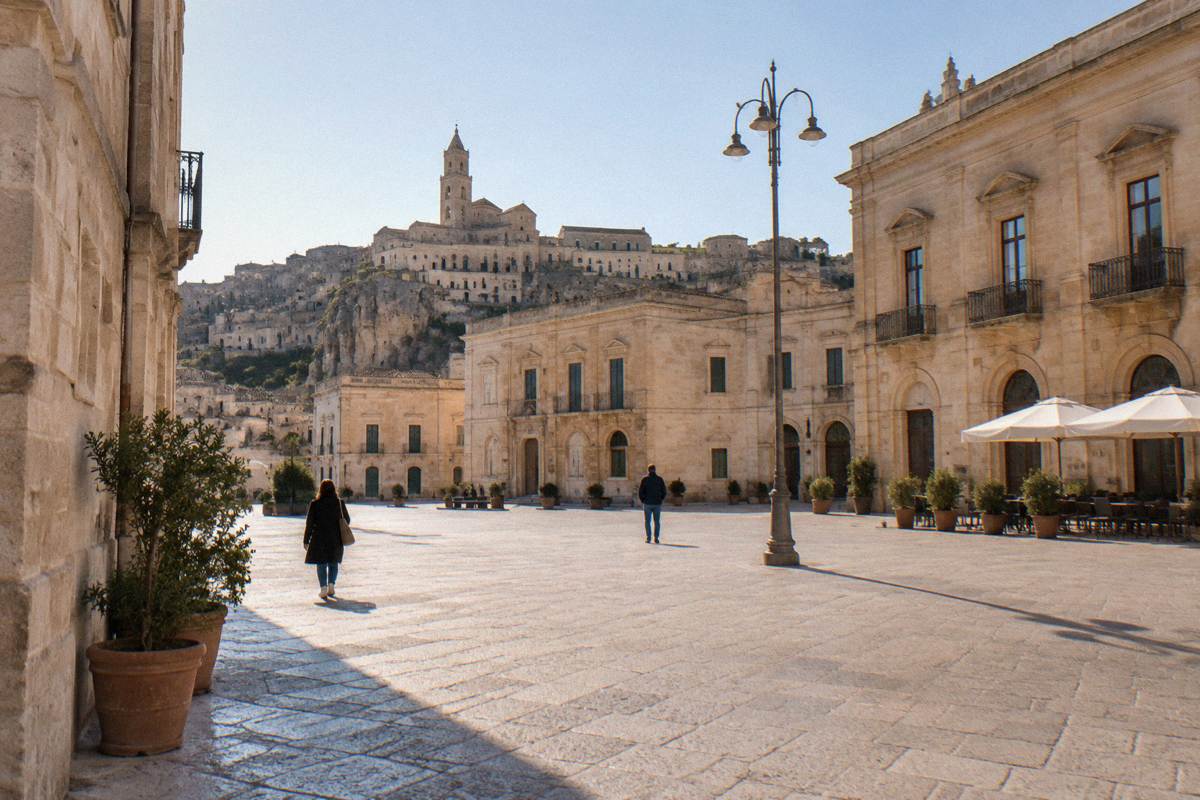
Piazza Vittorio Veneto is Matera's main modern square, standing directly above the Palombaro Lungo cistern and looking out over the Sasso Barisano. It is pedestrianised all day, sits at the edge of the Sassi UNESCO site, and is within a short walk of Casa Noha, Palazzo Lanfranchi, MUSMA and the Cathedral.
Piazza Vittorio Veneto is the broad, stone-paved square where Matera's modern upper town stops and the Sassi begin. The city sits inland in Basilicata, southern Italy, at about 400 m above sea level on the edge of the Gravina canyon, and this square marks the boundary line with unusual clarity: on one side, the planned streets of the newer city; on the other, the cave dwellings and rock-hewn churches of the Sasso Barisano spilling down towards the ravine. The square is closed to traffic all day, every day, and it works in practice as the city's front room, the place where walks begin, aperitivo tables spread in the evening and the panorama over the old quarters opens up without any climb at all.
What Is Piazza Vittorio Veneto In Matera?
Piazza Vittorio Veneto is Matera's principal modern square, laid out as the upper town developed beyond the medieval core, and today it functions as the hinge between the new city and the Sassi. It is a pedestrian area closed to vehicles 24 hours a day, it looks directly over the Sasso Barisano and the Gravina canyon, and beneath its paving lies the Palombaro Lungo, the vast cistern that stored the city's water. Almost every visit to Matera passes across it sooner or later.
The square belongs to the part of Matera that grew after the Sassi were the whole city. The old quarters, the Sassi di Matera, were the town until building pushed up onto the plateau, and the plateau's natural centrepiece became this open space on the rim. Matera was inscribed on the UNESCO World Heritage list in 1993 for "The Sassi and the Park of the Rupestrian Churches of Matera", and the square sits at the very edge of that inscribed landscape, which is why orientation walks gather here.
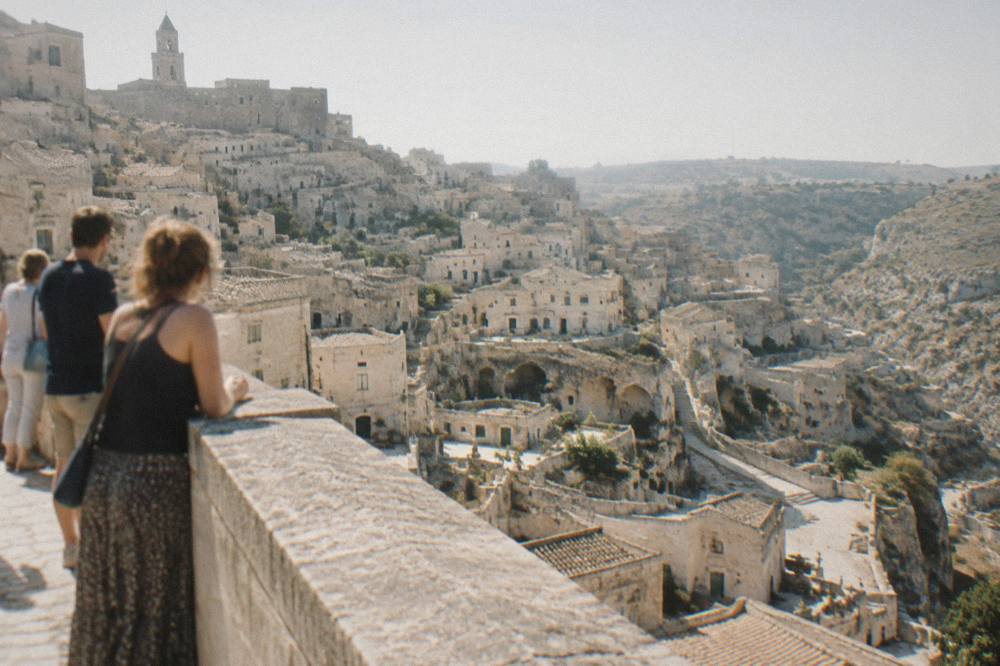
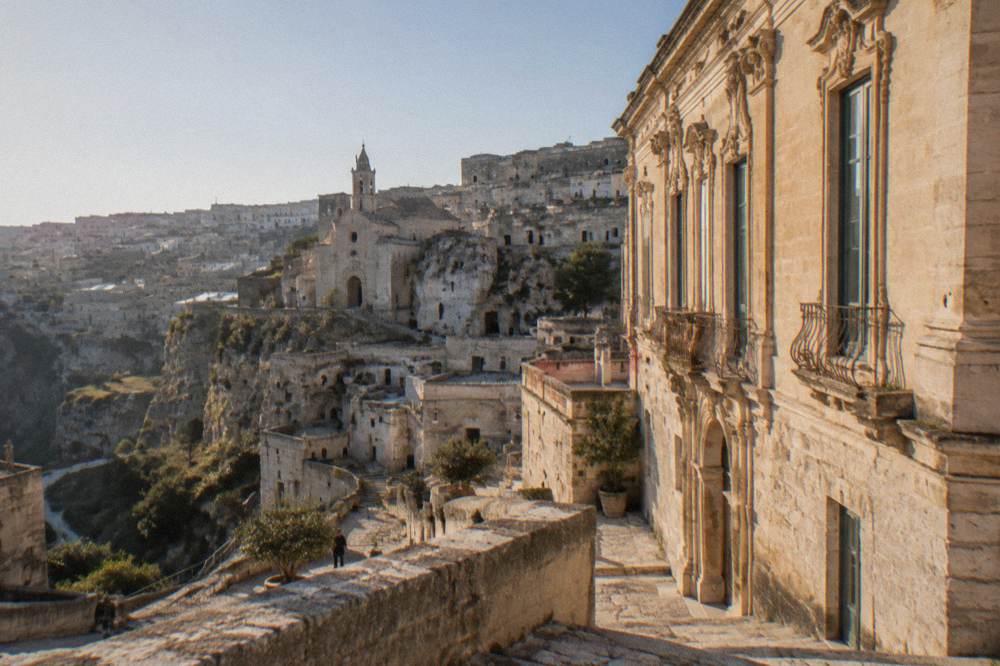
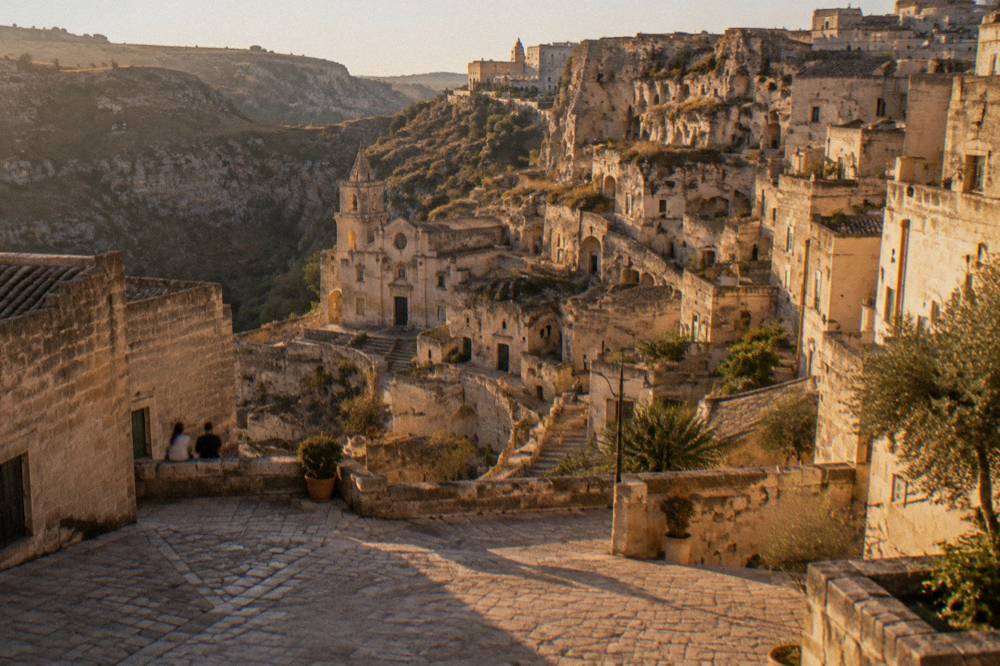
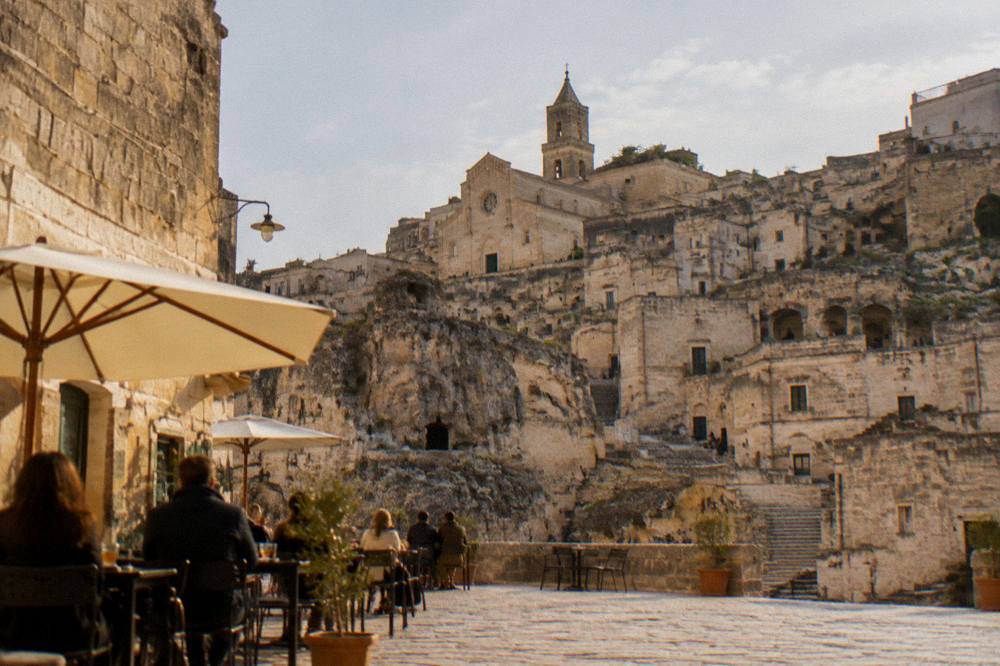
What surprises first-time visitors is the view. Standing near the western parapet, the whole terraced face of the Sasso Barisano is laid out below: cave facades stacked one on another, stairways cut into tufa, church domes and chimney stacks. The canyon country of the Parco della Murgia rises opposite. No other viewpoint in the city combines this with flat, vehicle-free ground and a steady supply of cafés, which is why the materani treat it as a promenade rather than a monument.
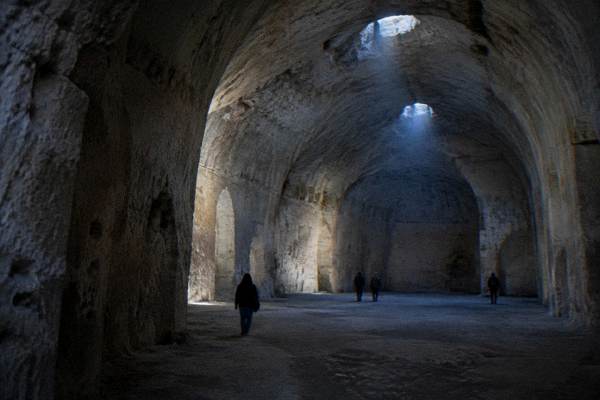
The square's surface is deceptive in one more way. The Palombaro Lungo, the enormous underground cistern carved and vaulted beneath the piazza, collected rainwater for the city for centuries. It is one of Matera's signature sights and its entrance sits at the square's edge; details on visiting are below.
Why Is The Piazza The Natural Starting Point For Exploring The Sassi Di Matera?
The piazza is the natural starting point because it sits at the top of the Sassi rather than inside them: from here every route descends into the districts and every climb back up ends here. It is pedestrianised all day, it is the main orientation point for guided walks and panoramic rides, and it sits within a few minutes on foot of Casa Noha, Palazzo Lanfranchi, MUSMA and the entrance streets to the Sasso Barisano. Starting high and finishing low is simply how the geography wants to be used.
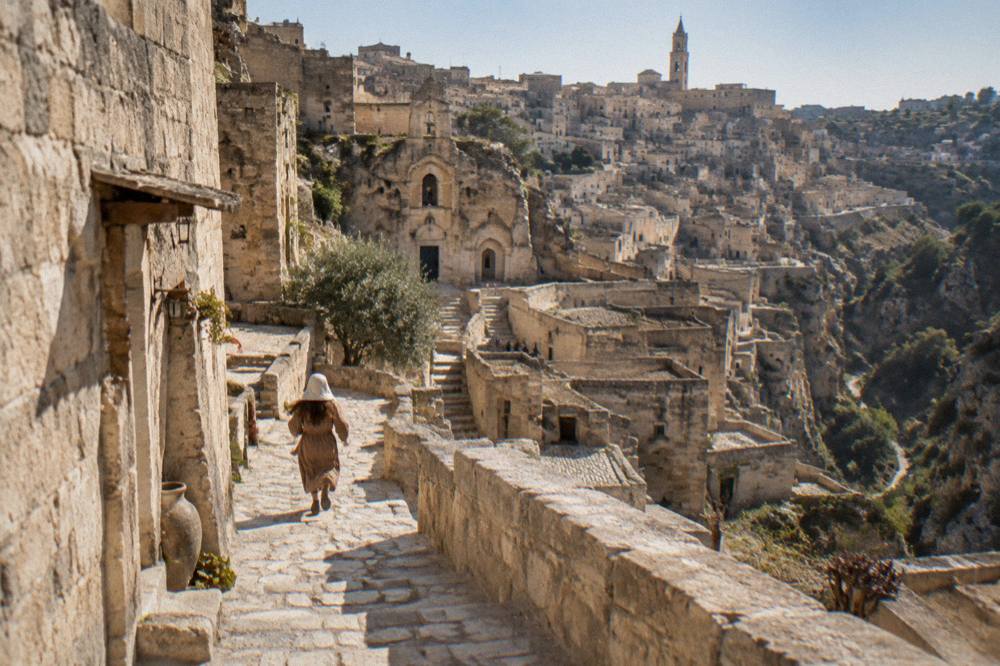
Walk down from the square into the Sasso Barisano and the streets narrow within fifty paces. The cave-house museums, the rupestrian churches and the staircase lanes of the old districts all connect to the square through a handful of descents, and each of them returns you to the same rim at the top. That loop shape is why tour meeting points cluster here, and why the self-guided and guided walking options described elsewhere on this site all begin from this side of the city.
Tip-based walks also run locally; if one interests you, confirm the arrangement and the meeting point directly with the guide.
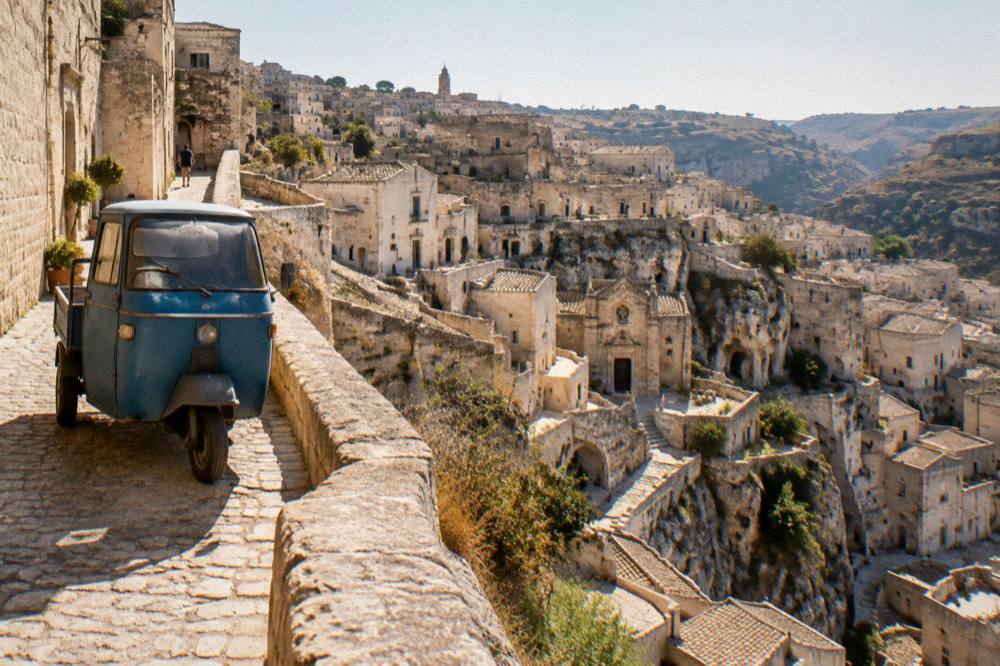
For visitors who prefer a motorised overview before walking, the small vehicle tours, tuk-tuks and Ape Calessinos, loop from the upper town around the viewpoints on both sides of the canyon, which gives a frame for everything walked afterwards. The trio above shows current options with live pricing.
What Can You See From Piazza Vittorio Veneto, Matera?
From the square's rim you see the full terraced face of the Sasso Barisano, the canyon of the Gravina, and the rupestrian-choir landscape of the Murgia plateau opposite; looking along the rim itself you see the Chiesa del Purgatorio, Palazzo Lanfranchi and the streets that climb towards the Cathedral and the Civita. At sunset the west-facing front of the caves catches the light, and the square becomes one of the city's principal open-air viewpoints without any ticket or climb.
The panorama works in two directions. Below and west, the Sasso Barisano: a stacked composition of cave facades, stone staircases and garden terraces dropping towards the canyon floor. Opposite, across the Gravina, the Murgia plateau with its scattered rock churches; the park's own site counts about 8,000 hectares by its own measure, protected under regional Law 11/1990. The classic far-bank viewpoints such as Belvedere Murgia Timone look back at this same skyline from the other side.
Along the square itself the landmarks are civic rather than rupestrian. The Chiesa del Purgatorio, with its skeletal facade carvings, stands a short walk away and hosts exhibitions included in the Oltre l'Arte combined ticket. Palazzo Lanfranchi, the baroque palace that now houses the Museo Nazionale di Matera, closes the eastern side of the view towards the Cathedral on the Civita ridge.
A panoramic tuk-tuk ride is one way to reach the far-bank viewpoints and the quiet lanes above the square in a single loop; the button above checks live availability, and the operator's listing carries the cancellation terms.
What Lies Beneath The Square: The Palombaro Lungo
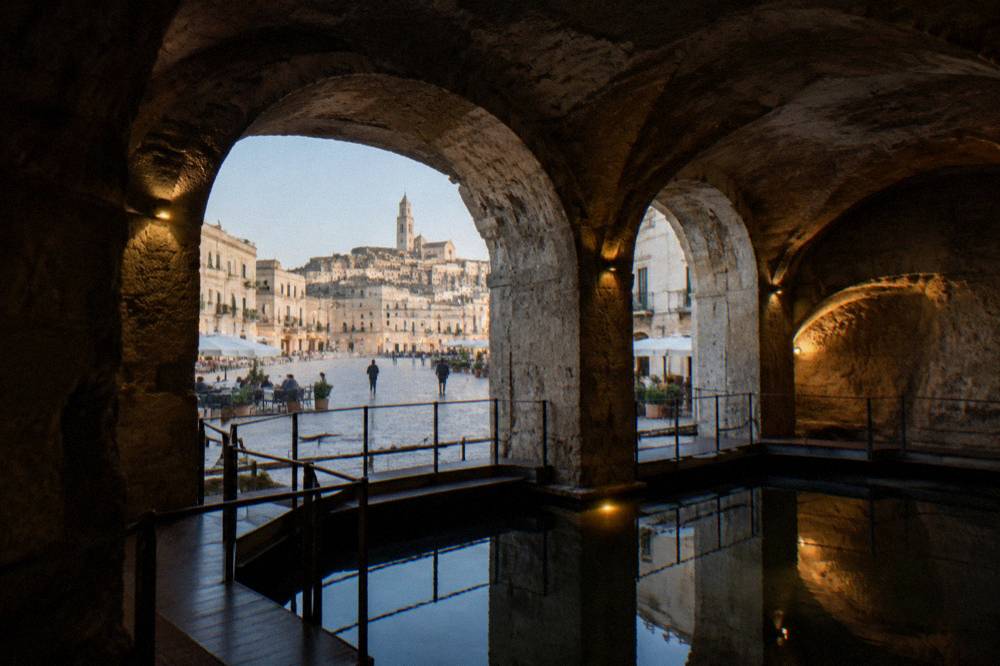
Beneath the paving of Piazza Vittorio Veneto sits the Palombaro Lungo, Matera's great underground water cistern, a vaulted rainwater reservoir dug into the tufa that served the city until the mid-twentieth century. Its entrance is at the square's edge, and visits are by guided tour only, with booking handled at the site; no official page currently publishes a ticket price or opening hours, so confirm both locally or at booking.
The cistern is the square's secret and the reason the ground here is hollow. Water management defines Matera's history: with no river on the plateau, the city survived on cisterns, neviere and canalised rainwater, and the Palombaro Lungo was the largest of them. Walking its floor, with the vaults rising overhead and the piazza's foundations overhead beyond them, is the closest thing Matera offers to descending into the logic of the Sassi themselves. The dedicated Palombaro Lungo guide on this site covers what a visit involves and what to confirm before you go.
The site's own page states that phone booking is not possible, so plan to arrange a visit through the channels the site lists or through a guided tour of the city that includes the cistern. As with several smaller Matera sights, no operator page with a price or hours could be verified, so nothing is printed here.
Which Museums And Churches Are Within Walking Distance Of The Piazza?
Within a short radius of the square you can reach Casa Noha, Palazzo Lanfranchi and the Museo Nazionale, MUSMA, the Cathedral and MATA, and the entrance lanes of both Sassi districts. Published admissions: MUSMA 10.00 EUR full, Museo Nazionale sites 10.00 EUR each or 15.00 EUR cumulative over two days, Casa Noha 6.50 EUR, and the Oltre l'Arte circuit from 4.50 EUR for one church to 25.00 EUR for eight sites.
This density is the square's real value. You can spend a whole day orbiting it without ever needing transport. The table below gathers the verified admissions within that radius, read on the operators' own pages.
| Site | Distance from the piazza | Full ticket | Notes |
|---|---|---|---|
| Casa Noha (FAI) | At the edge of the square | 6.50 EUR | Closed Wednesdays; closed 5 to 22 October 2026 for renovation |
| Palazzo Lanfranchi, Museo Nazionale | Short walk east | 10.00 EUR | Open 09:00 to 20:00; 15.00 EUR cumulative ticket, 2 days, all sites |
| MUSMA sculpture museum | Down into Sasso Caveoso | 10.00 EUR | Reduced 5.00 and 7.00 EUR; free to age 6 |
| Oltre l'Arte rupestrian churches | Inside the Sassi | 4.50 to 10.00 EUR | 1, 2 or 3 churches; hours from 28 March 2026 |
| Oltre l'Arte 8-site all-inclusive | Various | 25.00 EUR | Includes the Purgatory exhibition near the piazza |
| Storica Casa Grotta di Vico Solitario | Sasso Caveoso | 8.00 EUR | Tariff from 4 April 2026; free to age 10 |
Two closures matter right now. The Museo Ridola, the archaeology collection, has been closed since 7 April 2025 for energy works and a new display, with no reopening date published; its dedicated page tracks what is known. Casa Noha, the FAI interpretation centre at the square's edge that orients so many arrivals, is closed 5 to 22 October 2026 for renovation ahead of a relaunch with new displays. If either is on your list, check before travelling.
For the rupestrian churches specifically, the Oltre l'Arte circuit is the practical route in, covering Santa Lucia alle Malve, Madonna de Idris with San Giovanni in Monterrone, and San Pietro Barisano. Each has its own page on this site: Santa Maria de Idris, Santa Lucia alle Malve and San Pietro Barisano.
| Oltre l'Arte ticket | Price | Reduced | With licensed guide |
|---|---|---|---|
| 1 church | 4.50 EUR | 3.50 EUR | 2.50 EUR |
| 2 churches | 8.00 EUR | 5.50 EUR | 4.00 EUR |
| 3 churches | 10.00 EUR | 7.50 EUR | 5.00 EUR |
| Cathedral and MATA | 4.00 EUR | on the operator's page | on the operator's page |
| 8-site all-inclusive | 25.00 EUR | 16.00 EUR | on the operator's page |
Free entry applies to children up to 10 with a parent at the churches, and all Oltre l'Arte sites close on 25 December and 2 July, the day of the Festa della Bruna.
How Do You Reach Piazza Vittorio Veneto In Matera?
You reach the piazza on foot from almost anywhere in the centre, by train to Matera Centrale and then a walk uphill, or by car to the edge of the restricted-traffic zones, because the square itself is a pedestrian area closed to vehicles 24 hours a day. The ZTL cameras around the Sassi operate seasonally, 10:00 to 20:30 from 16 September to 30 June and 10:00 to 24:00 from 1 July to 15 September, and the central ZTL runs 24 hours a day all year.
Matera's rail operator is FAL, not Trenitalia; from Bari the posted weekday timetable involves a change at Altamura and about 1 h 45 to 2 h overall, and on Sundays and public holidays no trains run, with replacement buses instead. FAL's timetable page carries the current sheets. From Matera Centrale the square is an uphill walk through the modern town. Full route detail, including the airport options and where a hire car should be left, is in the how to get to Matera and Matera parking guides on this site.
Drivers should study the ZTL map before setting out. The square and Via Ridola are pedestrian areas (APU), with retractable bollards opening only 04:00 to 08:00 on weekdays for deliveries. The zones around it are camera-enforced, and the comune publishes the hours.
| Zone | Streets | Hours |
|---|---|---|
| Pedestrian area (APU) | Piazza Vittorio Veneto, Via Ridola | Closed to vehicles all day; bollards 04:00 to 08:00 weekdays |
| ZTL Sassi | Via Buozzi, Via Madonna delle Virtù, Via D'Addozio | 10:00 to 20:30 (16 Sep to 30 Jun); 10:00 to 24:00 (1 Jul to 15 Sep) |
| ZTL Centro | Via Scotellaro, Via del Corso, Via delle Beccherie, Via Duomo, Piazza Sedile, San Francesco | 24 hours a day |
| ZTL Piave | Electronic gates | Same seasonal hours as ZTL Sassi |
| ZTL Prefettura, Ridola, Casalnuovo, Stigliani | Evening zone | 20:30 to 24:00 |
Loading windows in the camera zones run 07:00 to 10:30 and 15:00 to 17:00. Transit declarations and queries go to the comune's ZTL office. Matera charges a tourist tax collected by your accommodation, and the amount is confirmed at booking.
What Is The Best Time Of Day And Year To Be On The Piazza In Matera?
The best time of day on the piazza is late afternoon into sunset from spring to autumn, when the west-facing caves of the Sasso Barisano catch full light and the square's café tables fill; the best months for combining thin crowds with workable weather are April, May, late September and October, because the APT Basilicata data shows September, not August, is Matera's busiest month, with 61,630 accommodation arrivals in September 2025 against 15,239 in February.
The crowd pattern runs against Mediterranean intuition. The APT Basilicata accommodation counts for the city show the peak in September (61,630 arrivals) ahead of August (60,257), with May and October close behind; February is the floor. In 2025, 57.4% of arrivals came from abroad, and in September 74.5% did. These are guests in registered accommodation, not day trippers, but the rhythm is real: the square is busiest in early autumn, not high summer.
| Month | Mean high °C | Rain mm | Arrivals 2025 |
|---|---|---|---|
| March | 14.1 | 59.2 | 23,629 |
| April | 17.4 | 56.5 | 45,195 |
| May | 22.7 | 41.7 | 54,101 |
| June | 28.2 | 35.1 | 50,186 |
| July | 31.2 | 21.2 | 43,966 |
| August | 31.3 | 21.7 | 60,257 |
| September | 25.7 | 44.8 | 61,630 |
| October | 20.8 | 51.7 | 52,538 |
Climate figures are ERA5 reanalysis, 1991-2020, for the Matera grid cell, not a weather-station record. November is the wettest month at 67.1 mm and July the driest at 21.2 mm; frost is possible from December to March. On a winter evening the square empties early, and the view holds its shape under the street lights.
Which Tours And Panoramic Rides Work Well From The Piazza?
The tours that work best from the square are the small-vehicle panoramic rides, tuk-tuk and Ape Calessino circuits that loop the viewpoints on both banks of the Gravina, and the guided walking tours of the Sassi that use the piazza as their orientation point. All product prices, ratings and durations for the options below render from live listings, and the walking tours that include a cave house and rupestrian church entry are the ones that pair most naturally with a visit that starts on the square.
The logic is geographical. The square gives you the overview; the walks give you the interior. A reasonable day pairs one with the other: a motorised loop in the morning when the light is on the Murgia side, then a descent on foot into the Sassi after lunch. Several walking tours include entry to a furnished cave house and a rock-cut church, which covers the two interior experiences the square itself cannot give you. Details of the furnished cave-house museum, the Storica Casa Grotta di Vico Solitario, are on its own page.
The Ape Calessino ride above, the compact vintage three-wheeler circuit, is the classic square-based panorama. A comparable open-top eco-bus option covers the same arc for those who prefer four wheels.
For visitors who want the walking version, the Sassi tour with cave house and rupestrian church below is the pairing this site features most often: it starts from the upper town and covers the ground the square looks over. Check current availability and the meeting point on the operator's live listing.
What Events Happen On Or Near Piazza Vittorio Veneto?
The events that shape the square's year are the Festa della Bruna on 2 July, when the whole city celebrates its patron and every Oltre l'Arte site closes, the Matera Film Festival from 7 to 15 November 2026, and the Presepe Vivente nei Sassi, the living nativity that runs through the Sasso Caveoso on four December weekends plus 2 and 3 January 2027 at 12.00 EUR full price. The square itself hosts gatherings and screenings rather than ticketed shows, and its role is as the city's stage.
The Bruna is the fixed point of the materani calendar. The organisers date the feast to 1389, when Pope Urban VI tied it to the Visitation and fixed 2 July, and the 2027 edition falls on a Friday. Programme details beyond the date are published closer to the event. In December the living nativity transforms the lanes below the square: the sixteenth edition, titled "Vera Fratellanza", opens 4 December 2026 with public days on 5-6, 12-13, 19-20 and 26-27 December and 2-3 January, its route running from Piazza San Pietro Caveoso through Vico Solitario and Rione Malve to Casalnuovo, with 20 scenes.
| Event | Dates | Tickets |
|---|---|---|
| Festa della Bruna | 2 July every year | Public feast; programme published nearer the date |
| Matera Film Festival, 7th edition | 7 to 15 November 2026 | On the festival's own channels |
| Presepe Vivente nei Sassi, 16th edition | 5-6, 12-13, 19-20, 26-27 Dec 2026; 2-3 Jan 2027 | 12.00 EUR full, 9.00 EUR ages 10 to 18, free under 10 |
| Gezziamoci jazz festival, 39th edition | To 29 December 2026 | On the venues' channels |
| Matera 2026 Mediterranean Capital of Culture | Programme closes 28 November 2026 | Varies by event |
In the run-up to Christmas the square does steady business as a meeting point for the nativity route below it. In November the film festival uses venues across the centre; screenings and details are on the festival's own site.
Where To Eat, Drink And Continue From The Piazza
The square's edges carry the highest concentration of cafés and aperitivo tables in Matera's upper town, and it is the practical base for evenings: the view-side tables fill at sunset, the lanes down into the Sasso Barisano hold cave restaurants, and the square's position means every walk back up from the Sassi ends here. For food specifically, the dedicated restaurant and what-to-eat guides on this site cover the verified picks, from pane di Matera to the cave dining rooms below the rim.
Aperitivo on the square is the local evening ritual: a drink, the view, and the slow assembly of the passeggiata. Down one level, the Sasso Barisano's cave restaurants occupy vaulted rooms cut into the rock face, and the walk between them and the square is a few minutes of stairs. The cave restaurants and where locals eat guides on this site give the detail, and the bars and aperitivo guide covers the square-side options.
From here the onward routes are clear. One descent leads into the Sasso Barisano and the Barisano side's rock churches; another crosses towards the Civita and the Cathedral; a third drops into the Sasso Caveoso towards Casa Noha's corner, MUSMA and the caveoso viewpoints. The one day in Matera itinerary on this site starts exactly here, and the things to do in Matera overview collects everything reachable from this square on foot. More of the city's sightseeing context is on Matera Travel Guide throughout.
Common Questions About Piazza Vittorio Veneto Matera
Is Piazza Vittorio Veneto in Matera free to visit?
Yes. The square is a public pedestrian space, open all day and night, and the viewpoint over the Sasso Barisano costs nothing. Only the attractions beneath and around it, such as the Palombaro Lungo cistern, the museums and the church circuit, charge admission.
Can you drive to Piazza Vittorio Veneto in Matera?
No. The square is a pedestrian area closed to vehicles 24 hours a day, with bollards opening only 04:00 to 08:00 on weekdays for deliveries. Cars stop at the edge of the surrounding ZTL zones, whose cameras run seasonally in the Sassi area and around the clock in the central zone. The comune's ZTL pages carry the maps and hours.
How far is Piazza Vittorio Veneto from the Sassi?
The square sits directly on the lip of the Sassi. The first lanes of the Sasso Barisano begin at its edge, and the walk down into the district takes only minutes, though the terrain is steep, stepped and uneven throughout. The Sasso Caveoso side is a somewhat longer walk from the square, still on foot.
What is under Piazza Vittorio Veneto?
The Palombaro Lungo, a large vaulted cistern carved into the tufa beneath the square, which stored rainwater for the city. Visits are by guided tour with booking arranged through the channels on the site's own page; no official ticket price or opening hours are currently published, so confirm locally or at booking.
When is the piazza busiest?
By the APT Basilicata accommodation data, Matera's busiest month is September, with 61,630 arrivals in 2025 against 60,257 in August, and by time of day the square fills from late afternoon as the sunset light hits the Sasso Barisano. February was the quietest month of 2025 with 15,239 arrivals.
Which sights are closest to the piazza?
Casa Noha stands at the square's edge (though it is closed 5 to 22 October 2026 for renovation), Palazzo Lanfranchi and the Museo Nazionale are a short walk east, and MUSMA, the Cathedral and the rupestrian churches of the Sassi all sit a few minutes' walk downhill.
The square earns its place on any Matera itinerary precisely because it asks nothing of you: no ticket, no climb, no schedule. Arrive once in the middle of the day to get your bearings, come back at sunset for the view, and let every route into the Sassi begin and end at its rim.