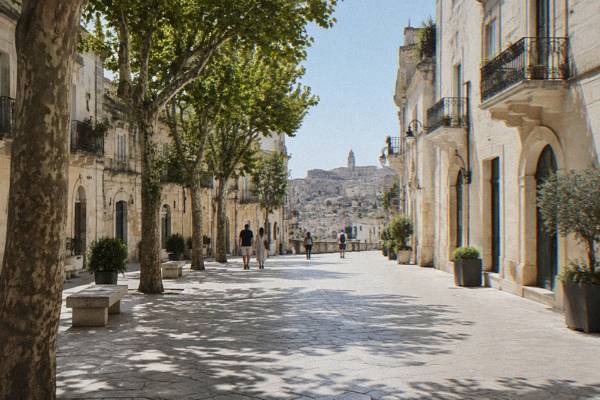
Castello Tramontano
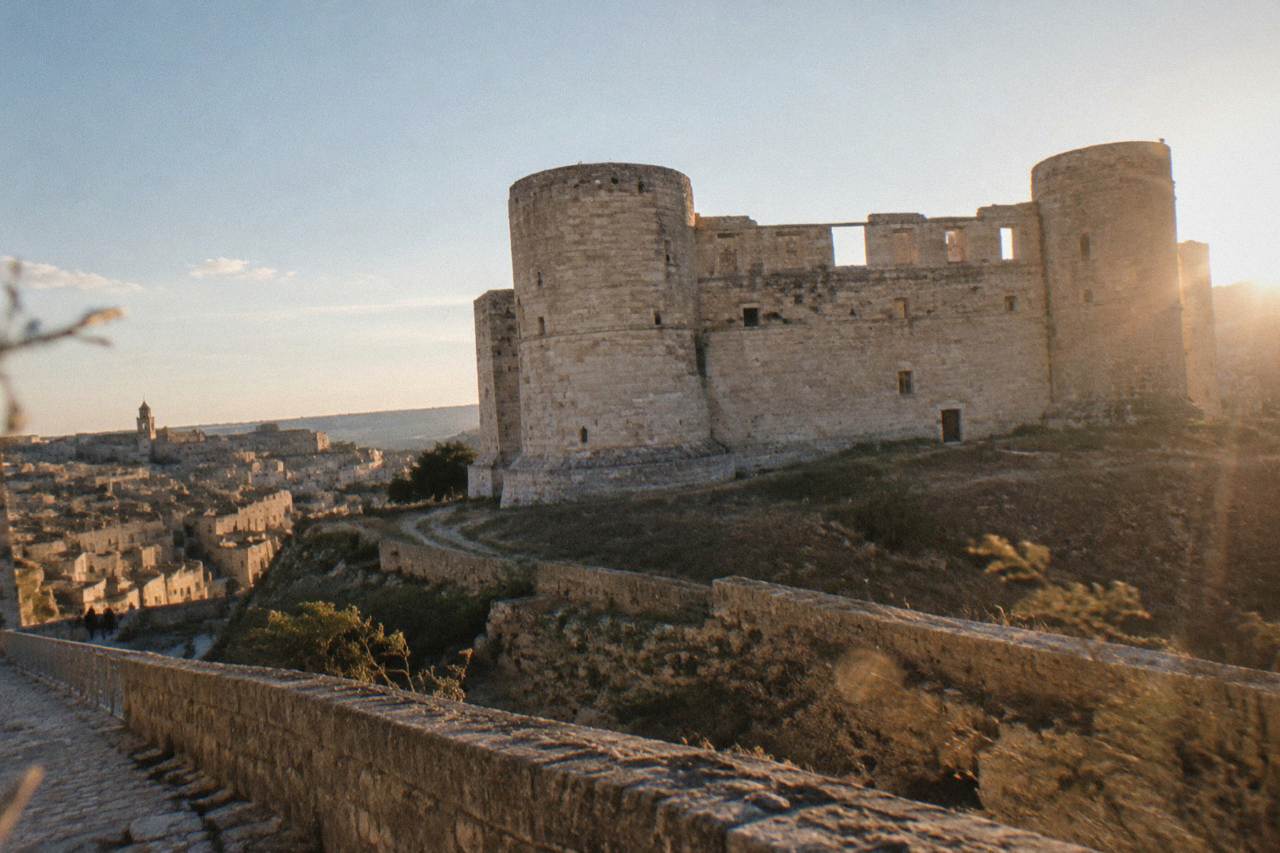
Castello Tramontano stands on the Larono hill above Matera's modern centre, an unfinished Aragonese-style fortress begun for Count Gian Carlo Tramontano and never completed after his death.
Short answer
Castello Tramontano is an unfinished historic castle on a low hill above central Matera, started for Count Gian Carlo Tramontano and left unfinished. It is a landmark of the skyline rather than a museum: no operator page publishes a price or opening hours for the interior, so treat it as a viewpoint and photo stop and check locally for any access.
Castello Tramontano is the unfinished castle that sits on the Larono hill at the northern edge of Matera, the inland city of Basilicata in southern Italy that is best known for its Sassi cave quarters. The building was begun for Count Gian Carlo Tramontano, the noble who then held the city, and it was never finished: his death stopped the work, and the shell has stood above the town ever since as one of the most recognisable silhouettes in the Matera skyline after the Sassi and the Murgia escarpment themselves.
This page, from the Matera Travel Guide editorial desk, sets out what the sources say about the castle, what a visitor can realistically do there, and how it fits into a visit that also takes in the Sassi and the rupestrian churches. One warning up front, because it shapes everything below: no operator page with a ticket price or opening hours for the castle's interior was found in this site's research. The interior's accessibility is treated as unverified throughout, and readers are advised to check locally.
What Is Castello Tramontano In Matera?
Castello Tramontano is an unfinished residential fortress on the Larono hill, a short walk north of Matera's Piazza Vittorio Veneto, begun for Count Gian Carlo Tramontano and left unfinished. Its chief interest today is architectural and scenic: a rare surviving example of an Aragonese-era defensive residence left in mid-construction, standing on a hilltop that looks back over the city and the Gravina canyon.
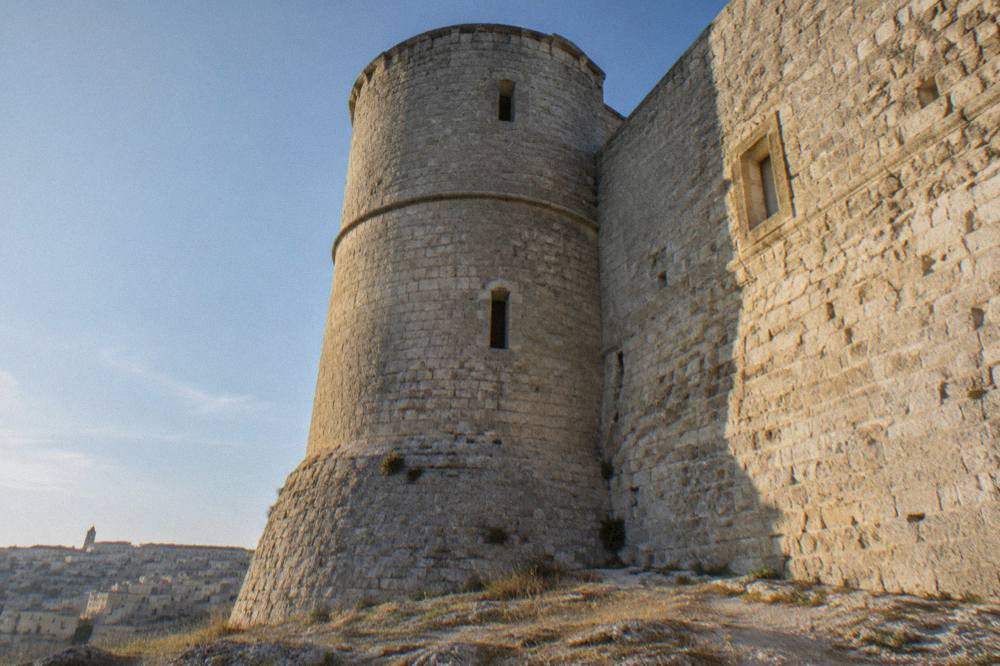
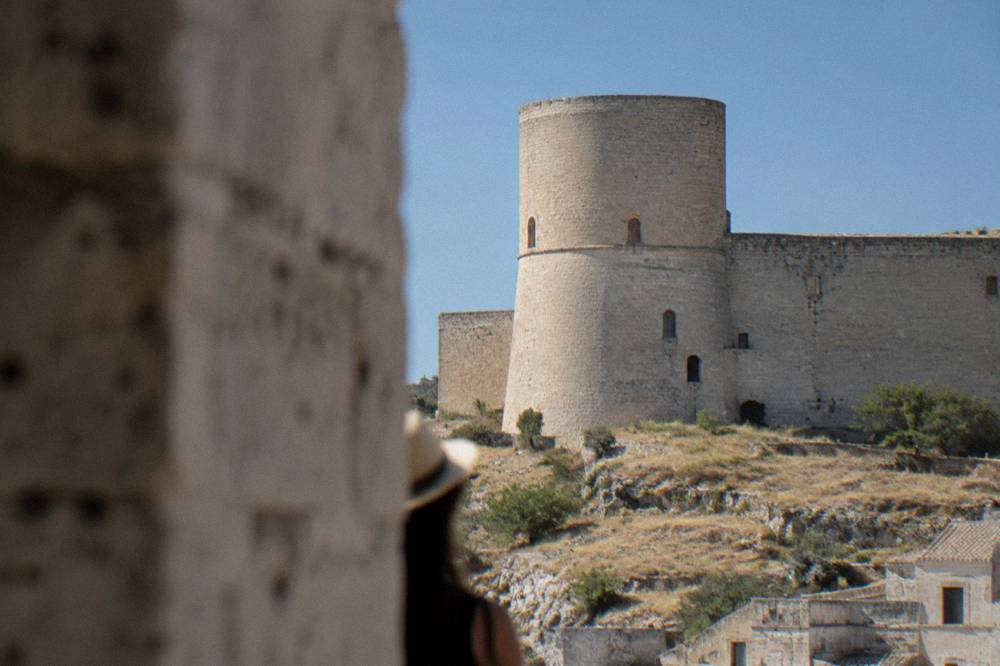
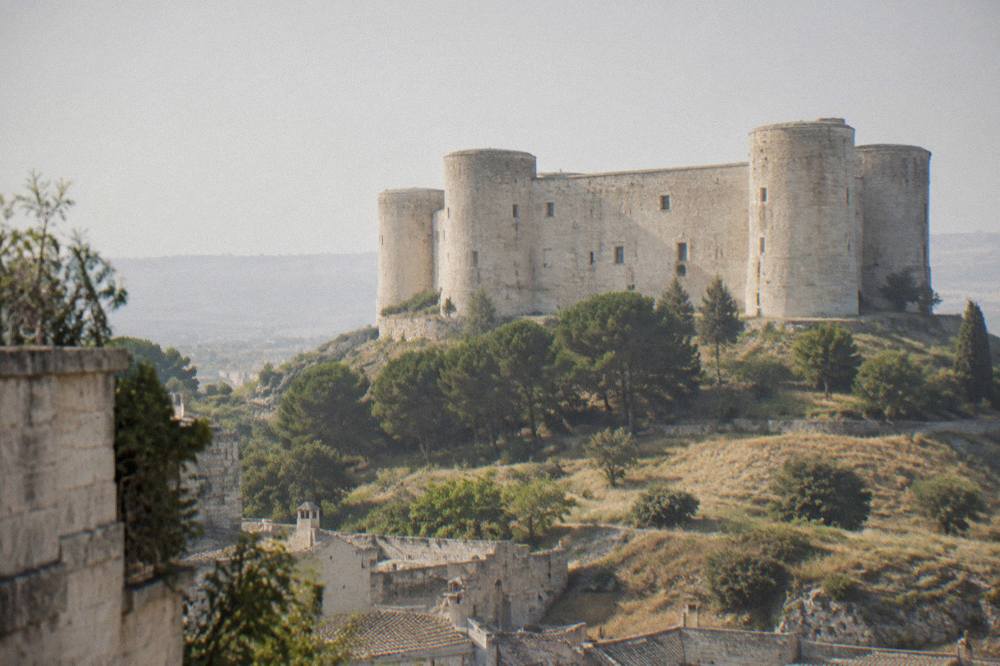
The castle is a hybrid of palace and fortification, the form favoured by Aragonese military architecture in southern Italy: a compact rectangular body with heavy round corner towers, designed to be both a residence and a statement of power. Because construction halted abruptly, the building reads as a fragment. Walls rise without their intended completions, and the whole mass has a truncated, arrested quality that finished castles do not have.
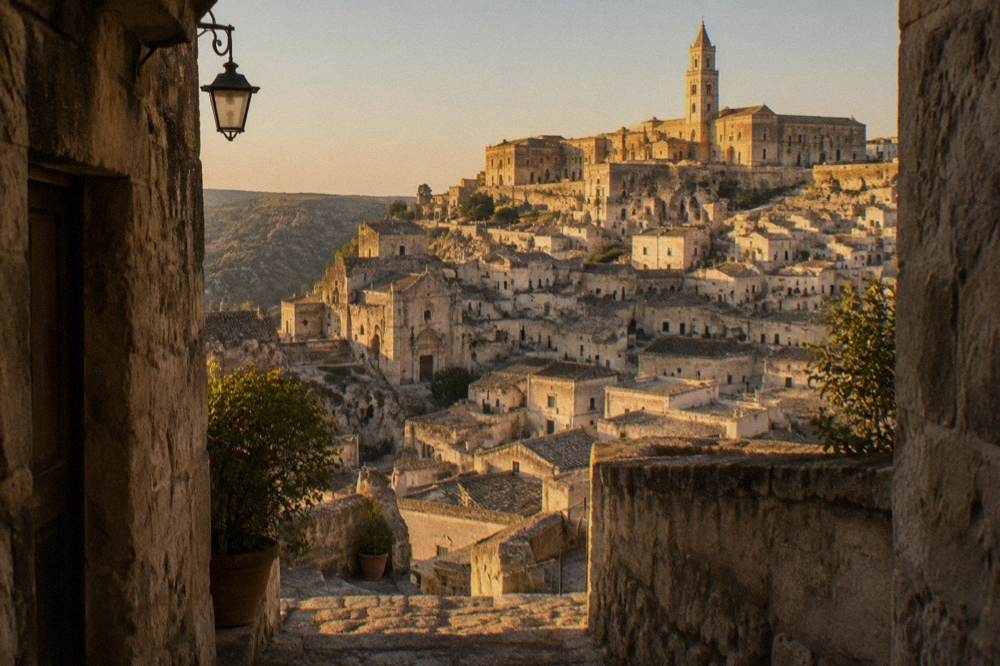
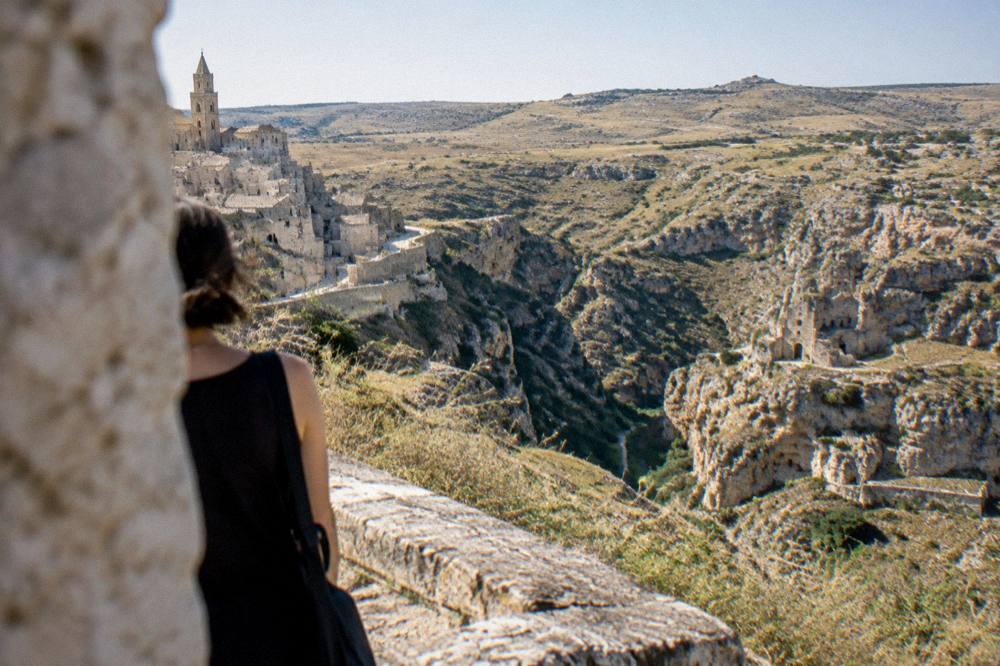
The hill it stands on matters as much as the masonry. Matera sits at about 400 m above sea level on the edge of the Gravina canyon, with the Murgia plateau opposite, and the Larono hill lifts the castle just above the flat modern centre. From the Sassi districts, Sasso Caveoso and Sasso Barisano, the castle appears at the top of the town as a crown shape; from the castle side, the view runs back over the tiled roofs of the Piano, the historic ridgeline between the two Sassi, and beyond them the ravine. There is no sea at Matera, and none is visible from here: the horizon is the Murgia.
Who Was Count Tramontano And Why Was His Castle Never Finished?
Count Gian Carlo Tramontano was the noble who governed Matera in the era the castle was begun, and the building was his project to assert power over the city from a fortified hilltop residence. The castle was never finished and stands today in the unfinished state it was left in.
The story the city tells itself about the count is not a flattering one. The traditional account describes a heavy-handed ruler whose taxes and exactions made him hated, and whose murder, on the road, was the town's answer. The details vary between tellings, and this site does not upgrade tradition into verified record; what is not in dispute is that the patron died violently and young, that the money stopped, and that the building never received its completion.
What survives is the skeleton of an ambitious design. The round towers, the thick curtain walls and the raised position were all delivered; the finishes, the upper residential ranges and the internal arrangements were not. Later owners and the city found uses for the shell over the centuries, and the structure has been consolidated more than once, but no campaign ever resumed the original plan. Visitors comparing it with Matera's other monuments should note the contrast in survival: the Sassi cave dwellings and the rupestrian churches were used continuously for centuries, while the castle was frozen at the moment its patron died.
That frozen state is precisely why historians value it. Finished castles show intent; an unfinished one shows method. The wall breaks, the stubbed vaulting and the tower staging document how masons of that era in this corner of the Kingdom of Naples actually organised a job of this scale, information that a completed and repeatedly remodelled building erases.
A note on how the castle is best seen. It is a skyline object, and this site's position is that it rewards viewing from a distance more than proximity: the classic compositions are from within the Sassi looking up, or from the Murgia side looking across the whole town. The guided and panoramic products listed above cover those sightlines, and the overnight-stay option pairs a castle-view evening with a guided Sassi walk the next morning. Availability and current prices are on the operator's live listing.
Can You Go Inside Castello Tramontano In Matera?
No operator page publishes a ticket price, opening hours or visit length for the interior of Castello Tramontano, and this site's research found no official source confirming that the interior is open to casual visitors. The honest answer is to plan around the exterior and the hilltop, and to check locally, at the tourist office or with a licensed guide, whether any interior access or guided visit is running on the day.
This is a deliberately cautious paragraph, and the reason is simple. For several Matera sights, the Palombaro Lungo cistern, Casa Cava, Madonna delle Virtù and San Nicola dei Greci, MOOM and Casa di Ortega among them, this site's research likewise found no operator page with a price or hours. The rule the editorial desk follows is that silence is not permission: a third-party blog repeating a price is not a source, and a castle that has hosted occasional cultural events in the past is not thereby "open". Where access exists it is typically occasional, event-driven or by arrangement, and it changes.
That still leaves a full visit's worth of castle. The exterior can be walked around at any time, the hill is public, and the photogenic material is outside: the tower massing, the wall textures, and above all the panorama over the city. Anyone hoping for a furnished interior with signage should recalibrate expectations toward Sassi museums instead. The Storica Casa Grotta di Vico Solitario, an 8.00 EUR full-price ticket on the tariff in force from 4 April 2026, reconstructs a cave dwelling in complete period detail, and the Casa Grotta di Vico Solitario page covers it fully. The Oltre l'Arte network offers the other strong interiors: its rupestrian churches run 4.50 EUR for one, 8.00 EUR for two and 10.00 EUR for three, with a 25.00 EUR all-inclusive ticket covering eight sites.
The table below is the practical comparison this site keeps for Matera's headline sights, using only prices verified on the operators' own pages.
| Sight | Full ticket | Notes from the operator's page |
|---|---|---|
| Rupestrian churches (Oltre l'Arte) | 4.50 EUR one, 8.00 EUR two, 10.00 EUR three | Daily from 28 March 2026; last entries 18:50 to 19:20 |
| Cathedral and MATA | 4.00 EUR | Daily 09:00 to 19:00, last entry 18:45 |
| Storica Casa Grotta di Vico Solitario | 8.00 EUR | Reduced 5.00 EUR; ages 11 to 18 pay 3.00 EUR |
| MUSMA sculpture museum | 10 EUR | April to September 10:00 to 20:00 |
| Palazzo Lanfranchi (Museo Nazionale) | 10.00 EUR | 15.00 EUR cumulative ticket, 2 days, all sites |
| Casa Noha (FAI) | 6.50 EUR | Closed 5 to 22 October 2026 for renovation |
| Castello Tramontano | Not published | No operator page found; check locally |
Where Is Castello Tramontano And How Do You Reach It From The Sassi?
The castle stands on the Larono hill just north of Matera's modern centre, a short uphill walk from Piazza Vittorio Veneto, the pedestrianised square that sits above the Sassi. There is no verified public transport link to the hill: the site's research found no official page for an urban bus route or fare in Matera, so the practical answer is to walk from the centre or arrive by tour vehicle, and to treat the final stretch as a gentle climb on foot.
The walk is straightforward. From Piazza Vittorio Veneto, whose own page covers the hypogeum beneath it, the route runs out of the historic core and up the low hill; allow a relaxed stroll rather than a hike. The gradient is real but moderate, and the surface is ordinary street paving for most of the way, unlike the stepped cava landings of the Sassi. This site never describes any Matera route as step-free or wheelchair accessible, because the terrain is steep, stepped and uneven in places, and readers with mobility needs should assess the final approach in person.
Coming from the station side changes the picture slightly. Matera Centrale is the FAL rail terminus, and FAL's posted weekday timetable shows the journey from Bari taking about 1 h 45 to 2 h with a change at Altamura; on Sundays and public holidays no trains run and FAL operates replacement buses. From the station the castle is a longer walk across the modern town, and visitors with luggage usually go to their accommodation first. Current times are on FAL's timetable page, and this site's Sassi di Matera guide covers the geography of the old quarters in detail.
Parking deserves a caution. Public car park names, capacities and tariffs are unverified on this site, and Matera's restricted traffic zones are not: the ZTL Sassi cameras run 10:00 to 20:30 from 16 September to 30 June and 10:00 to 24:00 from 1 July to 15 September, while the ZTL Centro around Via Duomo and Piazza Sedile is active 24 hours a day. Anyone driving to the castle area should park outside the zones and walk up. The rules and contacts are on the comune's own pages, which list the transit-declaration procedure, and the Palombaro Lungo page shares this site's coverage of the historic centre.
What Can You Actually See At Castello Tramontano In Matera?
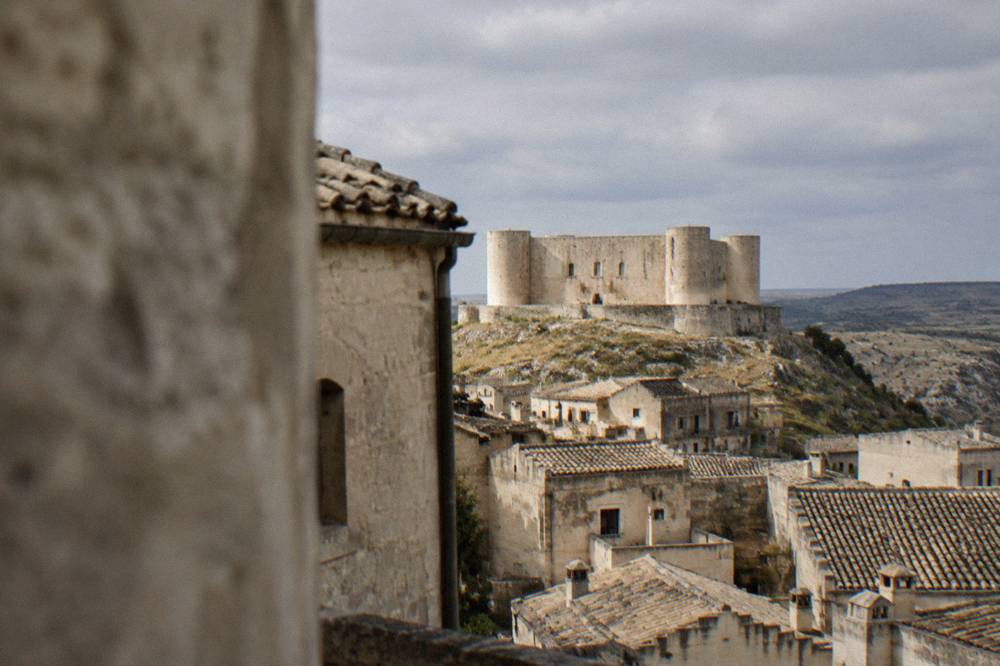
The visible substance of Castello Tramontano is its exterior architecture and its prospect: the massive round corner towers, the unfinished curtain walls, the raised fortified silhouette, and a hilltop panorama that takes in the whole of Matera from the Sassi ridgeline to the Gravina canyon and the Murgia plateau opposite. It is a five-minute history lesson in stone, and a viewpoint, rather than a collection or a museum.
Stand on the hill and the reading of the building is immediate. The corner towers dominate; their cylindicity is the signature of Aragonese military design in southern Italy, built to deflect cannon shot and to eliminate the blind angles of square towers. The walls between them are of the pale local stone that everything in Matera is cut from, the same tufa limestone that forms the Sassi and the rock churches, which is why the castle merges so naturally into the townscape despite being a completely different building type.
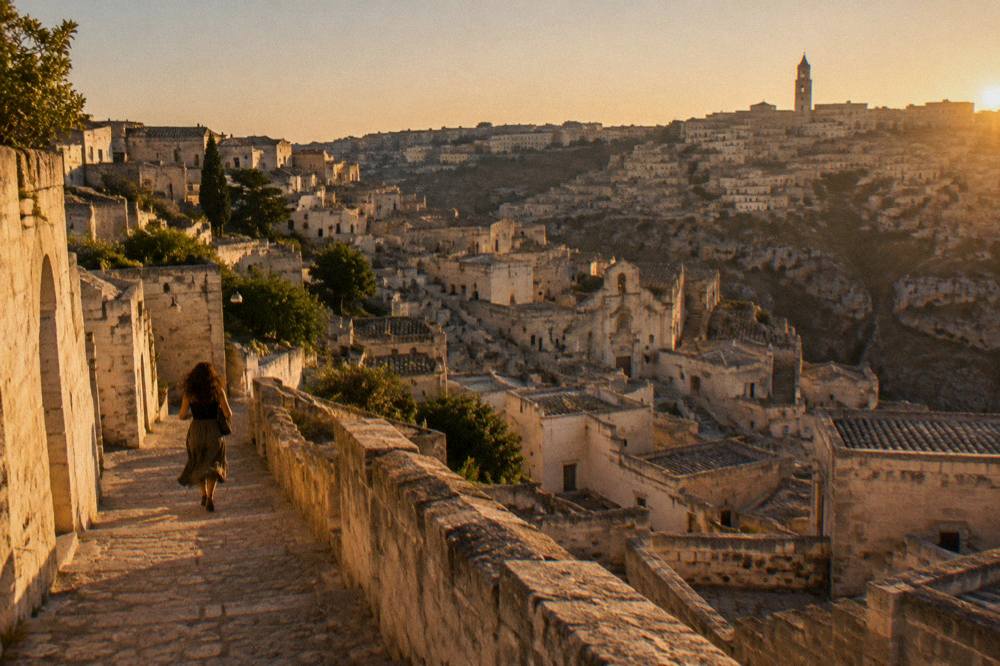
The panorama is the second exhibit. Facing south, the eye runs down over the modern Piano and catches the Civita ridge between the two Sassi, with the Cathedral's tower marking the high point of the old town, and then the land falls away into the Gravina. Across the ravine the Murgia plateau spreads out, scarred with the cave openings of the rupestrian churches, a landscape the Parco della Murgia Materana page explores in depth. Facing away from town, the horizon is the agrarian Basilicata interior, flat country running toward the Bradano valley.
Photographers should think about two framings. From the Sassi, the castle works as a top-of-frame accent in compositions of tiled roofs, best in the side light of early morning or late afternoon; from the hill, the town works as the subject with the castle reduced to a foreground mass of stone. Midday summer light is harsh, and the Matera Cathedral tower competes for skyline attention in every frame, so compose deliberately rather than shooting wide on arrival.
When Is The Best Time Of Day And Year To See The Castle In Matera?
Late afternoon into sunset is the strongest window for the castle in pure seeing terms, because the low sun lights the western faces of the towers and the Sassi across the valley at the same time; September and October are the strongest months, since the ERA5 reanalysis, 1991-2020, gives mean highs of 25.7 C in September and 20.8 C in October with 7.0 and 7.5 rain days respectively, and APT Basilicata data shows the crowds peaking in September rather than August.
The climate context is worth internalising because it inverts the usual Italian assumption. The ERA5 reanalysis, 1991-2020, gives Matera a mean high of 31.2 C in July and 31.3 C in August with only 21.2 and 21.7 mm of rain, against 44.8 mm in September and 51.7 mm in October; November is the wettest month at 67.1 mm and July the driest at 21.2 mm. Winters are cold at elevation: mean lows of 2.2 C in January and February, with frost concentrated from December to March. None of this makes a castle visit impossible in any season; it just changes the hour.
| Month | Mean high C | Mean low C | Rain mm | Rain days | Arrivals 2025 (APT) |
|---|---|---|---|---|---|
| Jan | 10.3 | 2.2 | 51.4 | 8.1 | 18,402 |
| Feb | 11.1 | 2.2 | 54.9 | 8.8 | 15,239 |
| Mar | 14.1 | 4.4 | 59.2 | 9.4 | 23,629 |
| Apr | 17.4 | 7.1 | 56.5 | 9.7 | 45,195 |
| May | 22.7 | 11.5 | 41.7 | 7.9 | 54,101 |
| Jun | 28.2 | 16.0 | 35.1 | 6.4 | 50,186 |
| Jul | 31.2 | 18.6 | 21.2 | 4.4 | 43,966 |
| Aug | 31.3 | 18.9 | 21.7 | 4.7 | 60,257 |
| Sep | 25.7 | 15.2 | 44.8 | 7.0 | 61,630 |
| Oct | 20.8 | 11.6 | 51.7 | 7.5 | 52,538 |
| Nov | 15.5 | 7.5 | 67.1 | 8.3 | 23,555 |
| Dec | 11.2 | 3.7 | 57.2 | 8.5 | 30,385 |
The arrivals column deserves a second look. APT Basilicata's accommodation counts, which are guests in registered accommodation rather than all visitors, show 61,630 arrivals in September 2025 against 60,257 in August, and 74.5% of those September guests came from abroad. Across 2025 as a whole, 57.4% of the city's 479,083 arrivals were from abroad, and the average stay was 1.56 nights. For a castle-and-viewpoint visit this matters at the margins only: the hilltop is never congested the way the Sassi viewpoints can be in peak hours, and an early-morning walk up in July, with a mean low of 18.6 C, is entirely comfortable before the heat builds.
Sunset itself is the city's ritual, and most of it happens elsewhere: the classic sunset view of the Sassi is from the Murgia side, across the canyon, which is exactly what the sunset Belvedere tours cover. A reasonable plan is to give the castle the late-afternoon hour and then move across the ravine for the sun-down view of the old town, or to reverse it in the morning when the Sassi face is in shade and the castle side is lit.
How Does Castello Tramontano Compare With Matera's Other Sights?
The castle is the outlier in Matera's monument list: everything else that draws visitors, the Sassi dwellings, the rupestrian churches, the hypogeal cisterns, is carved down into the rock, while the castle is built up on top of a hill, and it is the only major landmark with no published admission system. A first-time visitor should treat it as a one-hour exterior and viewpoint stop that brackets the cave-city visits, not as a destination of equal weight to the Sassi themselves.
The contrast is the point. Matera's UNESCO World Heritage inscription, granted in 1993, covers the Sassi and the Park of the Rupestrian Churches, a 1,016-hectare property UNESCO describes as an outstanding example of a rock-cut settlement exhibiting continuity over more than two millennia. The castle sits outside that story: it is elite architecture, imposed on the landscape, incomplete, and preserved as a curiosity rather than lived in. Seeing both in one day is the fullest picture of the city, because together they show the two Materas, the dug one and the built one.
| Sight | Type | Carved Or Built | Published Ticket | Best For |
|---|---|---|---|---|
| Castello Tramontano | Fortified residence | Built, unfinished | None found | Skyline, viewpoint, architecture |
| Sassi (Caveoso, Barisano) | Cave dwellings district | Carved | Open streets | Atmosphere, wandering |
| Rupestrian churches | Rock churches | Carved | 4.50 to 10.00 EUR | Frescoes, interiors |
| Casa Grotta di Vico Solitario | Cave-house museum | Carved | 8.00 EUR | Daily-life reconstruction |
| Palombaro Lungo | Water cistern | Carved | Not published | Engineering, check locally |
| MUSMA | Contemporary sculpture | Carved and built | 10 EUR | Art in cave spaces |
| Cathedral | Church | Built | 4.00 EUR with MATA | Skyline anchor, terrace |
For trip design, the sequencing writes itself. Morning in the Sassi with a guided walk, of which the site's roster lists several, including the Discover Matera overnight package with its stay, meal and guided tour; early afternoon in one of the ticketed interiors such as the Santa Maria de Idris or Santa Lucia alle Malve rock churches; late afternoon up the hill for the castle and the panorama; sunset from the Murgia side. The San Pietro Caveoso square and the Belvedere complete the loop, and the panoramic open-bus and Ape Calessino products in the roster cover the circuit for anyone who prefers not to walk the slopes.
What Day Trips Combine Well With The Castle And Matera?
Matera works as a base for inland and coastal day trips in every direction, with Altamura 20 km away by road, the Crypt of the Original Sin 13 km, Alberobello 68 km, Polignano a Mare 100 km and Lecce 204 km, all free-flow driving figures computed by routing engine over OpenStreetMap, and the castle's hilltop is a useful orientation stop before setting out, because the road geography of the whole region is visible from the edge of town.
The drive times below are free-flow figures with no traffic and no stops, so round them up mentally. They are distances from Matera's centre, and they define a practical ring: the Altamura and Gravina axis toward Bari, the Bradano valley axis toward Metaponto and the Ionian coast, and the long Itria valley run toward Alberobello, Locorotondo and the Adriatic towns. The coast is a day trip, not a suburb: there is no sea at Matera, and the nearest beaches by these figures are around Metaponto at 47 km on the Ionian side.
| Destination | Road km | Drive time |
|---|---|---|
| Crypt of the Original Sin | 13 | 19 min |
| Altamura | 20 | 20 min |
| Montescaglioso | 19 | 26 min |
| Gravina in Puglia | 30 | 31 min |
| Metaponto | 47 | 52 min |
| Craco | 57 | 58 min |
| Bari Airport | 64 | 1 h 01 |
| Bari | 68 | 1 h 02 |
| Alberobello | 68 | 1 h 23 |
| Polignano a Mare | 100 | 1 h 29 |
| Lecce | 204 | 3 h 08 |
Two of these deserve the castle treatment in reverse. The Crypt of the Original Sin, a painted rock crypt in the Bradano valley, is the carved counterpart to the castle's built mass, and visits are strictly by timed e-ticket booked at least 90 minutes ahead, with slots running from 09:30 to 18:30 in the April-to-September season and capacity of 20 people a slot; the ticket office is at a farm on the SS7 Appia, and no shuttle is included. The price sits inside the booking engine and is not printed on this site. The Crypt of the Original Sin page carries the full detail. Craco, the abandoned hill town at 57 km, pairs with the castle as a study in arrested places: one stopped by a patron's death, the other emptied by landslides.
What Events And Closures Should Castle Visitors Know About In Matera?
The verified calendar items that matter around the castle's hill are these: Oltre l'Arte's rupestrian churches and other ticketed sites close on 25 December and 2 July, the Festa della Bruna, whose fixed date of 2 July dates back to 1389 by the organisers' own history; the Matera Film Festival runs 7 to 15 November 2026; and Casa Noha is closed 5 to 22 October 2026 for renovation, while the Museo Ridola has been closed since 7 April 2025 with no reopening date published.
The castle itself has no calendar in this site's research; any use of the building for events is occasional and unverified, which is why the honest instruction remains to check locally. But the surrounding city has a real rhythm, and it affects any visit plan. The Bruna on 2 July is the city's patronal feast, and the whole town participates; Oltre l'Arte's closure of its church sites that day is the practical consequence for sightseeing. At the other end of the year, the Presepe Vivente nei Sassi, the living nativity, has its sixteenth edition with public days on 5-6, 12-13, 19-20 and 26-27 December 2026 and 2-3 January 2027, at 12.00 EUR full price on the organisers' own ticket page, with a route through the Sasso Caveoso from Piazza San Pietro Caveoso.
For castle photography in particular, the event calendar matters less than the light and the season. November is the wettest month in the ERA5 reanalysis, 1991-2020, at 67.1 mm over 8.3 rain days, and December adds early dusk; the trade is moody skies and empty frames. Spring, with 56.5 mm of rain in April over 9.7 rain days, mixes showers with the clearest air of the year, and April's 45,195 arrivals make it busy but not yet at September levels. There is no bad month for a hilltop view; there are only months that ask for an umbrella.
How Much Time Should You Give Castello Tramontano On A Matera Trip?
For the exterior, the hill and the viewpoint, about 45 minutes to an hour is the right allowance, folded into a walk between Piazza Vittorio Veneto and the northern edge of town; with a guide and any arranged interior access, or with a picnic stop on the hill, budget up to two hours. It is a stop on the route between sights rather than a half-day destination, and any Matera itinerary of one day or more has room for it.
The arithmetic of a Matera day supports this. The average stay in 2025 was 1.56 nights, computed from APT Basilicata's 748,812 overnight stays over 479,083 arrivals, so the typical visit is short and the Sassi take priority. A one-day plan that includes the castle looks like this: morning guided Sassi walk, midday in the Civita and Cathedral, early afternoon at a ticketed cave interior, late-afternoon walk up to the castle, sunset from the Murgia side. The San Pietro Barisano and Madonna delle Virtù and San Nicola dei Greci pages fill in the church stops, and the Belvedere Murgia Timone tour above handles the sunset leg with transfer included.
For slower trips the castle earns a second visit at a different hour, and the hill is pleasant for exactly that: it is one of the few places in Matera where the whole city composes itself in a single frame, castle-side, without the walk across the ravine. Anyone staying two nights or more, and the APT data shows a growing share doing exactly that, with 320,741 arrivals logged from January to August 2026 against 310,975 in the same months of 2025, has the slack to give the hill both a morning and an evening pass.
A last practical note on money. Matera charges a tourist tax collected by the accommodation, and its amount is confirmed at booking, not on this site, because no verified tariff page was found. Nothing about the castle itself costs money as far as published sources go: the exterior and hilltop are free to walk, and everything with a price attached, tours included, is listed above with its live availability at the operator's listing.
Common Questions About Castello Tramontano In Matera
Is Castello Tramontano in Matera open to visitors?
No operator page publishes opening hours or a ticket price for the interior, and whether it is open at any given time is not verified. Plan for the exterior and the hilltop, and check locally with the tourist office or a licensed guide for any arranged access.
How do I get to Castello Tramontano from the Sassi?
Walk. The castle sits on a low hill a short distance north of Piazza Vittorio Veneto, above the Sassi, and the route is an ordinary uphill street stroll of a few minutes. No verified urban bus route serves the hill, so a taxi or tour vehicle plus the final stretch on foot is the alternative.
Who built Castello Tramontano and why is it unfinished?
It was begun for Count Gian Carlo Tramontano, the noble who then held Matera, as a fortified hilltop residence. The castle was left in its unfinished state.
How long does a visit to Castello Tramontano take?
About 45 minutes to an hour for the exterior, the towers from outside and the viewpoint over the city and the Gravina. Allow up to two hours if a guided interior visit is running or if you stay on the hill through the late-afternoon light.
Is Castello Tramontano worth seeing if time is short?
Yes, as a viewpoint and skyline landmark, but not at the expense of the Sassi. The rupestrian churches, a casa grotta museum and the Sassi streets themselves are the core of a short visit; the castle fits naturally as the late-afternoon stop on the way to a Murgia sunset.
What is the best time of day to photograph the castle?
Late afternoon into sunset, when low light warms the western faces of the towers while the Sassi across town are also lit. Early morning works for compositions from within the Sassi looking up, with the castle as a top-of-frame accent above the rooftops.
The castle closes the circle on any Matera reading of the city: the Sassi tell you how ordinary people lived for centuries, and Castello Tramontano tells you how power tried and failed to announce itself over them. Walk up once, in whatever light your day has left, and the whole geography of the city, ravine, plateau and cave quarters, will make sense in a single glance.