Where To Stay In Matera
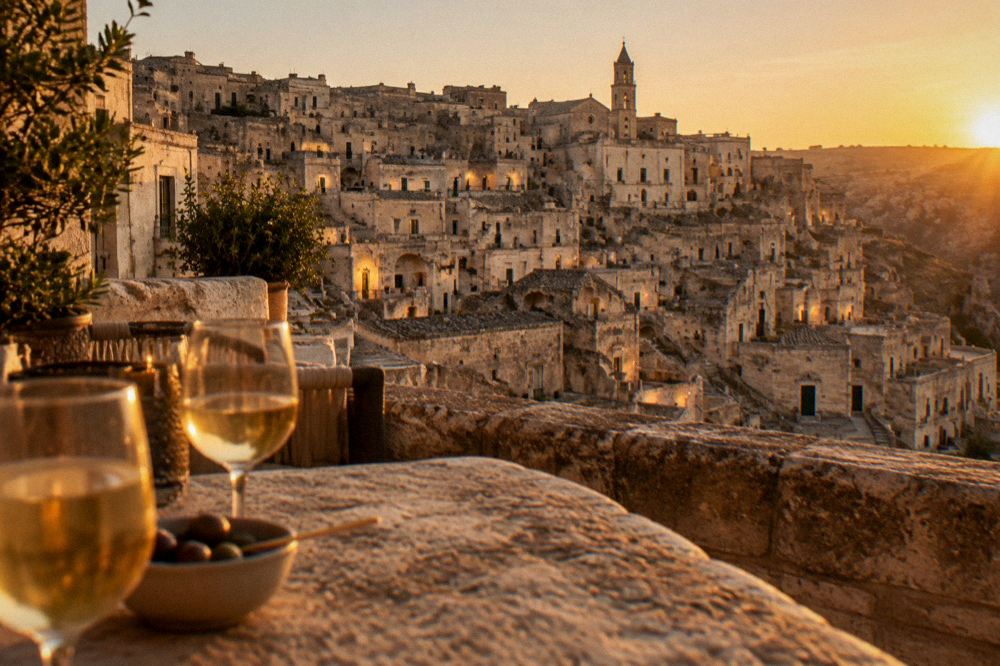
Matera, an inland city in Basilicata at about 400 m above sea level, splits into two worlds: the cave districts of the Sassi on the slope of the Gravina canyon and the flat, functional new town on the plateau above. Where you sleep changes everything about the visit, from the walk home at night to whether you can bring a car at all.
Short answer
Stay inside the Sassi, in either Sasso Barisano or Sasso Caveoso, if atmosphere matters more than easy car access, because the ZTL cameras and the stepped lanes make both driving and parking there impractical. Stay in the new town around Piazza Vittorio Veneto if you arrive by car, need step-free streets, or want cheaper rooms, and walk down into the Sassi in minutes. Two nights is the working minimum.
Matera, in the region of Basilicata in southern Italy, is an inland city of about 400 m above sea level on the edge of the Gravina canyon, and its hotel map follows that geography exactly. The cave quarters of the Sassi, Sasso Barisano and Sasso Caveoso, tumble down the slope in stepped lanes, while the modern city sits flat and level on the plateau above, around Piazza Vittorio Veneto and Via Ridola. The distance between the two is short, a few hundred metres of stairs and stone, but the experience of sleeping in each is completely different. This guide from the Matera Travel Guide editorial desk lays out the areas, the cave-hotel question, the driving restrictions and the booking calendar, drawing on the site's facts file rather than impressions.
What Are The Best Areas To Stay In Matera?
Matera has four practical bases: Sasso Barisano, the northern and slightly gentler of the two cave districts, with lifts, more renovated hotel stock and easier access from parking; Sasso Caveoso, the rawer southern district closest to the canyon views; the Civita, the high ridge between them, crowned by the Cathedral; and the modern new town on the plateau, around Piazza Vittorio Veneto, where the streets are flat, the hotels are conventional and the Sassi begin at the end of the block.
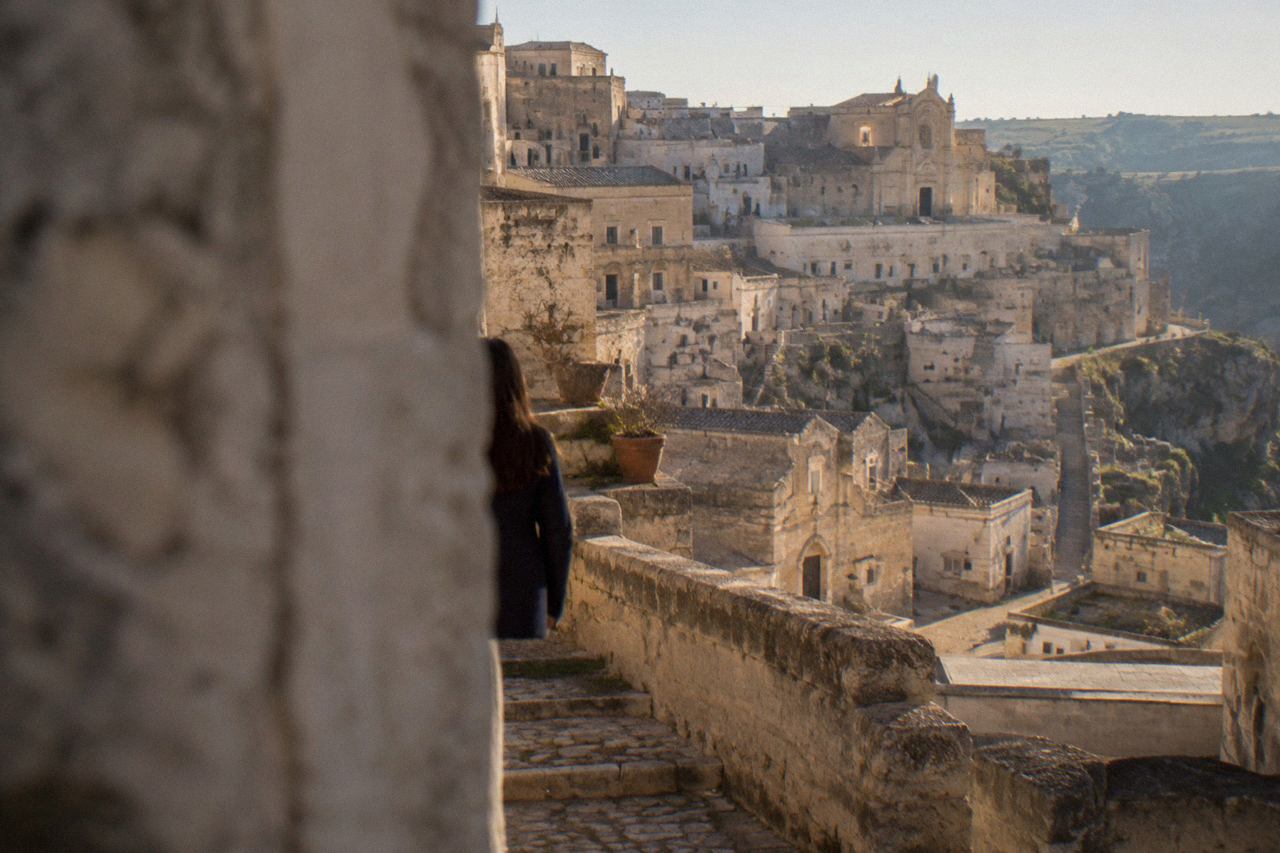
Each area suits a different visitor, and the differences are physical before they are anything else. The Sassi are steep, stepped and uneven, and no named route down into them is step-free. Barisano has the largest share of restored cave accommodation and, in recent years, a public lift that shortens the climb between the district and the upper town. Caveoso keeps more of the bare rock face and holds the viewpoints over the Gravina and the Murgia plateau opposite, including the ground around Piazza San Pietro Caveoso. The Civita is the smallest and quietest slice, a ridge of churches and palazzi with the Cathedral at its head, between the two Sassi. The new town, the Piano, puts restaurants, bars and ordinary shops on the level, with the Sassi hotels a short walk downhill.
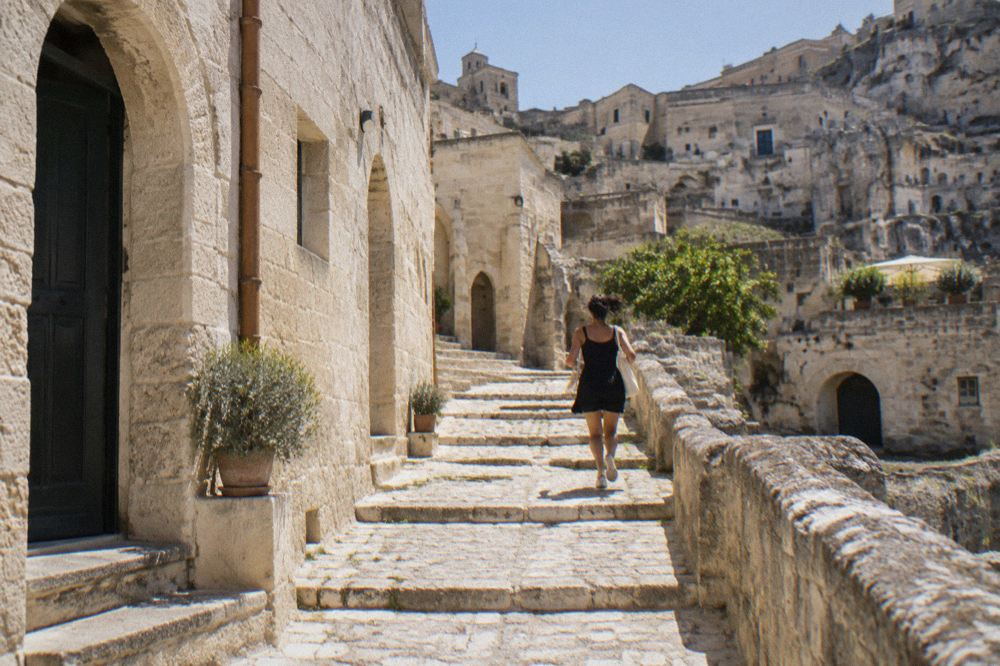
The table below is the short version of the trade-offs. Distances are walking distances on the stepped routes the districts actually have, not straight-line estimates.
| Area | Character | Getting there with luggage | Best for |
|---|---|---|---|
| Sasso Barisano | Restored cave hotels, more hotel stock, lift access nearby | Shortest drag from the plateau; some lanes slope rather than stair | First visit, atmosphere plus a bit of comfort |
| Sasso Caveoso | Rock face, canyon views, quieter at night | Stepped lanes throughout; luggage is carried, not rolled | Photographers, view hunters, second visits |
| Civita | Cathedral ridge between the two Sassi | Level walking once you are up, stairs at either end | Quiet sleepers, church lovers |
| New town (Piano) | Flat streets, conventional hotels and rentals, restaurants | Flat pavements from bus and station stops | Drivers, families, short stops, accessibility needs |
One more note on accessibility, because the site's facts file is blunt about it: never assume a Sassi address is wheelchair accessible because a listing says "centrally located". The stepped terrain is the whole point of the district. If level access matters, the new town is the area that can offer it, and confirming the door-to-door route with the property before booking is the only reliable check.
Is It Better To Stay In The Sassi Or In Matera's New Town?
Stay in the Sassi if the reason for the trip is the Sassi themselves, because waking inside the cave city, at night and at dawn, is the experience. Stay in the new town if you arrive by car, since ZTL camera gates and scarce parking make the Sassi a poor place to keep a vehicle, or if you want flat streets and the station, buses and restaurants of the modern city within a short walk.
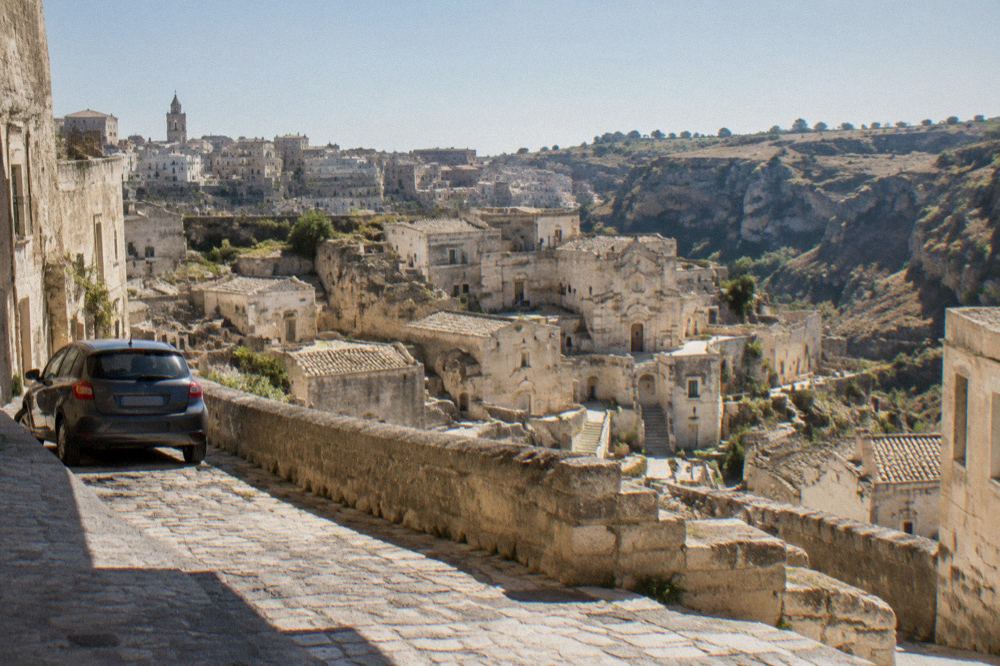
The driving argument is the decisive one for a large share of travellers. The Sassi districts sit behind the ZTL Sassi camera gates on Via Buozzi, Via Madonna delle Virtù and Via D'Addozio, active 10:00 to 20:30 from 16 September to 30 June and 10:00 to 24:00 from 1 July to 15 September, weekdays and holidays alike, according to the comune's posted hours. There is no driving into the district outside the loading windows even with a hotel booking, and the advice on parking in Matera and the ZTL rules is to leave the car on the plateau and walk down. Guests sleeping in the Sassi therefore carry luggage on foot or by hotel transfer; guests in the new town can often park within a few hundred metres. The car-friendly options are covered in detail here.
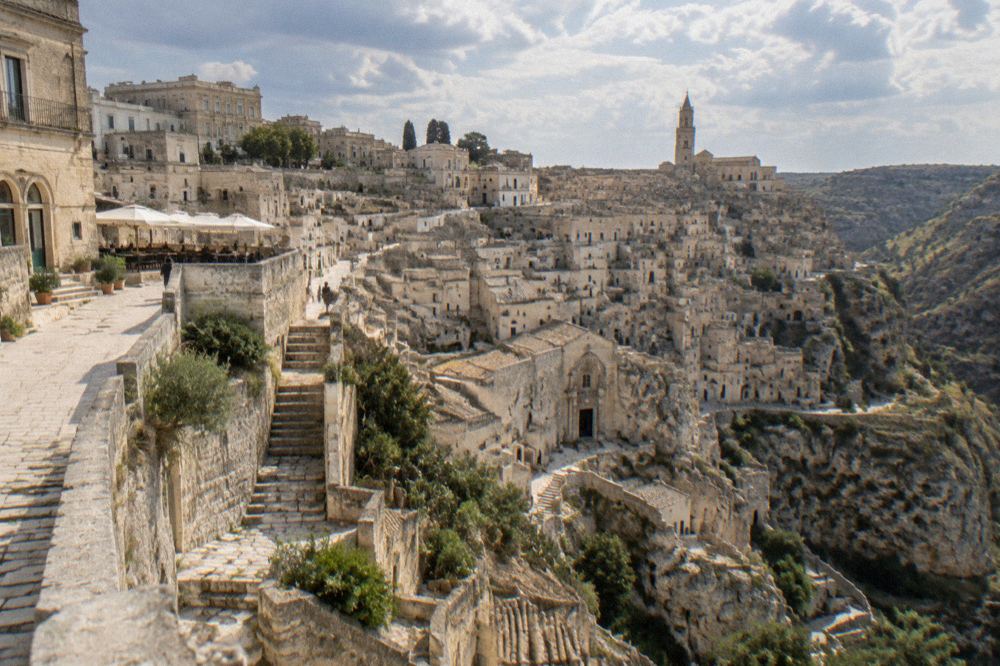
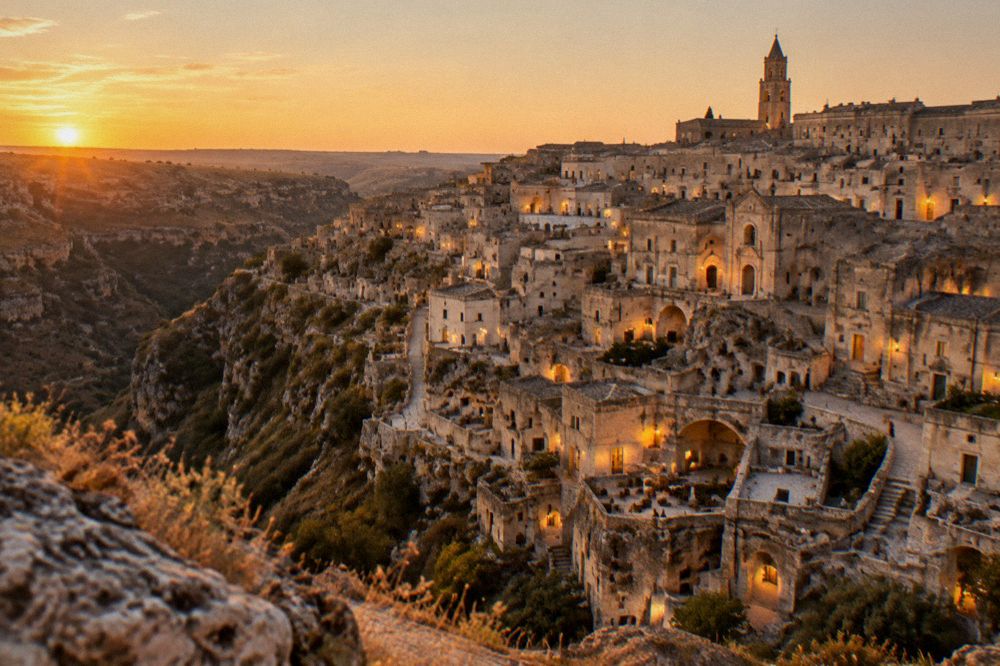
The counter-argument is atmosphere, and it is not small. The Sassi after dark, when the day crowds have gone and the cave facades are lit, is a different city from the one tour groups see at midday, and sleeping there is the only way to have it without staying out late. The new town compensates with practicality: the FAL station is on the edge of it, the pedestrian core of Piazza Vittorio Veneto and Via Ridola is closed to vehicles all day, and the walk down into the Sassi takes only minutes. If your trip pairs Matera with sightseeing elsewhere in the region, a guided walk makes the cave city legible in a way that wandering alone does not; the Sassi Walk with Cave House covers the historic centre and the rock-cut churches, and you can Check availability alongside your hotel search.
A night-by-night note also belongs here. The APT Basilicata accommodation data shows 479,083 arrivals in 2025 with an average stay of 1.56 nights, which means the typical guest is a one-to-two-night visitor. One night works for the viewpoints and a walk; two nights is the point at which Matera stops being a checkpoint, and the question of how many nights to book has its own detailed answer.
What Should You Know About Matera Cave Hotels?
A cave hotel room in Matera is cut into the tufa limestone of the Sassi, and the rock is the climate system: cool in summer, cool in winter, so packing a layer for the room is wise year-round. Most cave rooms are genuine, with vaulted or exposed rock ceilings, but the category spans everything from simple bed-and-breakfasts to full luxury conversions. No two properties are alike, and September books out first.
The cave-hotel story is inseparable from the district's history. The Sassi were the overcrowded cave quarters that the state began emptying, moving residents out between 1952 and the 1970s, and a 1986 law opened the way to restoration; the UNESCO inscription of the Sassi and the Park of the Rupestrian Churches came in 1993, on criteria that cite an outstanding rock-cut settlement with continuity over more than two millennia. The hotel stock is a product of that restoration: old cave dwellings, stables and cisterns converted into rooms. What that means practically is that ceiling heights vary, the rock itself is part of the stay, and the cave rooms belong to the wider cave geography of Matera, which includes visitable cave houses such as the Storica Casa Grotta di Vico Solitario, whose ticketing is detailed in the dedicated guide. The full range of properties is covered in the site's cave hotels page.
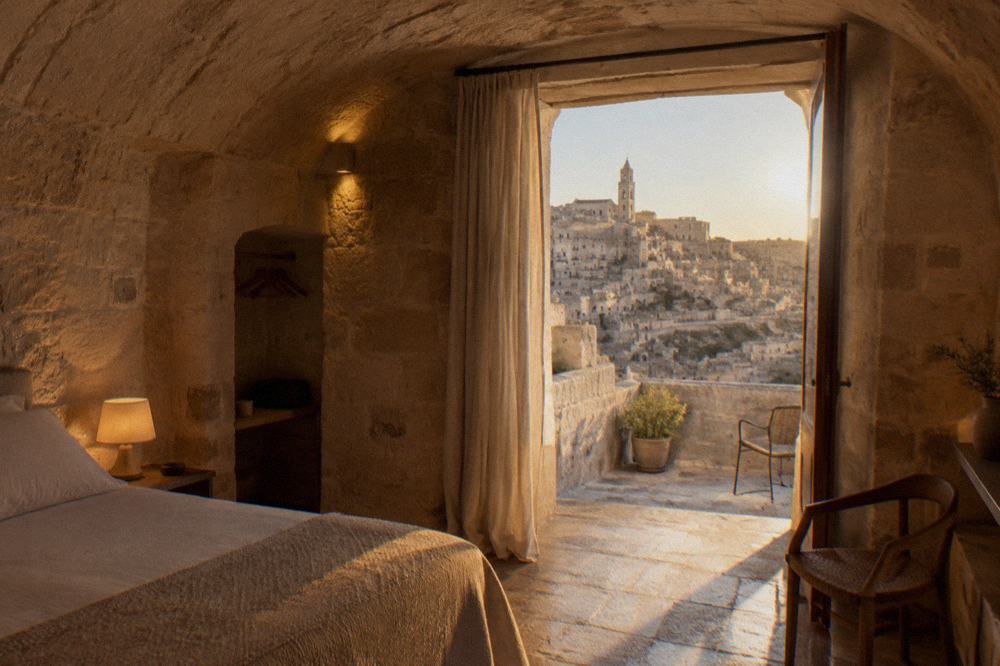
A few checks are worth making before you book any cave property. Ask whether the room is in the rock or in a stone building with cave features, because listings blur the line. Ask about luggage, since the arrival is on foot down stepped lanes. Ask about heating, because the rock holds cold in winter and damp is a real thing in the low season. And ask about the tourist tax: Matera charges one, it is collected by the accommodation, and the amount is confirmed at booking rather than on this site, because the rate itself was never verified from an official source. Rooms in the Sasso Barisano end of the market see the heaviest demand in September, and that month is not a guess: the APT data shows 61,630 arrivals in September 2025, the year's peak, ahead of August at 60,257.
For travellers who want the cave stay bundled rather than assembled piece by piece, there are packages that combine the room, a meal and a guided Sassi walk in one booking; the overnight-stay-and-tour product below is that format, and everything in it, from price to what is included, renders from the operator's live listing.
Prefer the whole cave stay bundled together? Book an overnight stay with Sassi tour here.
Where To Stay In Matera With A Car, And How Do The ZTL Hours Work?
With a car, the workable bases are the new town on the plateau and the streets outside the restricted gates. The ZTL Sassi cameras run 10:00 to 20:30 from 16 September to 30 June and 10:00 to 24:00 from 1 July to 15 September, every day, while the ZTL Centro around Via del Corso and Via Duomo is active 24 hours a day. The rule is simple: park on the plateau and never drive through a gate.
The comune's camera-hours sheet, published with ordinances 147 and 148 of 2025, sets out the whole map, and it is worth reading as a table rather than as prose because the zones differ sharply. The loading window in the Sassi zones is 07:00 to 10:30 and 15:00 to 17:00. The ZTL contact is ztl@comune.mt.it, and transit declarations go through the comune's dedicated portal.
| Zone | Streets | Camera hours |
|---|---|---|
| ZTL Sassi | Via Buozzi, Via Madonna delle Virtù, Via D'Addozio | 10:00 to 20:30 (16 Sep to 30 Jun); 10:00 to 24:00 (1 Jul to 15 Sep) |
| ZTL Centro | Via Scotellaro, Via del Corso, Via delle Beccherie, Via Duomo, Piazza Sedile, San Francesco | 24 hours, every day |
| ZTL San Giovanni / San Biagio | District gates | 24 hours, every day |
| ZTL Santa Cesarea | District gates | 24 hours, every day |
| ZTL Piave | Electronic gates, definitive operation | Same seasonal hours as ZTL Sassi |
| ZTL Prefettura, Ridola, Casalnuovo, Stigliani | Evening gates | 20:30 to 24:00 |
| Piazza Vittorio Veneto and Via Ridola (pedestrian) | Retractable bollards | Closed to vehicles all day; bollards open 04:00 to 08:00 weekdays for deliveries |
No public car park tariff in Matera could be verified from an official page, so this site prints none: check the signs at the lot and allow extra time on arrival, because the walk from the plateau car parks down into the Sassi is part of the journey. If you are arriving by rail rather than by car, the practicalities of the FAL service from Bari, with its change at Altamura and its Sunday replacement buses, are laid out in how to get to Matera and the Bari to Matera guide, and the airport routes have their own pages for Bari Airport and Matera's own airfield. Coming from further afield, the Rome to Matera and Naples to Matera guides cover the long-haul options, and by road Bari Airport is 64 km and about an hour's free-flow drive from Matera Centrale.
How Many Nights Should You Stay In Matera?
Two nights is the working minimum for a first visit, one night if Matera is a stop on a longer route, and three if the trip includes a day out to Alberobello, the Murgia park or the coast. The APT Basilicata data gives an average of 1.56 nights per guest in 2025, so the city's own visitor pattern is the short stay. A single night compresses the Sassi into a few hours of daylight.
The one-night stay works if the itinerary is honest about it: arrive, walk the Sassi with a guide, see a viewpoint at sunset, sleep, leave. The two-night stay buys the evenings, which are when the cave city shows a different face, and it spreads the stairs over two days instead of one. Three nights and up opens the region: Alberobello is 68 km and about 1 h 23 of driving, Polignano a Mare 100 km, Castelmezzano 82 km, and the balances of time and distance are in the two days in Matera and three days in Matera itineraries. The site's dedicated answer to the nights question, with the reasoning unpacked, is here. The full index of guides sits on Matera Travel Guide.
| Stay | What it covers realistically | What it misses |
|---|---|---|
| 1 night | A guided Sassi walk, one viewpoint, one dinner | Museums, the Murgia side, any day trip, the slow evenings |
| 2 nights | The Sassi at leisure, two or three cave churches, the Murgia viewpoint | Distant day trips without rushing |
| 3 nights | Everything above plus one full day out, Alberobello or the coast | Multi-town Puglia circuits, which need a different base |
When Is The Best Month To Book A Stay In Matera?
September, not August, is Matera's busiest month: 61,630 accommodation arrivals in September 2025 against 60,257 in August, with 74.5 per cent of September's arrivals from abroad, so book earliest for September. May runs close behind at 54,101 arrivals. The quiet months are February with 15,239 and November with 23,555.
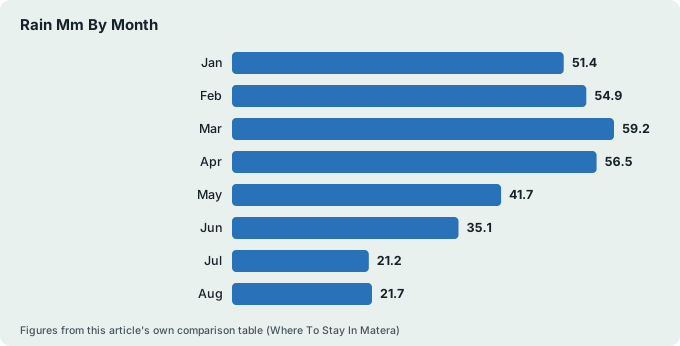
The climate explains part of the shift. The ERA5 reanalysis for 1991 to 2020 puts July and August mean highs at about 31 C and September's at 25.7 C, which is part of why the crowds have moved into early autumn. The pairing of climate and occupancy is the useful planning table, and it is one the first page of a search results page rarely shows: the busiest month is not the one with the biggest crowds on the beach calendar, and the summer heat peak does not coincide with the arrival peak. July 2025 drew 43,966 arrivals, fewer than April, May, June, August, September or October, even though the ERA5 mean high in July is 31.2 C against September's 25.7 C.
| Month | Arrivals 2025 (APT) | Mean high C (ERA5, 1991-2020) | Rain mm |
|---|---|---|---|
| Jan | 18,402 | 10.3 | 51.4 |
| Feb | 15,239 | 11.1 | 54.9 |
| Mar | 23,629 | 14.1 | 59.2 |
| Apr | 45,195 | 17.4 | 56.5 |
| May | 54,101 | 22.7 | 41.7 |
| Jun | 50,186 | 28.2 | 35.1 |
| Jul | 43,966 | 31.2 | 21.2 |
| Aug | 60,257 | 31.3 | 21.7 |
| Sep | 61,630 | 25.7 | 44.8 |
| Oct | 52,538 | 20.8 | 51.7 |
| Nov | 23,555 | 15.5 | 67.1 |
| Dec | 30,385 | 11.2 | 57.2 |
Two seasonal notes from the events calendar. Early October 2026 saw Casa Noha, the FAI interpretation centre in the Sassi, closed from 5 to 22 October for renovation ahead of a relaunch, so a stay in that window should not count on it; the Museo Ridola has been closed since 7 April 2025 with no reopening date published. In December the draw is the Presepe Vivente nei Sassi, whose sixteenth edition runs public days over four December weekends and 2 to 3 January, with tickets at 12.00 EUR full and 9.00 EUR for ages 10 to 18. The fuller seasonal picture, including the Festa della Bruna on 2 July, when hotels fill far ahead, is in the best time to visit Matera and Matera weather guides.
What Does A Stay In Matera Cost Beyond The Room?
Count on sightseeing tickets, food and the tourist tax on top of the room: the Oltre l'Arte rupestrian churches cost 4.50 EUR for one, 8.00 EUR for two and 10.00 EUR for three, the Storica Casa Grotta di Vico Solitario is 8.00 EUR full, MUSMA is 10 EUR, and the national museum sites are 10.00 EUR each or 15.00 EUR cumulative over two days. The tourist tax is confirmed at booking.
Under-18s enter the national museums free, and children up to 10 enter the rupestrian churches free with a parent, which softens the family budget considerably. The ticket side of a Matera stay is unusually modular, and the table below is built only from prices verified on the operators' own pages, so it is safe to budget against. Anything not in it, including the Palombaro Lungo and the Crypt of the Original Sin, whose prices sit inside booking engines rather than on a readable page, should be checked directly with the operator.
| Sight | Full price | Notes |
|---|---|---|
| Oltre l'Arte rupestrian church (Santa Lucia alle Malve, Madonna de Idris, San Pietro Barisano) | 4.50 EUR one, 8.00 EUR two, 10.00 EUR three | Free to age 10 with a parent; sites close 25 December and 2 July |
| Oltre l'Arte 8-site all-inclusive | 25.00 EUR (reduced 16.00 EUR) | Three churches, Vicinato a Pozzo, Casa Grotta Fiorentini, MATA, Purgatorio, Museo del Pane |
| Storica Casa Grotta di Vico Solitario | 8.00 EUR | Tariff from 4 April 2026; covers cave house, Neviera, natural cave, Sant'Agostino al Casalnuovo |
| MUSMA | 10 EUR | Reduced 5 or 7 EUR; free to age 6 |
| Museo Nazionale di Matera | 10.00 EUR per site, 15.00 EUR cumulative | Cumulative valid 2 days; under 18 free |
| Casa Noha (FAI) | 6.50 EUR adults | Children 3 EUR; closed Wednesdays |
| Presepe Vivente nei Sassi (December) | 12.00 EUR | Ages 10 to 18 pay 9.00 EUR; under 10 free |
Food needs less budgeting discipline than ticketing, but the same honesty: this site does not print restaurant prices it has not verified, and the practical approach is the restaurants guide and the what to eat in Matera overview, which cover the local dishes and where to eat them, with Pane di Matera deserving its own read. What can be stated with figures is the scale of demand: 748,812 overnight stays in 2025 across 479,083 arrivals, up 23.4 per cent in arrivals on the 2019 Capital of Culture year, so the cheap last-minute room in September is mostly a memory.
Which Day Trips Work From A Matera Base?
Alberobello, 68 km and about 1 h 23 by road, is the classic day trip from Matera, and others within range are Altamura at 20 km, Craco at 57 km, Metaponto on the Ionian coast at 47 km and Castelmezzano at 82 km. There is no sea at Matera, so the coast itself is a day trip. Two UNESCO towns in one day, Matera and Alberobello, is the pairing the organised tours are built around, with a tour leader on board the bus.
The driving distances above come from routing computed over OpenStreetMap, free-flow and without stops, so real days run longer. For travellers without a car, the organised day trip replaces the hire: the Matera and Alberobello tour with a tour leader on board covers both towns with the logistics handled, and it suits a two-night stay that wants a third day of sightseeing without a third night of driving. Its details, price and inclusions render from the operator's live listing rather than from this page, and you can Check availability while you plan the hotel.
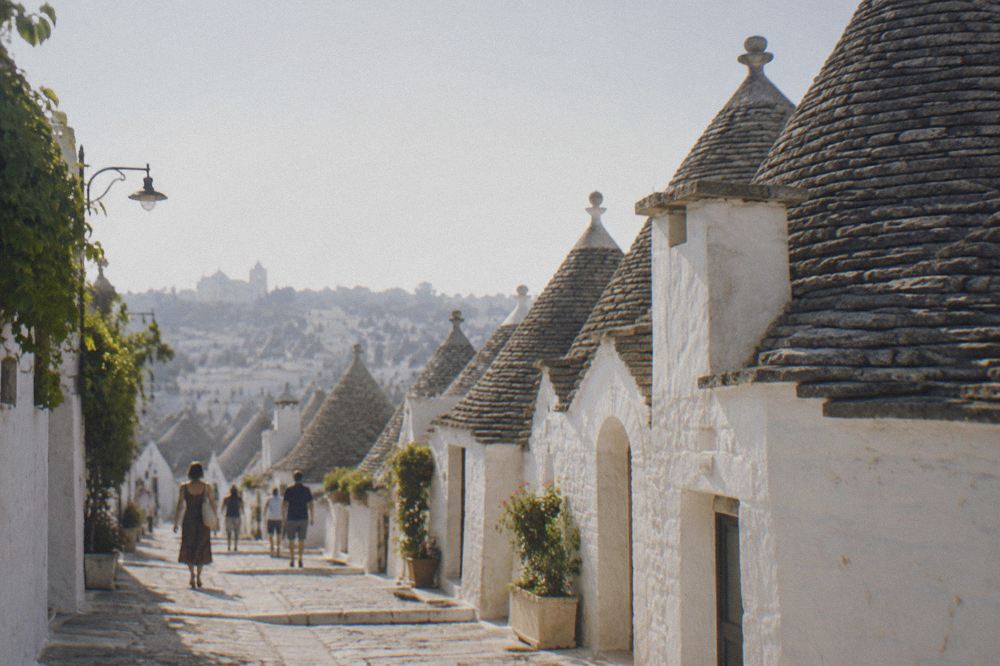
The wider region, and how many nights each combination needs, is mapped in the Puglia and Matera itinerary and the Matera and Alberobello in one day guides, with the hill towns of Castelmezzano and Pietrapertosa and the ghost town of Craco as the inland alternatives to the Adriatic. If the trip starts or ends in Puglia, the Matera versus Alberobello comparison answers the where-to-sleep question for the whole route.
Common Questions About Where To Stay In Matera
Where to stay in Matera?
Sasso Barisano for restored cave hotels and lift access, Sasso Caveoso for the raw rock and the canyon views, the Civita for quiet, or the new town around Piazza Vittorio Veneto for flat streets, cars and the station. Two nights is the working minimum.
Is it better to stay in the Sassi or outside them?
Stay in the Sassi for the atmosphere of sleeping inside the cave city; stay in the new town if you drive, since the ZTL cameras and stepped lanes make the Sassi impractical for cars. Both are within minutes of each other on foot.
Can you drive to a hotel in the Sassi?
Generally no. The ZTL Sassi cameras run 10:00 to 20:30 from 16 September to 30 June and 10:00 to 24:00 from 1 July to 15 September, every day, with only loading windows in the morning and afternoon. Park on the plateau and walk down, or arrange luggage transfer with the property.
How much is the tourist tax in Matera?
Matera charges a tourist tax collected by the accommodation, and the amount is confirmed at booking. This site does not print a rate because no official tariff page could be verified.
When should I book a hotel in Matera?
Book earliest for September, which with 61,630 arrivals in 2025 is the busiest month, ahead of August at 60,257 and May at 54,101. February is the quietest month.
Are cave hotels in Matera worth it?
A cave room puts you inside the UNESCO-inscribed fabric of the Sassi, cool in summer and cool in winter, and no two properties are alike because each is a converted cave dwelling. Check heating, luggage handling and whether the room is true cave or stone before booking.
The final choice usually comes down to one question: is this trip for the cave city itself, or is Matera one stop on a route through Basilicata and Puglia? If the first, sleep in the Sassi and accept the stairs. If the second, the flat new town with the car parked nearby will serve the whole region better, and the Sassi will still be there, ten minutes down the hill, every morning of the stay.