Sassi Di Matera Hotel: Where To Sleep Inside Matera's Cave Quarter
Sleeping inside the Sassi of Matera means a night in a cave dwelling carved into tufa limestone on the edge of the Gravina canyon. This guide explains which side to book, what a cave room is really like, how parking and the ZTL cameras work, and when to go.
Short answer
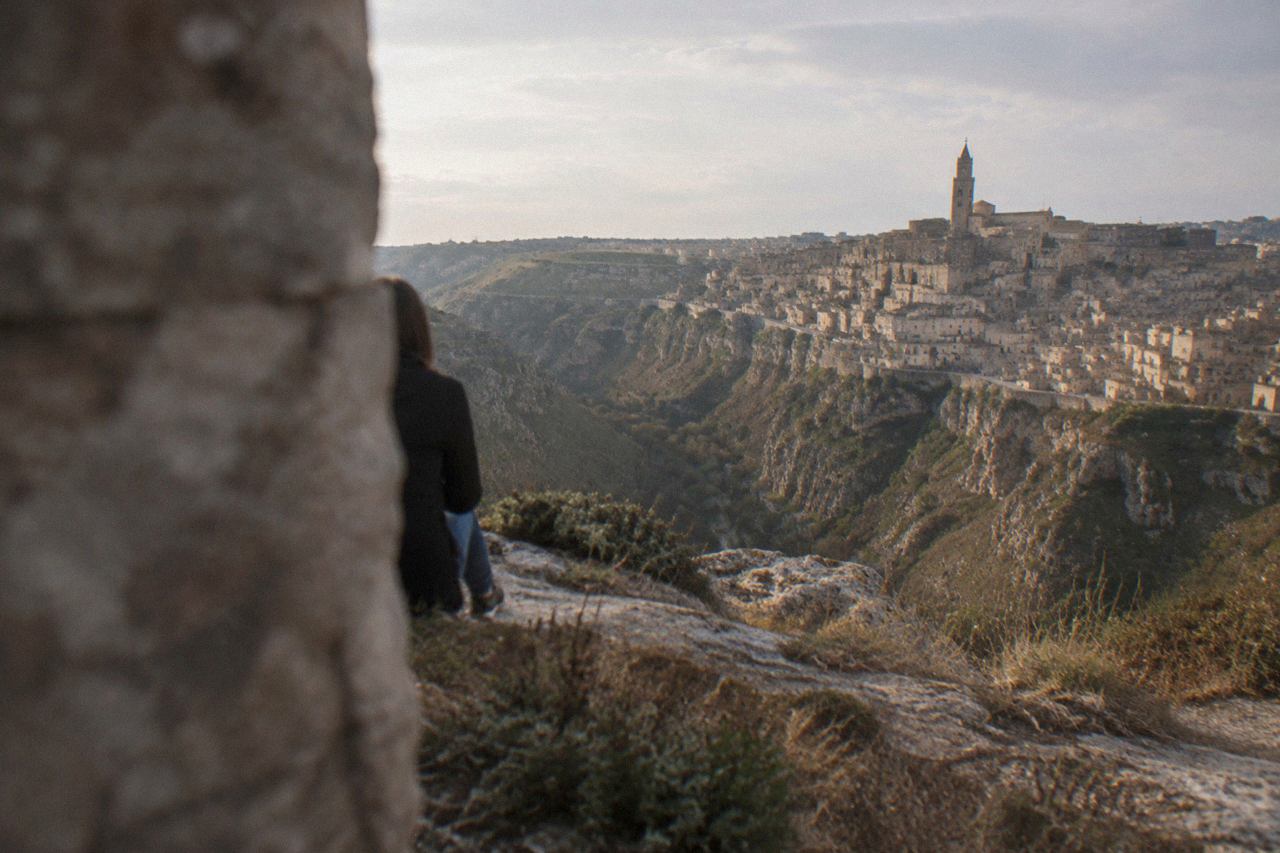
A Sassi di Matera hotel is a converted cave dwelling in Sasso Caveoso or Sasso Barisano, the two UNESCO-listed quarters either side of the Civita ridge. Sasso Barisano is the polished side with more full-service hotels; Sasso Caveoso is quieter, rawer and closer to the canyon viewpoints. Matera charges a tourist tax collected by the accommodation, with the amount confirmed at booking.
Matera, in the region of Basilicata in southern Italy, is an inland city at about 400 m above sea level on the edge of the Gravina canyon, and its two old quarters, the Sassi, hold one of the most unusual hotel stocks in Europe: rooms carved directly into pale tufa limestone. The UNESCO World Heritage property, inscribed in 1993 under the name "The Sassi and the Park of the Rupestrian Churches of Matera", covers 1,016 hectares and includes, in UNESCO's own words, "more than a thousand dwellings and a large number of shops and workshops". A large share of those thousand-plus dwellings now function as guest accommodation, from one-room cave bed and breakfasts to full hotels with spa pools cut into the rock. This Matera Travel Guide page sets out what the desk could verify from primary sources: which side of the Sassi does what, what a cave room actually is, how you reach a Sassi di Matera hotel by car without tripping the ZTL cameras, and when to book.
What Is A Sassi Di Matera Hotel, And Where Exactly Does It Sit?
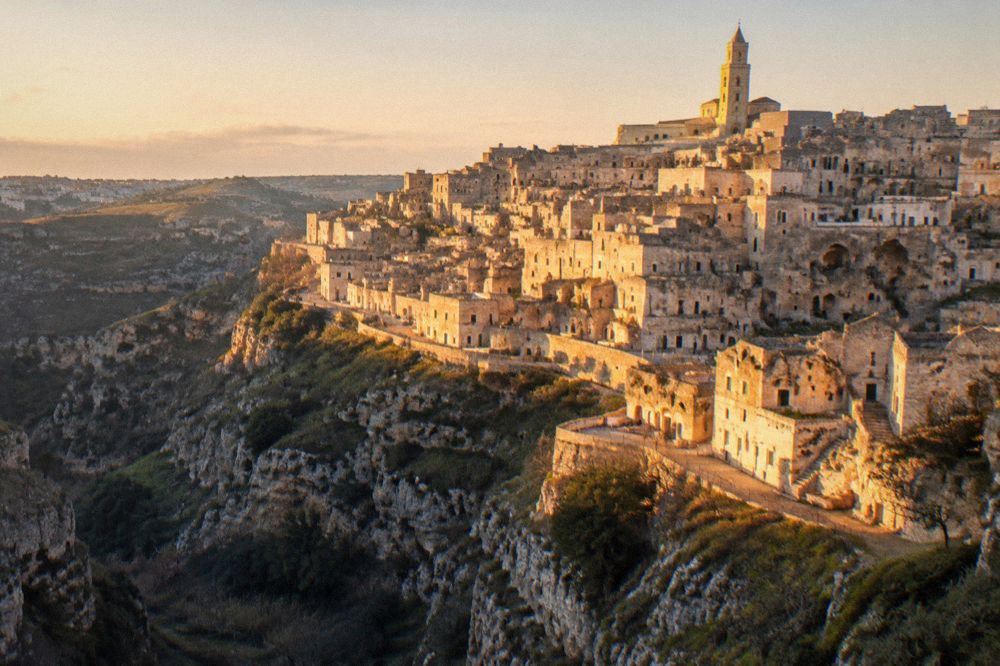
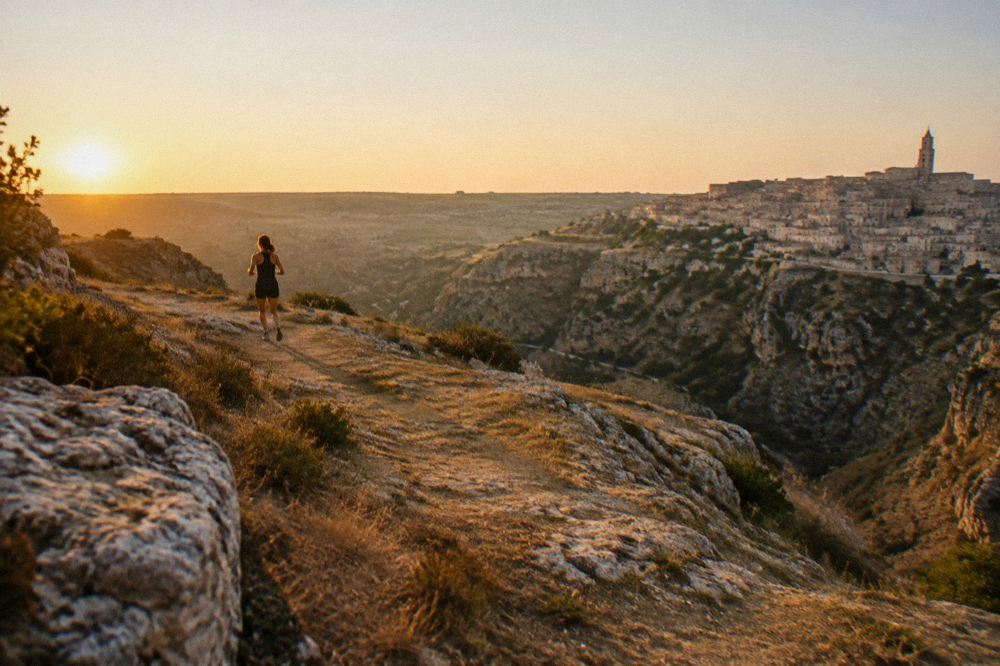
A Sassi di Matera hotel is a cave dwelling or stone house converted for overnight guests inside Sasso Caveoso or Sasso Barisano, the two historic quarters that slope down from the Civita ridge toward the Gravina canyon on the southern side of the modern city. The Civita, the old citadel between the two Sassi, holds the Cathedral, while the modern Piano sits on the plateau above. The whole complex sits opposite the Murgia plateau, a regional park of about 8,000 hectares by the park's own count.
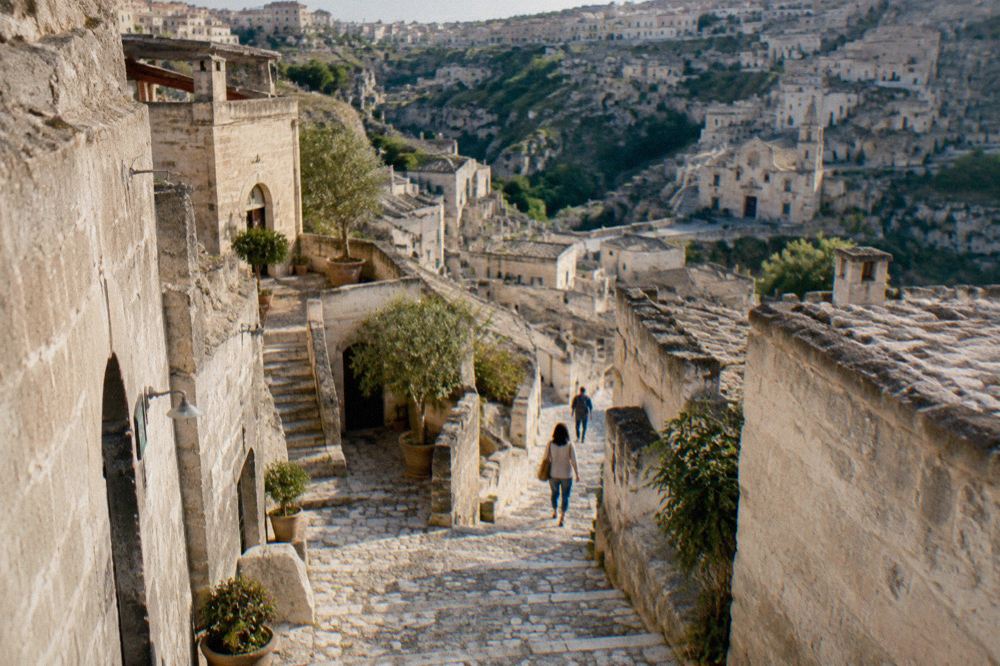
"Sassi" is simply the Italian word for stones, and it is the plural: one quarter is a "Sasso", as explained in what Sassi means in Italian. The two quarters are not interchangeable, and the difference matters to a hotel booking more than anywhere else in the city, because Sasso Barisano faces north toward the modern centre while Sasso Caveoso faces south toward the canyon and the Murgia. Most hotel addresses in the old quarter are on stair-linked lanes rather than drivable streets, which is the single fact that shapes arrival logistics. A good primer on the district itself is the Sassi di Matera attraction page, and the difference between Matera and Sassi di Matera is worth a minute if the names are new, because the modern city and the cave quarter are two different things and hotels exist in both.
The scale of the hotel stock follows the scale of the quarter. After residents were moved out of the Sassi between 1952 and the 1970s, a 1986 law opened the way to restoration, and the conversion of dwellings into accommodation accelerated after the 1993 inscription and again around the 2019 European Capital of Culture year. The APT Basilicata accommodation data records 479,083 arrivals and 748,812 overnight stays in Matera in 2025, an average of 1.56 nights per guest, and those counts cover registered accommodation in the whole city, of which the Sassi hold a substantial share. People do still live in parts of the Sassi as permanent residents, so a hotel lane is also a lived-in lane: the details are in do people still live in Sassi di Matera.
Sasso Caveoso Or Sasso Barisano: Which Side Should You Sleep In?
Sasso Barisano, the north-western quarter facing the modern city, holds the denser concentration of restored facades and full-service hotels, and it is the side to pick for restaurants, bars and a short walk up to Piazza Vittorio Veneto. Sasso Caveoso, the south-eastern quarter, is the rawer, quieter side, closer to the canyon rim viewpoints and the rock churches, with more small cave bed and breakfasts. The Civita ridge between them carries the Cathedral rather than hotels.
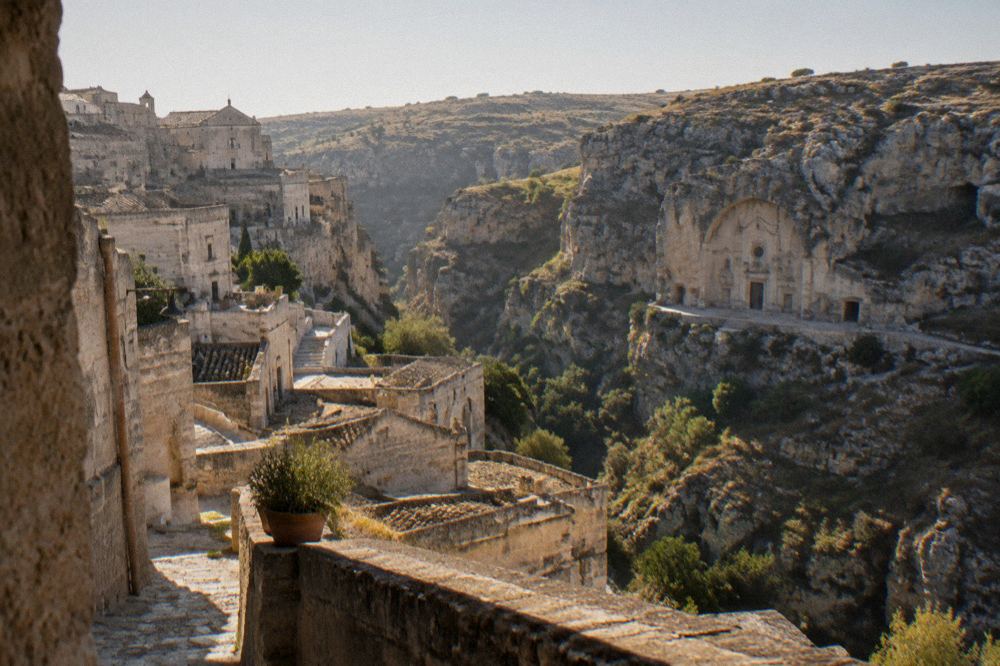
Neither side is "better": they serve different trips. A stay in Sasso Barisano puts the evening life of the centre within a few minutes of uphill steps, which matters because the Sassi are steep, stepped and uneven underfoot at night. A stay in Sasso Caveoso trades that convenience for the view side: the terraces look across the Gravina toward the Murgia and the rock-cut church facades on the opposite cliff, and the quarter holds key sights within its own lanes, including the Casa Grotta di Vico Solitario, the rock churches of Santa Lucia alle Malve and Santa Maria de Idris, and the square of San Pietro Caveoso. The broader choice of neighbourhoods, including the modern Piano and the Belvedere side, is mapped out in where to stay in Matera.
| Quarter | Orientation | Character | Nearest Landmarks | Suits |
|---|---|---|---|---|
| Sasso Barisano | North-west, faces the modern centre | Restored facades, full-service hotels, livelier evenings | Piazza Vittorio Veneto, San Giovanni Battista | First visits, short stays, dining out |
| Sasso Caveoso | South-east, faces the Gravina canyon | Rawer rock, quieter lanes, canyon views | San Pietro Caveoso, Casa Grotta, MUSMA | View seekers, photographers, longer stays |
| Civita | Ridge between the two Sassi | Cathedral and monumental core, few beds | Matera Cathedral, Palazzo Lanfranchi | Daytime sightseeing, not a hotel base |
| Piano | Plateau above the Sassi | Modern city, flat streets, drivable | Piazza Vittorio Veneto edge, shops | Arrivals by car, mobility needs |
One structural point the desk can state from the sources: the Sassi are steep, stepped and uneven, and no named route in the quarter is step-free or wheelchair accessible. The Matera accessibility guide covers the practical detail. If steps are a constraint, a hotel on the Piano with a Sassi view solves more problems than a cave room inside it.
What Does A Cave Room In The Sassi Actually Feel Like To Stay In?
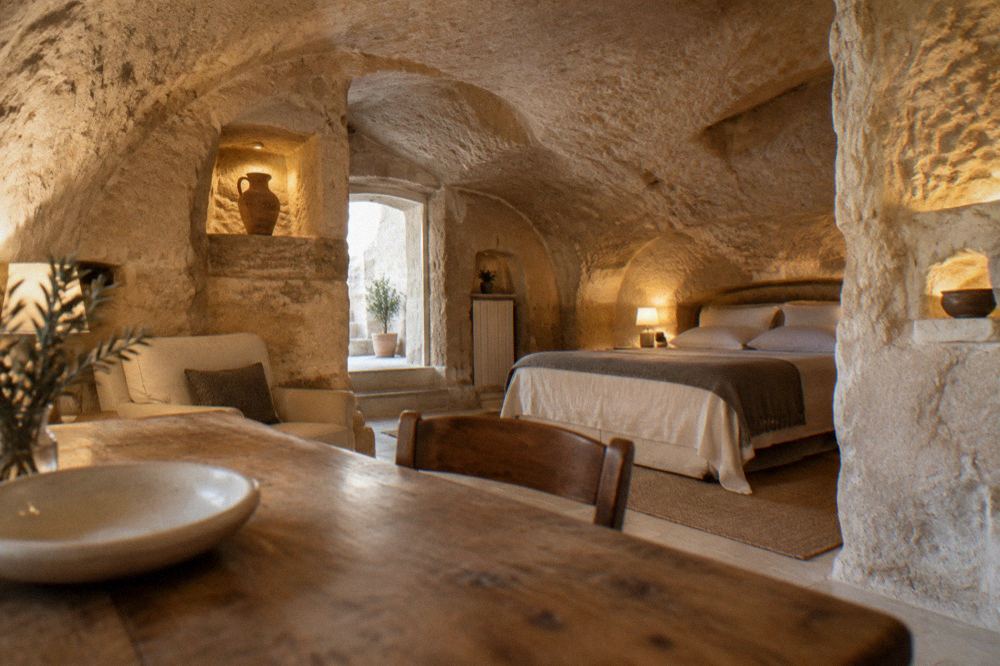
A cave room in the Sassi is a vaulted or rock-cut chamber inside the tufa, typically cool in summer and mild in winter, with thick stone or plastered walls, arched ceilings and small openings facing the lane or terrace rather than large windows. The rock moderates temperature swings, and the same physics that made the dwellings habitable for centuries, before the evacuation in more recent times, is what the restored rooms now sell.
Not every "cave hotel" room is fully underground: many are part cave, part built stone house.
What that means in practice depends on the room. Some chambers are former cisterns or animal shelters, and the Palombaro Lungo and Matera caves pages explain what those water and cave systems were. Expect any or all of the following, and check the listing: stepped or sloped access from the street, low doorways cut for an older world, humidity control as a design feature, limited mobile signal in deep rooms, and terraces that replace windows on the view side. The desk cannot verify any individual property's rooms, so the listing is the source for specifics. The dedicated Matera cave hotels page goes deeper on the typology, and for the eating side of the same buildings, the cave restaurants of Matera page covers dining in equivalent spaces.
The climate data supports the cave's reputation. The ERA5 reanalysis, 1991-2020, for the Matera grid cell gives mean highs of 31.2 C in July and 31.3 C in August against mean lows of 2.2 C in January and February, with about 55 days a year reaching 30 C and about 20 frost days, almost all from December to March. Rock interiors sit closer to the annual mean than either extreme, which is the whole point of the construction. The full picture, including rain, is on the Matera weather page.
| Season | Mean High (ERA5) | Mean Low (ERA5) | Rain (ERA5) | What It Means For A Cave Room |
|---|---|---|---|---|
| Spring (Mar to May) | 14.1 to 22.7 C | 4.4 to 11.5 C | 41.7 to 59.2 mm | Mild rooms, some damp in March |
| Summer (Jun to Aug) | 28.2 to 31.3 C | 16.0 to 18.9 C | 21.2 to 35.1 mm | Cave interiors cooler than terraces |
| Autumn (Sep to Nov) | 25.7 to 15.5 C | 15.2 to 7.5 C | 44.8 to 67.1 mm | November is the wettest month, 67.1 mm |
| Winter (Dec to Feb) | 10.3 to 11.2 C | 2.2 to 3.7 C | 51.4 to 57.2 mm | Frost nights outside, mild rock inside |
How Much Does A Sassi Di Matera Hotel Cost, And What Is The Tourist Tax?
No nightly rate for any Matera hotel appears anywhere in this site's verified sources, so this desk prints none: prices for Sassi accommodation vary by season, room type and how much of the room is cave, and the listing is the only reliable figure. What can be stated is structural: Matera charges a tourist tax, collected by the accommodation, and the rate, the night cap and the exemptions are confirmed at booking.
Demand data explains the price shape even without a single euro on the page. The APT Basilicata accommodation counts show the 2025 peak in September at 61,630 arrivals, ahead of August at 60,257, with May at 54,101 and October at 52,538, against a February low of 15,239. In 2025, 57.4 per cent of arrivals came from abroad, and in September 74.5 per cent did. A cave room on a September weekend is the scarcest commodity in the city's accommodation stock, and the average stay of 1.56 nights means a high share of the demand lands on weekend nights in particular. The best time to visit Matera page works through the same data for trip planning.
| Month (2025) | Arrivals (APT Basilicata) | Pressure On Sassi Rooms |
|---|---|---|
| February | 15,239 | Lowest of the year |
| March | 23,629 | Low |
| April | 45,195 | Rising, foreign majority |
| May | 54,101 | High |
| June | 50,186 | High |
| July | 43,966 | Moderate, peak heat |
| August | 60,257 | Very high, Italian majority |
| September | 61,630 | Highest of the year |
| October | 52,538 | High |
| November | 23,555 | Low |
The practical takeaway is that the same cave room costs the market rate of the month it sits in, and the desk advises reading three things at booking: the exact floor level and step count to the door, whether the room is cave or built stone, and the tourist-tax line, which will be itemised by the property. Anything beyond that, the booking page says.
Where Do You Park For A Sassi Hotel, And How Do The ZTL Cameras Work?
The Sassi hotel lanes are pedestrian in practice, and the old centre is ringed by limited traffic zones enforced by cameras, so nearly every Sassi stay involves parking outside the ZTL and walking down with luggage, unless the hotel holds a specific access arrangement. The ZTL Sassi cameras, on Via Buozzi, Via Madonna delle Virtù and Via D'Addozio, run from 10:00 to 20:30 between 16 September and 30 June, and from 10:00 to 24:00 between 1 July and 15 September, weekdays and holidays alike.
The full camera map matters because several zones run around the clock. ZTL Centro, covering Via Scotellaro, Via del Corso, Via delle Beccherie, Via Duomo, Piazza Sedile and San Francesco, is active 24 hours a day, as are the San Giovanni/San Biagio and Santa Cesarea zones. ZTL Piave follows the same seasonal hours as the Sassi zone. The evening-only zones, ZTL Prefettura, Ridola, Casalnuovo and Stigliani, run 20:30 to 24:00. The loading windows for deliveries are 07:00 to 10:30 and 15:00 to 17:00. The desk cannot verify any public car park's name, capacity or tariff, because no official tariff page exists, so treat any parking figure found elsewhere as unconfirmed. The Matera ZTL and Matera parking pages carry the full verified detail, including the transit declaration contact the comune publishes.
| Zone | Streets | Camera Hours |
|---|---|---|
| ZTL Sassi | Via Buozzi, Via Madonna delle Virtù, Via D'Addozio | 10:00-20:30 (16 Sep to 30 Jun), 10:00-24:00 (1 Jul to 15 Sep) |
| ZTL Centro | Via Scotellaro, Via del Corso, Via delle Beccherie, Via Duomo, Piazza Sedile, San Francesco | 24 hours, every day |
| ZTL San Giovanni / San Biagio | Quarter streets | 24 hours, every day |
| ZTL Santa Cesarea | Quarter streets | 24 hours, every day |
| ZTL Piave | Electronic gates | Same seasonal hours as ZTL Sassi |
| ZTL Prefettura, Ridola, Casalnuovo, Stigliani | Evening belt streets | 20:30 to 24:00 |
| Piazza Vittorio Veneto / Via Ridola APU | Pedestrian areas, bollards | Closed to vehicles all day, delivery bollards 04:00-08:00 weekdays |
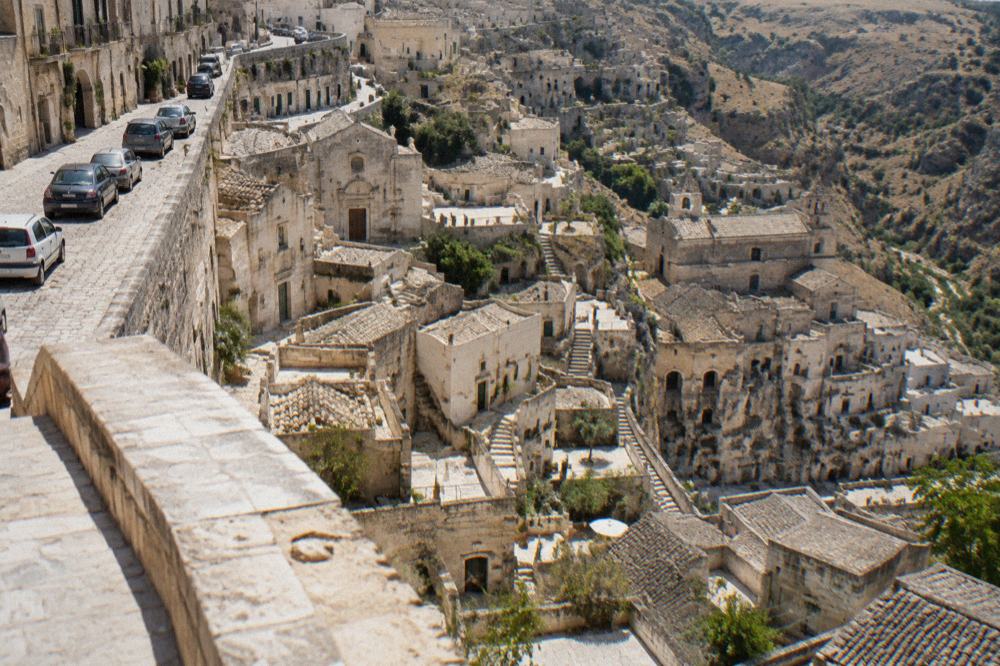
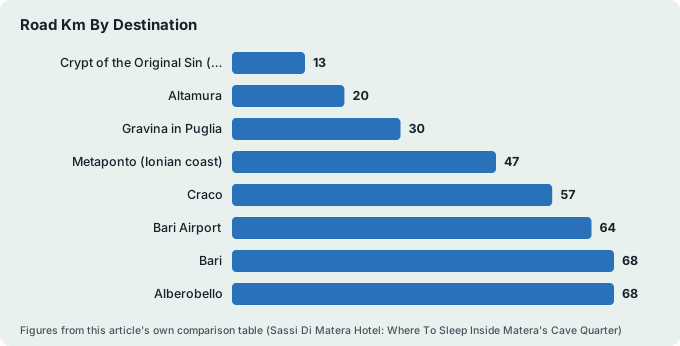
The corollary for arrival day: pack so you can carry bags on foot down stepped lanes, ask the hotel before arrival where it directs guests to park, and if you arrive by train, note that Matera Centrale is a FAL station with no Trenitalia service, as the how to get to Matera, Bari to Matera and Bari airport to Matera pages set out. By road the OSRM routing over OpenStreetMap puts Bari Airport 64 km and about one hour's free-flow drive from Matera Centrale, Bari itself 68 km and about 1 h 02, and the closest of the major day-trip towns, Altamura, 20 km away.
What Can You Walk To From A Sassi Di Matera Hotel?
Everything inside the old quarter is on foot from any Sassi bed: the three Oltre l'Arte rupestrian churches, the Casa Grotta di Vico Solitario, MUSMA, Palazzo Lanfranchi, the Cathedral and the MATA museum are all within the same square kilometre of lanes, and the canyon viewpoints of the Sasso Caveoso rim are minutes from its hotels. The verified walk-in admissions range from 2.00 EUR for the Casa Grotta di Via Fiorentini to 10.00 EUR for MUSMA or a single Museo Nazionale site.
The ticket prices below are the ones the desk read on the operators' own pages, and they are the budget that a Sassi stay implies, because a hotel inside the quarter turns each of these into a five-minute walk. Oltre l'Arte's ticketing lists 4.50 EUR for one rupestrian church, 8.00 EUR for two and 10.00 EUR for three, with the Cathedral and MATA route at 4.00 EUR and an eight-site all-inclusive ticket at 25.00 EUR, reduced 16.00 EUR. All Oltre l'Arte sites close on 25 December and 2 July, the day of the Festa della Bruna.
| Sight | Verified Entry | Notes From The Operator's Page |
|---|---|---|
| Rupestrian church (Santa Lucia alle Malve, Madonna de Idris, San Pietro Barisano) | 4.50 EUR | 2 churches 8.00 EUR, 3 churches 10.00 EUR |
| Cathedral and MATA | 4.00 EUR | Daily 09:00 to 19:00, Sunday pause 10:00 to 12:30 |
| Oltre l'Arte 8-site ticket | 25.00 EUR | Reduced 16.00 EUR, covers churches plus MATA, bread museum and more |
| Casa Grotta di Vico Solitario | 8.00 EUR | Tariff from 4 April 2026, covers four sites |
| Casa Grotta di Via Fiorentini | 2.00 EUR | Daily 09:00 to 19:00 |
| MUSMA | 10.00 EUR | Reduced 5.00 or 7.00 EUR, free to age 6 |
| Palazzo Lanfranchi (Museo Nazionale) | 10.00 EUR | Cumulative 15.00 EUR for all sites over 2 days, under 18 free |
| Casa Noha | 6.50 EUR | Closed Wednesdays, and closed 5 to 22 October 2026 for renovation |
Two closures matter to planning right now. The Museo Ridola has been closed since 7 April 2025 for energy works and a new display, with no reopening date published. Casa Noha, the FAI orientation site that many itineraries used as a first stop, is closed 5 to 22 October 2026 for renovation ahead of a relaunch. Beyond the museums, the living quarter itself is the walk: the desk's self-guided walking route and Matera viewpoints pages map the lanes and terraces, and the best restaurants in Matera and what to eat in Matera pages cover the evenings.
When Is The Best Time Of Year To Sleep In The Sassi?
September is both the busiest and, by the climate data, one of the most comfortable months to sleep in the Sassi: 61,630 arrivals in September 2025, the year's peak, against a mean high of 25.7 C after the summer's 31 C afternoons, with 44.8 mm of rain. The shoulder months of April, May and October combine arrivals of 45,195 to 54,101 with mean highs of 17.4 to 22.7 C.
February is the quietest month, 15,239 arrivals, with mean lows of 2.2 C and frost nights.
The desk's honest framing is that there is no bad month, only trade-offs. Summer stays put you in the cave when it earns its keep: the rock interior is the cool side of the city on a 31 C afternoon, and July, at 43,966 arrivals, is actually less pressed than the months either side of it, though the Matera in summer page covers the heat management. Winter, with mean highs near 10 C and about 20 frost days a year, is cold and damp at 400 m elevation, but the Matera in winter page shows what the low season buys: the December living nativity, the Presepe Vivente, runs public days across late December and early January, with tickets at 12.00 EUR full and 9.00 EUR for ages 10 to 18, verified on the organiser's own page. November is the wettest month in the ERA5 reanalysis at 67.1 mm, so pack for rain rather than sun in the late autumn.
Which Tours Pair Well With A Stay Inside The Sassi?
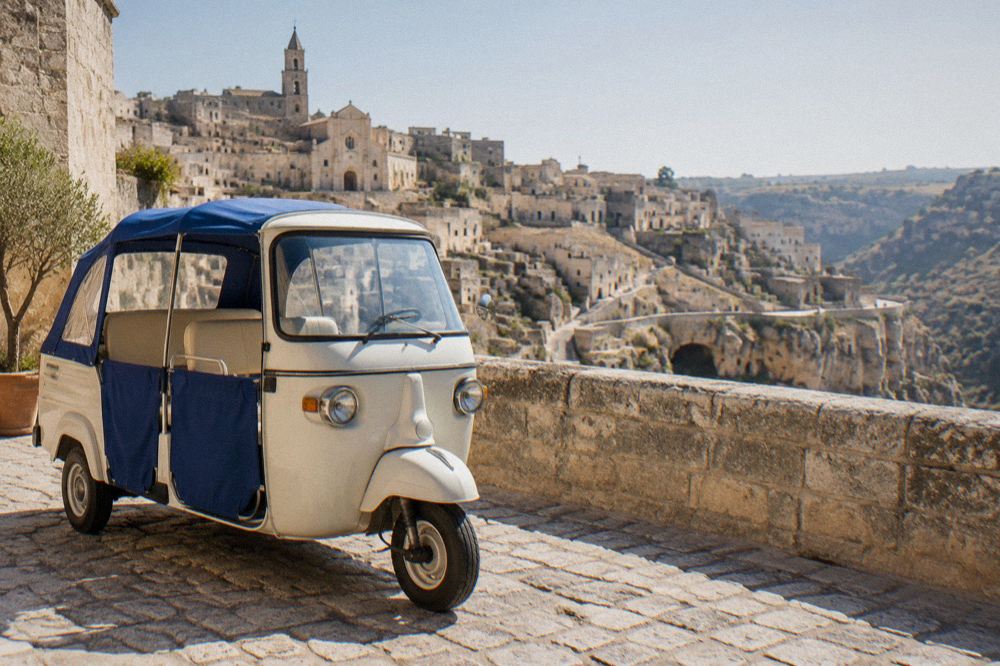
The tours that fit a Sassi hotel stay are the ones that either teach the quarter or frame it from outside: a guided walking tour of the Sassi and its rock churches from inside the lanes, and a panoramic vehicle tour, the Ape Calessino or open-bus rides, that climbs to the Murgia-side viewpoints a hotel guest would otherwise reach on a long walk. Beyond the city, Alberobello, 68 km and about 1 h 23 by road in the OSRM routing, is the classic pairing.
To pair the stay with a guided walk through the lanes, book a Sassi overnight stay and tour here.
The desk's featured pairing for this page is the Ape Calessino standard panoramic tour: the Ape Calessino panoramic tour of the Sassi threads the three-wheeler through the Sassi lanes and out to viewpoints, which is the orientation a first-night guest benefits from. Check availability. On foot, a guided walk with entry to a cave house and a rock church covers the interior story; the details of what these walks include are on the Matera walking tour page, and the city's things to do page indexes the full range.
For the deeper history, a premium-guided walk of the Sassi adds context the cave walls do not carry on their own.
For the classic regional pairing, Alberobello's trulli are a short drive away by road, and a local-led walk there is the easiest way to see them without a car.
Which Day Trips Are Easy From A Sassi Hotel Base?
From a Sassi di Matera hotel, the verified free-flow drive times put Altamura 20 minutes away, the Crypt of the Original Sin ticket office 13 km and about 19 minutes, Gravina in Puglia 30 km, and the Adriatic coast at Polignano a Mare 100 km and about 1 h 29, computed with the OSRM routing engine over OpenStreetMap. There is no sea at Matera itself, and the coast is always a day trip.
The desk's computed table below gives the road distances a hotel guest needs for planning, with the caveat that these are free-flow times with no traffic and no stops. Booking is mandatory for the Crypt of the Original Sin, by e-ticket at least 90 minutes before the slot, with guided slots through the day from April to September and fewer in winter, and the ticket office sits at Azienda Agricola F.lli Dragone on the SS7 Appia, about 15 minutes by car from Matera, with no shuttle included. The crypt's price sits inside the booking engine and is not printed here.
| Destination | Road Km | Free-Flow Drive |
|---|---|---|
| Crypt of the Original Sin (ticket office) | 13 | 19 min |
| Altamura | 20 | 20 min |
| Gravina in Puglia | 30 | 31 min |
| Metaponto (Ionian coast) | 47 | 52 min |
| Craco | 57 | 58 min |
| Bari Airport | 64 | 1 h 01 |
| Bari | 68 | 1 h 02 |
| Alberobello | 68 | 1 h 23 |
| Castel del Monte | 73 | 1 h 11 |
| Polignano a Mare (Adriatic coast) | 100 | 1 h 29 |
The individual day-trip pages, from Alberobello and Altamura to Craco, Polignano a Mare and Bari, carry the detail for each, and the Basilicata road trip page strings the regional ones together.
Common Questions About Sassi Di Matera Hotels
Is it worth staying in a Sassi di Matera hotel rather than in the modern city?
For a first visit, yes for at least one night: the Sassi empty of day trippers in the evening and the canyon views from the terraces are the reason the quarter was inscribed by UNESCO in 1993. The trade-offs are stepped lanes, luggage carried on foot and ZTL parking rules, all covered above. The modern Piano is the flat, drivable alternative.
Are Sassi hotels actual caves?
Many rooms are genuine rock-cut chambers in tufa, and many others are part cave, part built stone house. The listing describes each room's construction; the desk does not verify individual properties. The typology of Matera's caves is explained on the Matera caves page of this site.
Can I drive to my Sassi hotel door?
Generally no. The Sassi lanes are stepped and pedestrian in practice, and camera-enforced limited traffic zones ring the old centre, with ZTL Sassi cameras active 10:00 to 20:30 for most of the year and 10:00 to 24:00 in July and August. Ask the hotel where it directs guests to park.
How much is the tourist tax in Matera?
Matera charges a tourist tax collected by the accommodation, and the amount is confirmed at booking. No verified rate has been published on an official page, so this site prints none.
When should I book a Sassi hotel?
September is the peak month, 61,630 arrivals in 2025 against a February low of 15,239, with May, August and October close behind. Book early for September and Christmas-period stays, when the Presepe Vivente runs.
Is a cave room hot in summer or cold in winter?
The rock moderates both extremes. The ERA5 reanalysis, 1991-2020, gives mean highs of 31.2 C in July and mean lows of 2.2 C in January, and cave interiors sit closer to the annual mean than either, though winter stays are damp as well as cold.