Matera Centro
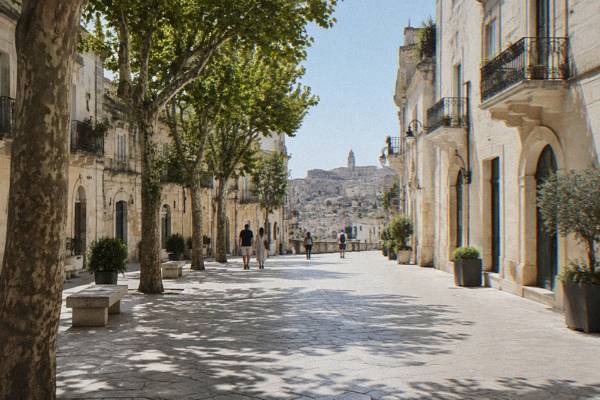
Matera Centro, the Piano, is the flat modern heart of Matera in Basilicata: the plateau above the Sassi where the shops, the museums, the station roads and the evening passeggiata all sit.
Short answer
Matera Centro is the Piano, the level modern quarter built on the plateau above the Sassi. It holds Piazza Vittorio Veneto, Via Ridola, Palazzo Lanfranchi and the main museums, and it is where buses, trains and day trippers arrive. Entry to the area itself is free; the paid sights are individual.
Matera Centro is the Piano, the level quarter that spreads across the plateau above the Sassi of Matera, an inland city in Basilicata, southern Italy, at about 400 m above sea level on the edge of the Gravina canyon. The name is literal: "piano" in Italian means a flat plain or level, and this is the one piece of genuinely flat ground the city offers. Everything dramatic in Matera, the cave districts of Sasso Caveoso and Sasso Barisano, drops away below the rim of this plateau, while the Piano itself carries the shops, the banks, the museums, the cafés and the everyday life of a city of 59,368 residents (ISTAT, 1 January 2026). This page from the Matera Travel Guide editorial desk covers what the Piano is, what to see on it, what tickets cost, how the driving and parking rules work, and how it connects to everything else.
What Is The Piano In Matera?
The Piano is the modern, level centre of Matera in Basilicata, sitting on the plateau directly above the two Sassi districts and the rocky spur of the Civita. It is where the city moved its civic life after the cave districts were emptied, with residents relocated from 1952 into the 1970s, and it holds Piazza Vittorio Veneto, Via Ridola, the cathedral-facing streets, the museums and the bulk of the shops, bars and hotels. Every visitor passes through it; not everyone realises it has its own sights.
The historical outline is straightforward. The Sassi were the inhabited core of Matera for centuries, cave dwellings and stone houses cut into tufa limestone, and the Piano above them held the convents, the nobles' palaces and the cathedral on the Civita spur. From 1952 into the 1970s residents were moved out of the Sassi into new public housing on the plateau, and civic life consolidated around the flat streets: Piazza Vittorio Veneto, Via Ridola, Via del Corso, Piazza Sedile. A 1986 national law opened the way to restoring the Sassi, and tourism brought them back, but the Piano remained the working city.
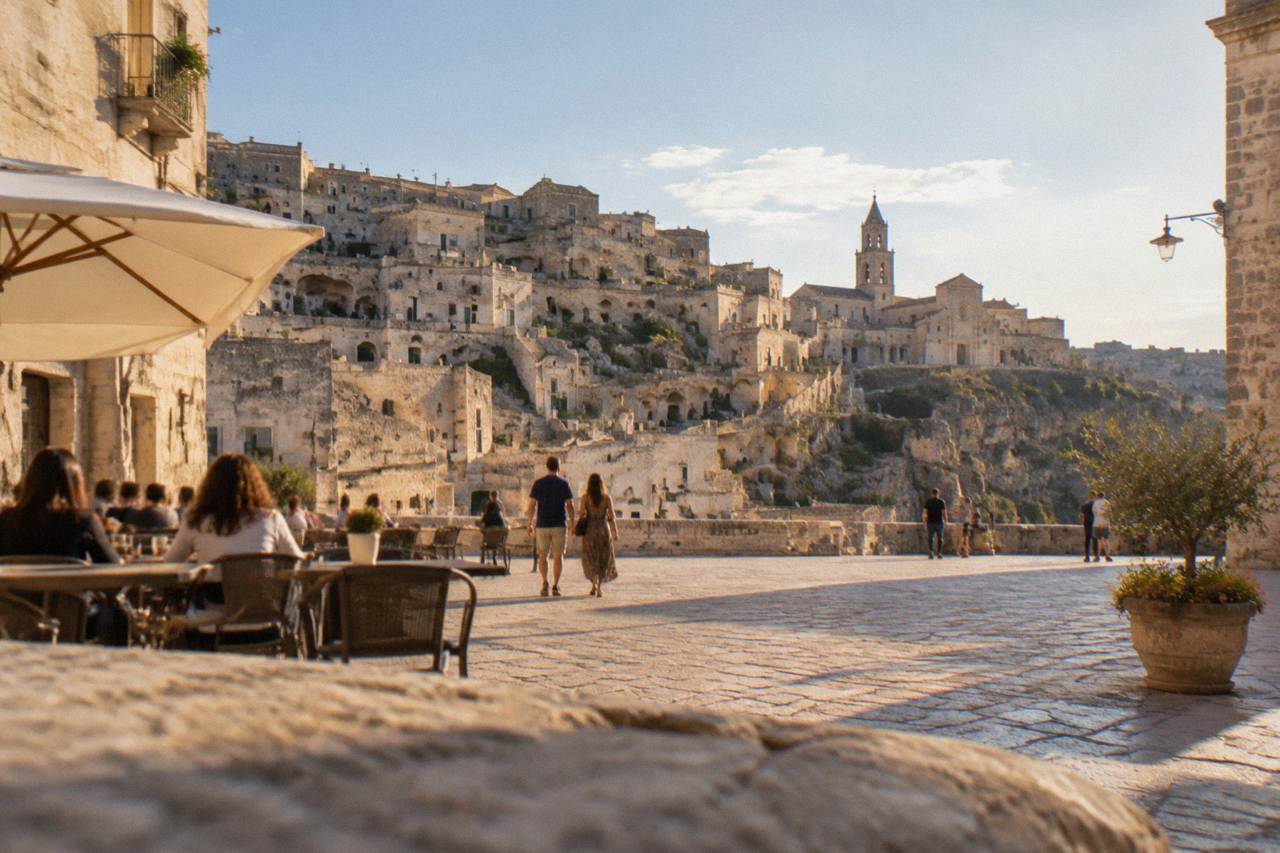
Geographically the Piano is a rim. Stand at Piazza Vittorio Veneto and you are on a terrace, with the whole cave city below you and, beyond the Gravina canyon, the Murgia plateau and its rock churches opposite. UNESCO inscribed "The Sassi and the Park of the Rupestrian Churches of Matera" in 1993, and the Piano's edge is where that World Heritage landscape is seen from, even though the flat streets themselves feel like any small southern Italian city.
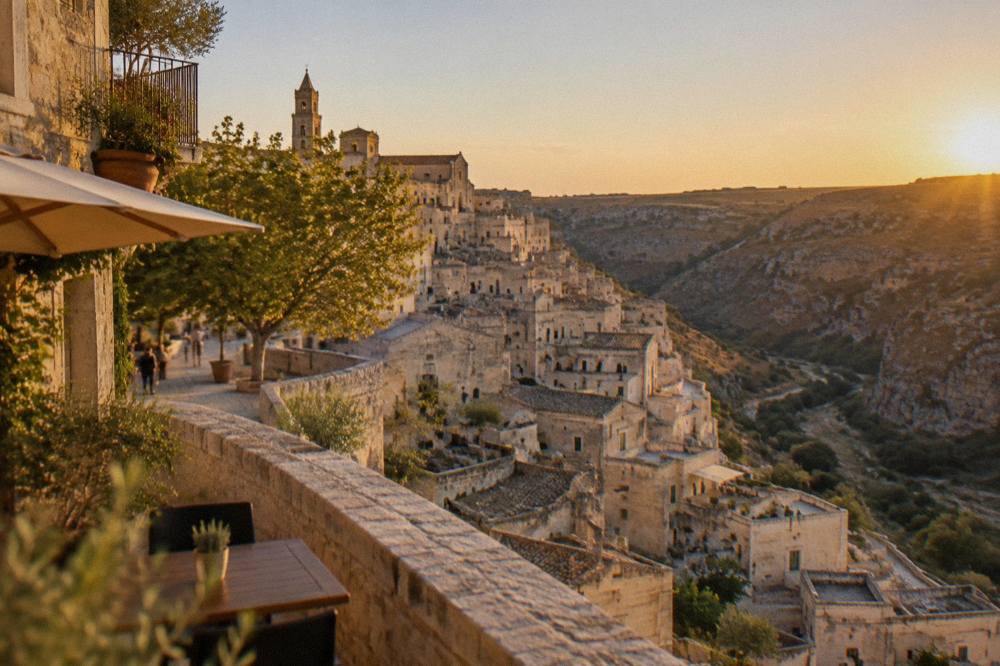
Practically, the Piano is where arrival happens. Matera Centrale, the FAL railway station, sits on the plateau; intercity buses stop within walking distance of it; and the main hotels and restaurants cluster on the flat because, unlike the Sassi, you can roll a suitcase here. From the Piano everything else is a descent: steps and lanes drop into Sasso Barisano to the north-west and Sasso Caveoso to the south, with the Civita ridge and the Matera Cathedral between them. If you are planning a first visit, the one day in Matera itinerary walks this exact geometry.
What Are The Best Things To Do In Matera Centro?
The best things to do in Matera Centro are: stand on the terrace of Piazza Vittorio Veneto over the Sassi, visit the Palombaro Lungo cistern beneath the square, tour Palazzo Lanfranchi and the national museum collections, see MUSMA's sculpture museum in Sasso Caveoso's upper edge, browse Via Ridola's shops and bars, and descend the stair streets into the Sassi themselves. The Piano is compact: the whole list fits into a day on foot.
Piazza Vittorio Veneto is the natural anchor. It is a pedestrian area, closed to vehicles all day under the city's access rules, with retractable bollards that open only 04:00 to 08:00 on weekdays for deliveries. Beneath the square lies one of the city's more surprising sights, the Palombaro Lungo, a vast historic water cistern carved into the rock; its official site states that phone booking is not possible, so check current visiting arrangements and prices locally, as the site does not publish them.
Via Ridola, also pedestrianised all day, runs from the square past Palazzo Lanfranchi, home of the Museo Nazionale di Matera. The museum's own site lists a full ticket at 10.00 EUR per site, a 15.00 EUR cumulative ticket valid two days across all its sites, free entry under 18, and site-wide hours of 09:00 to 20:00, Monday to Sunday. The palace stays open while a dedicated works page, "Cantiere Lanfranchi", runs on the museum site. Note one collection you cannot see: the Museo Archeologico Nazionale Domenico Ridola has been closed since 7 April 2025 for energy works and a new display, and its visit page still reads "Temporaneamente chiuso".
From Palazzo Lanfranchi the ground falls away into Sasso Caveoso, where MUSMA, the sculpture museum in the cave complex of San Giacomo, charges 10 EUR full with reductions listed on its own site (April to September 10:00 to 20:00; October to March 10:00 to 18:00). Further along the rim, Casa Noha, the FAI property that projects the city's story onto its own cave walls, charges 6.50 EUR for adults and 3 EUR for children, open every day except Wednesday, though it is closed 5 to 22 October 2026 for renovation ahead of a relaunch with new displays. For the cave-city descent itself, the Sassi walk with a cave house and rupestrian church entry is this site's featured tour for the area: Check availability beside the full Matera walking tour overview.
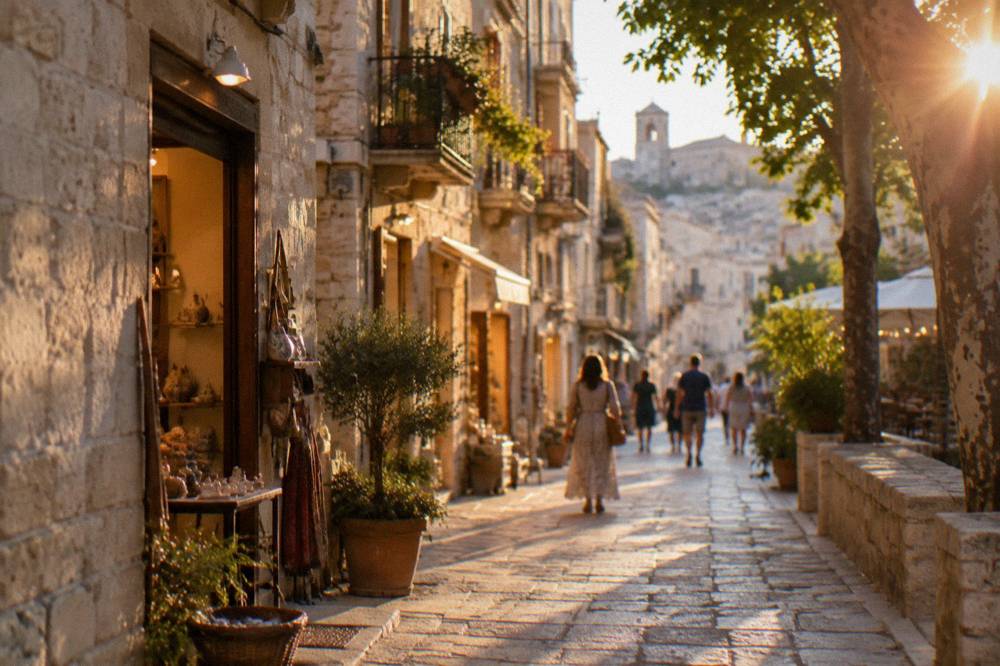
Evening is when the Piano earns its keep. The passeggiata fills Via Ridola and the side streets, aperitivo bars put tables out, and the terrace viewpoints over the Sassi catch the floodlights. The whole span of things to do across the city, Sassi and Piano together, is collected on the things to do in Matera page.
Which Sights Around The Piano Need Tickets, And What Do They Cost?
The main ticketed sights around the Piano are the Oltre l'Arte rupestrian churches (4.50 EUR for one, 8.00 EUR for two, 10.00 EUR for three), the Cathedral and MATA route at 4.00 EUR, the Storica Casa Grotta di Vico Solitario at 8.00 EUR full, MUSMA at 10 EUR, the Museo Nazionale at 10.00 EUR per site or 15.00 EUR cumulative, and Casa Noha at 6.50 EUR. Walking the Piano, the squares and the terraces costs nothing.
All prices below were read on the operators' own pages and are the tariffs in force. Reduced rates exist for nearly every site; where a category matters to you, the operator's page is the place to confirm it.
| Sight | Full price | Notes from the operator's page |
|---|---|---|
| Rupestrian church (Santa Lucia alle Malve, Madonna de Idris, San Pietro Barisano) | 4.50 EUR | 8.00 EUR for two churches, 10.00 EUR for three |
| Cathedral and MATA diocesan museum | 4.00 EUR | Daily 09:00 to 19:00, last entry 18:45 |
| Oltre l'Arte all-inclusive, 8 sites | 25.00 EUR | Reduced 16.00 EUR; covers churches, MATA, Museo del Pane and more |
| Storica Casa Grotta di Vico Solitario | 8.00 EUR | Tariff from 4 April 2026; covers four sites including the Neviera |
| MUSMA sculpture museum | 10 EUR | Reduced 5 EUR and 7 EUR; free to age 6 |
| Museo Nazionale di Matera | 10.00 EUR per site | 15.00 EUR cumulative, 2 days; under 18 free |
| Casa Noha (FAI) | 6.50 EUR | Children 3 EUR; closed Wednesdays |
Two warnings save disappointment. First, all Oltre l'Arte sites close on 25 December and on 2 July for the Festa della Bruna, so a summer visit landing on the patronal feast finds church doors shut even as the whole city celebrates. Second, the Crypt of the Original Sin, 13 km and about 19 minutes' drive from the centre, requires a booked e-ticket at least 90 minutes before the slot; its price sits inside the booking engine and is not printed here. Booking details are on the crypt visitor guide.
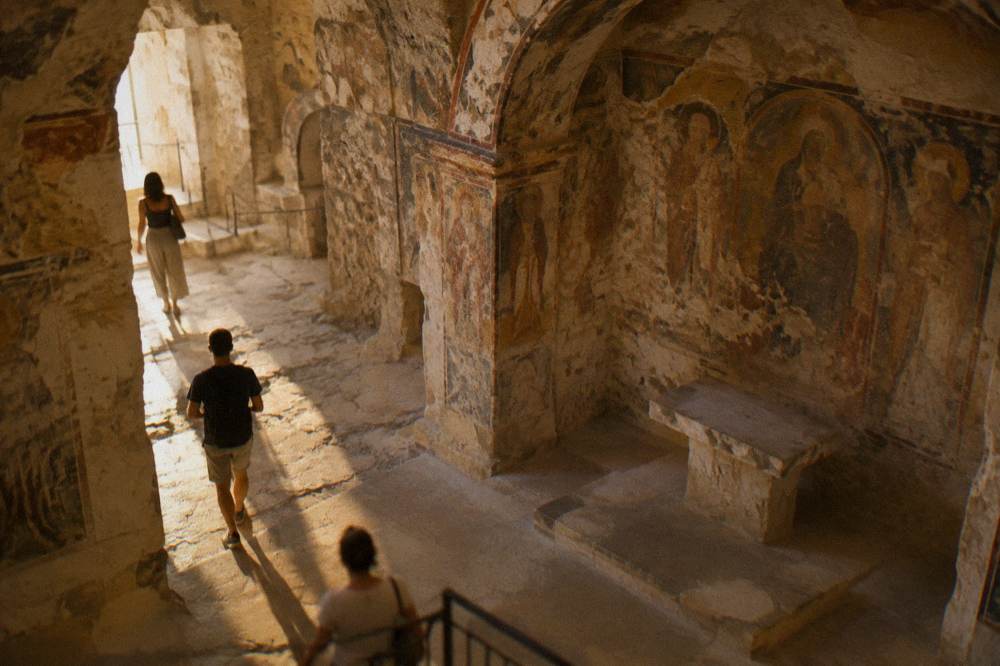
If churches carved into rock are the reason you came, pair the Piano's museums with the dedicated rupestrian churches of Matera guide, which details each site, its frescoes and its hours.
Where Do You Eat And Drink Around Matera Centro?
The eating and drinking strip of Matera Centro runs along Via Ridola and the lanes off Piazza Vittorio Veneto, with a second cluster at Piazza Sedile where the Piano meets the descent into the Sassi. The area covers everything from morning coffee bars to cave restaurants dug into the rim, and aperitivo in the early evening is a fixed habit of the city rather than a tourist invention.
Via Ridola and Via del Corso carry the daytime trade: pastry shops, bread sellers, and bars where Pane di Matera IGP, the city's registered PGI bread, is the default side to anything. In the evening the weight shifts to the terrace edge, where tables look straight down into the lit Sassi; the where to eat in Matera with a view answer page maps the best of those balconies, and the local-eats angle is covered in where locals eat in Matera. For what to order, the regional shortlist, peperoni cruschi, crude bread with tomatoes, lamb and the pasta of the Matera tradition, sits on the what to eat in Matera page.
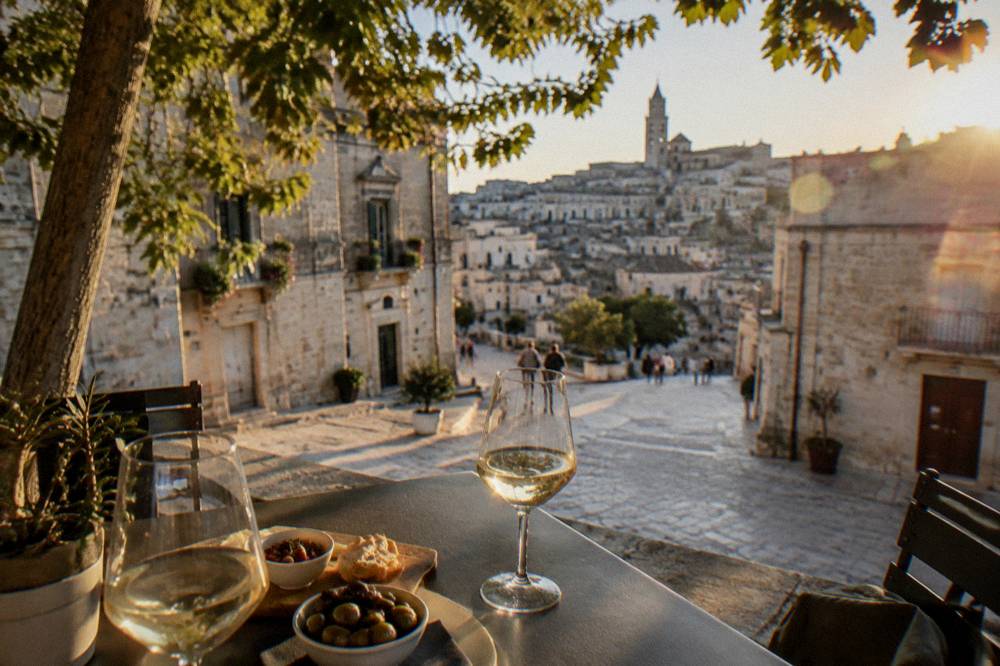
The bar-and-aperitivo scene is compact enough to wander without a plan; the Matera bars and aperitivo guide gives the editorial desk's shortlist. Prices vary by place and season, and this site quotes no restaurant figures: check the menu before sitting, which in Matera is normal practice anyway.
How Do You Drive Into Matera Centro, And Where Can You Park?
You can drive into Matera Centro only outside the ZTL camera hours: the Sassi zone's gates run 10:00 to 20:30 from 16 September to 30 June and 10:00 to 24:00 from 1 July to 15 September, while the central streets of Via del Corso, Via Duomo and Piazza Sedile are limited 24 hours a day, every day. Outside those windows, and outside the gated streets, the plateau is ordinary driving; parking is paid street parking and car parks whose tariffs this site does not publish.
The ZTL, Matera's limited traffic zones, are enforced by cameras under ordinances 147 and 148/2025, and the municipal PDF sets out the hours precisely. The practical summary:
| Zone | Camera / gate hours | Streets covered |
|---|---|---|
| ZTL Sassi | 10:00 to 20:30 (16 Sep to 30 Jun); 10:00 to 24:00 (1 Jul to 15 Sep) | Via Buozzi, Via Madonna delle Virtù, Via D'Addozio |
| ZTL Centro | 24 hours, every day | Via Scotellaro, Via del Corso, Via delle Beccherie, Via Duomo, Piazza Sedile, San Francesco |
| ZTL San Giovanni / San Biagio | 24 hours, every day | San Giovanni and San Biagio quarters |
| ZTL Piave | Same seasonal hours as ZTL Sassi | Electronic gates, definitive operation |
| ZTL Prefettura, Ridola, Casalnuovo, Stigliani | 20:30 to 24:00 | Evening-only enforcement |
| Piazza Vittorio Veneto and Via Ridola | Closed to vehicles all day | Bollards open 04:00 to 08:00 weekdays for deliveries |
Loading windows of 07:00 to 10:30 and 15:00 to 17:00 apply to the timed zones, and transit declarations go through the comune's dedicated portal, with questions to ztl@comune.mt.it. No official public car park tariff page exists, so this site prints none: arrive, read the signs at the machine, or ask your accommodation, which is also where the city's tourist tax is collected and confirmed at booking. The full driving picture, including hire cars and the roads in, is on the car rental and driving in Matera and Matera parking pages.
When Is The Best Time To Visit The Matera Piano?
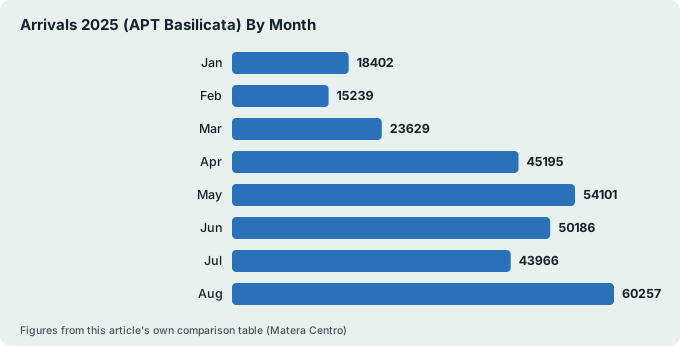
The best time to visit the Matera Piano is May, June, September or October, when the APT Basilicata data shows arrivals high (54,101 in May, 61,630 in September 2025) but the ERA5 reanalysis 1991-2020 mean highs sit at 22.7 C in May and 25.7 C in September rather than the 31 C of July and August. February is the quietest month, with 15,239 arrivals in 2025 and mean highs of 11.1 C.
The counterintuitive fact about Matera's seasons is that September, not August, is the busiest month: in 2025 the city's registered accommodation logged 61,630 arrivals in September against 60,257 in August, and 74.5% of those September arrivals came from abroad. July is as warm as August on the ERA5 means, 31.2 C against 31.3 C mean high, yet it drew fewer arrivals than six other months. What that means for the Piano specifically is simple: terrace tables and viewpoints are hardest to get in late September, not mid-August, though the difference between the two is small.
| Month | Mean high C (ERA5 1991-2020) | Rain mm | Arrivals 2025 (APT Basilicata) |
|---|---|---|---|
| Jan | 10.3 | 51.4 | 18,402 |
| Feb | 11.1 | 54.9 | 15,239 |
| Mar | 14.1 | 59.2 | 23,629 |
| Apr | 17.4 | 56.5 | 45,195 |
| May | 22.7 | 41.7 | 54,101 |
| Jun | 28.2 | 35.1 | 50,186 |
| Jul | 31.2 | 21.2 | 43,966 |
| Aug | 31.3 | 21.7 | 60,257 |
| Sep | 25.7 | 44.8 | 61,630 |
| Oct | 20.8 | 51.7 | 52,538 |
| Nov | 15.5 | 67.1 | 23,555 |
| Dec | 11.2 | 57.2 | 30,385 |
November is the wettest month at 67.1 mm and July the driest at 21.2 mm on the same reanalysis. Winter brings its own case: fewer people, floodlit Sassi, and from 4 December 2026 the Presepe Vivente nei Sassi, whose sixteenth edition, "Vera Fratellanza", has public days on 5-6, 12-13, 19-20, 26-27 December 2026 and 2-3 January 2027, with tickets at 12.00 EUR full and 9.00 EUR for ages 10 to 18, free under 10. The full seasonal picture, including frost days and what to pack, is in the Matera weather and best time to visit Matera guides.
How Does The Matera Piano Connect To The Sassi And To Day Trips?
The Piano connects to the Sassi by stair streets and lanes at roughly a dozen points along its rim, with the main descents at Piazza Sedile toward Sasso Barisano and below Palazzo Lanfranchi toward Sasso Caveoso; it connects to day trips by road, with Altamura 20 km and about 20 minutes away, Alberobello 68 km and about 1 h 23, and Bari 68 km and about 1 h 02 in free-flow driving. The FAL railway serves Matera Centrale from Bari with a change at Altamura.
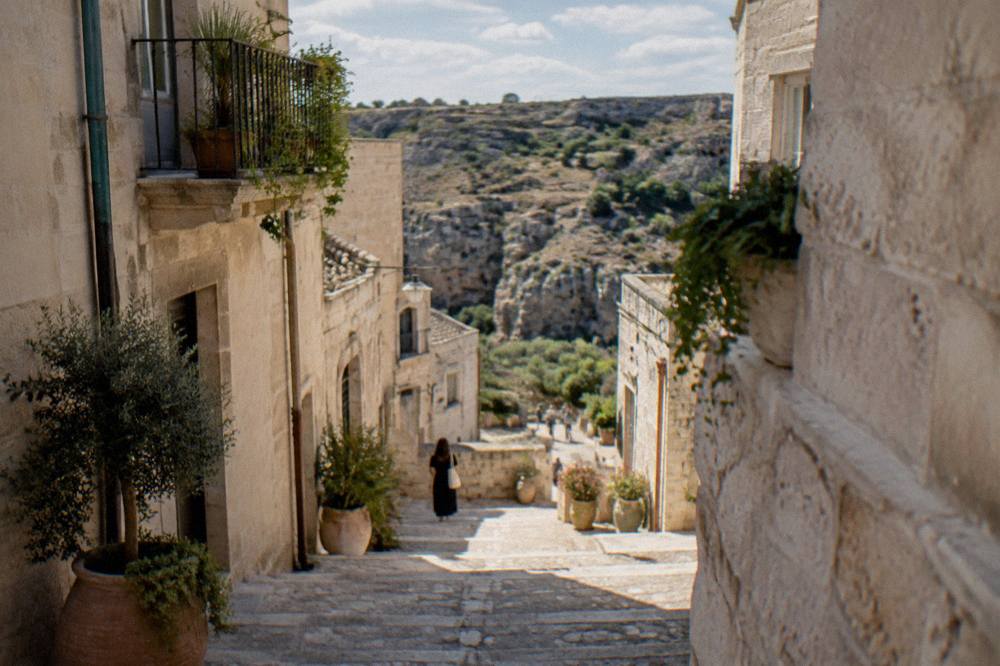
The rail detail matters because guides get it wrong. There is no Trenitalia station in Matera; the operator is FAL, and from Bari the posted weekday timetable involves a change at Altamura, taking about 1 h 45 to 2 h. On Sundays and public holidays no trains run at all, and FAL runs replacement buses, with its festive timetable sheet listing 8 arrivals at and 8 departures from Matera Stazione Centrale. From 12 October 2026 FAL is also changing the rail programme between Matera Sud and Altamura, replacing two early trains with buses. Current times are on FAL's own timetable page; this site never quotes them to the minute. The full arrival picture, including Bari Airport, is in how to get to Matera.
For day trips, the Piano is the natural launch pad because the flat streets hold the bus stops and, if you have a car, the parking. Selected free-flow drives, computed over OpenStreetMap:
| Destination | Road km | Drive time |
|---|---|---|
| Altamura | 20 | 20 min |
| Gravina in Puglia | 30 | 31 min |
| Craco | 57 | 58 min |
| Bari Airport | 64 | 1 h 01 |
| Bari | 68 | 1 h 02 |
| Alberobello | 68 | 1 h 23 |
| Polignano a Mare | 100 | 1 h 29 |
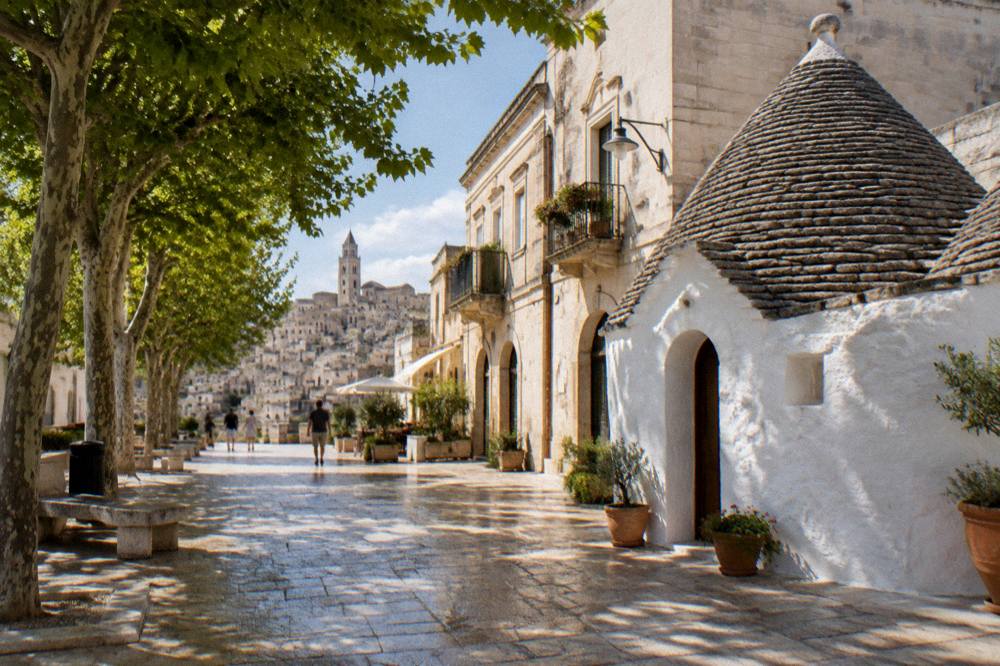
Alberobello, in Puglia, is the pairing made constantly: the two UNESCO towns sit about an hour and a quarter apart by road, and a day trip to Alberobello is the single most common add-on to a Matera stay.
Back inside the city, if the steps into the Sassi are the part that daunts you, wheels exist: the open-top eco-bus tours the panoramas from the road, and a two days in Matera plan splits the Piano and the Sassi sensibly across a weekend.
Common Questions About Matera Centro
Is Matera Centro the same as the Sassi?
No. Matera Centro is the Piano, the flat modern quarter on the plateau above the cave districts. The Sassi, Sasso Caveoso and Sasso Barisano, are the rock-cut districts below the rim, with the Civita ridge between them. The two meet along the Piano's edge at places like Piazza Sedile and Piazza Vittorio Veneto.
Can you walk from Matera Centrale station to the Sassi?
Yes, on foot and downhill. Matera Centrale, the FAL station, sits on the Piano, and the descent into the Sassi begins from streets a short walk from the station area. The route is stepped and uneven in the Sassi themselves, so allow time and wear solid shoes.
Is Matera Centro flat?
Largely yes, and that is the point of its name: the Piano is the level plateau, closed to through vehicles along Piazza Vittorio Veneto and Via Ridola. The moment you leave the rim you are on steps and sloping lanes. No route into the Sassi from the Piano can be called step-free.
Do you have to pay to enter Matera Centro?
No. The streets, squares and viewpoints of the Piano are free public space, and there is no Sassi entry fee or visitor cap in force. Individual sights charge: the rupestrian churches, the cathedral route, the cave house museums and the national museum all sell their own tickets, itemised in the table above.
Where do you get the best view of the Sassi from Matera Centro?
From the terrace edge of Piazza Vittorio Veneto and the streets beside it, looking south-east over Sasso Caveoso toward the Murgia plateau. For the classic full-postcard angle across the canyon, cross to the Belvedere Murgia Timone on the opposite side of the Gravina.
What is the emergency number in Matera?
112, the single European emergency number, free with automatic location and multilingual support. Matera's phone district joined the single number on 2 December 2025.