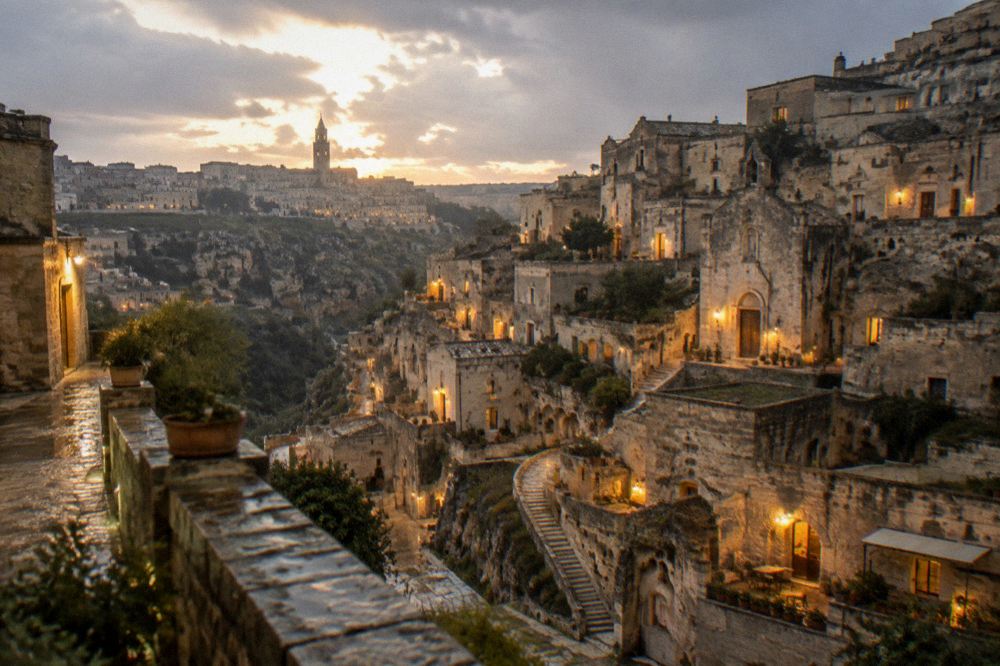
Matera In The Rain
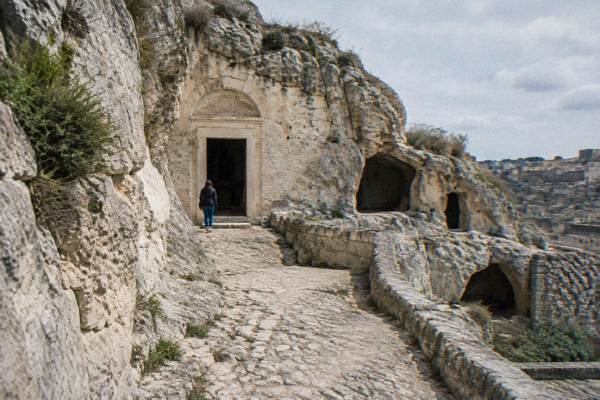
Rain changes the Sassi rather than closing them. This itinerary covers the covered sights, the museums, the dry-footed ways across the city and the day trips that survive bad weather.
Short answer
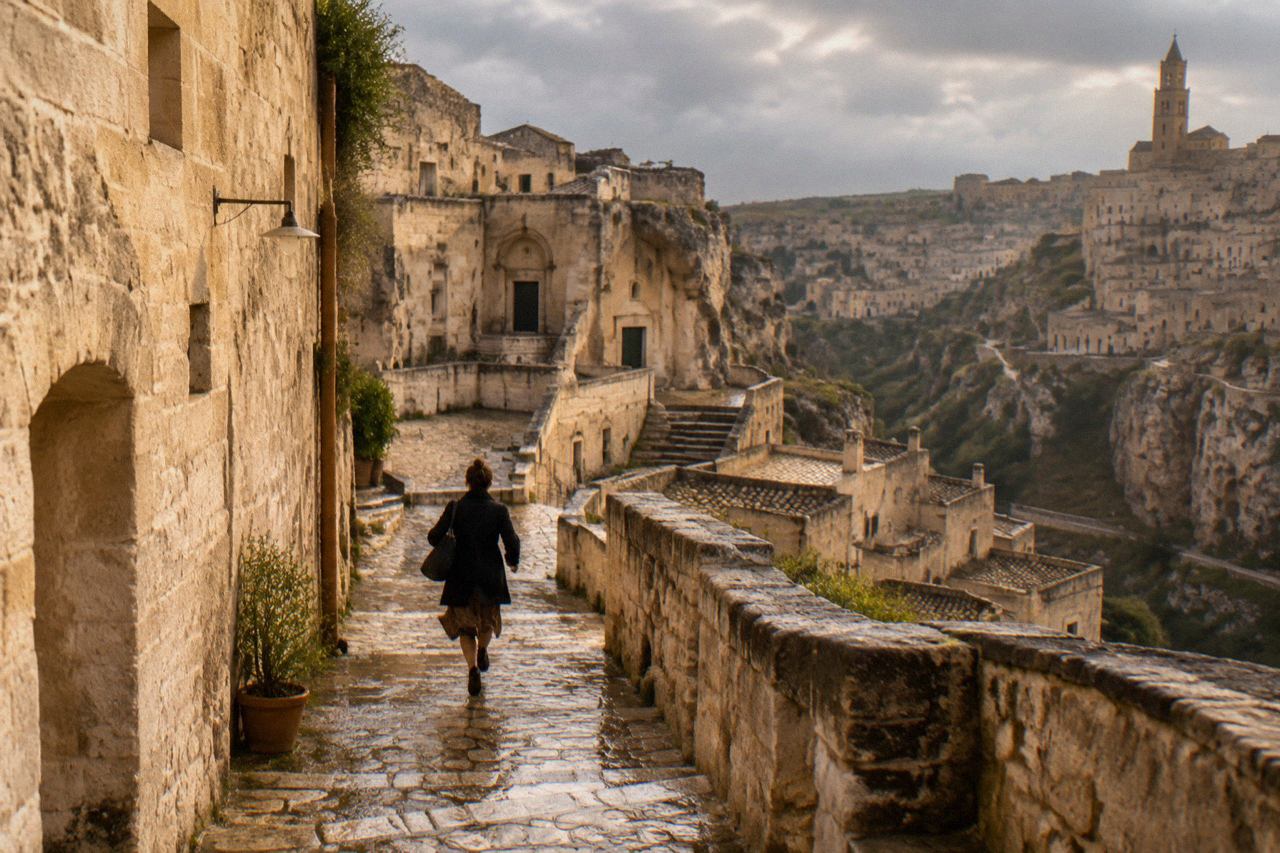
Matera in the rain still works: the rupestrian churches, the cave-house museums, MUSMA and Palazzo Lanfranchi are all indoors, an Ape Calessino or tuk-tuk panoramic ride keeps the views without the walk, and the Sassi themselves are steep and slippery, so this plan swaps cliffside paths for cave interiors.
Matera, in Basilicata in southern Italy, is an inland city at about 400 m above sea level on the edge of the Gravina canyon, and its climate is continental-leaning rather than Mediterranean-mild. The rain that falls on the Sassi falls on pale tufa limestone, stepped alleys and cave mouths, and it changes the character of the place rather than shutting it. The ERA5 reanalysis, 1991-2020, gives the city about 562.5 mm of rain a year spread over roughly 90.7 rain days: this is not a desert, and a wet day is a real planning problem for anyone whose itinerary is all viewpoints and canyon paths. This page is the wet-weather answer, built from what the operators' own pages and the park's own site state, with the open-air items replaced by cave interiors, covered vehicles and places where the roof is the point.

How Often Does It Actually Rain In Matera?
Rain in Matera is concentrated from October through March, with November the wettest month at 67.1 mm against 21.2 mm in July, the driest, and roughly 90.7 rain days across a typical year, according to the ERA5 reanalysis, 1991-2020. A rain day counts 1 mm or more. Winter is cold and damp at this elevation: mean lows sit at 2.2 C in January and February, and about 20 frost days a year fall across the city, nearly all between December and March.
Those numbers come from a modelled grid cell at about 398 m, not a weather station, and they describe the whole year rather than any single week. The shape matters more than the digits. Spring and autumn carry moderate rainfall with serious visitor traffic: the APT Basilicata data gives 45,195 arrivals in April 2025 and 52,538 in October, both months where the rain-day count runs above seven. Summer is dry and crowded. Winter is wet and quiet, with 15,239 arrivals in February 2025 against 61,630 in September.
For a rainy-day plan, the monthly picture tells you what you are dealing with:
| Month | Mean high C | Rain mm | Rain days | Arrivals 2025 |
|---|---|---|---|---|
| Jan | 10.3 | 51.4 | 8.1 | 18,402 |
| Feb | 11.1 | 54.9 | 8.8 | 15,239 |
| Mar | 14.1 | 59.2 | 9.4 | 23,629 |
| Apr | 17.4 | 56.5 | 9.7 | 45,195 |
| May | 22.7 | 41.7 | 7.9 | 54,101 |
| Jun | 28.2 | 35.1 | 6.4 | 50,186 |
| Jul | 31.2 | 21.2 | 4.4 | 43,966 |
| Aug | 31.3 | 21.7 | 4.7 | 60,257 |
| Sep | 25.7 | 44.8 | 7.0 | 61,630 |
| Oct | 20.8 | 51.7 | 7.5 | 52,538 |
| Nov | 15.5 | 67.1 | 8.3 | 23,555 |
| Dec | 11.2 | 57.2 | 8.5 | 30,385 |
The pairing worth knowing: the wettest month, November, is also one of the quietest, with 23,555 arrivals in 2025. A rainy day in November in Matera is a rainy day with room to move, which is not something a rainy day in September can promise.
Which Indoor Sights In Matera Work Best On A Wet Day?
The strongest rainy-day sights in Matera are the Oltre l'Arte rupestrian churches (from 4.50 EUR for one church), the Storica Casa Grotta di Vico Solitario at 8.00 EUR, MUSMA at 10 EUR and the Museo Nazionale at Palazzo Lanfranchi at 10.00 EUR, all of them indoor or almost entirely indoor, and all open daily on the tariffs and hours their own pages publish. One caveat: the Museo Ridola has been closed since 7 April 2025, and Casa Noha is closed 5 to 22 October 2026.
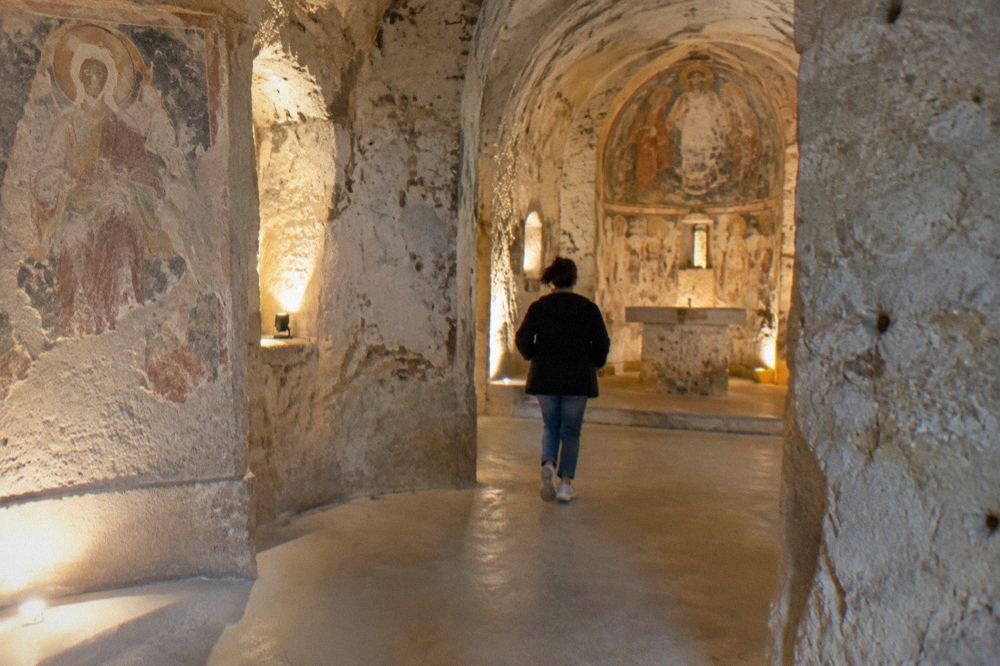
The rupestrian churches are the natural first stop because the rock is the roof. Oltre l'Arte's ticket page lists Santa Lucia alle Malve and Madonna de Idris with San Giovanni in Monterrone open daily 09:30 to 19:30 from 28 March 2026, San Pietro Barisano daily 10:00 to 19:00, with combined tickets at 8.00 EUR for two churches and 10.00 EUR for three. An all-inclusive 25.00 EUR ticket covers eight sites, including the Antica Casa Grotta in Via Fiorentini, the Museo del Pane and MATA. The rupestrian churches of Matera have their own full page on this site.
The cave-house museums work the same way. The Storica Casa Grotta di Vico Solitario charges 8.00 EUR full on the tariff in force from 4 April 2026, and the ticket covers the cave house, the Neviera, the natural cave and the rock church of Sant'Agostino al Casalnuovo: four roofs, none of them affected by the weather. Its own page gives October to December hours of 09:30 to 18:00 on weekdays. MUSMA, the sculpture museum in the Sasso Caveoso, is open Monday to Sunday, 10:00 to 20:00 from April to September and 10:00 to 18:00 from October to March, full ticket 10 EUR. Palazzo Lanfranchi, seat of the Museo Nazionale di Matera, keeps site-wide hours of 09:00 to 20:00 Monday to Sunday and carries a works page while staying open. All Oltre l'Arte sites close on 25 December and 2 July.
The ticket prices side by side:
| Sight | Full ticket | Hours to check on the operator page | Wet-day note |
|---|---|---|---|
| Rupestrian church, single (Oltre l'Arte) | 4.50 EUR | 09:30 to 19:30 from 28 Mar 2026 | Interior is inside the rock |
| Two rupestrian churches | 8.00 EUR | same | Best value on a wet morning |
| Casa Grotta di Vico Solitario | 8.00 EUR | Oct to Dec 09:30 to 18:00 weekdays | Covers four indoor sites |
| MUSMA | 10 EUR | Oct to Mar 10:00 to 18:00 | Cave-palazzo interior |
| Palazzo Lanfranchi (Museo Nazionale) | 10.00 EUR | 09:00 to 20:00 | Museum, open during works |
| Museo Nazionale cumulative | 15.00 EUR, 2 days | 09:00 to 20:00 | Under 18 free |
| Casa Noha | 6.50 EUR | closed 5 to 22 Oct 2026 | Reopens with new displays |
Two closures matter. The Museo Ridola, the archaeological museum, has been closed since 7 April 2025 for energy works and a new display, and its visit page still reads "Temporaneamente chiuso". Casa Noha, the FAI interpretation centre, is closed 5 to 22 October 2026 for renovation ahead of a relaunch with new spaces and displays. Any older itinerary that sends you to either on a rainy day is out of date.
Can You Still Walk The Sassi In The Rain?
You can, but with care: the Sassi are steep, stepped and uneven, wet tufa and worn stone become slippery, and no named route in the Sassi is step-free or wheelchair accessible, so on a rainy day the sensible version is a short guided loop through the covered cave churches rather than the full canyon-side network, with an open-vehicle or bus panorama saved for a drier hour.
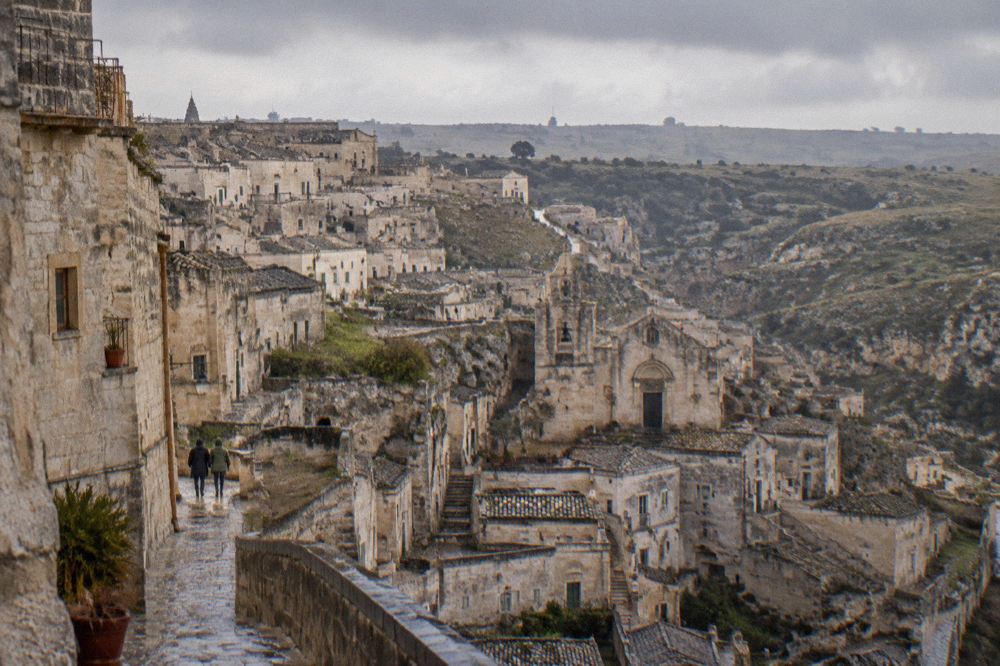
This is where a guided walk earns its place, because a guide routes around the worst of the wet stone and the cave interiors break up the exposure. The Sassi di Matera themselves are described in full elsewhere on this site; the rainy-day question is narrower, and it is about footing. The stepped lanes of the Sasso Caveoso and Sasso Barisano drain downhill, which means water moves across the same stones you are standing on. Shoes with grip matter more than an umbrella, which the narrow lanes render nearly useless anyway.
The covered alternative to walking is real. A tuk-tuk or Ape Calessino panoramic ride keeps the viewpoints without the descent, and the bus panoramas do the same with a roof. These are described in the section on rainy-day tours below. For the walk itself, the self-guided walking route page maps the dry-weather version; on a wet day, take its cave-church segment and drop the Murgia-side paths.
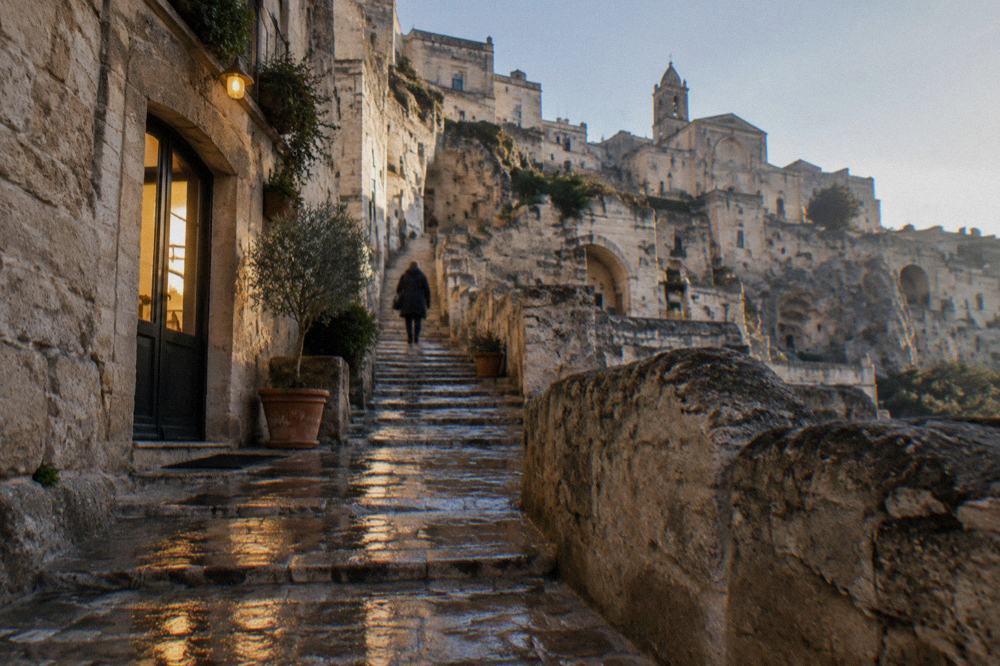
Between the indoor sights and the ride, a wet day divides cleanly: caves and museums in the rain, viewpoints in the gaps. The Sassi face the Murgia plateau across the Gravina, and the cloud that fills the canyon on a rainy morning sometimes clears within the same afternoon, which is why the itinerary keeps the panorama flexible rather than booking it for a fixed hour.
Which Rainy-Day Tours In Matera Keep You Under Cover?
Three kinds of bookable tour suit Matera in the rain: walking tours built around cave-house and rock-church interiors, where the stops are indoors even if the route is not; covered or semi-covered panoramic rides in Ape Calessino vehicles and open-top buses, which trade walking for sitting; and the food-and-drink tours and pasta classes, which are entirely indoors. Prices, ratings and durations for each render from the listings on the tour cards on this page.
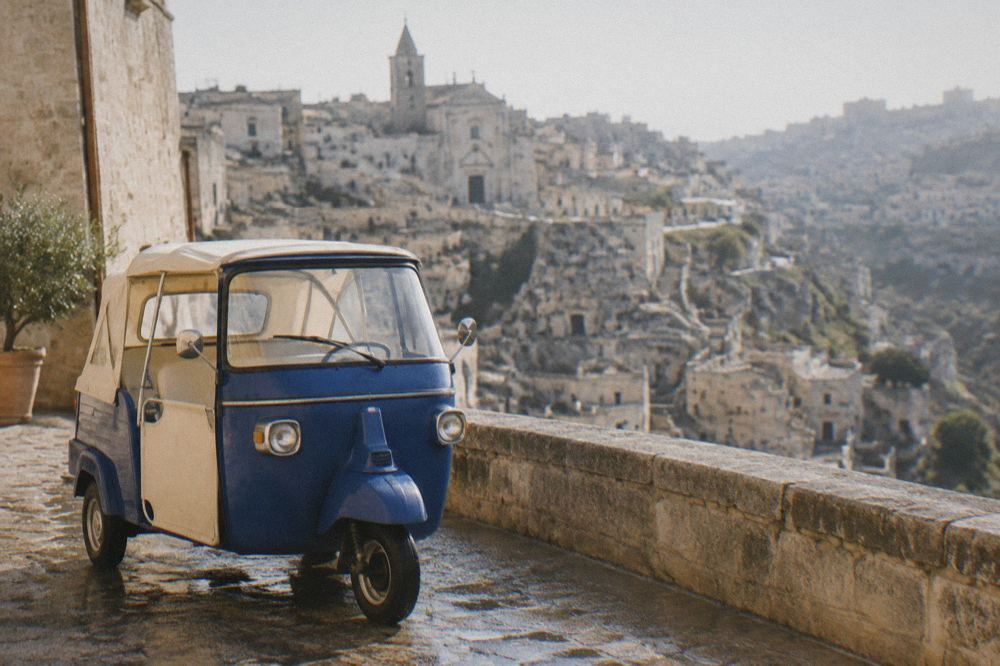
The panoramic rides are the unexpected rainy-day answer. The Ape Calessino is a three-wheeled vehicle with a roof and, on the versions used for tours, side protection, and its route crosses the viewpoints above the Sassi that a walker would reach by stairs. The booking page says the standard panoramic tour covers the Sassi di Matera from the road. The open-top eco-bus is exactly what its name says, so it suits a dry gap rather than active rain, but it is a sitting tour with a canopy of sorts. The decision rule is simple: umbrella weather, take the Ape; drizzle or a clearing sky, the open bus works. Other pages covering the same trip are gathered on Matera Travel Guide.
The walking tours split by content. The ones built on cave churches and cave houses, like the guided city-center tour with cave churches and houses above, spend their stops indoors and only expose the connections between them. The Matera walking tour page on this site compares the walks in detail. Food tours and pasta classes are the fully indoor option: a cooking class at a farmhouse outside the city or a pasta class in an ancient wine cellar in the Sassi keeps the whole party under a roof, and the tastings are the itinerary.
Where Do You Eat In Matera When It Pours?
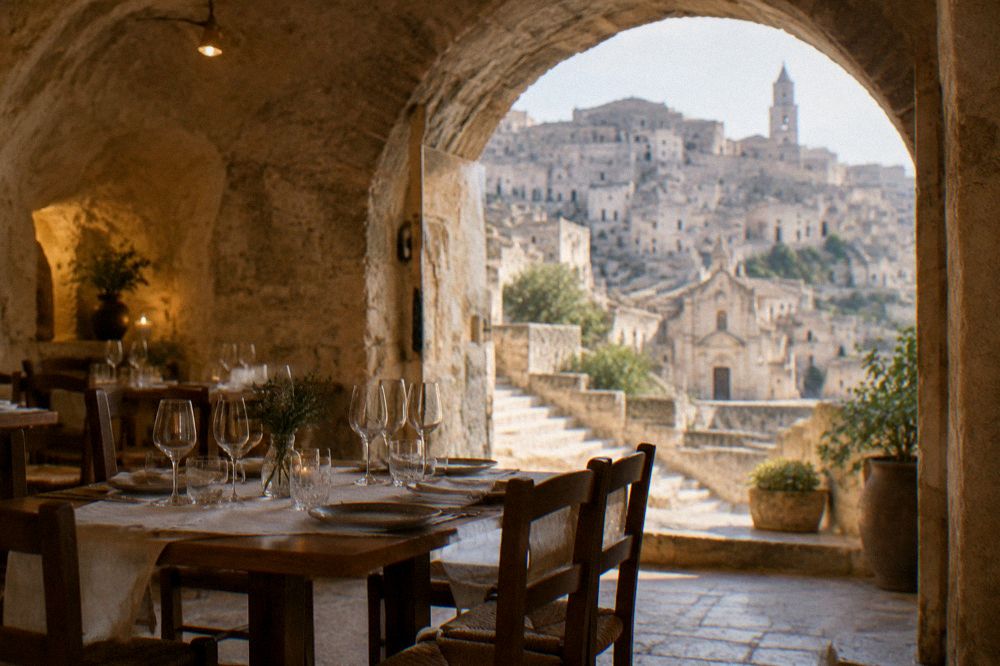
The rainy-day answer to eating in Matera is the cave restaurant and the wine cellar: a string of dining rooms in the Sasso Caveoso and Sasso Barisano occupy historic cisterns and cave interiors, so lunch or dinner doubles as an indoor sight, and the dishes to look for are the pane di Matera, the orecchiette, the lamb of the Murgia and the crumbly peperoni cruschi that the region fries and salts.
The cave restaurants and the restaurants of Matera have dedicated pages here; the wet-day point is structural. A cave dining room is a consistent temperature year round, dry by definition, and often the most atmospheric interior you will enter all day. Reservations matter more in rain, because everyone else has the same idea and the indoor tables go first. The bars and aperitivo culture around Piazza Vittorio Veneto move under arcades and inside when the weather turns; the Matera bars and aperitivo page covers the standbys.
What the plate should carry on a wet day, by course:
| Course | What to order | Why it suits the weather |
|---|---|---|
| Bread | Pane di Matera, the PGI loaf | Dense, salted, baked daily |
| Pasta | Orecchiette with crumbly cruschi peppers | Hot, local, winter-proof |
| Main | Murgia lamb, slow-cooked | The inland specialty |
| Cheese | Caciocavallo and ricotta | Region's pasture tradition |
| Sweet | Castagnaccio-style chestnut cake in colder months | Autumn and winter item |
| Drink | Aglianico del Vulture red | Basilicata's flagship red |
What If The Rain Lasts All Day?
If the rain settles in, Matera has two escapes: the Crypt of the Original Sin, a fully indoor rock church about 15 minutes by car from the city, booking mandatory by e-ticket at least 90 minutes before the slot, and the wider day-trip ring, with Altamura 20 minutes away by road, Alberobello about 1 h 23, and Bari about 1 h 02 in free-flow conditions, per routing computations over OpenStreetMap.
The Crypt of the Original Sin is the single best all-day-rain sight in the Matera orbit because there is no outdoor component at all: the visit is inside the rock, the ticket office is at the Azienda Agricola F.lli Dragone at Contrada Petrapenta, and the operator's page asks visitors to arrive 30 minutes early for a guided slot with a capacity of 20 people. The Crypt of the Original Sin page here covers the booking mechanics. No shuttle is included in the ticket, so it suits a hire car or a driver rather than a bus connection.
The day-trip ring, with road figures computed free-flow and rounded:
| Destination | Road distance | Drive time | Indoor weight |
|---|---|---|---|
| Crypt of the Original Sin | 13 km | about 20 min | Entirely indoor |
| Altamura | 20 km | about 20 min | High: museums and bakeries |
| Montescaglioso | 19 km | about 26 min | Abbey interior |
| Gravina in Puglia | 30 km | about 31 min | Rock church and old town |
| Bari | 68 km | about 1 h 02 | Museums, covered old town lanes |
| Alberobello | 68 km | about 1 h 23 | Trulli interiors and museums |
Altamura and Alberobello have their own day-trip pages on this site. One structural note for the rail option: there is no Trenitalia station in Matera. The rail operator is FAL, the posted weekday timetable changes at Altamura, the journey runs about 1 h 45 to 2 h, and no trains run on Sundays and public holidays, when FAL substitutes buses. FAL's timetable page carries the current sheets and the service notices.
How Do You Pack For Matera In The Rain?
Pack for Matera in the rain around footwear: shoes with real grip for wet stone, a hood or cap rather than an umbrella for the narrow Sassi lanes, a warm layer for cave interiors that sit noticeably cooler than the street in summer and milder than it in winter, and a compact dry bag for phone and tickets, because the stepped lanes funnel water downhill across the same stones you walk on.
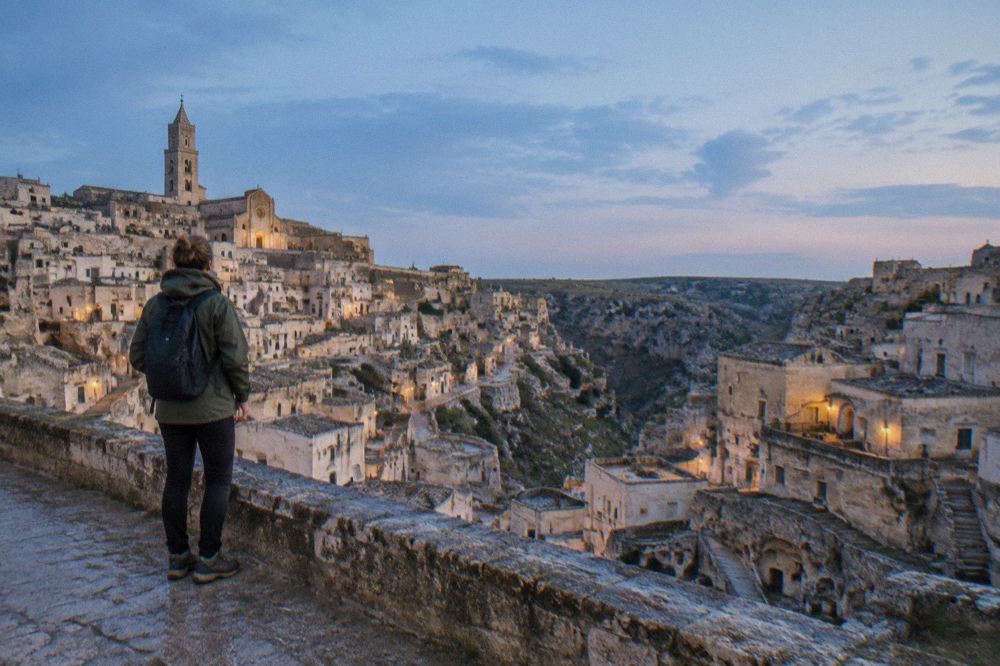
The clothing question has its own page, what clothes to pack for Matera; the rainy-day additions are specific. The caves hold a steady cool temperature, so a light layer earns its place even in July. The stone steps of the Sasso Caveoso polish smooth under decades of feet and become glassy in rain. And because the ZTL camera hours mean arrival logistics usually end with a walk, plan for the last ten minutes on foot to be the wettest part of the evening.
| Item | Why it matters in Matera |
|---|---|
| Grippy shoes, not smooth soles | Worn tufa steps are slippery when wet |
| Hood or cap | Umbrellas catch in narrow lanes and stairways |
| Light warm layer | Cave churches and cisterns sit cooler than the street |
| Compact dry bag | Tickets, phone and camera on a wet descent |
| Spare socks | A Sassi walk in rain finds every low point |
Does Matera Beat The Rain In Winter?
Yes, and often better than in the shoulder months: Matera's winter is wet but quiet, with 15,239 arrivals in February 2025 against 61,630 in September, so the indoor sights that feel full in autumn have room, the December programme includes the Presepe Vivente nei Sassi from 4 December 2026 on public days across four December weekends and 2 to 3 January 2027 at 12.00 EUR full ticket, and the city's cave interiors make the rain almost irrelevant to the itinerary.
The living nativity is the one winter event that turns bad weather into atmosphere rather than cancelling it: the route runs from Piazza San Pietro Caveoso through Vico Solitario, Rione Malve and Casalnuovo to Via Bruno Buozzi with 20 scenes, and the Matera in winter and Matera at Christmas pages here cover the full programme. The Matera Film Festival runs 7 to 15 November 2026, indoors, in the wettest month of the year, and the contemporary art exhibition "The Sea Is Closer Than You See" runs to 8 December 2026 across Palazzo Lanfranchi, TAM, MUSMA and the Basilicata Open Space, which makes a multi-stop museum afternoon out of a downpour.
Common Questions About Matera In The Rain
Does it rain a lot in Matera?
The ERA5 reanalysis, 1991-2020, gives Matera about 562.5 mm of rain a year over roughly 90.7 rain days, with November the wettest month at 67.1 mm and July the driest at 21.2 mm. Rain concentrates from October to March.
Are the Sassi of Matera walkable in the rain?
Yes, with care. The Sassi are steep, stepped and uneven, and no named route is step-free or wheelchair accessible. Wet stone is slippery, so grippy shoes matter, and a short loop through the covered cave churches is the sensible wet-weather version.
What is there to do in Matera when it rains?
The rupestrian churches, the Casa Grotta di Vico Solitario, MUSMA, Palazzo Lanfranchi and the Crypt of the Original Sin are all indoor or almost entirely indoor, and panoramic rides in an Ape Calessino keep the viewpoints without the walk. The Museo Ridola has been closed since 7 April 2025.
Is November a bad month to visit Matera?
November is the wettest month at 67.1 mm, but it is also quiet: the APT Basilicata data gives 23,555 arrivals in November 2025 against 61,630 in September. The Matera Film Festival runs 7 to 15 November 2026.
Do I need an umbrella in Matera?
A hood or cap usually works better. The lanes of the Sassi are narrow and stepped, and umbrellas catch on walls and passageways. Shoes with grip matter more than rain cover for the upper body.
Can you visit Matera's cave churches in bad weather?
Yes, that is what they are for. The Oltre l'Arte churches are rock-cut interiors, open daily from 09:30 or 10:00 on the hours published from 28 March 2026, and they close only on 25 December and 2 July.
A wet day in Matera is not a cancelled day. It is the day the city spends indoors, in the rock, at a long lunch under a vault, and the rain on the tufa outside makes those interiors easier to understand than any blue-sky afternoon ever will.